Category: Review

March 5, 2025 – The Tucci Table

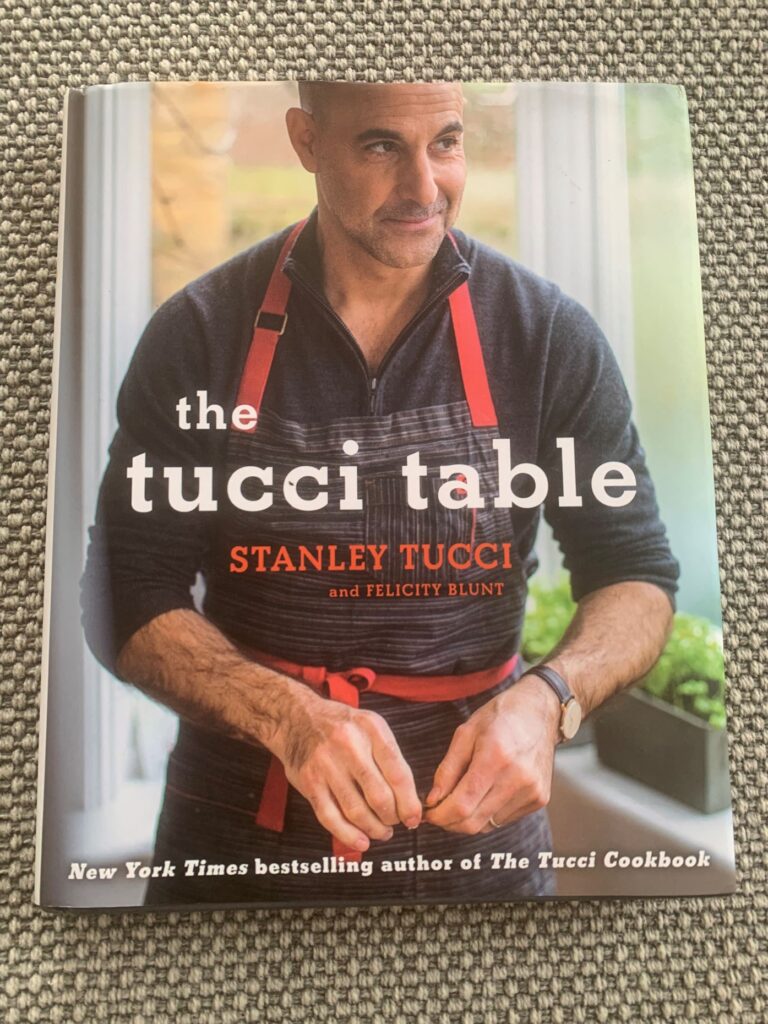
The Tucci Table by Stanley Tucci is the March Left Coast Culinary Book Club selection. Normally, I would present this much later in the month but it is a short cookbook. With those, I don’t really read. I read the opening caption and scan through the list of ingredients. In a couple of evenings, I was done.

This book is supposed to be about the repertoire of recipes that the Tucci’s eat in their home. It is pretty Italian forward with some British, American and French influence. I haven’t cooked anything but the ingredient lists are pretty simple and doesn’t require many exotic ingredients that are hard to source. I would say that it is pretty approachable from that standpoint.

The one thing that I will say about Tucci is that he is pretty sincere about his food. I do believe that he takes an interest in it. In fact, we just bought two pans that had his endorsement on it from Williams and Sonoma. They are very nice pans and they were on clearance so we paid significantly less than retail value. They replaced some worn out, non-stick pans that we had. As a result, it is my opinion that he is a credible resource when it comes to cooking.

I respect the man from the culinary standpoint. As for the rest of him, my impression is that he is an ultra-egalitarian, liberal elitist. For that reason, I cringe at the selection of the book title. In addition to that, I am not a fan of pasta. I find it boring. Yes, I eat it now and then but I just don’t crave it ever. You can guess that my opinion of the book is negative.

I would say that if you had no cookbooks, this would be one that you could use for everyday cooking. It is simple and varied enough that you could make quality meals from it. But, for a person like myself there is nothing really new here. As a result, I cannot wholeheartedly recommend it.

I know that you didn’t ask but I will say it anyways. What makes a good cookbook? To me it is one that strikes at all levels. Simple cooks as well as advanced cooks can get inspiration. The last one that I remember fitting the bill was the one skillet cookbook from April 2023. It was Indian, African, Asian as well as western all cooking in one dish. That was novel and interesting.

There are some celebrity chefs that I am a fan of. I like Paula Dean for authentic southern food, Rick Bayless for Mexican food and Steven Reichl for barbeque. To me, it is not the notoriety of the chef but the subject mastery that makes me respect the chef. I am not saying that Tucci has not mastered food, but lets face it he is an actor. As such, there is a credibility gap.

It reminds me of when Emeril Lagasse became famous in the mid-1990s. I don’t know for sure but my impression is that he is a competent and surely charismatic Cajun chef. But, does that mean that he is now an authority in counter top ovens or inexpensive cookware? They may be fine products but just as likely it is a money grab. Anytime someone is using their name to hawk wares, we need to consider the source and motivation.

End Your Programming Routine: Is it really bad? No, it is meh. Tucci has good branding sense and just like there are Food Channel groupies there are Tucci groupies. They are going to latch onto whatever he puts out. I don’t select all the books, I help facilitate the operation. It is just my two cents on this selection.

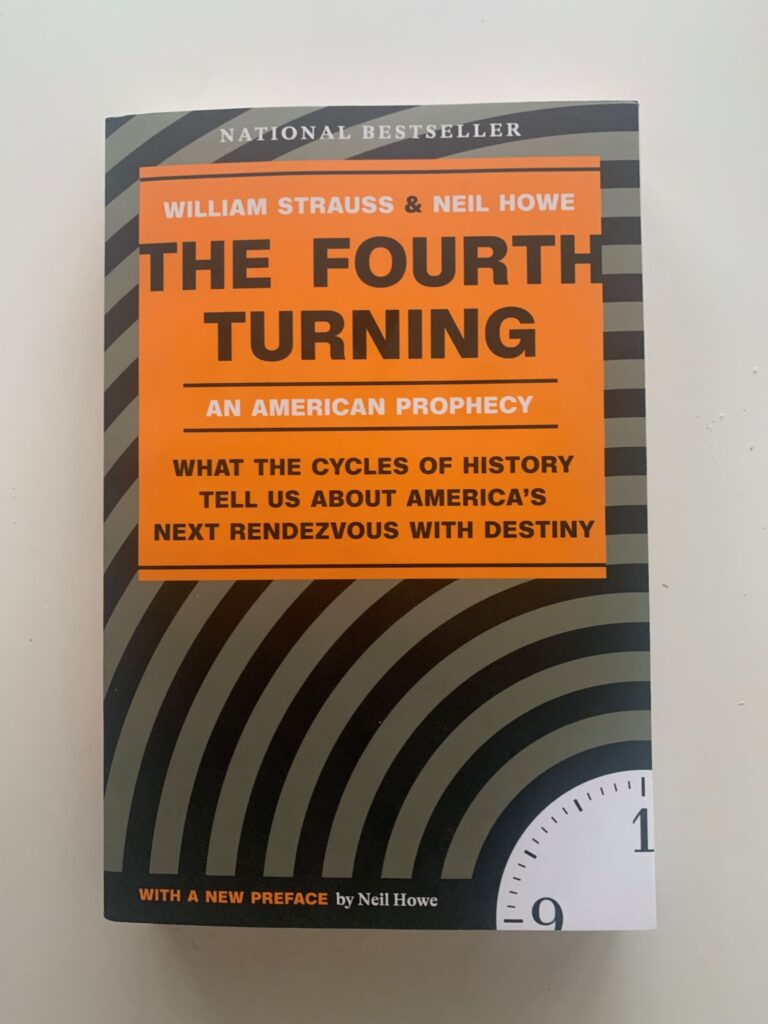
February 28, 2025 – The Fourth Turning, Chapter 8

Last week I talked about the Awakening, this week it will be the Unravelling as we barrel toward the Crisis. Don’t forget, this book was published in 1997 so in theory, we were in the middle of the Unravelling when the book was published. It will therefore be up to us to figure out what that acute event is considering the book is almost thirty years old now.

First, let us talk about the book. The Unravelling begins in 1984 at the second election of Ronald Regan. In this period, the Millennials are being born, Gen-X is coming into adulthood, the Baby Boomers are coming into mid-life and the Silent Generation is reaching elderhood.

There are still plenty of GIs around but the youngest among them would be in their sixties and the oldest would be in their mid-eighties. According to the Fourth Turning theory, that would make them largely irrelevant, but not true. We still had Reagan’s second term and George HW Bush aspirations for two to go before they relinquish ultimate power.

The theory predicts that the Unravelling would last 18-25 years, the length of a typical generation. That should put the Crisis between the years of 2002 and 2009. I will save the Crisis for next week but it is hard to talk about this period without addressing it’s starting and ending events. The truth is that I am not sure of the trigger. 9/11 meets some of the criteria but not the results of society in Crisis. We will just have to proceed and then we can debate the specifics next week.

What is the Unraveling anyway? The basic premise is the order and structure that was implemented as a result of the High start to fall apart. As an example, both the High and the Awakening periods were extremely active in fraternal organizations. The Elks, Eagles, Moose, Odd Fellows, American Legion had many active members. These groups were bound together for common purpose and community outreach but as the members age, they are not replaced by the younger generation.

The charitable actions fulfilled by fraternal groups becomes increasingly fractured into more, smaller organizations that may perform niche elements. In the Unravelling, society does not necessarily stop doing the work of charities but the mechanism of how they are performed continues to diminish. That would be the disintegration of High era societal norms.

Interestingly enough, the Baby Boomers who could not be bothered to raise their Gen-X children circle the wagons and become born again. It looks like the Awakening had two results. First, self exploration and then conformity. This causes the early Gen-Xers and the later Boomers to become ‘helicopter parents’ to their Millennial kids with an attempt to compensate for their own parent’s absence. There is a rise of the Evangelical right and family values. From the attempt to put warning labels on music to Promise Keepers, both Republican and Democrat agree that changes need to be made.

With the GIs in charge still, the Silent being silent and the surge of Baby Boomers influence and authority we were seeing a transition of power skipping one generation and moving directly to the Baby Boomers. The Gen-X skepticism of this change of heart in the Baby Boomers accentuates the Unravelling.

This was my era. I was roughly nine to thirty. Given my age, I kind of spanned two Saecula in my formative years. I was too young to fully participate or remember the Awakening, but not so in the Unravelling. To me, the event that completely articulates this era was Woodstock 1999.

Woodstock (1969) was a music festival that represented the mood of the youth in the Awakening. I don’t know for sure, but I think that it accidentally became a success. It was one of those organic experiences that touched a generation’s mood by medium and accessibility. The event is largely remembered as good and positive with some character building misery along the way (mud pits).

In contrast, Woodstock 99 also touched a generations mood. A corporate contrived event provided a venue for the castoff generation to rage. By the time Limp Bizkit played Break Stuff the tinder was lit. The light towers were torn down, the stage was destroyed and three deaths resulted. Rage Against the Machine followed by Metallica played while the venue literally burned. There is no excuse for that behavior but maybe the attendees (Gen-X) wouldn’t have acted the way they did if they felt the weight of their generation and their role in the Unravelling?

I am certainly not condoning Woodstock 99. But I also see some parallels between Woodstock 1994 and 1999 and our current political situation. Woodstock 1994 was supposed to be a generational event like 1969. What it failed to deliver in generational unity, it provided as the ember to build more aggression the next time it came around. Likewise, I don’t think that we would have the same Trump presidency today if he would not have lost in 2020. Those lessons learned in the first term with time to prepare have unleashed the current situation within politics.

End Your Programming Routine: While Woodstock 99 was abhorrent, was it different than the 1960 – 70s? Bombings, protest marches, race riots were on the whole more deadly and not isolated to one event but decades. The argument could be potentially made that those were ideological fights, this was the Awakening after all. I would say, who is to argue with natural order? This is precisely what is supposed to happen in the Unravelling. A perfect sign that things are not ok.

February 21, 2025 – The Fourth Turning, Chapter 7

This was an interesting chapter for me. After I did the math last week and realized that most of my grandparents were from the Silent generation and not the GI generation I had more revelations this week. I realized that the majority of the Baby Boomers were children of the Silent generation as well. I had often wondered how they could have been born in the American High and things turned so quickly. I now realize that opposing generations are bound to strife making the GI’s and the boomers opposing.

This was the era that I was born into and I spent the first nine years. Like many young children, it was all that I knew and seemed completely normal to me. I had an uncle that was a self proclaimed hippie. My mom was born again from the Billie Graham youth crusades of the late 1960s. Another uncle was a Vietnam vet. My mom excluded, all of my aunts and uncles were all divorced.

As we were transitioning out of the Awakening, the boomers were termed the ‘me generation’. I always thought it had as much to do with their size and age of the generation but it also seems like it probably had as much to do with the saeculum as anything. Generation X became the abandoned, latch key kids ignored by their self absorbed parents.

My parents were more traditional, as a I didn’t experience any of the typical abandonment of my generation. But, I would say that my wife did. I have heard the stories over and over again so I feel like I can relate a little bit. These were things like leaving a blank, signed check so that the kids could go to the store or buy dinner from a restaurant while they were out or at work late.

The generation that interest me the most in this era is the Silent Generation. What exactly were they doing in this period if the GIs were in charge and the Boomers were making the most noise? From what I read, they were the bridge between the two generations. They continued the post war high policies that ultimately went up in smoke under Boomer retaliation.

Though it took until Biden to actually have a Silent generation president, apparently they controlled the majority of the state legislatures and governorships during the Awakening. As a result, it was business as usual for the Silents. This was the generation that actually stood for civil rights but because the GIs controlled the federal level, it wasn’t realized. It took the Boomer’s rejection of the GIs to move these policies forward.

One very interesting phenomenon happened in this saeculum. For the first time ever, the elder generation maintained their wealth as they transitioned. Across human history, elderhood meant loosing financial freedom. As a result of post war entitlements and a rocking economy, they did very well. In fact, the title of ‘poor’ shifted from the elder generation to the first time ever the child generation. That would be Gen-X in this context.

You can almost track our socialism downfall right here. Because the economy problem was solved, now it was time to turn on parity with LBJ’s war on poverty in 1966 i.e. welfare. He was quoted as saying that poverty will be gone by the early 1970s. That level of hubris, a signature of the GI generation lacked the forethought that instead of freeing people, it actually created a class of people destined to never leave the housing projects.

There has been plenty of government bloat since Abraham Lincoln, the first strong arm president. The GI generation was the first generation to fully utilize Social Security while the giant Silents and Boomers were pumping money into the system. Meanwhile all the excess money was drained to fund things like Vietnam and Medicare/Medicaid, Food Stamps, Section Eight and the like.

Reading this book has been a breath of fresh air. I have often wondered how this country got so screwed up from a Jeffersonian republic to an f’d up socialist mess and why people feel so passionately that freedom is not worth the risk of security. I now see that people were wanting to do the right thing the wrong way. I would have to say that while I respect the gumption of the GI generation, I really don’t think that they have earned the title of Greatest Generation.

In my book, the greatest generation would make this country infinitesimally better. While I see a lot of things that they did with the idea of what is better for me will be better for you. In practicality, every domino that is set up has a corresponding complexity and downside to it being part of the system. I think that there is a fatal error in the belief of solve one problem (WWII) does not mean that all problems can be solved, especially with the same tools.

I would go as far as to say that the GI generation did tremendous damage to this country. Who started USAID in the first place? The GIs of course under JFK. The Silent perpetuated it, the Boomers took it and added more individual elements (meaning race and division). I hear people wonder out load how politics got so divisive. It is pretty clear to me that the ‘me generation’ put their stamp on the process. If they didn’t take care of their own kids, what makes you think that they are going to take care of your feelings (or interests for that matter)?

Don’t look to Gen-X to fix it. This is our time, but it doesn’t look like it will be our turn. This latter section has more to do with the forthcoming chapters, but it all stemmed from this period. I actually think our best hope is for Trump to break it so thoroughly that it cannot be repaired. The timing is right for Winter to hit. Just remember that the Awakening is the summer.

End Your Programming Routine: Next week is going to be a doozy at over 70 pages. Just remember that it was written in 1997 and that the third saeculum had not ended at that point. This means that there is likely going to be some conjecture in the text. I have not yet read it either so we won’t have as nice of a road map of history to results as we did this week. I don’t know why the Boomers are destined to rebel but maybe they actually had a point with all of the entitlements the GIs created.

February 14, 2025 – The Fourth Turning, Chapter 6

At this point, we know all about the generations and the turnings. We have focused on the vocabulary that is crucial to understanding the writing. In theory, we know everything that we need to know to really integrate and understand what is our current saeculum. This chapter is all about the first turning and the American High (1946-1964)

The generations that are in play in order from oldest to youngest Lost, GI, Silent and Baby Boomers. As with all of this book, there are no clear lines. I find it easiest to work backward so the Baby Boomers were the result of the oldest Silent generation and the youngest GI generation is a good example.

My paternal grandparents fall right on the line. As an example my grandmother was born in 1925. That makes her technically part of the Silent generation since the GI generation range is 1900-1924. My grandfather was born in 1922 making him amongst the youngest of the GI generation. When I look at my maternal side, my grandfather was born in 1925 and my grandmother in 1930. This of course makes them both of the Silent generation

Like the book explains, people around the edges of a generation can take on properties of either generation. Before I did the math, I assumed that they were all of the GI generation since they were of age and involved in WWII (ignorance on the part of my maternal grandmother). Further, because all of the children were of the Baby Boom generation it was an automatic assumption. Of course, I did no math and I wasn’t a conversant of the theory like I am now.

The mood of the country was as the turning implies, high. The book makes a point to talk about the roles of each generation and their contributions to the era. I will spare the details suffice to say that the GI generation was large and in charge. They pretty much overwhelmed the remainder of Lost generation and elbowed out the Silent generation from further prominence.

Momentum is the term I would use to describe how society proceeded. As a reward for saving the world, the GI Bill is introduced causing all who qualified to become the most educated in history. That same bill made buying a shiny, new house much easier and that became the standard. Live better than your ancestors in every way.

The children of this turning (Baby Boomers) were the product of committed, successful and secure parents. This resulted in a certain coddling as well as the idea that children had a voice. Theories about the importance of what they had to say have led to the conclusion that they were destined to become entitled. This of course will manifest in the next turning.

The unity of the period resulted in things like institution building and homogenization. Factors such as TV played a strong cultural role in that beside just the mood. Medicine, food, education and socioeconomic status were all at parity during this period. Compared to rural poverty (or at least scarcity) the middle class life in the suburbs seemed like a dream.

This is probably intuitive, but I have never thought of it in this way before. Community unity drives individuality to almost nothing. As a result, issues such as Civil Rights take a back seat to group prosperity. This will of course raise its head in the next turning. My takeaway from this is that this is a watchpoint. While I don’t consider movements such as BLM as individuality, the fact that it is a social issue points to lack of cultural cohesiveness and prosperity. That is certainly an indicator of what turning we are actually in.

The American High ended with the assassination of JFK, America’s first GI generation leader. The die was cast however. He was followed by LBJ, Richard Nixon, Gerald Ford, Jimmie Carter, Ronald Regan and George HW Bush all of the GIs. From 1961 – 1992 one generation imprinted it’s nation building fingerprint on our policy and politics. That is a time frame that is fifty percent longer than the generation’s fall saeculum itself. Some might say that is undue influence.

End Your Programming Routine: It is hard to really put too much commentary on history. I think it is generally known what the stronger generations did in certain time periods. Notice I didn’t really even talk about the Lost generation nor the Silent generation. I think that is largely because those generations were really a non-factor in history. That is not to be disparaging, it still remains to be seen if Gen-X will have a hand in the next turning. We are running out of time as the oldest are in their sixties now, already stepping into Winter.

February 13, 2025 – Like Water For Chocolate

Like Water for Chocolate by Laura Esquivel is the February 2024 Left Coast Culinary Book Club selection. This is the first Mexican themed book we have done in a long time. It is also one that has been around a while. I saw the movie in the mid 1990s. I will be honest, I don’t remember anything about it. My wife read the book in Spanish in 1994 when she was studying in Mexico. This is my first go around reading the book.

The story takes place in revolutionary Mexico (1910-1920) somewhere along the border. I surmise this because it references swimming in the Rio Grande at one point. The premise of the story is about a young women Tita who is in love with a boy but because of a family tradition of the youngest daughter has responsibility to take care of the parents until they die is denied marriage from her widowed mother. As a result, the boy marries her sister and the emotional tension between him being around throws Tita into cooking elaborate meals.

There is of course much more to the story but I am not going to spoil it. What surprised me about the book is that there are 11 recipes in it. The text of the book are the steps on how to make each dish. By my experience, they look like the real deal with the right ingredients and flavors. This is exactly the kind of fiction that we are oriented to read.

Being that this is February, a romance is the perfect selection for the month as well. As you probably guessed, I am not much of a romantic. I found some of the plot a little too out there for me. But the one thing that I can say is that the mysticism that is woven into the culture is right on. These come out with the home remedies that are used throughout the book.

Again, not much of a Romance reader I found the story bearable. If you like that sort of thing, then you might find this book even tame. It was edgy without being explicit would be my description. For that reason, I can say that it is a book that can be read in a setting like ours.

I enjoyed the story to a point. The farm life, the food, the history and the politics were all enjoyable to me. As an example, the storage mechanisms for eggs in a pre-electric era was pretty cool. The shower, the self reliance with keeping and eating animals raised on the farm were also enjoyable. I suppose that the story without the sexual tension wouldn’t have been a story at all. For those reasons, I would say that if you were going to read a romance, this would be the one for me.

For the dinner, I am bringing Mole. Not the recipe in the book but I have already made this and it is in the freezer. It is quite a bit of work which is why I cherish the leftovers but this is the perfect occasion to break it out. This is a group that will appreciate it and if they have only had it in the restaurant it is going to blow their minds.

The art of Mole is almost lost. Most people make it with a starter base commercially available. One person I spoke with years ago said that nobody has five hours to make this when they can just use the starter. I don’t like the sweet, bland, gelatinous blob at all. That being said, there are literally hundreds of variations of the sauce hailing from Oaxaca. Not having a particular ingredient shouldn’t be an excuse to not find a Mole that you can make.

I would be interested in trying some of the other recipes in the book. The very first one was called Christmas Rolls which is chorizo and sardines on a hard roll like a sandwich. I love chorizo and I am intrigued. There is also a recipe for chorizo in the book. I have never made it but I have made the pre-cursors and I think it would be fun. There are several others, but you read the book.

End Your Programming Routine: What I really like about the book is the passion in the story is translated to passion in the food. That is something that I can connect with. The truth is that did not translate when I watched the move all those years ago. But, maybe I will watch it again to see if I really missed that. One thing for sure is that you are not going to get the ingredients in the movie. For that reason, the book is better but maybe this is one to que up for Valentines Day between you and your special someone.

February 7, 2025 – The Fourth Turning, Chapter 5

If you are struggling to keep up, you got a break this week with the chapter only a couple of pages long. My feeling is just because it is short that doesn’t make it clear. In fact, I am really grooving on the book and the theory but this chapter makes no sense at all. Even the definitions seem to have conflicting opinions about the meaning.

Chapter five is all about the Gray Champion. The origin of the name comes from a short story written by Nathaniel Hawthorne in 1835. The story takes place in colonial Boston (1689) and is about a much disliked Governor Andros. The Gray Champion is an unknown, unnamed character that stands up to Andros and his troops as well as warns the rest of the people about the ills of letting Andros proceed.

Strauss and Howe tend to take a more recent view of the Gray Champion. That is a person that stands up to the status quo. In the story, he represented the Puritan ideals which were directly opposed by the British monarchy and the colonial system. Theoretically, the Gray Champion would re-appear whenever Puritan values were threatened. Strauss and Howe specifically mention Paul Revere and John Brown as an examples of that. The Gray Champion is the harbinger of the forthcoming crisis.

A more common interpretation of the Gray Champion is an individual that leads through crisis. Names that we would all recognize are George Washington, Abraham Lincoln and F. D. Roosevelt. What is important about this version is that these are all individuals that are not born of the Hero generation but lead the Heros through the Crisis.

I didn’t find out the second definition until I was researching the Gray Champion to write this. That definition seems to make more sense in terms of the overall theory because I cannot fathom as to why a Gray Champion would be required to initiate a crisis. But if I really try, maybe I can take a stab at it like the difference between WWI and WWII.

Make no mistake, both were horrific events. The reason WWII was the crisis and not WWI is several fold. The first being WWI created WWII by the settlement that was reached and the punitive restrictions placed on Germany as a result of the war. The second being is that WWI sort of happened. It was Rube Goldberg of assassination and alliances that set the war into motion. As a result, there was no real warning or concern about a building conflict. It was a war that grew as time went on (much more like an unravelling).

I am not totally sure who the Strauss and Howe Gray Champion is in WWII, but maybe it is Winston Churchill. He was certainly instrumental in holding the line against Germany and dragging the United States into the war. Even with that, I am not clear why a Gray Champion is required if the crisis is unavoidable. Maybe it is more of a coincidence rather than a requirement?

Strauss and Howe stress that a war is not required for a crisis despite the fact that our most significant events and cycles have been bookmarked by such events. It was Howe’s speculation that the crisis might have begun with the 2012 financial crisis. If Howe was right, would that make Ron Paul the Gray Champion? Also, if that were true, how are the Millennials (Heros) fixing it? We will have to wait another 7-10 years to find out I guess.

Under the more common definition, I was reading that Trump might be considered the Gray Champion. I definitely see him as determined and visionary using strong arm tactics just like Lincoln and FDR. I personally do not want to give him that title but somebody is going to get it and it would actually fit right under Howe’s opinion of the crisis dates. By that token, we are there and he is the leader and what Trump is doing seems to have effect.

Just like I wrote about last week, even though Gen X is in the fall season and should be generally in power, the fact that the Baby Boomers are the stronger generation makes Trump an exceptional character. He is not of the Millennial generation but leading through crisis. The same would be true with Gen X in charge but the point is that everything fits the theory perfectly.

End Your Programming Routine: Yeah, so I don’t totally get it. I guess that I get what the Gray Champion does but I don’t get why it has to be. It makes me wonder who that figure actually is. It also makes me want to keep an eye open for that person. The most logical person would probably look like a conspiracy theorist, dismissed and discredited by the status quo. As always you have to end your programming and keep looking at the evidence if you want to be ready for the crisis.

January 31, 2025 – The Fourth Turning, Chapter 4

We are literally mid-winter around here. We are also supposed to be entering winter in the seasons of the saeculum. This chapter is all about the seasons. It covers the major categories of what defines and aligns the period. It also goes through all of the seasons and the transitions of the American focused period. There was a lot here, so let us get into it.

Remember in US history class, it always starts at the beginning? Same with this theory. In this book, it actually goes back further than most US history text. The point is to understand the cycle and subsequent turmoil to actually create the America that we know. Where US history classes focus on the what, this book makes a huge effort on the why.

Like the previous chapters, we ultimately have to add some more labels. Don’t get mad, I didn’t do this but be darn sure that you get this or you will get lost in all of the comparisons. Last week I talked about the generations and their nicknames. This week we get schooled in those time periods. The heroes are still the heroes no matter what stage of the saeculum we are in.

  • First Turning – High
    • 0-20 years old: Profit (Baby boomer) generation
    • 21-40 years old: Hero (GI) generation
    • 41-60 years old: Artist (Silent) generation
    • 60+ years old: Nomad (Lost) generation
  • Second Turning – Awakening
    • 0-20 years old: Nomad (GenX) generation
    • 21-40 years old: Profit (Baby boomer) generation
    • 41-60 years old: Hero (GI) generation
    • 60+ years old: Artist (Silent) generation
  • Third Turning – Unravelling
    • 0-20 years old: Artist (Millenial) generation
    • 21-40 years old: Nomad (GenX) generation
    • 41-60 years old: Profit (Baby boomer) generation
    • 60+ years old: Hero (GI) generation
  • Fourth Turning – Crisis
    • 0-20 years old: Hero (GenZ) generation
    • 21-40 years old: Artist (Millenial) generation
    • 41-60 years old: Nomad (GenX) generation
    • 60+ years old: Profit (Baby boomer) generation

The list above highlights the generations and their positions during each turning. The thing that sticks out in my mind is that Gen Z is the hero generation. This means we need to pay particular attention to that generation because they will be the precedent setters for the next High and unity period. In this theory, the Nomad generation should be solidly in charge by this point but given the size of the Baby Boomers versus GenX, I still do not see that to be universally true.

This chapter also goes into the factors that comprise the individual turnings. Those would be things such as politics, foreign affairs, economy, family and society, population, social disorder and culture. All are fascinating and seem to hold true thirty years after the book was written. I cannot write about all of that, it is too much detail for a weekly summary so I encourage you to read for yourself.

One thing I can say for sure is that each of those factors has a high and a corresponding low. Generally speaking, that is a unifying period in a high to a completely decentralized period in the unraveling. This is to say that the opposite of the hero generation is the nomad generation and so tastes and expectations will keep riding this circle as the saeculum moves on. The same is true with the profits and the artists. The profits start the descent from the unity until the nomads complete it. Then the artist generation starts the unification until the heroes complete it (that is if the Millenials survived the ‘Tide Pod Challenge’).

But that is just it. Social media is unifying the culture in ways that we can even imagine. Yes the Tide Pod challenge was highly stupid. In my opinion so were flash mobs, Ice Bucket challenge and likewise VSCO girls and Tik Tok dancing. It is not the activity nor the platform but the desire to ‘go viral’ that seems to live inside of everyone. It the reason nobody cares people spew opinions to their circle of fiends. I guess that includes myself in that statement.

The thing that this book has really impressed on me is that I used to believe that generations rebelled from rebellion sake. When a society is in a high, what is the purpose of rebellion and destroying that? What I have come to understand is that the cycle is unavoidable. It is the destiny of each generation to fulfill their position in the respective saeculum.

I never expected to get this perspective realignment from this book. It has actually opened my eyes to be more accepting to all of these new ideas and practices that the new generations adopt. Don’t get me wrong, I don’t plan to embrace or even adopt most these new ideas but I can understand where they are coming from and will temper my tendency to denigrate them.

End Your Programming Routine: Next week you will get a break, the chapter is only a couple of pages long. Expect that I will be briefer than normal. Following that we will be reading and talking about the seasons in our current saeculum. That should be interesting to do a deep dive. If you are reading along with me, I am sure that you will agree that mastering the vocabulary is the critical step to really getting enriched by this though provoking theory.

January 24, 2025 – The Fourth Turning, Chapter 3

What can I say, there is a lot here. As I read further, I get a little more confused or muddled because of the context switching and lack of total command of the subject matter. This is one of those books I should probably read more than once to get the best value from it. But, never fear. I am doing my best to get an accurate explanation out.

Generations I get. Seasons I get. Architypes I get. Moving from architype to season to generation, not so much. Let me try to use an example. I am Generation X. At the time the book was written, it was called Generation 13, Gen-X had yet to be universally adopted as Gen-X was used to describe the very latest Baby Boomers (more on that in a bit).

Based on my current age, my season is Fall. Zero to 20 is Spring, 21-40 is Summer, 41-60 is Fall and 60+ is winter. When the book was written, I was in Summer so you have to keep remembering the context of theory and not trying to tie in current day which is somewhat confusing.

Now this is where things get kind of confusing. My architype is nomad. This has to do with the characteristics of my generation. One word to describe that would be alienated. In contrast, the GI generation was the Hero – heroic generation, the Korean war vets (Silent) were the Artist – sensitive and the Baby boomers were the Profit – narcissistic generation.

Imagine the confusion when the book bounces between 13ers/Gen-X/Summer/Nomad. Not only do you need to master time context but also the terms. As I am reading I have to keep recalibrating that calculus to follow along. But it is all good.

This chapter is all about seasons, so hopefully we have all the basic vocabulary down finally. The point is that as the generations move through time, they have roles to play. As an example Fall is the season that generation assumes power or control. In theory, at this time Generation X should be becoming the predominant generation for power.

We should all know from national politics that Trump is a Boomer and Biden is the Silent Generation. As far as VPs go Harris is Generation X and Vance is a Millennial. I think the fundamental question is will Generation X ever assume control? This chapter answered one of my fundamental generation questions. There is a hard line in terms of generation inclusion based on birthdate. But, the reproductive cycle is unpredictable.

For this reason, Boomers and Gen-X have had children that fall into the Millennial generation. The generation that is the most powerful (usually the largest) will have undue influence over the new generation. For this reason, we are seeing the Boomers still hanging on in politics and business leadership. But it goes much farther and deeper than that.

It has to do with societal group think. What are the school board policies? How should the public react to untested vaccines? Gay marriage? Marijuana? Even though a generation might universally agree with positions, it wasn’t until the Boomers were solidly in power that we saw those changes come into effect.

For that reason, I suspect that the Millennials will shortly grab the torch from the Boomers. We will likely see adoption of Trans rights when that generation is solidly in power. Where do those ideas come from? Their spring season of course. Remember which generation had undue influence, the Boomers. See, it is not that hard.

Given that Boomers were born all the way to 1964, that puts the very youngest at 61. It is very likely that Trump will be the last Boomer president. Though not impossible to have one last Baby Boomer president, are we ready for a Gen-X or Millennial president? Ready or not, here it comes and all that goes with it.

End Your Programming Routine: I definitely could have written a lot more today. I feel like I have a much better handle on generations and what there are influences and why. If you are not reading with me, then you are definitely missing some stuff. As an example, the book uses famous names to the generations as well as more than a one word definition to the Archetype. That also helps with context.

January 22, 2025 – Hot Dish Confidential

Hot Dish Confidential: That Year My Friends Taught Me to Cook by George Sorensen was the Left Coast Culinary book club selection for January. As it turns out, one of our club members has a shirt tail connection to the author and apparently he lives locally even though the story largely takes place in Minneapolis.

I am just going to have to play the hand that I am dealt. The book starts out really promising with a description of a family dinner at a restaurant that no longer exists about a hour from me. I couldn’t follow exactly but somehow George feels guilty about the fact that he cannot cook and starts what could best be described a dinner club.

According to the book, the author takes the lead in organizing themed dinners where each of the participants contributes something to the effort. There are a some differences between what they do and what we do. Ours is a dinner theme based on a book. It seemed like many people were actually cooking immediately before the meal in most months of the book. They sometimes incorporated costumes and there was one person in charge of wine.

The theory is that this is a story of a year learning how to cook. Therefore, each chapter is a month to make up that year. My criticism is that he never really talked about learning to cook. The way that I read it, George organized each dinner an nearest I can tell he learned by being there. On top of that, I would guess that at least a third of the book is him travelling to other countries and at least one section he talks about how he was suckered into an Amway meeting.

To be blunt, the book is poorly written and would benefit from some serious structural editing. Late in the book, he starts talking about Susan as someone special like it was obvious to the reader. I inferred that this was to be his eventual spouse but there was no mention prior and I even went back to re-read the previous chapter to see if I missed something. I got the feeling that most of the book were events in his life that were thrown into a blender and reordered to fit into the idea of the book.

I definitely understand that travel and culture can relate to appreciation of food and by proxy recipes and technique but I have never learned anything about cooking by going to a restaurant. Given that was such a prominent proportion of the book, I have to call bull on the premise in the first place. The book would have been so much better if it had just been anecdotes of a year of this supper club.

Even the title is misleading. There is a small definition of Hot Dish in the beginning. For those of you that don’t know, Hot Dish is midwestern term for casserole. It is what it is, not fine dining but as much as I like good food, I don’t turn up my nose at casserole. Other than a couple of pages, Hot Dish played no role in the book at all. Just based on title, I am disappointed that the book wasn’t more relatable or down to earth.

It was not one hundred percent bad, I enjoyed learning about how they ran their club. There were some recipes in the book. I made the Asparagus quiche for the meeting and it turned out well. There was a number of ideas and pairings as a result the monthly menus that I think were inspirational.

End Your Programming Routine: It is not a cookbook, it is not even a cohesive story. Because this book club is a voluntary event that I enjoy, I do not regret reading the book but I cannot recommend it given so many other choices out there. If I had one piece of advice for George, the author I would say rework this thing so he could make a much more compelling argument for reading.

January 17, 2025 – The Fourth Turning, Chapter 2

In my exuberance to keep reading, I forgot some of the facts. I definitely got the main points but I wanted to make sure that I got the important things in detail since I have a whole day to write for. So, I had to kind of re-read the chapter to refresh myself on the details. This is the whole definition of saeculum.

The word saeculum is of Latin origin. The actual etymology is unknown but the term is attributed to the Roman Censorinus. He essentially codified or named the belief that the Roman competitors called the Etruscans believed. The way it worked was when the last living person that remembered a particular event died, then time started over.

It would be interesting to figure out what that actual thing was, but certainly we have had some galvanizing events in our history, say 9/11 or Pearl Harbor. This saeculum is deemed a human century. But, circular time is not unique to European culture for good reason. The Mayans and Hindus also had circular time because it was natural, following the seasons.

If time was circular, then certainly halfway between where you start and where you end is another significant event. This is the concept of Yin and Yang, something I have talked a little about with the Art of War. This is the reason for the balance between the two like Summer and Winter. I would be remised to not mention that others put a little more granularity into the circle. This is where we have Spring juxtaposed against fall.

As of 1997, American history perfectly followed a 80-100 year cycle. I am going to summarize the author’s analysis of American history.

  • Medevil
    • Crisis: War of the Roses (1459-7)
  • Reformation (103 years)
    • Climax: Protestant Reformation (1517 – 42)
    • Crisis: Armada Crisis (1569-94)
  • New World (101 years)
    • Climax: Puritan Awakening (1621-49)
    • Crisis: Glorious Revolution (1675-1704)
  • Revolutionary (92 years)
    • Climax: Great Awakening (1727-46)
    • Crisis: American Revolution (1773-1794)
  • Civil War (82 years)
    • Climax: Transcendental Awakening (1822-44)
    • Crisis: Civil War (1860-5)
  • Great Power (81 years)
    • Climax: Third Great Awakening (1886-1908)
    • Crisis: Great Depression and World War II (1929-46)
  • Millennial
    • Climax: Consciousness Revolution (1964-1984)
    • Crisis: 2025?

There are some of us that are wondering when the next crisis is due. By the math it would be this year. Something to note is that puts us at 81 years past the last cycle. Some cycles are 100 years while others are only 80 and therefore, it could be that the Consciousness Revolution is not at the climax at only 30 years beyond WWII.

However, having lived through most of it, I cannot see any other climax in that time frame. Generation X fits the prototype of the Fall generation with Millennials as the Crisis generation. We just don’t know.

One thing I find extremely interesting is every single climax is religious based. I have to wonder about our perceptive shift away from religion since the last Crisis. As such, has there been a true or detectable climax in this cycle? It was probably easier to say that the Consciousness Revolution in 1997 was the climax and add fifty years.

But what if the climax was secular? I would probably pick the late 1990s to early 2000s as the Internet revolution. The economy was the new God. If that were true then that puts the next crisis at 2030-2045. I would certainly argue that today’s political climate seems more like the 1850s with talk of succession and very clearly disgruntled constituents. The other thing to consider is that if Strauss and Howe are correct, we are due for some pain very shortly.

End Your Programming Routine: Hopefully you got the gist of saeculum. I find it fascinating that history has tracked so tightly to these timelines it gives a lot of credibility to the theory actually being true. It looks like the next chapter is about more granularity in that cycle. Think Spring and Fall.