Category: Review

July 11, 2025 – Boundaries, Chapter 5-6

These are the last two chapters of part one. I am going to spend most of this post talking about chapter five rather than six, for reasons that I will explain when we get there. The author’s rightly claim that to be successful in any endeavor, you must know ‘the rules’ of the game. Chapter five is all about the ten rules of boundaries.
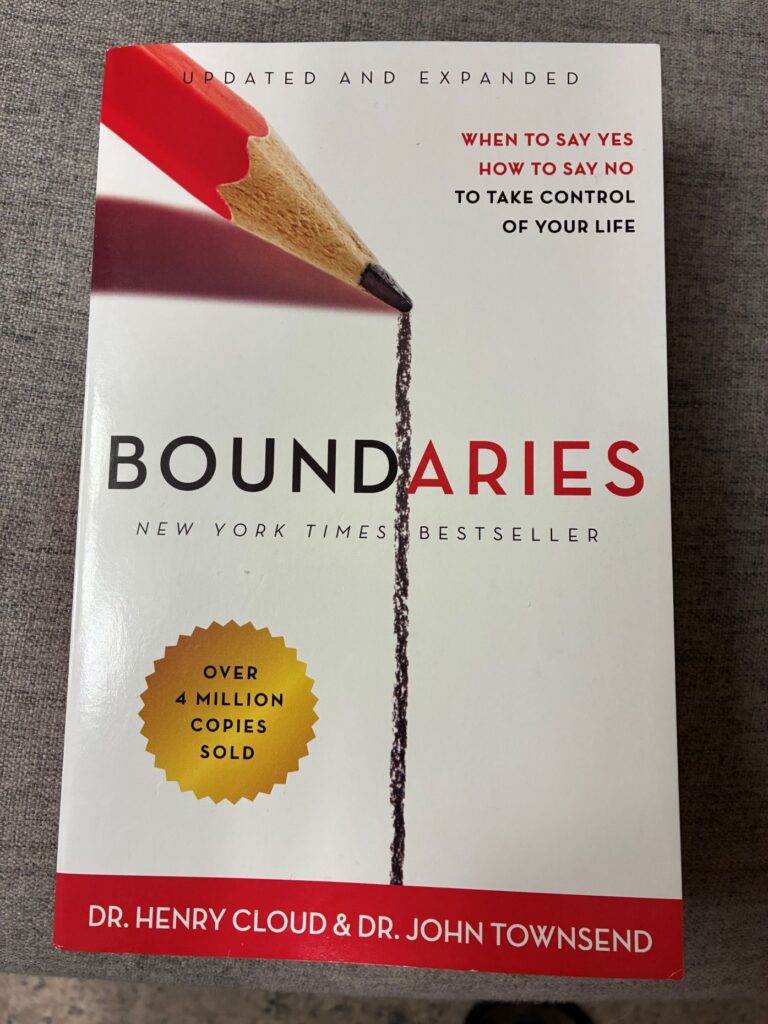
I will quickly list the ten rules below.

  1. Sowing and reaping
  2. Responsibility
  3. Power
  4. Respect
  5. Motivation
  6. Evaluation
  7. Proactivity
  8. Envy
  9. Activity
  10. Exposure

I don’t really feel like duplicating the work already printed in this chapter. It is redundant and I am not any sort of expert in the topic. In case you are not reading the book, it is probably worth putting some definition on each of these rules. It also helps me remember in two or three years what this book was all about. I do that sometimes.

  • Sowing and reaping – This is pretty evident what it means. The one thing that struck me as unique is that sometimes people do not reap what they sow because someone else does it instead, see responsibility below.
  • Responsibility – We cannot have successful boundaries if we do not take responsibility for our actions. A classic failure is the idea of codependency.
  • Power – Just like the 12 steps idea, we have to acknowledge that there are some things that are completely within out control. By the same token, there are issues that entirely out of our hands.
  • Respect – I think that this is two fold. The first is that we won’t get respect if we do not give respect. Similarly, we have to trust that others will respect boundaries if given meaning that if we don’t state our boundaries, some people may realize that there is a boundary.
  • Motivation – We have to have desire to set boundaries. Usually that lack of desire is a result of fear of action like it will hurt someone else or make them angry. Our motivation has to be independent of what we thing the actions of others will result.
  • Evaluation – This law is more about the how and when to express boundaries. It is true that setting down the line can cause hurt feelings but what are the repercussions of not doing it? Sensitive subjects demand sensitive conversations.
  • Proactivity – State your boundaries up front. I do think that the trick is to perform the proper Evaluation before blurting something out that is out of context.
  • Envy – The best way that I can describe this is that it is the opposite of what we want. We need to be aware of our own hang-ups to be able to effectively communicate what we do want.
  • Activity – If I understand this correctly, this law is intended to keep moving forward. After you state your intentions, you have to follow through with enforcing the boundaries as well as staying in relationship.
  • Exposure – Clearly, values and boundaries have to be known.

I think that the part that kind of bothers me about these laws are they are not clearly distinct. For instance, Proactivity, Activity and Exposure are closely related. Sowing and Reaping along with Responsibility are closely related. Envy seems like an anti-law. I will be honest, I think that this would have way impact if the laws were tidied up quite a bit. I cannot clearly say a particular scenario fits one law or the other.

Moving on to chapter six. I suppose that maybe this chapter was necessary. It is about the hang-ups for having boundaries. I kind of found it a weak, whine fest which is why I chose to not spend much time on the chapter. This is the list from the book.

  1. Boundaries are selfish
  2. Boundaries are disobedient
  3. Boundaries others will hurt me
  4. Boundaries hurt others
  5. Boundaries mean that I am angry
  6. Boundaries injure me
  7. Boundaries cause guilt
  8. Boundaries burn bridges

End Your Programming Routine: I had read to this point when I started writing about this book a few weeks ago. It probably explains my kind of sour start. Some of the earlier chapters I felt relatively insightful. Unfortunately, these two feel bloated and need refining. I suppose the alternative is that I am just not getting it, I guess that you can be the judge of that.
July 3, 2025 – Boundaries, Chapters 3-4

Last week I wrote about what it means to not have boundaries. I think that we can all imagine such things. As promised, this week I am getting more technical with the types of personalities define boundary issues. And then in chapter 4, it talks about how boundaries are defined and recognize as us individuals.

At some point, we all have boundary issues. Maybe you are not the aggressor but the one aggressed upon. Only one of those situations do we have any sort of control which is why we all have boundary issues. Depending on your personality type is how you default to boundary situations.

Chapter Three is titled “What are boundaries”. There are essentially four different types of boundary definitions. Here they are.

  • Compliant – Feels guilty and/or controlled by others.  Can’t set boundaries.
  • Avoidants – Sets boundaries against getting help from others.
  • Controllers – Aggressively or manipulatively violates boundaries against others.
  • Non Responsive – Sets boundaries against the responsibility to love.

In the book, these types are placed in a table. The Compliants can’t say no and the Non-Responsives can’t say yes. The Avoidants can’t hear no while the Controllers cannot hear yes. When you look at the four types, do you see yourself? I sure do, Much like the Myers-Briggs tests and other such personality tests, I don’t necessarily find myself squarely one category all of the time.

Ironically, I can see myself with all of them from time to time. In my marriage, I am almost completely Compliant. In my non-working time outside of my marriage, I am almost completely Avoidant. While I am at work I am a combination of Controller and Non-Responsive. I can think of times that I have knowingly ignored subordinates requests to try and grow at the expense of trying. But, that has been rare and far and few between.

I don’t think that I am an alien or something not human. I am not sure that it is normal to have all four traits but I also don’t think it is abnormal to have different responses in different situations. It probably is a good indication of why I am always striving to be fiercely independent and self-reliant. It probably explains why I have issues ‘fitting in’.

That being said, my dichotomy speaks to the two types of boundaries, functional versus relational. Functional boundaries are things related to task completion whereas relational has to do with people. I won’t lie, I do think that my functional boundaries are stronger than my relational. I don’t have as much of an issue standing up for myself in a work situation because I feel like I have less to lose.

Chapter four is titled “How boundaries are developed”. This is an very interesting chapter in that it describes the necessary states to not only grow up but also to develop healthy boundaries. When boundary problems develop, it is often a trauma or stunting at a particular stage. Examples of those causes from the book are things like withdrawal from boundaries, hostility against boundaries, overcontrol, lack of limits, inconsistent limits, trauma

There are five developmental stages that have purpose. They are:

  • Bonding (birth) – mother and child bond
  • Separation (6 mos – toddler) – recognizing that independence is necessary
  • Hatching (child) – developing independent personality
  • Reproachment (child) – establishing boundaries with safe limits
  • Practicing (pre-teen to teen) – Acting within boundaries with ever increasing control

I look at this list and I can see exactly where my development diminished. Since it is biological, bonding and separation happen. I think that my development slowed in Hatching and severely stunted in Reproachment. This seems to be an extremely common occurrence with strict parenting. When a child is not allowed to safely say no then they do not develop the skills to set personal boundaries.

Clearly, not everything remains static. My sister (youngest) had much less in the terms strict boundaries than I did. My brother rebelled and had much more friction. His personality was stronger in determination to become independent whereas my sister really did not have to try that hard.

End Your Programming Routine: I am not complaining, it is just the way it is. And it certainly is not an excuse to not address the problem. This book has already changed my perspective on boundaries. I now realize that I have issues as well rather than strictly thinking I am the victim.

June 27, 2025 – Boundaries, Chapters 1-2

I have been a fan of the Dave Ramsey book list for many years and this book has been on my to read list for all of them.  The Seven Habits of Highly Effective People is also recommended by me as well.  Other titles like Who Moved My Cheese have a message but I find to be a bit situational. 

I kind of, sort of had fantasies of reading this and having an epiphany when my wife’s parents were alive.  Boundaries were a huge issue in our relationship.  I left them more to my wife to deal with because I felt like I didn’t want to get in the middle of their relationship.  That was probably the wrong thing to do because we each as individuals have boundaries.  I am just as entitled to have my boundaries as well.  What a complicated mess.

I wanted to buy copies for both of us.  I thought by reading it, we would self-reflect on the lessons and things would get better.  I realize now that was probably not going to happen.  Part of why I held off was I was uncertain about whether the idea was insulting.  I also realize that boundaries have two parties with the aggressor and the egressed. 

A number one problem with people violating boundaries is not knowing (my problem) or not caring (their problem).  Hence the need to study boundaries.  I kind of just accepted that this was the way things were going to be without stating my wants in the situation.  This is a little bit unfair to them and it certainly did not make me any happier. 

This of course caused friction within the marriage as well.  My wife was unhappy at the constant conflict over boundaries who then brought them to me.  I would then in turn defer to her and nothing would get resolved.  My stance was, if you wanted a relationship then this was the price that was to be paid.  I should mention that she was very good and up front about boundaries which is why I expressed my attitude a above. 

Chapter one is an anecdotal story about a woman who struggles in happiness because of being buffered about in a life without boundaries.  I have kind of violated my principles by reading way ahead and so I am kind of biased about this book already.  Let me warn you up front that this book is highly based on Christian principles.  While I think that there is some value for everyone, it feels like throughout the book it is the ‘meek Christian’ that cannot dare to set boundaries.

I have met these people for sure and the audience is clearly intended for the faithful but to me it feels extremely stereotypical.  Being paralyzed in the ‘turn the other cheek’ mentality to not be able to function in life is more rare than it would seem based on the book.  There is nothing wrong with faith base counseling, in fact I think that it helps set the proper perspective and context for us faithful.  But, I do think that it is wrong to come at this as a crisis of faith.  That idea discounts a lot of people that probably need these words but will be turned off by the faith forward approach.

Let’s not throw the baby out with the bathwater yet.  Chapter two is about all the different kinds of boundaries.  Some of them are not personal based but culturally based.  For instance, I noticed in China the personal zone was extremely different than what I was used to.  In line for the subway, people would literally press right up against others.  What we would consider a tight western line would have some air right in between two people.  It was one of the things that I was quite ready to leave when I came back home because it felt very suffocating.

Reading all of the different types of boundary examples did make me understand that I also had boundary violations.  It wasn’t just that others transgressing on me but that I failed to express where mine were.  I always felt like people should know not to do this or that but then it completely makes sense that if I do not communicate as such that this kind of thing could happen.

End Your Programming Routine: Hopefully, things get better from here.  I have started out a bit negative which I do feel is warranted.  But, like I said let’s give it a chance.  Next week we will get a little more scientific about the subject.  I will talk more about the book instead of my own situation instead.

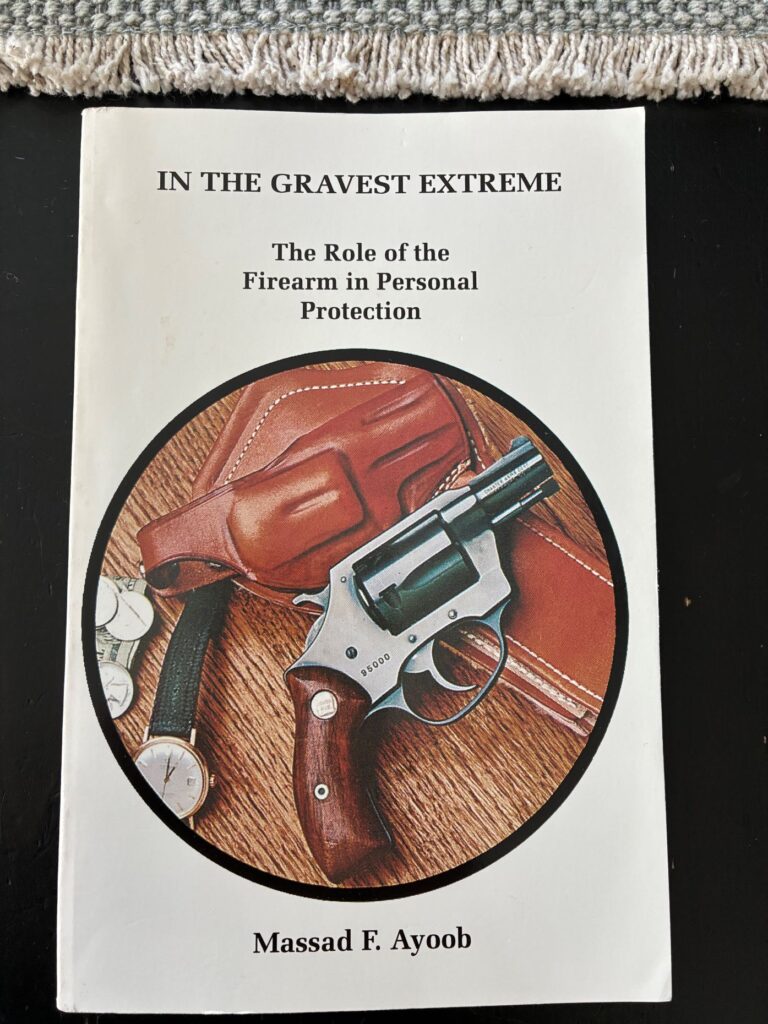
June 20, 2025 – In the Gravest Extreme: The Role of the Firearm in Personal Protection, Chapters 17 and Conclusion

We have come to the end of this highly regarded book. Today I am am talking about what happens after a self-defense shooting, my opinion of the book and then what is next on AltF4.co. Let’s go.

Ayoob’s advice on what to do after a shooting is in alignment with what I have heard in today’s environment. Be the first to call the police if you can. Disarm before the police show up. Give a brief, non-confrontational statement and no more. It should contain certain phrases such as “I was afraid for my life. I shot this man and I will be happy to cooperate when I receive counsel with a lawyer”. That is it.

Before the ‘Summer of Love 2020’, there was the George Zimmerman shooting of George Floyd (2012). I happen to believe that Zimmerman was trying to do the right thing but going about things very ignorantly and stupidly. I am not sure that Floyd was up to no good, but Zimmerman was playing citizen cop, poorly.

There was plenty of digital evidence that something occurred and Florida is a castle doctrine state. The fact that Zimmerman was somewhat of a nuisance 911 caller and on the phone when he pursued and ultimately shot Floyd did not play well in his favor. Fortunately for Zimmerman, he was initially not charged with negligent manslaughter.

But, for political reasons (IMHO) Zimmerman was investigated for Civil Rights violations by the Department of Justice. Remember that this was the Obama era. From the time of the shooting in February 2012 until the case was ultimately dropped by the DOJ in April 2015, there was widespread speculation into Zimmerman’s character and intent. How is your nest egg? I will remind again that there are organizations like USCCA and Citizens Legal Defense Network.

This is a book that I was excited to read. I wanted to believe that being a highly respected work by a highly respected subject matter expert it would stand the test of time. Upon reading it, I realized that there has been too much legislative and technological water under the bridge to make this book relevant today. It would take a person already versed in this topic to be able to discriminate between the good and the not so good here.

What I think is good with it is that if you live in a ‘Constitutional Carry’ state, you need to know that there is a lot more to things then just strapping on your piece. Even if you just have a gun in the home, you need to know the parameters of when lethal force is legitimate. There are proper procedures to perform after a confrontation and you have to start somewhere.

I think Ayoob is in his mid to late seventies now. Ten years ago or so, I used to occasionally listen to him on his own podcast. I am a little surprised at some of the language used in the book that I am more than sure he would not endorse today. These would be the brandishing suggestions and the more tough guy bent that he set in some cases. I suspect that a lot of that was more a result of him being a New York City police officer. Lawmen will always be held to different (looser) standards than citizens not to mention qualified immunity (again).

It can’t be helped that so much time has passed as well as technology. Since I have been around so long, I have observed Ayoob’s recommendations evolve to slim automatics to 9mm to the current one and a half stack pistols like the Sig Sauer P365. Technology changes everything with tactics. It makes things like the suburbs possible to commute to a job daily. Now, with work from home ubiquitous an employee can literally live anywhere.

The book that I am starting next week is called Boundaries by Henry Cloud. This is a book that I have been wanting to read for twenty years. It is on the Dave Ramsey recommended list and it happens to be an area that I am weak in. There is no excuse to delay things that long as I always thought that it would be useful when my wife’s parents were alive. Better late than never.

I am not committed to how to break it up yet. It will likely be two chapters a week with the last week of reading is the last three chapters. To be prepared, read chapter one and two.

End Your Programming Routine: Ayoob has a newer book called Deadly Force which is definitely on my list. The description says that it is a follow-up to this book. I suspect that we will see all the newest and better, more relevant recommendations there. It is not my next book but I will probably read it this year. In the Gravest Extreme is out of print and rightly so. I think that it’s time has come and gone.

June 13, 2025 – In the Gravest Extreme: The Role of the Firearm in Personal Protection, Chapters 15-16

Reading gunfighting tactics from a book is probably not the best idea. Don’t take my word for it, I am no consultant or trainer. I do believe that even with the best laid plans, practice is required. The problem is that most ranges do not allow holster draw. Mine specifically does but it does have to be with the intent of practicing techniques. I am not sure how you prove that but word to the wise.

The value of reading tactics comes after some training. This provides another perspective and the ability to analyze information. I do have to say that I learned something in this chapter that I never knew. Apparently, some revolvers have full length ejectors while others do not. Truthfully, I don’t know which ones I have or how to look for them, what models, etc.

The reason that I bring this up is that I was considering some classes for my wife. Nearly ever single self-defense pistol class requires a pistol (not a revolver). I don’t really have such a thing that I would consider appropriate. If it were me, I would just take what I have because that is what I might carry. The point is that I paid much more attention to the revolver information in this book whereas the vast majority of today’s concealed carrier would have a pistol.

Practice: no truer words were said. If you cannot hit anything at the range, how in the heck do you think you will defend your life properly? I have to admit that while I take a handgun nearly every range trip, I am a significantly better rifle shot. Not only are handguns harder to shoot accurately, but I practice rifle shooting most days with the air rifle. Most of my practice is offhand (no support) or left hand (weak hand) as well.

When it comes to things like shotguns and trap shooting, my kids can shoot my pants off. They shoot at least 75 targets for sixteen weeks a year whereas I might shoot 25 targets in one season (2X a year). They have significantly more experience than I ever have and it shows when we compete or shoot together. Those are two examples where practice is better than a loaded handgun in the sock drawer.

I do believe that you can read about safety from a book and it is effective. I am not going to extensively cover the rules of firearm safety. Some groups reference three rules while others say four. Neverthess, if you follow these you will always be safe.

  1. Treat every gun as it is loaded
  2. Keep your finger off of the trigger until ready to shoot.
  3. Verify your target and what is behind it.

Something that I think about is when others are around. I know that I am not going to do something stupid but what happens when there are other kids around? For that reason, when I am going to clean some firearms over the course of several days, I make sure that they are disassembled to the point of not being able to be used. I suppose kids smart enough could figure out how to put it back together but then they would have to know where the ammunition is, how to load it etc.

Don’t get me wrong, I don’t leave stuff laying around routinely, even temporarily. But, I like to put stuff back in the safe clean. Often when I come back from the range I don’t have the time to clean up that day. I may have stuff on the bench for a few days while is am actively cleaning. Always make sure that I get my stuff put away expediently and be aware of what others may or may not know.

One last story. I know someone that was sleeping with a 9mm handgun under the pillow. One night while this person was sleeping they accidentally pulled the trigger. Fortunately, the only consequence was a hole in the wall. I have never gone out shooting (intentionally) with them but I highly suspect their judgement. Don’t do this.

End Your Programming Routine: We are approaching the end. Next week will be the last chapter and I will offer a conclusion as well. This will be unlike most books where the conclusion follows the last chapter. I felt this book was sufficiently short enough that it didn’t warrant another week. It is extremely unlikely that you would ever have to defend yourself, above everything else… be safe.

June 6, 2025 – In the Gravest Extreme: The Role of the Firearm in Personal Protection, Chapters 13-14

OK, my opinion of this book is changing from what I believed before I read the book until now being almost finished. These two chapters are nearly worthless because so much has changed in 45 years. Even some of the information is no longer accurate because of technological changes. I just don’t think that you can overlay the old information with today’s new choices.

The first chapter is all about firearms choice. Ayoob recommends a two inch, 38 Special as the best overall choice. Personally, as someone who owns one, I have to disagree in today’s market. With a short barrel length, accurately aiming is very difficult. Recoil ranges from snappy to stinging, making shooting often uncomfortable. A magazine capacity of five pales in comparison so something like a Sig Sauer P365 that holds 13.

Something that I feel is definitely wrong is the lack of endorsement for the rifle as a self defense platform. The Modern Sporting Rifle (ex. AR-15), primarily in carbine configuration has a long track record in urban combat. I do not believe that it works well for the untrained and unpracticed but then again I don’t think that any of this does. Any sort of long arm is not for street carry. Ask Kyle Rittenhouse about packing around a rifle into trouble. That fits right into the Machismo of carrying a firearm.

But as far as home defense, it is amongst the best choices. As a rifle, the bullet energy of a 223 Remington is three times that of a 357 magnum. Rifles are inherently easier to aim and shoot accurately. An MSR magazine can carry 30 rounds. Last and best is that the 55 grain bullet tumbles on impact. This phenomenon tends to significantly reduce over penetration that will be experienced by almost any other choice.

When I started this series, I referenced the 1986 Miami shootout. This was a pivotal moment in self defense and ballistics theories. It was deemed that a large part of the failure was the result of 9mm full metal jacket ammunition that was unable to penetrate glass and deliver lethal force. As a result, the FBI developed the 10mm cartridge.

The 10mm proved to be extremely effective but caused an unintended consequence of swelling the grip size. The extra recoil and increased size made slighter, statured officers unable to competently use the firearms. That quickly morphed into another cartridge which is the 40 S&W. The Forty reigned supreme for twenty years in the law enforcement arena due to superior ballistics over 9mm.

But, times change and the economy of scale with the military (and most of the world) using 9mm, it was deemed more economical to use. There were also still complaining about the recoil of the Forty as well. As a result of the shootout and all of the cartridge development led to the FBI ballistics test. Note that the test is not caliber specific. Consequently, 9mm has largely overtaken the law enforcement market again due to significantly better ammunition development.

All of this is to say that Ayoob deemed the 9mm marginal which is simply not the case in 2025. Ayoob himself claimed that the ‘king’ of cartridges is the .45 Auto. This analysis is simply due to bullet diameter. Mind you .45 caliber is 11.4mm. So, in reality we are talking about a 2.4mm difference between bullets as the only real differentiator on full metal jacket ammunition.

That is all semi-automatic pistol stuff. There have been a bunch of new cartridges in the revolver arena as well. I will disregard all of the elephant rounds and say that the 327 Federal and the older 32 H&R Magnum have come onto the scene. When Ayoob says that there are no 32 caliber cartridges that are adequate for self defense, that would be wrong. There are a host of other benefits that I will not get into here but if I was picking a revolver and cartridge for self defense, I think I would look in this direction.

I want to end this by saying that I do not own a whole bunch of firearms. But, the reason that there are so many handgun choices and calibers is that there is a situation for all of them and choice is only one of them. A person could reasonable justify revolver for the woods, a small handgun for pocket or summer carry, a double stack for crowded situations or winter carry. In my mind, there is no perfect situation. A handgun is best for concealment and to keep the other hand free.

If you were to tell me that I had to pick one, I would say that I prefer not to be there when the confrontation happens. If you said that I had to be at the confrontation, I pick a long gun. If that is not an option, pick the one that you are the most comfortable with and can shoot the best. While I respect Ayoob’s vast experience in the ballistics arena, I side on the fact that a hit is better than a miss.

End Your Programming Routine: I don’t mean to demean Ayoob, it is just that these chapters do not stand the test of time for reasons that is beyond his control. As a person that was alive in 1980, I can tell you first hand things are very different technologically between then and now. What if you were advising cars from 1980 in 2025? The best economical car to buy is a Renault Le Car

May 30, 2025 – In the Gravest Extreme: The Role of the Firearm in Personal Protection, Chapters 10-12

This week we have three chapters that are all about personal protection in action. Some anecdotes are personal while others are first hand. I will spend the majority of today’s work talking about the last one but each chapter will get a little bit of analysis at least.

Before we actually get into the specific chapters this week, I have been reading mention of the term “Super Vel”. I figured that it must be some sort of ammunition but I have never heard of it. I decided I would look into it a bit. As it turns out, Super Vel is a brand of ammunition. Based on the history (in the link), I would say that it was one of the first boutique, high performance cartridge manufacturers. Today’s equivalent would be Double Tap or Buffalo Bore. Sadly, Super Vel went out of business in 1981 right after this book was published.

The good news, a contemporary of Ayoob at Guns Magazine purchased the name and is producing Super Vel again. I have never seen it in the stores but looking around it can be purchased over the internet at what appears to be reasonable prices to me. It is 50% cheaper than the Underwood, hard cast lead .38 special I just purchased. Cool, retro packaging and story, now I know.

Chapter ten, I think is about justifying an informed choice to carry a handgun. While I am no Massad Ayoob and I do not claim to be, I don’t think that the advice is that good. What Ayoob is implying is that flashing your firearm (brandishing – see last week) can be a deterrent all on it’s own. While I believe that can be true, what if there was another assailant behind that I didn’t see. I repeat again, only show a firearm when you are justified to use it. An intimidating guy leaning against a car does not meat that standard.

There is also another phenomenon in self defense. The first person to contact the police is the victim. It would not be beneath a low life to call the police on you for flashing a firearm and all of the sudden you are arrested. Show your firearm only when you draw it. Draw it only when you are justified to use it. If you cannot shoot them on the spot, best to turn around if your are feeling intimidated.

In the next chapter, it talks about two things, discretion and competency. I made my feelings known about discretion already. As to competency, I whole heartedly agree to the concept. Some states require competency for your permit. But, going deeper than that a well placed shot beats misses every day.

When it comes to caliber or capacity, there are a lot of mall ninjas out there. The fact of the matter is that if you cannot hit your target, then all of that is moot. But even more than hitting the target is hitting the target to stop it. I have seen enough animals hit in less than lethal spots to run off or hole up to be dangerous. An animal is enacting the fight or flight reaction where as a person hellbent on suicide by cop might start coming for the person shooting at them.

Finally, the last chapter this week is the gold treasure of the book. You can do all the fundamentals right, a justified shoot, no other injuries and lose nearly everything. As soon as the ‘victim’s’ family decides to file suit, your second hell is about to begin. This happens with police departments all of the time. They have a nice insurance policy to accommodate the situation.

Criminals have figured out that they can get one more payout from the state. Generally, it is in the form of a settlement rather than invest all the resources in a trial. If $10,000 makes the problem go away then that is saving a week’s worth of lawyer fees. Hence, this is why Ayoob’s advice on cash wrapped in a matchbook is a cheap insurance premium.

Who has cash and needs matches these days? Don’t be an idiot, figure out some token that you can sacrifice to potentially eliminate years of pain (if you make it out of the situation). There are also concealed carry insurance funds out there. It would be wise to belong to one of those if you have made that choice to carry a firearm. The principle that I always go back to is “If you think that you are walking into a place that you will need to use your firearm, then it is best to avoid that place”.

End Your Programming Routine: If you are reading the book along with me and you are having a hard time with me contradicting Ayoob, I would say that you need training. I will admit that I also need more training and do not consider myself an expert. But, my words are coming from years of multiple, consensus sources in a developing field of civilian concealed carry. Don’t forget that this book was written before any of that began.

May 23, 2025 – In the Gravest Extreme: The Role of the Firearm in Personal Protection, Chapters 6-9

**Note: May 26, 2025 is a holiday. I am taking one, you should too.**

This week gets into the tactics of concealed carry. It covers the basics of where you might possibly have or use a firearm. I do think what is conspicuously missing is our interactions outside of our own business, home, street or car. We are missing things like church, restaurants, stores and all the places we might be besides the four that he talks about. That being said, we were years away from ‘shall issue’ concealed carry when this book was written. As a result, it is understandable the focus and the omission.

I never knew this but apparently, Ayoob grew up in a family business. A jewelry store to be specific. Rightly so that he was exposed to potential conflict while at the shop. I don’t know but that is possibly as risky of a proposition as being a convenience store owner operator. For most of us, I would guess that having a firearm stashed at work is probably a no go. Likely, carrying concealed would be a better proposition anyway.

My grandfather was a sole proprietor in an shady business. He was a landlord that dealt in the lower tier of renters. As such, he was robbed several times in his career during office hours. Unfortunately, they did get away with his Purple Heart awards from World War II. I would say that he could have benefitted from a gun at his office.

A gun in your home is the most likely place that it will be. While there are many people that are permitted to carry, I suspect that few will actually do it. But, having protection around at home is much more likely which is what makes going into somebody else’s home so risky. Ayoob offers what I think are reasonable tactics still today for dealing with a home invasion and family protection.

When we were living in South Carolina, I don’t think concealed carry was a legal construct. I didn’t investigate thoroughly, but I was told by many residents that it was legal to have a firearm in the glove box. I do know that was the case in other states and so I had no reason to doubt that. This has never been a practice that I have ever been comfortable with or employed.

Today in Oregon, to have a firearm in the glovebox would require you to have a concealed carried permit. Surely others will do this as well but it still doesn’t make it a good idea. I was home a few years ago when the police rang the doorbell. They said that the neighbor had a firearm stolen out of the car and wondered if we had any doorbell footage. I told him I would check and didn’t see anything.

The point being, is that leaving a firearm in the car leaves it out of your control. Run of the mill break-ins can have your property ending up in the black market. It also would be hard to reach when you really need it too. That being said, I could see putting a firearm in the car when going on a road trip or something. Where legal of course.

I know that I skipped around a little bit but the last chapter I am going to talk about is the gun in the street. Ayoob really is focused on the tactics of deploying a firearm in the streets but this is really the run of the mill concealed carry. I suspect that it is pretty sound advice but I do think that it should be taken with a grain of salt. A lot of this has changed but you do need to be aware of the term brandishing.

Brandishing is flashing a firearm with the intent of intimidation. I am more than sure Ayoob is not implying that you brandishing is a valid technique, but the wording and the way that it is written kind of, sort of seems that way. Once again, in states where that is a crime you are only legal to display a firearm when you are legal to use one. States that permit open carry typically do not have brandishing laws. The point remains that you need to know your state laws down pat.

There is a concept in this chapter that is talked about but it also comes up later in the book in a big way. That is, it is cheaper to not get in an altercation than to be in the right. I will save most of that for next week. Suffice to say, carrying a gun is a tool in the toolbox. It doesn’t mean that it is the first or best or only tool.

End Your Programming Routine: Good stuff. I keep saying that with all that has changed in this landscape, the tactics remain good and legally defensible. It helps to know and understand the history and evolution to be able to pick out the nuances and changes. Reading this book has inspired me to get the updated book that Ayoob has published because I suspect that most of what is wrong here gets corrected. It won’t be the next book but it will be soon.

May 22, 2025 – Hiking the Oregon Coast Trail

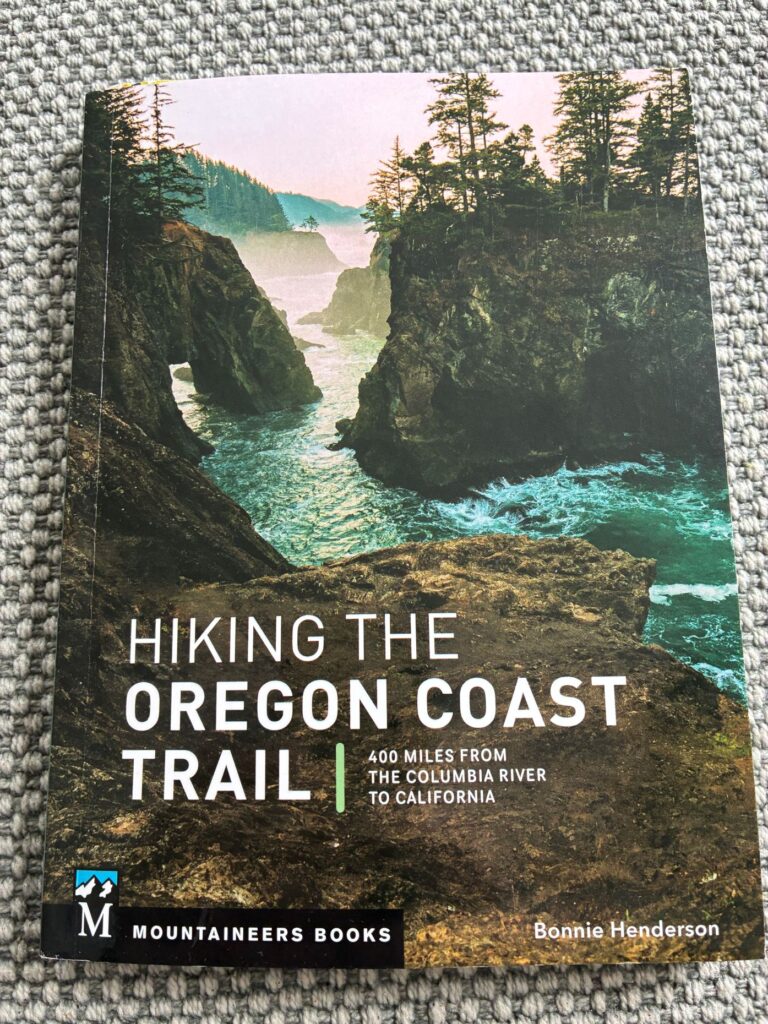
This is the self proclaimed guidebook that you don’t need. I didn’t say that, Bonnie Henderson the author did. The Oregon Coast Trail is a route that runs the entire length of the Oregon Coast. It is also one that I have hiked a portion of in the early 1990s as it was being actively developed.

One of the things native Oregonians stake their claim on is the precedent setting legislation that happened in the 1960s. But it actually starts much earlier, in 1913. Governor Oswald West declared that the Oregon Coast was a state highway. The declaration claimed that the high tide line was the extent of guaranteed access.

In the 1960s, a bill was introduced to make all beach access public. This would be all the sand/shoreline above the high tide land. After a supreme court case was settled, all the beaches became public property. The book claims that there are 262 miles of beach, other sources say 360 miles. It probably depends on how you define beach as to which number you go with.

The reason that the author says that you do not need this guide is because 90% of the trail is on the beach and therefore no trail guide is really needed. I can say with my experience that we walked a lot of the beach, in my memory it was more like 50/50. Memories can be fallible for sure and I have no way of measuring or validating that number. I simply remember spending a fair amount of time in the coastal forest.

The selling point from the author is that this book will make the experience better. For instance, if you want to keep to 90% beach hike, then you will need to ferry across some rivers. If you opt to stay on the ground, then you will need to detour up to a road, likely US101 and cross in a standard fashion. This not only adds some extra miles but also potentially makes your hike more like a highway walk.

From the central coast north, it is relatively populated. What that means is that even walking the beach you can go out to eat or stay the night in a hotel. In theory, you could walk from hotel to hotel for the night making this a very different experience than very remote Pacific Crest Trail. But, if you are more inclined for the roughing it badge, there are tons of camp grounds that provide amenities like water, toilets and cell phone charging.

I have a lot less experience south of the central coast. It is farther from me and there are many less ways to get there. In other words, it is much more wild and rugged. While the beach is 100% open all the time, the author claims that hiking October through April is not recommended due to the amount of water draining to the ocean. I can say for a fact that most cities storm water drains are piped directly to the beach. This can easily become a deluge of water given how much it rains and all of the elevation there is on the coast.

I personally think it would be crazy to hike in the wetter months to begin with. While we don’t have many hurricane type storms, I have seen roofs ripped off of restaurants due to such storms. I can’t imagine being exposed all day in that kind of weather. Not to mention, who would enjoy a day of 4 inches of rain.

My sudden interest in non-PCT trails should be obvious. With my decision to delay my hike a year due to lack of physical fitness, I need to find some places to test my abilities. Being that I am only an hour to the coast, this seems like a natural fit for more exploration. The author also claims that this is a trail that can be done in about 30 days. I am thinking that this actually seems attainable rather than the six months for the whole PCT.

End Your Programming Routine: The recommendation to hike southbound seems tame enough. That is because northbound is into the prevailing wind (which is the way I did it). Those are the kind of recommendations a book like this gives. This is a local author who has done it more than once. Even if I never do the hike, I am proud to support people who are willing to help others with their experience.

May 16, 2025 – In the Gravest Extreme: The Role of the Firearm in Personal Protection, Chapters 3-5

I know that I keep saying this but I feel like this group of chapters is another where time has probably changed prevailing attitudes. For one thing, the deregulation of concealed carry has created an industry of specialized civilian training. And with that, has come a plethora of resources that didn’t exist in 1980 like the internet and podcasts as two examples. I think that those resources have spread a broader net of better information.

I remember as a kid, we would say things like ‘shoot bad guys in the knee’. Of course, I grew up under the shadow of the early westerns and every TV show with a bad guy had a good guy. There was no such show concepts like Breaking Bad where the good guy was also a bad guy or you couldn’t quite draw clear lines. As such, we wanted to do the proverbial ‘shoot ’em in the shoulder’ because the thought of taking life would put us in the bad guy category.

With that strong desire to be a good guy, there was also the idea that we would put the bad guys away with a citizen’s arrest. This is probably the result of too much A-Team or MacGyver. Ayoob did a pretty good job of cautioning the bad guy could turn the tide from captive to captor. That is a pretty valid point because the best practices today would say you shouldn’t draw a gun unless you are justified to shoot in the first place. Holding a perpetrator at gunpoint changes the force equilibrium.

More so than the risks of a captive, if a third party calls in a 911 call, how do the police distinguish between a good and a bad guy? We assume that we are talking about the good guy holding the bad guy at gunpoint but it could be just as easily the other way (for lots of reasons). For reasons of both safety and liability, it is just best to not emulate TV shows with a Citizen’s Arrest.

Regardless of what the police would do, what are you going to do? There is probably a 95% chance that a man beating a woman in the parking lot is the aggressor. But what if you were wrong? What if it was two men fighting, now who is the aggressor? What if one is stabbing another, is that assault or self defense? We just don’t know. It is sad and selfish but it is best for self preservation to not try to pick.

An active shooter is a different story. In that case, there is a clear aggressor. When I talk about concealed carry, I am also talking about a handgun. If you are unfortunate enough to be around an active shooter event the best you are going to do is have a loaded handgun. Handgun against handgun and you have a chance if they are an average marksman. Handgun against a rifle and you are going to need some luck.

Every person needs to make the calculus on what you would do. My values are to get myself and anyone with me away from the shooter. That means that I am not typically looking to engage. If you did, what if the shooter is dead but you also hit a bystander? Are you legally prepared for a lawsuit? It doesn’t matter if the victim should be thankful, he might be looking to cash in or maybe he can no longer work. These are all of the tough choices that need to be made.

Really the last chapter I want to talk about today does not fit into the first two nor next week’s so it ended up here. One of the largest growth factors in firearms has been women. I have to say that his suggestion of a snub nosed 38 special is superseded by many, many better choices today. As an owner of one, it is difficult to shoot well. It also recoils like a getting kicked in the hand. That was probably the best you could do in 1980.

You all know that I am not a woman (even in today’s culture) so it is hard for me to really identify with those particular struggles. That being said, the number of products for women’s concealed carry is a lifetime away from where it was when the book was written. I know for a fact that 5.11 makes yoga pants with integrated holster as an example.

End Your Programming Routine: The fundamentals are definitely 1980s sound. There isn’t much that has changed from the legal standpoint. We are really talking about legal standards that go all the way back to middle ages England, what is another forty-five years? It is the gear that have made exponential improvements. From bullets, holsters, laser aiming devices, flashlights, red dot sights, glow in the dark (tritium) sights, magazine capacities, new calibers, etc. The one right choice in 1980 has a bunch of potential better choices today.