Category: Review

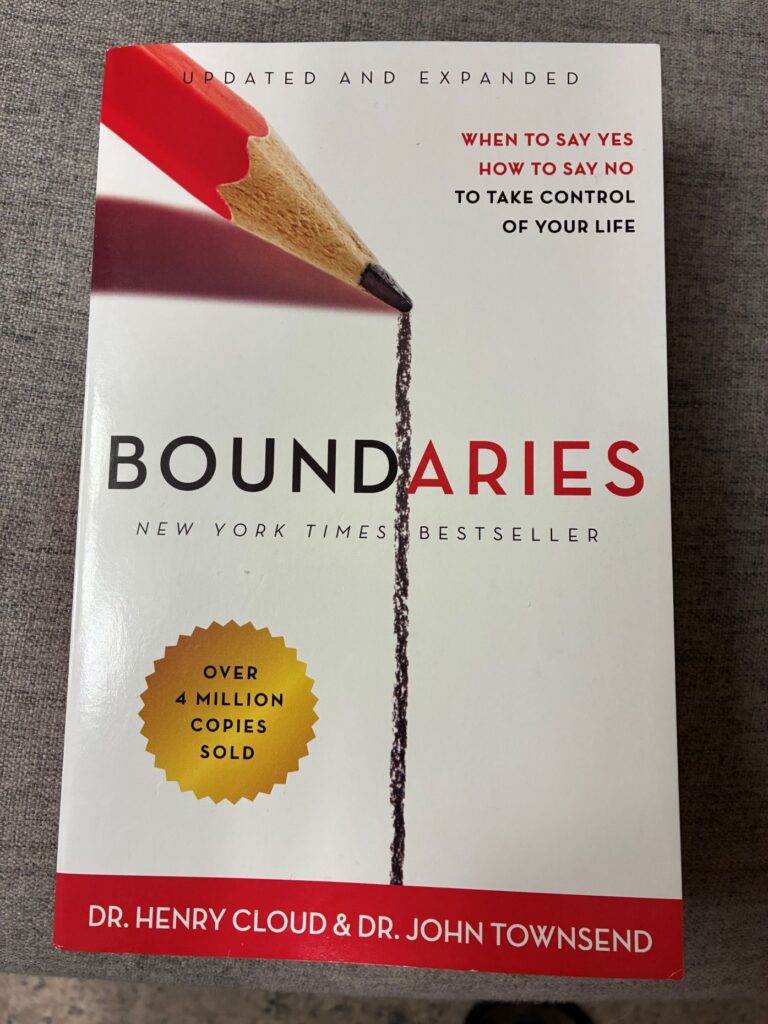
September 19, 2025 – Boundaries, Chapter 17 and Conclusion

When I was planning on how I was going to break this week out, I really didn’t know what was in chapter 17. The fact that it is a fictional story of the women that previously did not have boundaries and how she was buffered around by life and now she is promoted and in control I find to be a little bit pedantic. With that said, I am not going to address chapter 17 any further.

I won’t say that I did not learn anything from this book because that is not true. But, what I will say is that I found myself annoyed reading it sometimes. The bent toward being too Christian to have boundaries and the anecdotal fiction that ‘read this book and everything is going to be alright’ is problematic. I don’t think that if Dave Ramsey wasn’t constantly pushing it that it would have ever made the sales numbers that it did and for good reason. It just is not that good.

Let us not throw the baby out with the bathwater though. I know from personal experience that when you have deficiencies, it is extremely difficult to change even with cognizance. I really appreciated the perspective that you cannot fix it yourself. Even when you read chapter 17, Jean didn’t change her boundary problems alone, she had a therapist and a support group. I think that is what to take out of this book, serious boundary problems need help.

If you think that there might be a problem, reading this book is a good step in sort of getting a baseline. This also requires that you read it with intellectual honesty. It should be read, digested and contemplated. If you do that, then I think you will eventually come to the realization that there are things that can be done but real change cannot be done alone.

What more can I say? I guess that if someone were to ask me what to do about addressing boundary problems, this would be my first suggestion and really because it is the only one that I know. That being said, this is really not a recommendation. I think that if you knew nothing about anything, “Seven Habits of Highly Successful People” would be much more valuable even though it is not a one for one subject replacement. It is just that if you think of life holistically, one situation shares many similarities with many others even if they are not related.

Another thing about this subject is that there is only one person that can be changed and that is yourself. It is very difficult to deal with someone that is overbearing, especially if you are a pleaser like myself. They have to have the same realization that they have boundary problems and want to do something about that in order to have a day with boundaries.

As I said in the opening week of this series, I have been wanting to read this book for over ten years. I was married into an entire family of significant boundary problems. Just one example was that when my sister-in-law got married, that night they were paid a visit by the parents at their hotel. Years later, they laughed about it because they intuitively knew how wrong that was and yet they never internalized how damaging their constant inappropriate behavior was.

Quite possibly if I had read the book ten years ago, I would have realized that I should probably done some things differently. That is unfortunate because the primary reason for wanting to read the book is no longer with us. Possibly, I missed an opportunity to be a better person earlier then when I realized I also have boundary problems, just of a different nature.

End Your Programming Routine: Let me bottom line this book. I am glad I read it but I really don’t recommend it. I get it that it is intentionally marketed to Christians but I found the biblical case and support too weak. I also think that waving the Christian flag was a crutch for the not addressing the significant numbers of secular interactions we have every day. As an example, nearly every single person I interact with at work is from India and not Christian. It is just not someone trying to be overly godly that I am interacting with. If you have a problem, seek therapy now, don’t read a book.

August 22, 2025 – Boundaries, Chapters 15-16

I am on the ragged edge, I finished reading this week’s reading with one day to spare last week. I technically had time to complete this entry but I was too busy to be able to write. It is funny that three weeks ago my mind was occupied with organizing my sporting goods and backpacking area and planning my hunting season to the only thing I can think about is this bathroom refresh. It has caused me to be thinking, scheming and working all of my waking hours. Because my mind was consumed, I had to do a heavy refresh on the content.

In theory, we have made it through identifying what boundary issues look like and what those issues are. This week we have moved on to doing something about it. Of course, before you can do something about it then you have to understand why you would not. Chapter fifteen is all about why you would not or struggle to set boundaries.

I haven’t been in this exact situation so I am using speculative language. But imagine that your partner is an abusive alcoholic. What might be preventing you from putting up boundaries is fear of repercussions. What if they hurt me? What if they hurt themselves? It is a pretty compelling excuse not to push boundaries.

The book breaks these resistance reasons into categories of external and internal. External resistances are things that others do as a result of us wanting to set boundaries. Those would be things such as anger, guilt, consequences and physical resistance. Internal resistance would be things like human need, guilt and fear of the unknown.

I know that I have been guilty of both internal and external resistance. The first and most significant hurdle for me is always internal. I do a lot of thinking before acting and that has a habit of building up in my head. I also tend to be way more passive then most others and I rationalize that I will ‘put up’ for a certain amount of time. What I don’t really realize is that action of ‘put up’ also tends to build up. It also feels like after I have put up for a certain amount of time that it then seems insignificant or too late to bring up boundaries. What a mess.

It is all well and good to have a bunch of new information and potential skills, but how do we know that we are making progress in our new boundary filled lives? This is what chapter sixteen is all about. I would simplify the chapter by saying that there is a progression of life becoming happier and more fulfilled. To be a slight more succinct, you find yourself gravitating away from the boundary violators and more toward like minded people. While boundaries are becoming solidified you start moving towards more personal freedom and satisfaction.

I often wonder why I have a tendency to live and let live. In contrast, there are others in my life that insists on intervention and confrontation. Both have their virtues for sure, but I am probably way too laissez-faire. On the other hand, I find this other person way to contentious. But, when the two are effectively combined, probably the right outcome. The way that I rectify my attitude is that my boundaries with others are well established. And what I mean by that is that I am content with where I am at.

This is not to say that I have a good grasp on all boundaries. Because I am hands off and this other person is confrontational, it often leads to conflict. While I have previously seen it as borderline bullying, I have come to understand that I have not setup good boundaries with this person. The confrontation doesn’t come from a bad place but a place that is comfortable and normal. Effectively communicating better ways to address issues is really on me. As you can see, I put up with it until the situation is over and then we move on again, not solving anything.

There is an old folk saying that I will paraphrase. Never measure with a micrometer that is marked with chalk to be cut by an ax. Setting boundaries is one thing but seeing them in motion and feeling better takes time. Many times we are often so busy fighting the battle that we don’t even realize that we have made progress. We have to use the right tools and perspective for the situation. That also requires some grace.

End Your Programming Routine: Now that we are 2/3 of the way through Developing Healthy Boundaries (section 3), I feel like this section is a bit of a misnomer. Chapter fifteen was all the reasons that we struggle with boundaries and I feel like a lot of this was covered earlier. Chapter sixteen was a mythical outcome of successful boundaries. I am no expert but I suspect that the path can take many forms and still be successful. Next week we will finish Boundaries and the following week we will be starting Mere Christianity by C.S. Lewis.

August 14, 2025 – Ken Burns: The Vietnam War

I did it. I Figured out how to watch this without paying $20 per episode ($200 total) to own. I was able use my library’s free streaming service. Granted, it is slightly limiting. You are given 10 credits each month and each movie or episode is 1 – 4 credits. This took me spanning over two months to have enough credits to watch the whole mini-series. But that is OK because I started late in July and so August came quicker than I realized.

I have been a Ken Burns fan for a long time. When I was in middle school, I recorded each episode of his Civil War series. That was so long ago, I don’t really remember that much about it other than I felt pretty satisfied on the subject when it was over. But, it was already a subject I had studied pretty extensively, so most of it was not too revolutionary.

Ken Burns: The Vietnam War was a powerhouse documentary. When I was growing up in the 1970s and 1980s, that war was in the American psyche. Heck, when I was born the US had not even completely and formally evacuated Vietnam. When I was a youngster, most Vietnam Veterans were less than ten years from their service. We are now twice as far away from 9/11 then we were from Vietnam when I was a kid. You betcha it was a sore subject in this country.

I used to believe that the US could have won the war, we just did not fight it in a way that would have. I no longer believe that. It was based on nothing but a sheer belief that Team America had to be the best. Now that I am older and wiser, I can see my naivete was just sheer ignorance. At almost 17 hours, this review probably deserves more than one blog post. I am going to try and get it in one long one.

I have questioned a lot of things about my country in recent years. I am as anti-communist as they come. I believe in personal accountability and yielding the merits of my own work both good and bad. The reason I am against permanent, social safety nets is that I believe that they de-incentivize personal accountability. That being said, I can understand the American desire to contain Communism in the 1940s.

President Truman sent military advisors to Vietnam in 1948. They were to bolster the colonial ruling French and beef up the South Vietnamese efforts aiding the French who were fighting Chinese backed, North Vietnamese Communists. The North Vietnamese wanted two things: to get rid of French rule and to unite the country. A ceasefire in 1953 drew the Vietnamese De-Militarized Zone (DMZ) directly resulting in France’s withdrawal from Vietnam.

In a subversive way, France drew the United States significantly deeper into the conflict by playing on the US weakness for stemming expanding communism. But, they were smarter than us and when France abandoned Vietnam, the left the United States with the bag of supporting South Vietnam as it was now called. Puppet elections and widespread corruption left a completely dependent country on foreign support both militarily and financially.

Clearly, hindsight is 20/20 and the Domino Theory of Communism advancing did not happen. The question that I keep asking myself is ‘why is it that America thinks it is our business to get involved in other nation’s affairs’? Eisenhower, Kennedy, Johnson and finally Nixon all knew that we were not going to win this war and yet the first three kept escalating the war. I strongly believe that Nixon would not have ended it if it were not for his utter fear of total revolution. He had no choice. But it still took seven years for that to happen.

For those of us who did not live it, we may think that of all of these events in sort of one big, grab bag called Vietnam. As an example, there was always protests and civil unrest. It was the Tet Offensive of 1968 that really changed the country’s mind. Due to the US getting completely surprised and most of the South Vietnamese soldiers on Lunar New Year break the illusion was shattered. How could the US be winning the war and yet they needed to double the troop size from a quarter to half a million men? Clearly we were being lied to about what was happening and the country got mad.

Out of that grab bag also came Watergate. While my impression was always Nixon was a slimy POS, This film gave me a whole new perspective. When it was apparent that Nixon was going to win the 1968 election, Nixon started negotiating with North Vietnam and the Viet Cong going outside of the official government channels basically signaling that there was going to be a change in US policy focusing on peace with dignity. We know this because Johnson had bugged Nixon’s phone lines. Knowing that was illegal, Johnson never divulged this information nor that it was happening at all.

I tell that anecdote because it was my impression that it was only Nixon who was a crook. But, what it really told me was that corruption was already in place for both sides. Just like they were fighting a war that was already known to be unwinnable, they were playing the public as fools with almost everything they were doing.

What all of this has ultimately crystallized to me from all of this was that this is the true legacy of the GI generation. From a remarkable victory in World War II to a stalemate in Korea to an utter defeat in Vietnam. Granted, I know that this is way more complicated and mixed, but it was the GIs that fought in World War II, advised in Korea and lead in Vietnam.

The best I could say about all of this is ‘travesty’. Americans lost around 58,000 soldiers the North Vietnamese lost 2.5 million people. That is just killed, then there is wounded and invalid and there is nothing to say of the psychological effects. It is true the country was united in government and boundaries but they were as divided as ever. Vietnam struggled to thrive economically under communist policies.

End Your Programing Routine: For what? What was this all for? This war was an homage to arrogance and resulted in futility. I have been to the Vietnam Veterans Memorial and stood back and watched in solemnness as the tears flowed while names are traced of friends and loved ones that were killed. It was powerful and humbling to realize that now over almost thirty plus years some people were still struggling to move on. What can you say, possibly it is worth $200 to watch.

August 8, 2025 – Boundaries, Chapters 13-14

It is hard to believe but I went from being weeks ahead to almost not making it this week. I really had to buckle down and get these chapters in the book read. Fortunately, my wife had a long doctor’s appointment allowing me to get half of my reading in the other day. That motivated me to finish the second chapter in time.

Even though the whole notion of boundaries is of personal nature, this week is even more so. Chapter thirteen is all about boundaries with yourself and chapter fourteen is about boundaries and God. I know that there is different theology at play here but I believe that essentially there is a lot in common between internal boundary problems and Christian relationship boundaries as they are largely one sided and often occur in private.

We will go chronologically in our review today. The idea that internal boundaries exist is kind of novel and I can certainly identify with that. My wife says that I always live inside of my head. Despite me writing every day and espousing opinions, I would wager that people really know nothing about me.

I am reserved and have a go along to get along personality. What that really means is that I play poker face pretty well. I generally tolerate nearly anything for a short duration with an eye toward the future. That means I may be really not meshing in social settings but I will change that in the next opportunity I get. Meaning I might say that I wish to never be in that position again. That doesn’t mean that I don’t make an effort to be cordial and social for the time being.

Cloud and Townsend claim that there are seven areas where people struggle with internal boundaries. Those would be food, money, time, task completion, words, sexuality and substance abuse. What is revolutionary to me is that they claim we need accountability to change and cannot be done alone. This is a nicer way of saying that there is no such thing as willpower. I have always been in the camp that you can do anything you set your mind to, but I can see this perspective as well.

It might seem obvious, but it is their claim that often these internal boundary conflicts are in response to external boundary issues. It is a form of self sabotage. I eat and gain weight to not be attractive because finding the right partner is difficult. That is just one example.

I believe that this is why I struggle with empathy. I have always believed that internal boundaries are largely within our control. With that, if you are not willing to put in the work, why should I? What was revolutionary to me was that this is a process of try and fail and the accountability partner not only has to understand that but also coach and encourage through that. That can be a very anguishing process for all parties and something that I am not particularly good at.

The steps that Cloud and Townsend say are necessary to change internal boundaries are as follows: identify the symptoms, find the root, identify the conflict, take ownership, ask for what do you need and begin. I won’t spend any more time with that as this is already running long but read the chapter for more details.

This was a great chapter for me. It ended with an opinion on victimization. They define real victims are in circumstance where they have no control. To me, that becomes a very small group of people. Overeating is not being a victim, a child being sexually abused is almost certainly a victim. In today’s diminishing woke world, there were a lot of people stealing TVs in a riot rather than having a boot on their neck. I am just saying that the claim of victimization needs to meet a defined set of circumstances.

Moving on to the next chapter I also got a new perspective. I never considered the idea that we have boundaries and god has boundaries. The chapter uses biblical examples of where boundaries were exploited. The whole idea of asking during prayer is a boundary issue. Is it justified? Have we ‘earned’ it? Is there a greater plan that we cannot see at work?

Just because we are not granted our prayer now does not mean that it is not going to happen. I thought that it was an interesting perspective to present that possibly the asker has not tried hard enough. Imagine what life would be like if every prayer was answered when asked? It is definitely the idea that there is no success without failure. Why is that? Because we need to learn the boundaries of what works and what does not and the variables that play into those situations.

Those of us with children will recognize the crocodile tears scenario. Let them stew for an hour and they will move on. If they don’t give up, then eventually we will come to recognize that this really is something that they want. And at that point we can make a plan to enable what they want like earning money to purchase. Giving up is a certainty that it will not happen. The same is apparently true with prayer. I never thought of it in such a way.

End Your Programming Routines: This week really resonated with me. I know that I have some personal boundary issues. They stem from my inability to confront something, I am not sure what that is yet. It is also really difficult to take a personal problem and ask for accountability from someone that may not even know that the problem is occurring. As I struggle with empathy, it seems like a bridge too far to ask for help. We will see how it goes.

August 1, 2025 – Boundaries, Chapters 11-12

One of the nice things about this book is that it seems to flow with how I want to do things. That would be two chapters at a time and the subjects seem to work topically together. This week it is boundary problems with work and the digital world. For many of us working at home or in the technology sector, the digital world is a must. The truth is the digital world is here to stay whether it is required for work or not.

Let me tell you that I have had some boundary problems with work. One thing that taking a two years off really helped me was with perspective. I have a much stronger propensity to have better boundaries now then I ever did before I just let everything go. It doesn’t mean that I still don’t struggle at times but creating that separation made things so much clearer.

I find it a lot easier to take a stand in a large company then when I was with a small one. Their, you are almost family and those bonds quickly become strong. But, the weak bonds and relationships in a large company are much easier to defend. It makes it especially true when I am working from home. I just put things on my calendar and walk away when it is time.

I think where work boundary problems are evident is that this is an environment of sanctified hierarchy. Once we are deemed adults, we are all treated as equals (in theory). So friendships, romantic relationships and even familial interactions we have the ability to declare the we are independent adults and with it comes the ability to lead our own lives and consequences thereof. Not so at work.

I wouldn’t call my dad a workaholic by any means but there were a lot of times where he travelled for months at a time sometimes returning home every other week and sometimes once a month. That was my model and work was supported and encouraged. Add to my travelling being on-call and work never ended. I worked and worked in various jobs.

As funny as it sounds, I have a much less likely to have boundary problems with the digital world. Part of that is because I do not participate in much social media. The other part is that I want to be done with technology by the time I am done with work.

It was about 15 years ago, a co-worker was leaving. I talked to him about his decision and from that conversation he asked a favor. Create a LinkedIn account and join a particular group that was common to the work that we did. I did and didn’t think too much about it as it has not been super busy over the years.

I have the application on my phone. Particularly when I was looking to get back into the workforce, I had notifications turned on. My logic was that I had to be ready at the drop of a dime for a recruiter to contact me and offer me a job. But, I started noticing a couple of things as well. One of those things was that I was starting to get in the habit of clearing my notifications every time I saw them.

The second thing that I was noticing was that I kept getting notified of the same stories. This was not a notification from a different source or a variation but that it was the same story I read a week ago. It was happening over and over again, Every time I unlocked my phone I had new notifications. Of which, nothing was ever significant.

I decided to turn off notifications and I have not looked back. Important things like messages from recruiters also send emails. Every time I log in, there are 20+ notifications because I only check every couple of weeks. But they are almost always ‘so and so likes this’ and things of that ilk. These days, I recognize LinkedIn as a necessary evil. My last two jobs were the result of having an active profile and I have had multiple interviews as well. But, I do keep it at bay.

End Your Programming Routine: There is a ton to be written about these two subjects. I really cannot do justice with digital boundaries in one quick write-up. Even if you are not reading the book, observe your digital habits as a third person. I see all the time most people are on their phones the entire waiting period at the doctor’s office. We have forgotten how to be still because most people are addicted to technology. Just wait until AI is fully integrated.

July 25, 2025 – Boundaries, Chapter 9-10

These are two chapters that I have been interested in reading, boundary issues with the spouse and children. I feel like the two are kind of joined at the hip considering that one might have issues with one that bleeds into the other. I am pretty convinced that people don’t just have boundary problems in one area, at least I don’t.

The concept of systems thinking comes to mind. By now, I hope that it is obvious that most problems have a systematic approach to resolution. I am not seeing much of a difference between a boundary issue with friend versus a spousal relationship. Sure, there is more intimacy between partners and hopefully more grace as well but the reality is that they have similar roots and resolutions.

In fact, this chapter reapplies several laws found in chapter five to use as examples. The book also adds a nine point list to help with resolution. I don’t see it specific to spousal boundaries but to all mature boundary problems.

  1. Inventory the symptoms
  2. Identify the specific boundary problems
  3. Find the origins of the problem
  4. Take in the good
  5. Practice
  6. Say no to the bad
  7. Forgive
  8. Become proactive
  9. Learn to love freedom and responsibility

Moving to chapter ten, let’s hope that you don’t have too many boundary problems with children. Otherwise we need to call the police and protective services. Rightly so, a large focus of this chapter is all about installing age appropriate boundaries as well as teaching them so children grow up as healthy, appropriate adults.

When I was a young child (pre school) I remember that my bedtime was seven o’clock. As I moved into grade school, my bedtime became 8PM until summertime and then it was nine. Throughout grade school it bounced back and forth in this manner, it seemed normal. So that by the time I was in middle school, this was routine and there were no questions asked.

We had a bit of a kerfuffle in middle school as my peers and friends found Saturday Night Live. My mom said that we were expected to be ready and attentive for church the next day. The pastor’s husband was also a fan of Saturday Night Live and he could not make it to church routinely and slept late on Sunday’s. After that point, I never questioned that my bedtime was nine o’clock no matter what season or day it was.

It was late May in my senior year and my parents were confronting me with something else. I was already 18, but what I said in the conversation is that I had no meaningful connection with my peers. They were exercising their adulthood and transitioning out of the house and yet I felt nothing relatable with them. My parents responded with ‘there was no reason why I couldn’t do the things that they were doing’.

Somewhere in the age of middle school to high school, I missed the boat of age appropriate freedom and boundaries. Ultimately, it was my fault for not trying to exert or push for expanded boundaries but I never realized it was something that I should be doing or that would have long term effects. To date, I have a hard time relating to pop culture trends and platonic relationships.

This is a polite way of saying that I have to own my own problems. I have the power to do anything that I want if I desire to change this. That being said, it is the parents responsibility to guard their children against retarded development. I think that my parents fell into the convenience trap of saying ‘well he is not asking for anything, so it should be fine’ rather than saying some of these choices are more age appropriate.

My wife and I are completely opposite. As much as I had severely restricted boundaries, she had almost no boundaries. Therefore, we have struggled over the years to set appropriate boundaries with our kids. It is almost the opposite where she would want more and I would want less for them. And then we went full circle to boundary problems within our relationship. It is always way more complicated than this but it is an example.

End Your Programming Routine: There is a lot of discussion in chapter nine about feelings. Not what you do causes this or that result but I feel scared, lonely, abandoned, whatever. I have never been much into feelings but I now understand that these are signals for boundary problems. Be warned that it is just as likely a boundary problem that other’s own to cause negative feelings. But, that is delicate and this is the place that you really need double down on collaborative resolution.

July 18, 2025 – Boundaries, Chapters 7-8

As I mentioned last week, it was the last chapters of the part one. This of course means that these are the first two chapters of the part two. I guess I would describe this part as scenarios with the different social groups that we frequently interact. For instance today we read about boundary conflicts with family (ch7) and friends (ch8).

It shouldn’t be any wonder that boundary issues with family start with them as well. The term arrested development is probably a pretty good descriptor. If steps are not made to mitigate old roles and problems then it is pretty likely that they carry forward.

Dave Ramsey has this term of Powdered Butt Syndrome. In his case, he is referring to any person that has powdered your butt will never see you as an authority figure. I don’t find that to be completely true but it is definitely niche. In my case, my dad is frequently coming to me for technology issues. He sees me as an authority in that space.

I also secretly suspect that he likes and trusts my approach better than other helpers because I don’t just push buttons or click the mouse. I am cautious and deliberate when I am working on his computer. But, the fact remains that this phenomenon is real and my point is that boundary problems start right where they ended.

The thing that I like about this chapter is that it talks about boundary resolution. To me, it seems like it has nothing to do with family specifically. In my book, the concepts that the chapter talks about are pretty universal. They would be: Identify the symptoms, Identify the conflict, identify the need that drives the conflict, take in the good, say no to the bad, forgive the aggressor, respond don’t react, live in the freedom

Switching gears into Chapter 8 now and boundaries and your friends. Back in chapter 3, we learned about the different types of personality disfunction. This chapter goes through some scenarios with your friends and what happens when one type interacts with another.

I don’t know for sure, but I assume by the type pairings that this book is targeted toward the compliant personality type. Otherwise, this chapter misses on what happens when an aggressive controller and a non-responsive get together. I hate to get too negative because I have to assume that the intent of the audience was everyone and not just compliant types.

  • compliant/compliant – lack of leadership
  • compliant/aggressive controller – takes without asking
  • compliant/manipulative controller – always in a jam
  • compliant/non-responsive – ignored

This is part of what bothers me about this book. When two compliant types are friends, the book makes a point of using an example of they both make conflicting plans. Each one agrees to the other despite the conflict. The point was each were so timid that they could not possibly say no to the other despite the looming disaster.

As I have stated repeatedly, I am not a psychologist or therapist. That being said, I have to say that scenarios such as what is used in the book has to be almost zero. Maybe it is hyperbole or possibly I do not have enough exposure to other people’s problems.

The other three types of interactions are pretty much as you would expect. As such, I don’t think that much explanation is required. Like the discussion in chapter 3, I find myself in between compliant and non-responsive. I don’t really have a ton of friends (surprise, surprise) but there have been some times when I really wanted to say no but I didn’t and so I ignored the decision. Remember that compliants cant say no and non-responsives do not answer.

You know, I am sure that it is dysfunctional but I really do not have many friends and I really do not value their place in my life. My attitude is sort of take them or leave them. A part of that has to do with some friends that I had 20 years ago. I did not recognize personality type before this book but I knew that I could not say no and if I stayed around long enough, I would eventually get into serious trouble.

End Your Programming Routine: I don’t mean to be disparaging, but I do recognize that my boundary issues are a result of my upbringing. Despite that, I have been an adult longer than not and I feel like I have outgrown my interpersonal boundary issues with my family. It wasn’t always smooth but they understand that I am an independent adult. That feels good and normal.

July 17, 2025 – Eat Like You Give a Fork: The Real Dish on Eating to Thrive

Here we go again. This book by Mareya Ibrahim is the Left Coast Culinary Book Club selection for July. It is part cookbook and part guide book for clean eating. I don’t know all of the specifics but we now have a member that has dietary allergies. This is kind of unfortunate for the club but we are working our way around it by now labelling all of our dishes with an ingredient list.

When it comes to cookbooks, I don’t really read them word for word. I do scan every recipes and I will read any sort of ancillary comments or recipe introduction. This book is really half text and half cookbook. A lot of it is a justification or overview of the section. More on that in a minute.

This book is a conundrum for me. Part of it I absolutely agree with and part of it I absolutely disagree with. But, let’s save the overall judgement to the end. Ibrahim’s reasoning for clean eating I absolutely agree with. The basic premise is our American’s diet is garbage. Like any other detox, you have to break your association of activity to result. She suggests a two week training course to re-adjust your taste buds. She talks about how kids need to try new things a number of times to get accustomed to the food. This is the first section.

I have no issue with that. I do feel strongly that our diet is a choice. Many of us are lazy more than we should be. Lazy becomes habit forming and pretty soon we have health problems. Ibrahim’s suggestion is that every plate should be 50% non-starchy carbohydrates. I have no issue with that either, it seems pretty smart.

When you start to re-introduce starches, she goes into a lot about good and bad grains. I certainly understand that people with gluten sensitivity absolutely need to stay away from gluten. The research that I have done into paleo says to me that it is not the grain per se that is the problem, but the glycemic conversion of sugar to energy that is actually the problem. It is that conversion reaction that causes inflammation and inflammation is the root to many of our modern health problem.

The next subject that the book talks about is protein. Guess which way it went? You guessed it, fish and white meat chicken. Red meat is highly recommended to eat very sparingly. I can certainly say that I disagree with this recommendation. Fish, chicken and red meat are all good sources of protein. This is especially true when you are not combining fat and inflammation at the same time.

Since I brought up fat, I certainly side with Ibrahim on eliminating trans fats. In my book there are two types of fats that are good. One is pressed from something like olive oil and the other is from animals. I can in no way endorse grape seed oil or any oil that is the result of distillation.

What I will say as a positive for the book is that if you followed it, I am confident that it is an infinitesimal improvement over the typical American diet. I think my concerns over the book is I cannot fully endorse the science or lack thereof. This is a huge problem in the health and nutritional field. It is so convoluted with industrial food, pharmaceuticals, politics and money that it is almost impossible to find truth.

My real worry is that people already ignorant of how to use logic to assess truth from fiction come out of this reading half baked. One other thing that bothered me about this book was that the language was pretty chippy, it is even in the subtitle. Just like all the crap on YouTube/Facebook/Tick-tok that is entertaining more than educational. There is an old saying that ignorance is dangerous.

End Your Programming Routine: Maybe I was a little harsh on the book? It’s not bad, it’s just not great. I wouldn’t give it as a gift to someone else but if you wanted to start somewhere why not here? This is why I started where I did today because I could strongly agree and disagree with parts of the book. The first place to start is actually starting and this book can help with that.

July 11, 2025 – Boundaries, Chapter 5-6

These are the last two chapters of part one. I am going to spend most of this post talking about chapter five rather than six, for reasons that I will explain when we get there. The author’s rightly claim that to be successful in any endeavor, you must know ‘the rules’ of the game. Chapter five is all about the ten rules of boundaries.

I will quickly list the ten rules below.

  1. Sowing and reaping
  2. Responsibility
  3. Power
  4. Respect
  5. Motivation
  6. Evaluation
  7. Proactivity
  8. Envy
  9. Activity
  10. Exposure

I don’t really feel like duplicating the work already printed in this chapter. It is redundant and I am not any sort of expert in the topic. In case you are not reading the book, it is probably worth putting some definition on each of these rules. It also helps me remember in two or three years what this book was all about. I do that sometimes.

  • Sowing and reaping – This is pretty evident what it means. The one thing that struck me as unique is that sometimes people do not reap what they sow because someone else does it instead, see responsibility below.
  • Responsibility – We cannot have successful boundaries if we do not take responsibility for our actions. A classic failure is the idea of codependency.
  • Power – Just like the 12 steps idea, we have to acknowledge that there are some things that are completely within out control. By the same token, there are issues that entirely out of our hands.
  • Respect – I think that this is two fold. The first is that we won’t get respect if we do not give respect. Similarly, we have to trust that others will respect boundaries if given meaning that if we don’t state our boundaries, some people may realize that there is a boundary.
  • Motivation – We have to have desire to set boundaries. Usually that lack of desire is a result of fear of action like it will hurt someone else or make them angry. Our motivation has to be independent of what we thing the actions of others will result.
  • Evaluation – This law is more about the how and when to express boundaries. It is true that setting down the line can cause hurt feelings but what are the repercussions of not doing it? Sensitive subjects demand sensitive conversations.
  • Proactivity – State your boundaries up front. I do think that the trick is to perform the proper Evaluation before blurting something out that is out of context.
  • Envy – The best way that I can describe this is that it is the opposite of what we want. We need to be aware of our own hang-ups to be able to effectively communicate what we do want.
  • Activity – If I understand this correctly, this law is intended to keep moving forward. After you state your intentions, you have to follow through with enforcing the boundaries as well as staying in relationship.
  • Exposure – Clearly, values and boundaries have to be known.

I think that the part that kind of bothers me about these laws are they are not clearly distinct. For instance, Proactivity, Activity and Exposure are closely related. Sowing and Reaping along with Responsibility are closely related. Envy seems like an anti-law. I will be honest, I think that this would have way impact if the laws were tidied up quite a bit. I cannot clearly say a particular scenario fits one law or the other.

Moving on to chapter six. I suppose that maybe this chapter was necessary. It is about the hang-ups for having boundaries. I kind of found it a weak, whine fest which is why I chose to not spend much time on the chapter. This is the list from the book.

  1. Boundaries are selfish
  2. Boundaries are disobedient
  3. Boundaries others will hurt me
  4. Boundaries hurt others
  5. Boundaries mean that I am angry
  6. Boundaries injure me
  7. Boundaries cause guilt
  8. Boundaries burn bridges

End Your Programming Routine: I had read to this point when I started writing about this book a few weeks ago. It probably explains my kind of sour start. Some of the earlier chapters I felt relatively insightful. Unfortunately, these two feel bloated and need refining. I suppose the alternative is that I am just not getting it, I guess that you can be the judge of that.

July 3, 2025 – Boundaries, Chapters 3-4

Last week I wrote about what it means to not have boundaries. I think that we can all imagine such things. As promised, this week I am getting more technical with the types of personalities define boundary issues. And then in chapter 4, it talks about how boundaries are defined and recognize as us individuals.

At some point, we all have boundary issues. Maybe you are not the aggressor but the one aggressed upon. Only one of those situations do we have any sort of control which is why we all have boundary issues. Depending on your personality type is how you default to boundary situations.

Chapter Three is titled “What are boundaries”. There are essentially four different types of boundary definitions. Here they are.

  • Compliant – Feels guilty and/or controlled by others.  Can’t set boundaries.
  • Avoidants – Sets boundaries against getting help from others.
  • Controllers – Aggressively or manipulatively violates boundaries against others.
  • Non Responsive – Sets boundaries against the responsibility to love.

In the book, these types are placed in a table. The Compliants can’t say no and the Non-Responsives can’t say yes. The Avoidants can’t hear no while the Controllers cannot hear yes. When you look at the four types, do you see yourself? I sure do, Much like the Myers-Briggs tests and other such personality tests, I don’t necessarily find myself squarely one category all of the time.

Ironically, I can see myself with all of them from time to time. In my marriage, I am almost completely Compliant. In my non-working time outside of my marriage, I am almost completely Avoidant. While I am at work I am a combination of Controller and Non-Responsive. I can think of times that I have knowingly ignored subordinates requests to try and grow at the expense of trying. But, that has been rare and far and few between.

I don’t think that I am an alien or something not human. I am not sure that it is normal to have all four traits but I also don’t think it is abnormal to have different responses in different situations. It probably is a good indication of why I am always striving to be fiercely independent and self-reliant. It probably explains why I have issues ‘fitting in’.

That being said, my dichotomy speaks to the two types of boundaries, functional versus relational. Functional boundaries are things related to task completion whereas relational has to do with people. I won’t lie, I do think that my functional boundaries are stronger than my relational. I don’t have as much of an issue standing up for myself in a work situation because I feel like I have less to lose.

Chapter four is titled “How boundaries are developed”. This is an very interesting chapter in that it describes the necessary states to not only grow up but also to develop healthy boundaries. When boundary problems develop, it is often a trauma or stunting at a particular stage. Examples of those causes from the book are things like withdrawal from boundaries, hostility against boundaries, overcontrol, lack of limits, inconsistent limits, trauma

There are five developmental stages that have purpose. They are:

  • Bonding (birth) – mother and child bond
  • Separation (6 mos – toddler) – recognizing that independence is necessary
  • Hatching (child) – developing independent personality
  • Reproachment (child) – establishing boundaries with safe limits
  • Practicing (pre-teen to teen) – Acting within boundaries with ever increasing control

I look at this list and I can see exactly where my development diminished. Since it is biological, bonding and separation happen. I think that my development slowed in Hatching and severely stunted in Reproachment. This seems to be an extremely common occurrence with strict parenting. When a child is not allowed to safely say no then they do not develop the skills to set personal boundaries.

Clearly, not everything remains static. My sister (youngest) had much less in the terms strict boundaries than I did. My brother rebelled and had much more friction. His personality was stronger in determination to become independent whereas my sister really did not have to try that hard.

End Your Programming Routine: I am not complaining, it is just the way it is. And it certainly is not an excuse to not address the problem. This book has already changed my perspective on boundaries. I now realize that I have issues as well rather than strictly thinking I am the victim.