Category: Review

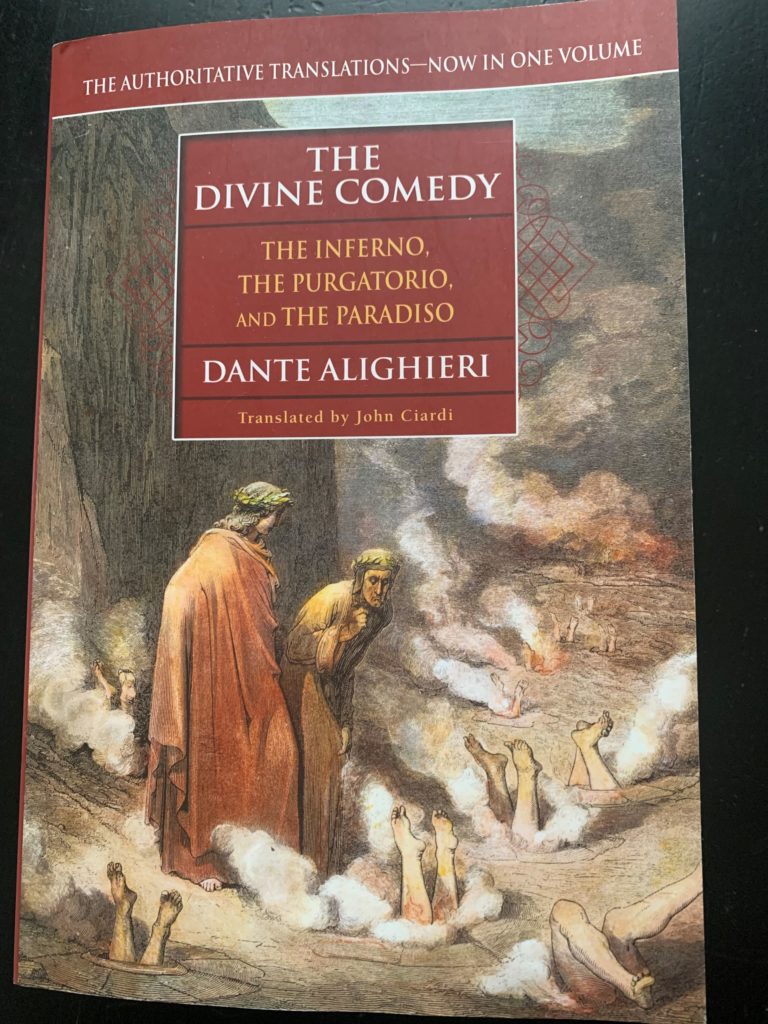
January 12, 2024 – The Divine Comedy, Inferno, Canto I-II

Now I have gone a done it. I picked something so ambitious that I don’t know where to start. In case you are not familiar, The Devine Comedy was written in the late 1200s, set in 1300. Of course, it was written in Italian which means it was translated into English for me. Because of it’s age, it has been looked at over and over again and so there is lots of opinions about what it says and what it means.

I have read part 1 (The Inferno) before. All three of these are poems which contain much symbology making it not only abstract but also highly subjective to the translators vision. I find myself reading and re-reading because I don’t know what is exactly happening. My version is huge, it seems like half of it are notes as to what this or that is referring to or why they chose this translation versus others.

My purpose for picking this book was to spend more time talking about eternity and Devine topics more critically. For instance, I don’t particularly believe Purgatory, it will be interesting to see what Dante has to say about it. So far, I can already tell that it is helpful to have a good command of Roman history, mythology and Christianity because there is a lot here that I am referring to the notes to keep up.

This book is going to take a while. I plan on breaking it up into one topic at a time. Canto I and II are considered introductions to the levels of hell. So, when I get to the first level, that will be a week unto its own. I don’t know the book well enough to say what each week will be yet, but maybe I can do it as I go along. That being said, feel free to read ahead.

Because things are so cryptic, I am going to look at other sources while we go along. Normally, I don’t like doing that because I feel that it influences my opinion. But, in this case, it is necessary otherwise I won’t get anything out of this. If I don’t get anything, it will be pretty difficult to give anything worthwhile.

With that, Canto I and II are considered the introduction to the Inferno. Canto I has Dante entering the afterlife met by Virgil, the Roman poet. It has been speculated that Virgil is at the beginning of the journey because he lived pre-Christ. Therefore in the Catholic belief, he could not attain pure heaven nor hell. Virgil will be guiding Dante through Hell and some of Purgatory.

Canto II, Virgil explains that he was instructed by Beatrice to deliver three prayers to Dante because of concern for his love life. In case you don’t know who Beatrice is, she is the love of Dante’s life but married to another so he can’t have her. I had to look her up too, confused yet? Because of Dante, she was a semi-famous subject for nineteenth century art, but more of an inspiration to the story.

Virgil sort of lays out the land of how things are going to go including getting past the leopard of malice and fraud, the lion of violence and ambition and the she-wolf of incontinence. Now we have some foreshadowing for the hierarchical levels of hell too. If you thought like I did, hmm the worst sin is to poop all over the place. I had to think about that wording a little stronger. Actually the first definition in Webster is a the state of being incontinent. And the definition of incontinent contains 1) lacking self-restraint 2) not being under control.

We might imagine all types of sin that fall into that category. In broad strokes or my interpretation is non-violent crime, followed by violent crime and then sadistic, evil acts. All that is of course subject to the lens of the period. We will wait and see what this actually translates to in the book.

My book offers a summary before each Canto. In the summary, it claims that Dante and Virgil are symbols for human reason while Beatrice is the representing Devine love. It also talks about the levels being recognition of sin for hell, the reunification of sin for purgatory and then finally heaven. Even though I don’t hold those Catholic beliefs, I can sort of see the value of clearing them out of your existence before heaven. It is like the twelve step program, you have to attempt to make amends before you can be free yourself.

Let me cut to the chase here. If we believe everything about the symbols, then this is God telling Dante to figure it out. Use your human brain to understand eternity and I will use the most attractive bait I can find to persuade you. And so, we begin The Devine Comedy by Dante Alighieri.

End Your Programming Routine: This was and will be hard. With the advent of modified beliefs and 750 years, we will see if we can learn the same lessons that Dante did. I do not believe that humanity or behavior has changed significantly since that time but our interpretation or judgement may have. Next week will be Canto III and IV,

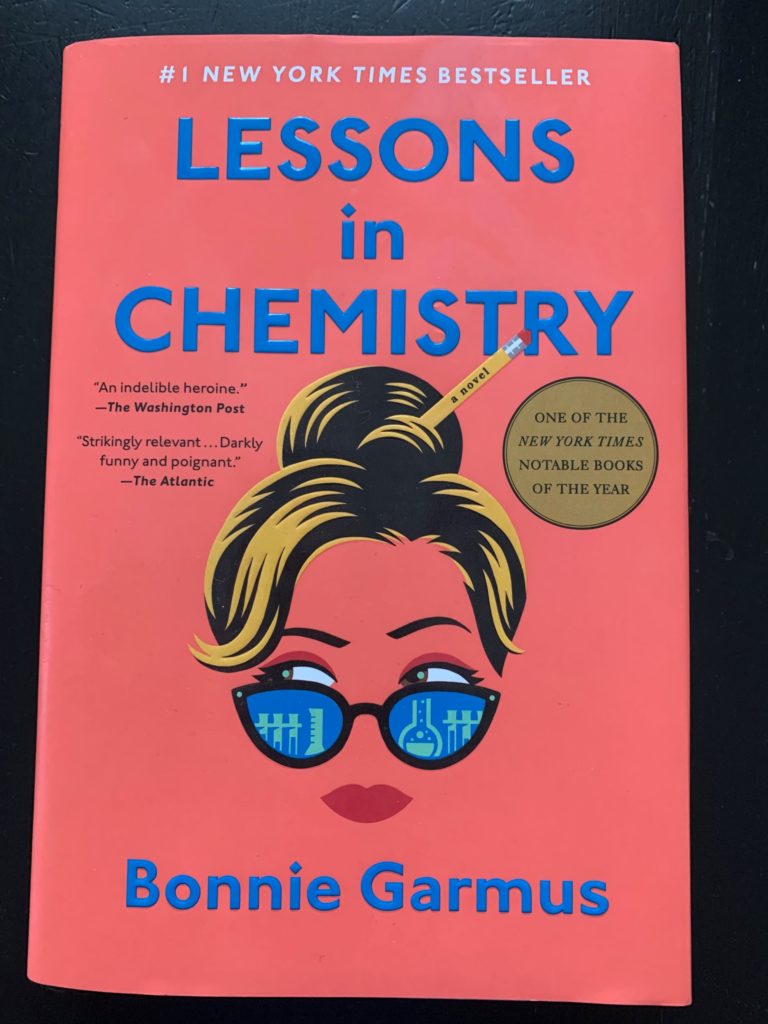
January 5, 2024 – Lessons In Chemistry

For once, I am ahead of the game. It helped that I took some time off during Christmas to do things like read. Lessons in Chemistry by Bonnie Garmus was the January Left Coast Culinary Book Club selection. I think that I would also be remised that if I didn’t say that this is not the normal Friday book review. I will talk later about what is happening next week.

This is not the typical type of book that we have been reading. For the last five years, it has been cookbooks and memoirs. We are not going to abandon those completely but lighten things up dispersing genre related fiction. This one you might say loosely relates to food as the main character Elizabeth Zott hosts a TV show about cooking.

This was one of the hottest books of 2023. It was the most checked out in the New York Public Library. It was the number one download in audiobooks and a New York Times bestseller. Of course I have never heard of it, but it was suggested by one of the book club members. It is safe to say that this is on the leading edge of trendy fiction last year.

There is a lot to say about this book. The plot has some things very familiar to me as well as things I know nothing about. It is set in the 1950s and 1960s about a woman who is in a man’s world in many ways. She is a chemist (something I know a little about) trying to be taken seriously in a science which I could imagine.

Elizabeth is a bit of a dichotomy. She wants to make waves in research but refuses to play the game in order for her to compete or gain respect for that matter. I am certainly not excusing wrong doing or even pretend that I totally understand the mindset of the 1950s because I wasn’t there. I was born post women’s revolution and a child of the 1980s, Women were always in the workforce, including a very few chemists.

I do have a bit of an Elizabeth streak in me too. Maybe it is a chemist thing, but sometimes you get a bit of right is right and it doesn’t matter what the consequences are. That attitude is not without its drawbacks however. I think that the trick is to deploy that tactic at the proper time. It is really hard to do and something that Elizabeth really doesn’t master either.

The major theme of the book to me is women’s rights. In my class of ten or so graduates, I think two of them were women. So, I have been watching the small tidal change of females in STEM for the last thirty years. What I am seeing is the shift of the sex demographic in higher education. The numbers are overwhelmingly female at all higher education institutions so it eventually has to trickle into the male dominated fields at some point.

I enjoyed the book. I suspect that if it had not been set in chemistry, maybe I wouldn’t have as much. It has that Mississippi Burning kind of appeal to it. The injustice is so strong that you root for the character to get vengeance. I suppose that I never gave it a thought about what life would be like for a woman in the 1950s trying to make a go of science in the academic world.

I have never read a work of fiction where chemistry played such a major role. I am also saying that I never really read Michael Creighton, so maybe that would qualify my statement a little. But, the Back to the Future/Weird Science/Honey I Shrunk the Kids type of portrayal is much more common way to put science out of reach for most people. The writers don’t understand it, so they are not going to make an attempt to make it approachable.

Heads up for next week I am starting Dante’s Devine Comedy. Dystopian fiction has kind of run it’s course for the time being. I thought that we might investigate the afterworld, not just our current one and so that is what I am picking for the next book. I have read the first third before. That is what we typically refer to as ‘Inferno’ and talks about the layers of hell and their corresponding sins. I am trying to figure out exactly how to break it down at the moment.

End Your Programming Routine: There is a good reason that this book was so popular last year. It is a fresh subject and a new approach to mystery. It reminds me a little of an alternate Julia Child plot. She shares many of the traits of Elizabeth with a little more worldly acumen. The story line kind of follows a similar arc but you can read that for yourself.

December 29, 2023 – Slaughterhouse – Five, Conclusion

This is the end friends, for the book and the year. The reason that I got turned on to this book was I was looking at reading lists related to 1984 and Fahrenheit 451. Most of the books that I have been working on for the last two years have been on that list. This one, I can see that it is a very distant cousin at best.

It’s not that I didn’t enjoy the book, I certainly did. It is just that the book wasn’t what I expected. The truth is that I didn’t really know what to expect. Or maybe more specifically, I expected it to be more dystopian that it was. This was an acid trip on the horrors of war.

I enjoyed the dark humor and satire throughout the book. It reminded me a lot of “Hitchhiker’s Guide to the Universe” but set in a more historical setting. I guess I don’t follow the alien encounters interlaced throughout the book. If I were to hazard a guess, I would say it was either to lighten up the darkness or make the whole story of war a farce. I am not sure which.

The main character Billy Pilgrim is made out to be a buffoon. In many ways, it was hard to empathize with him. The only thing that really changes this is that many of the other characters are even more dislikable. The sci-fi author Trout is a two-bit hustler, Billy’s wife Valencia is a glutton, most of the different soldiers were blood lustful jerks as examples. It makes the hapless Billy much more likeable compared to everyone else he encounters.

Does this book fit into the AltF4 reading list? I am gong to say no if you are following along. I would say that if this is the first book you read with me, then maybe. As far as it goes with changing your programming, you should already know that I am pretty anti-war. Even if we give World War II a pass as a ‘just’ war, it more than likely wouldn’t have happened without our meddling.

You had Churchill begging the US to get involved. You had the neutral US running arms and ammunition to the allies while at the same time embargoing raw materials to imperial Japan. And Hitler’s rise to power was a direct result of the World War I settlement and punitive policies that the US was instrumental in codifying. Sure, the Nazis were disgusting but they were only following our lead on our progressive, eugenics ideas. Using hindsight, who didn’t think that we were going to get involved?

Ever seen the movie where the bully antagonizes someone until they get fed-up and strike? We are the bully. Let me be clear, this is not what the book is about but the time to fight is actually before we get to the fight, not when we get in theater. It is too late by that point and then we have Billy’s account.

Now that we know what the book is not about, let me give a quick opinion on what I think about the book. Many pundits think that this is Vonnegut’s view of war through his personal experience. I can buy that. Kurt is Billy and arrives to the scene by what he feels as unprepared. As the “F’n New Guy”, not only is he scared and unprepared but also not battle hardened. So, everything that he sees seems revolting, including all of the people that he meets that are tempered by war. This is exemplified by the war winding down and people acting out of anger making things seem more senseless than in the context of battle.

I liken this book to all the flashbacks that Kurt sees as the result of PTSD. Whether he really had that or not, he probably had seemingly unrelated triggers bringing him back to those horrible days in the war. Truthfully, I think that a movie like “Platoon” does a better job transcribing the horrors to the uninitiated than this book. But the book is not so depressing and a lot more humorous than “Platoon”.

End Your Programming Routine: “Slaughterhouse – Five” does not make the AltF4 reading list. But, after reading it, I am more interested in more of Vonnegut’s work. There is nothing wrong reading a recognized author for entertainment. It just doesn’t quite bring the punch of foreshadowing deceptiveness as many of the other titles I have read in this vein. It is only the lens that I am evaluating the work that causes this opinion. “Slaughterhouse – Five” is a unique book with a good message that entertains along the way.

December 22, 2023 – Slaughterhouse – Five, Chapters 7-10

We have reached the end of another book. This was a different sort of book then the ones I have been reading in this series. I would say that it is the lightest of all of them but before I get carried away with the totality of the work, today I am going to focus on the last four chapters.

Here is a quick section summary of these chapters. There is a crash of the plane full of optometrists in Vermont. Billy was the only survivor. Then the bombing actually happens. Billy’s wife Valencia dies of carbon monoxide poisoning on her way to visit Billy in the hospital. The war ends for Billy as the Germans flee the Russians

I am struggling to perform a linear read a chapter, note the theme and then write about it. So much so that I went to read what other people was saying about the chapters. The story jumps around so much that it is hard to draw any sort of direct correlation to a strong point.

Some of the analysis I read talked about things like Tralfamadorian theory and drawing analogies to Einstein with four dimensions (X, Y, Z plus time). There was also the very strong antiwar theme, that one seems obvious and is the one that I would pick overall. There is also a bunch of symbolism that is pretty heavily abstracted.

For instance, on analysis I read said that the bird at the end represents the nonsensical-ness of war. I suppose that because the bird is the last thing written and not a character in the book, then maybe I could buy that it does mean something. But there were other speculations where Billy’s hatred of the barbershop quartet was related to the faces of the singers versus the faces of the Germans when they first saw the destruction of Dresden. Have you ever seen the ‘Gilmore Girls’? The show is annoying enough but then when you have the random barbershop quartet interlude into your conversation, it is downright obnoxious. In my experience, a barbershop quartet can be wonderful or downright inappropriate.

I missed this when I read the previous chapter block, the significance of the title. Before I read the book, I made an assumption was the title was going to be something like five individuals participated in some sort of urban firefight. As it turns out, the title is actually the POW’s address. This comes up several times in Billy’s delusional dreams as he goes back and forth between being in the war and other random events in his life.

End Your Programming Routine: I am struggling to find meaningful, consistent themes so I am going to cut it here. I definitely have more to say next week and I don’t think I will be so blasé. Distinguishing a very non-linear story with a specific portion of the book makes it hard to pick appropriate anecdotes. So it goes.

December 15, 2023 – Slaughterhouse – Five, Chapters 4-6

Here we go trucking along, one more week before the end of the book. I am still enjoying this psychedelic trip into the mind of a WWII vet. Even after all this book is supposed to be about, the prisoners of war finally arrive at Dresden at the very end of chapter six. So lets do a quick plot summary.

We have a whole diatribe where Billy goes on a long distance trip with aliens. After being shown off in a zoo like an animal, he is flashed back to being in a mental institution to a honeymoon night to a prisoner of war. Finally, in chapter six is all about his war comrades and their personal delusions.

I am getting the sense from reading different analyses of this book that there is more inferred than is written. There are strong biblical references combined with alien references as well as the horrors of war. If all of this is to be believed, then this thing has more dimensions than the Twilight Zone. I am going to reserve stating my opinion for after the book but you literary types can interpret this as foreshadowing.

I am not feeling it today. I am not sure what I think yet, but one thing that does drive me crazy is trying to make something out of nothing. And I am saying that I have nothing so far. I remember from my school days how we would spend the entire hour trying to force all of this innuendo into books that we would read. I am going to resist the urge to do that at this moment.

End Your Programming Routine: For this reason, we will consider this week a check-in. This isn’t the first week I have felt this way, but it is the first week that I realized that I am approaching that point of trying to force something. With that, I hope that you are enjoying the book as I am.

December 8, 2023 – Slaughterhouse – Five, Chapters 1-3

I am making decent progress on this book. To me, it seems like a change of pace that is an easy read. That is probably because I am missing all of the significance enjoying this story.

Kurt Vonnegut was an author of the ‘Greatest Generation’. He served in the heart of the World War II years and was part of some of the infamous battles is Europe like D-Day and the Battle of the Bulge. It is no wonder that war has a strong pull to his work. This is my first exposure to Vonnegut and the way things are going I will be back for more.

The story’s main character is a man named Billy Pilgrim. He seems to be an enigma of a person surrounded by luck. So, for instance he marries into money and becomes a highly successful business owner with investments in the medical field as well as franchises such as hotels. Meanwhile, it seems like he can barely function in a day to day capacity.

I don’t know this for a fact, but the story seems to be written as a PTSD description or possibly mental illness. I haven’t read this book of the same genre but Electric Kool-Aid Acid Test by Tom Wolf and trying to describe what taking LSD feels like seems like how this book is structured. There are many horrific events that are described as time flashes forward and backward each event triggering a new anecdote of the story.

I can see why Vonnegut is labeled a humorist of satirist. So far, there is a lot of death in the book. Each time a death is written about, he uses the phrase ‘so it goes’. But, to make it more comical, he even uses the phrase out of context. As an example, when he is describing dead (flat) water, so it goes. A lot of serious and absurd situations are delivered deadpan and matter of fact.

As of yet, I haven’t determined anything in line with my typical concepts in these three chapters. I was reading a quote by Vonnegut and he said about this book the book is nonsensical because there is nothing valuable to learn about mass extermination. This is why people have labelled Vonnegut as a strong antiwar voice.

I could add one more thing this week. The supposed subject of this book is the firebombing of Dresden Germany. As of yet, Vonnegut has not really written about it. Billy is trying to write a book about the event but has a hard time getting his war buddy’s to talk about it. So let’s focus on that.

The firebombing of Dresden has two opinions. The first is that this was a campaign to eliminate resources the Nazis were using to continue fighting the war. The other side contends that this was a punitive attack. It is true that these were valuable, soft targets but it is also true that most of the damage was not military but civilian. I know that it is a very thin line between military and civilian when they are building war material. The opposition side contends that it was unnecessary because it was only a matter of time before Germany gave up.

I suspect that this anti-bombing opinion has gotten ahold of Vonnegut. Later in the book he starts to reveal more, including his own opinions as a result of the observation of the campaign. You will have to wait until next week for more of that stuff. Just like I talked about Wednesday, it just isn’t fair and when something unfair happens, you want vengeance.

End Your Programming Routine: Don’t think for a minute that you cannot substitute Japan for Germany. We were going to do whatever we had to to ensure that we were going to make them pay as well. The difference between our story and theirs is that it is very rarely brought up that a neutral country (USA) had cut off Japan from raw materials and built weapons and munitions for the Allies. There is no way I can condone the actions of our opponents but don’t think they didn’t have some shoving to get there.

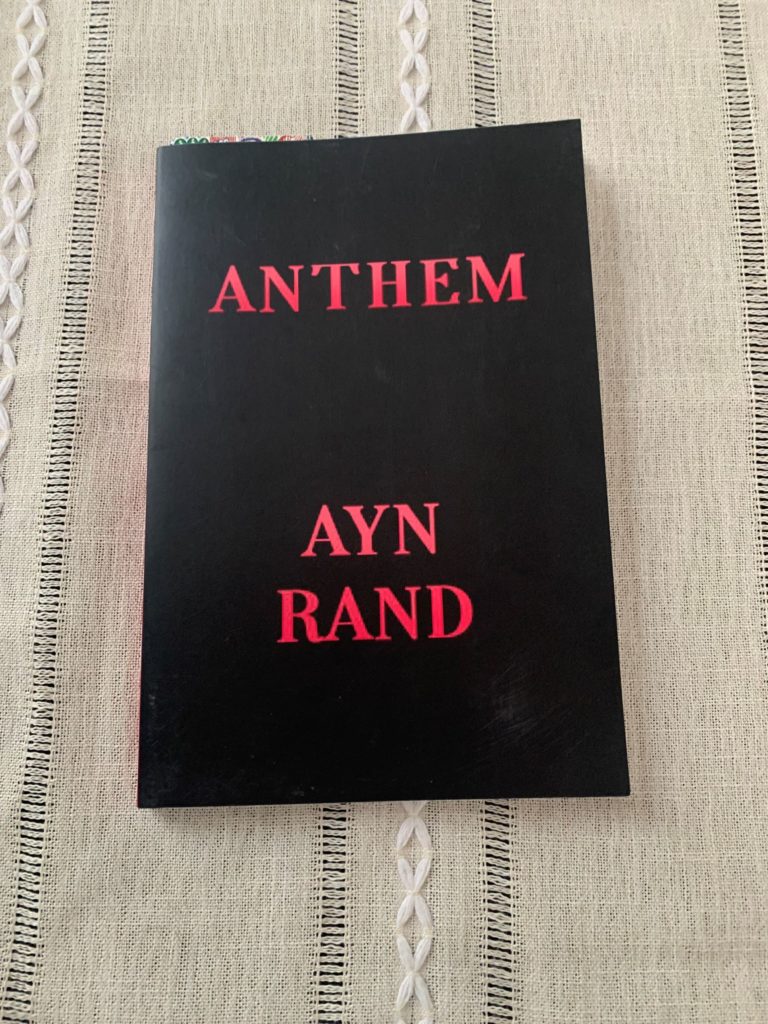
December 1, 2023 – Anthem, Conclusion

I probably could have written this conclusion last week. I kept moving ideas and sentences into this post because I thought that they were too broad for just analyzing the last three chapters. But, I wasn’t totally ready to move on so here we are.

It should be clear that I am a fan of Rand’s work and the Objectivist movement. This books is a short and concise version of the very same message in Atlas Shrugged. Even some of the same phrasing was used. I felt like I was reading an abridged version or even a chapter of Atlas Shrugged, some of those were pretty long.

What to say about this book? I think that I will use a series of comparisons to do that. I would say that if you have never read or don’t know Rand, read this book first. If it turns out that you like the message, then move on to Atlas Shrugged. I kind of feel like I invested so much time into Atlas Shrugged that this was just a re-run of that story and message.

If I look at Anthem versus We, both had their idiosyncrasies. I think that the Anthem story was easier to follow minus the third person, plural language. I know that was done deliberately but I definitely found myself having to re-read things multiple times because I got sucked into this ‘who else is in this conversation?’ mode. By contrast, We often had gaps in the story line that left me guessing at what is actually happening.

I suppose that the reader needs to employ suspended animation for any of these dystopian stories. For me, it is not the flying cars or talking animals but the little things. For instance the source of the energy for the lightbulb in this book or the perfectly furnished home that exists in the middle of the forest that the character stumbles on for happily ever after that bothers me. My mind can take a leap to the non-existent but I have a hard time with the unbelievable.

Ultimately, I have to rank this below Atlas Shrugged. But I suspect that if circumstances would have been different, it would have been the other way. If you recall that review, I felt that book was way too long. It is not the length of the book per se that I mark it down, just the fact that it is the same story and the little nuances that didn’t seem to be in Atlas Shrugged. Maybe Fountainhead will be just right?

End Your Programming Routine: Let me bottom line this. If you have read Atlas Shrugged, skip this book. If you had read nothing from Rand, definitely read this book for the Objectivist point of view. Looking ahead to next week the book is going to be “Slaughterhouse Five” by Kurt Vonnegut. I have tentatively planned to cover two chapters a week. So get reading…

November 24, 2023 – Anthem, Part 10-12

As I announced in the podcast Monday, I am no longer going to have an introductory post for my Friday reviews maybe I should do away with the conclusion post as well. Not today however. I am going to keep it this way for now, It is just that the last three chapters are only about 20 short pages.

We now that Equality 7-2521 and Liberty 5-3000 have found an empty, yet inhabitable house in the middle of the woods. As a result of reading different books they decide to rename themselves “Prometheus” and “Gaea”. Furthermore, they go through more self-exploration and hatch a plan go back to the city and bring their friends back to the woods and start life over.

Those familiar with Rand would definitely identify the concepts in Part 12. It sounded like a carbon copy of the values espoused in Atlas Shrugged. Man should live for themselves, fight for what they have, collectivism is evil, etc. You know that I buy into all those things and I respect Rand for being so upfront with this as well. In fact, good on her for being consistent and deliberate in her beliefs.

The only thing that I really don’t necessarily agree with is the the last couple of sentences. (Spoiler Alert) “The word which can never die on this earth, for the heart of it, and the meaning and the glory. The sacred word: Ego”. This is Prometheus’ belief as the key to humanity and happiness. I don’t agree with Rand on this.

Of course, I have had my own struggles with happiness but if I could have it my way it would be the ability to pursue your passion. I suppose that it may be whether you take the Freud position or the first definition. I cannot say. 1) The self, especially as distinct from the world and other selves. 2) In Psychoanalysis, the division of the psyche that is conscious, most immediately controls thought and behavior and is most in touch with external reality.

I am getting all kinds of curmudgeonly lately in my reviews. I like Prometheus’ spirit here but have you considered how difficult it is to persuade brainwashed people to take a leap of faith that is 180 degrees of their whole lives. Just like his naivete with the light bulb, to think he is going to march into the lion’s den and covert a bunch of his friends unscathed seems pretty far out.

I think another flag is the house itself. I am pretty sure whatever conflict that occurred was well before the lives of Gaea and Prometheus. Time and weather is not kind to structures and material goods. There is reference to cloth that disintegrated but most things were perfectly serviceable.

I have a thing for this, but have you seen picture of the Sarajevo Olympic grounds from the 1980s? There are trees growing through the venues. Granted the characters are only twenty at most, but I think it is fantasy to think that they are going to find perfectly preserved shelters and live happily ever after. I think it would be more like the tunnels from earlier in the book minus the active electrical power.

So, I am already bordering on next weeks analysis of the book overall. It’s hard to believe that given all of the superstition and primitive technology, that there would be any risk of the former state coming after them or even find them let alone defeat or subjugate them.

End Your Programming Routine: There is a quote that I like from Jack Spirko. “Never attribute to malice that can be explained by incompetence”. I will let you noodle that out but it basically puts a dagger in a lot of conspiracy theories. I am not saying that the candlemakers are bumbling idiots, but they may not be the scholars that they proport.

November 21, 2023 – Review: Kitchens of the Great Midwest

Kitchens of the Great Midwest by J. Ryan Stradal is the November selection of the Left Coast Culinary Book Club. I have to say that I didn’t have high hopes for this book but it ended better than I had expected. The reason that I say that is because one of Stradal other works, The Lager Queens of New York was a book read by my wife’s other book club that also reads romance books with shirtless firemen and lumberjacks.

The story is a bit disjointed and it took most of the book to weave together. Each chapter has a culinary experience loosely happening with or around the main character Eva Thorvald. Some chapters she is the focus while others she just makes an appearance. I don’t think I have ever read a book that had the main character portrayed in this style.

Ultimately, this is a rags to riches story. Eva suffers personal tragedy and social trauma throughout her young life. As the chapters progress, so does her age and the book covers roughly 25 years in just over 300 pages. Many of the supporting characters vary from gritty to psychotic and the all the while Eva keeps on moving forward.

I was listening to a podcast recently about the structure of SEAL training. What the former instructor was saying was that the premise was pretty simple. It wasn’t necessarily what they testing but how. They wanted to wash out people that were going to give up when the circumstances were not fair. He said many people could handle the physical part, it was the seemingly ruthless and unwarranted punishment that they couldn’t take. I think that it is fair to say that Eva Thorvald is a SEAL of the culinary world.

The story was interesting because it wasn’t a feelgood one. There were self-absorbed, idiot chefs as well a characters getting addicted to pain pills. I found myself asking ‘what is going to be this fool’s malady’? Fortunately, we only had to put up with the bad characters for a chapter. The good ones seemed to make cameo appearances throughout the book.

My overall opinion of this book is really clouded by one thing and that was the over the top extravagance of Eva’s career and life as the book moves on. Honestly, I think that this book would have been better and more believable if they would have toned down her success a little. I will give an example, Eva hosted a dinner where all the diners had to repel down a cliff to get to the table.

Maybe I am just a fuddy duddy but this sounds like cheesy, Mission Impossible stuff. I realize that most people don’t buy into that, but it definitely kind of soured the book for me. I am already kind of on the fence with haute cuisine the ostentatious descriptions but add James Bond to it and it is too much.

I think that you will like this book if you like food and fantasy. I don’t mean the Game of Thrones kind but more like the Cinderella kind. It’s hard to tell if Eva is a exotic beauty or a sasquatch by the different character’s descriptions. I will say that after all of the heartache, it is nice to know that perseverance and humility is rewarded, even if it is unbelievable.

End Your Programming Routine: It’s nice to step away from cookbooks and ‘chef-y’ memoirs, even if they are not necessarily my cup of tea. I am willing to give Stradal another chance because of his approach to stories. I can’t say that I knew where this story was going based on the disjointedness of the book. I didn’t hate it, I just didn’t like it.

November 17, 2023 – Anthem, Part 7-9

These three chapters are the heart of the book. I suppose it is serendipitous that I chose to break the book up in this way. So, let’s get into it.

Chapter seven begins with Equality 7-2521 marching into the World Counsel of Scholars with his lightbulb. It went exactly how I expected that it would. In fear for his life, Equality escapes the city into the forest where he is sure no one will ever come after him. After surviving the night, he understands that he will never be able to return. The next day, who shows up in the woods out of the blue but the Golden One. Apparently, she has pretty good tracking ability.

It is pretty easy pickings to figure out what to talk about with this session. It is the sunk cost fallacy and the Council of Scholars. First of all, to be in the conversation you have to be part of the group. “A Street Sweeper! A Street Sweeper walking in upon the World Counsel of Scholars! It is not to be believed! It is against all the rules and all the laws!”. The first level of security is only having conversations with those initiated and approved.

There is now a closed feedback loop for any ideas. Once Equality connected the lightbulb, now there was sheer terror in the room. For some unknown reason, the light scared the scholars. But, then the next tool that is used is the power play. “How dare you think that your mind held greater wisdom than the mind of your brothers? And if the Councils had decreed that you should be a Street Sweeper, how dared you think that you could be of greater use to men than sweeping the street?”

Oh, but why? “Then it would bring ruin to the Department of Candles. The candle is a great boon to mankind, as approved by all men. Therefore it cannot be destroyed by the whim of one man.” So, this is the real problem. I don’t know if they were shocked that someone found something that they were not supposed to or that they were scared of the technology, both are possible.

How many times have we seen something surpassed by better technology? Using the automobile, it is clear that the 2023 version is highly superior (in most aspects) to the 1963 version. I can state this empirically because looking at studies, the average age of a vehicle on the road is 12 years old. In 1963, vehicles were lucky to make it to 100,000 miles. In fact, some vehicles in the 1970s were lucky to survive more than a handful of years.

On the other hand, how many times have we seen government prevent innovation by doing things for our own good. Let us just use the minimum square footage building requirement. This is strictly to protect tax base. Look at old houses that are one bedroom and one bathroom. The way this is effecting innovation is that it is not rewarding good design. It is also wastes resources via utilities, heating, cooling and lighting unused space. I don’t think that we suffer from houses that are too small, we suffer from poorly designed houses. If there is limitless space, there is no incentive to build better structures from an ergonomics standpoint.

Finally, there are forces in the industrial military complex that desperately want to replace the A-10. But, then there are greater forces that do not see the need. Why replace something that does the job effectively. This is the final insight, money of course. If something perpetually did the job and did it well, it negatively impacts someone’s ability to profit on the change. But then again, there is always the opposite perspective of someone supporting the status quo.

End Your Programming Routine: I am resisting the urge to jump ahead since I have already finished the book at this point. But, I am controlling myself. I don’t really understand the fear of the woods outside of the city. I don’t rationalize how they travel or even have a network of other cities if they are so contained to the space. But, I guess those are questions that won’t get answered. For now, I will settle on fighting the status quo head to head is bound to be nearly impossible.