Category: Review

March 15, 2024 – The Divine Comedy, Inferno, Canto XXXII – XXXIV

Finally, we made it to the bottom and it is only uphill from here. Interestingly enough, hell is frozen rather than flame filled. I suppose to me, it is fitting. I find cold to be worse than heat any day. Especially when we are talking true pain, cold is much more painful. Heat makes me lethargic and maybe even moody, but not painful like cold.

Deadliest catch is on right now. They talk about -30 degrees with the wind blowing and all wet. I honestly don’t think I can do that. I remember taking shifts at the Christmas tree lot. I was bundled up and sitting in front of a space heater to have my feet numb from the cold. I guess that is why I work in front of a computer all day.
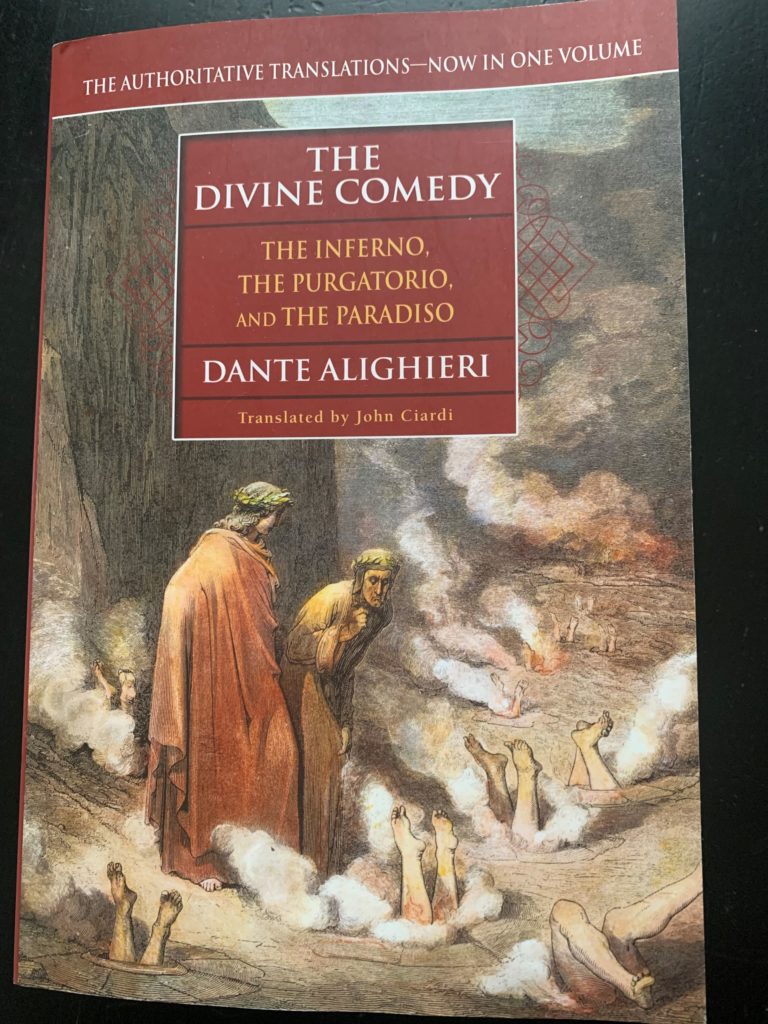
It turns out that the worst level of hell is the compound fraudsters. To be one hundred percent honest I didn’t see a lot of difference between what happened on other levels and this one. Dante talks about several occurrences of a character that lures a group of individuals to dinner and then kills them all.

I guess to me, luring them to death and killing them isn’t any different than stabbing them in the back when they aren’t looking. I guess you had to be there. In the three levels of circle nine, each of the characters were a bit more frozen. In level one, the characters are frozen up to the neck. In the second level, their heads are frozen face down. I the third level, they are completely encased into the ice.

On the second level, there was a long story about a man and his sons who were imprisoned and ultimately starved to death. The father and the captor were frozen close enough whereby the father could bite the captor, a nod to his starvation. I am not sure the sins of the father to be honest but for some reason this situation drew a lot of condemnation from Dante.

Satan is where you would expect, at the very bottom. Here is out look at him. Satan is frozen solid. He has three faces, Judas, Brutus and Cassius (more on that in a minute). He has wings and is hairy.

I find the three faces of Satan very interesting. Judas’ face is flanked on either side by Cassius and Brutus. These were two senators involved in the plot to assassinate Julius Caesar. As an Italian, I suppose Dante’s Roman history was in his blood so to speak. That being said, In this era of city states I wonder about Dante’s affinity for Rome. It would be like us Americans reminiscing about King George III or something.

I think that I have to take issue with Judas. First of all, I understand that Judas betrayed Jesus. That being said, without the crucifixion of Jesus, we would not have redemption. I would say his actions were fundamental to Christianity. Second, Jesus know he was going to be betrayed by Judas, it was all part of the plan.

Allegedly, the devil was a fallen angel that fell into disfavor with god. As a matter of fact, the original serpent from Genesis was the devil. Therefore, I say Satan predates the beginning of man and earth. So, I guess that I am going to disagree with Dante on the theology of the devil.

In order to leave hell, Dante and Virgil have to crawl over and down the Devil. Apparently, there is a hole underneath him that straddles Hell and Purgatory. When they cross over, it is described as going from night to day. The hole apparently goes through the center of the earth hence the difference in daylight.

End Your Programming Routine: I am happy to to be moving on. It is depressing to spend life in Hell. I appreciate the ice setting and the gruesome torture. I have no idea what to expect in purgatory. I am definitely going to have words to say when I wrap up next week. So, I will save it for then.

March 12, 2024 – Convoy

There were some pretty campy movies in the 1970s. Believe it or not, I don’t think Convoy was one of them. Yes, it has some cheesy action and some CB jibber, jabber and the plot was a little thin, but the subplot was subversively amazing. In fact, so good that I don’t think they even realized what they had done.

Convoy was a movie released in 1978 based on the song by CW McCall in 1974. The embedded video is a modified version of the original song which is the opening of the movie. The movie stars Kris Kristofferson as a truck driver who inadvertently leads a group of trucks on a convoy that is essentially trying to escape a dirty sheriff.

This movie is currently playing on Pluto. If you have internet access, then you can also watch the movie for free. My wife was gone for the weekend and I turned this on while I was cooking in the kitchen. I soon found that I was too invested in the story that I needed to finish it.

The night before, I was watching James Caan as The Gambler (1974). I fell asleep before the movie was over so I wanted to watch the last twenty minutes. I saw that Convoy was coming up next. As a fan of The Dukes of Hazzard and Smokey and the Bandit, I figured I was going to like this and I wasn’t dissapointed.

I am not a trucker and I don’t know any. I really don’t get what a convoy actually does other than it is pretty menacing seeing a whole line of trucks bearing down on you. But, I think this movie has inspired a genre of protest whereby truckers impede goods movement or traffic. The last, most famous one in recent memory was the Canadian trucker strike of 2022 over requiring vaccinations for Covid-19.

Known by the CB handle ‘Rubber Duck’ (Kristofferson) or more commonly Duck, realizes that the only way out of his predicament is by driving to Mexico. This draws a lot of support from close by truckers who join up in the convoy. This in turn creates a regional sensation with the public. Remember, we only had three TV stations in those days.

What makes this movie great is that the New Mexico governor tries to coopt the public sentiment and support for the truckers into helping his campaign for senate. There it is, the ugly gold nugget. The people were largely oblivious as they are involved in the party of it all. Meanwhile, Duck and the other truckers could see right through it. There was a lot of political babble from the governor about feeling the pain and taking action with the people.

This is the where we stand. As an example, as soon as the politicians took hold of the tea party, it died. A leader has to be ambivalent of the details and aloof of the results to be effective. We used to call that integrity or doing the right thing for the right reasons. When you have a stake in the results, now all of the sudden the purity of the movement is compromised and the absolutism of right and wrong become subjective. As long as we have lessor of two evils as our choices, it will never work.

End Your Programming Routine: Look beyond some of the antics, this is a great movie. As a matter of fact, there was a time when people believed that legal didn’t equate to right. It took me a long time to get there, but I am here now. Sure, maybe there were other problems around like equality but we are quickly becoming equal slaves.

March 8, 2024 – The Divine Comedy, Inferno, Canto XVIII – XXXI

We did it! This week was a slog. I had hours and hours into reading and re-reading to try and keep up with the continuity and understand what was happening. Thank goodness for the summary before each Canto started because in some cases, I wouldn’t know what was happening.

Sometimes I read the text and then I go back to the summary and wonder, how in the world did the author come to that conclusion based on what I read? Lost in translation I guess. In this section in particular, there were numerous notes saying ‘this isn’t exactly how it was written and here is the exact translation. This didn’t make sense, so I translated it as such…’.

I appreciate that actually. While maybe not the version of the text that we would want to use for research, I appreciate someone taking the initiative of this is more in the spirit of what is going on. As long as it is noted in places that were modified, we are free to form our own opinion by reading middle age Italian :).

This section is over 100 pages in my book, so I am not going to be able to go too deep into all the sins. What was noted by the translator and I have come to enjoy is the punishment is related to the crime. For instance the grafters were perpetually submerged in boiling pitch. The pitch represents the sticky hands in the living world. The thieves morph back and forth between reptilian figures because people who steal are snakes.

I think when I look at this section in the light of modern terms, I have to think that there is too many divisions of sin in hell. We have the Simoniacs (which I had to look up the definition) who are people that used their position to sell influence. As you would expect, this was largely church administrators and politicians. Then you have the Hypocrites who do one thing and say another. But the worse of them all is the Falsifiers. Honestly, I have a hard time distinguishing one sin from the other, they all seem intertwined to me.

Speaking of Falsifiers, there were three distinct categories with the worst of the worse being the Alchemist. Maybe as a scientist I don’t see a big deal. I theorize that alchemy was a crime against nature and therefore a crime against god. I also suppose that maybe they were considered cheats which clearly holds more wrath than crimes of passion in Dante’s time. But really, alchemy is one of the worst crimes known to man?

This section more than any has a lot of obscure references. To date there has been a lot of Greek and Roman mythology that I have struggled with. The characters are slightly familiar but their back story is basically a blank to me. Many of the previous levels are heavily referenced in those common stories. In this level, there are so many interactions with contemporaries that it makes it really hard to follow. It paints a picture that as Dante’s wrath goes, so do the characters that he perceived wronged him get more detailed and deeper in hell.

I can understand that, I fact I think that it is brilliant. I am going to write a comedy making fun of my enemies. The more angry I am at them, the worse their situation is going to be in the story. All the while, I am not committing any actual sin because it is art, fiction, its entertainment. The only problem is that if you are 700 years removed from Florence, it is hard to get the jokes.

Next week, I will be finishing The Inferno. We are about to find out who is going to be at the same scale as the devil. The following week, I am going to an analysis of the Inferno and then we will be into Purgatory and ascending toward Heaven for the remainder of the book. So, after this very heavy week of reading, things are going to get a lot easier and then a break.

End Your Programming Routine: What I take away from this week is that this is clearly a story of Dante using a heavenly setting, not a heavenly story with contemporary characters. The latter reason was why I started down this journey in the first place, but I am committed now so we are going to find out who Dante holds next to the Devil and who is next to God. It definitely will effect my final opinion and recommendation of the Devine Comedy, but it is nice to know.

March 5, 2024 – Review: The Boys In The Boat

“The boys in the hood are always hard. Come talking that trash they pull your card…” Remember that song? Well, the boys in the boat are also pretty hard. Coming of age in the Great Depression and participating in grueling work-outs in terrible weather kind of makes my bones chill. You might have seen the movie, I haven’t yet but it is on my shortlist just to complete this story.

The Boys in the Boat by Daniel James Brown is a non-fiction story about the University of Washington crew team striving for 1936 Olympic gold. It is more or less focused on a couple of people. Al Ulbrickson is the Washington coach, George Pocock is a boat builder and unofficial consultant and rower Joe Rantz from birth to winning the gold medal in 1936.

Joe is the book’s major character. He had an amazing and heartbreaking, hardscrabble upbringing. The death of his mother and the cold shoulder of his step mother left him alone in his high school years. It is impressive that despite the cruelty of the period, Joe was able to hustle to the point that he could get into the university and stay there.

The first third of the book was the history of the three primary characters. The second half of the book was the ebb and flow of the crew team. Finally, the last fifteen percent or so was the Olympic tribulations. An interesting aspect of the book was the parallel Nazi story where the Olympics were used to deceive the rest of the world of the building evil. Short anecdotes were added about the propaganda setup that was part of the effort.

This was a book that I got for Christmas. It came as a a recommendation from a friend of my mom. I had no idea that there was a coming movie or that this story was becoming a phenomenon. Since I read almost everything put in front of me, I went ahead and dove into the book. That being said, I will offer my analysis now.

Since I haven’t seen the movie, I am going to have to speculate here. Usually I am a book over movie person. That may be because I usually read the book long before seeing the movie. I have to wonder in this case if this is a movie before the book. The reason I say this is because the book is wildly detailed. This is a long, almost 400 page story for the quest. I suspect that the same effect could have been achieved at half the volume of words.

I really enjoyed the backstory of Joe Rantz. The following chapters of the ups and downs of the crew seasons and constitution of the team got quite nuanced and drawn out. While the title is Boys in the Boat, there really was not much back story or focus on any of the other boys other than Joe. I think if I was the editor, I would have refocused the entire story, including the title on Joe.

While I found the Nazi component intriguing, this comes off as a thinly cloaked, pro-USA propaganda story of its own. We have the Germans giving their own team the best lane while the pure grit Americans win despite being put at a disadvantage proving that we were the divinely favored ones.

Was the story worth the effort? I would have to say that if you are a UW fan, a rower or a non-specific history buff then yes, but otherwise no. The human interest is really in the character Joe Rantz and the amazing feats that he did to survive and thrive. It is hard to understand the perspective of the privileged Yale, Harvard or Cornell versus hoping to eat daily Washington team. So, it is a common man triumph that could get the same effect in a novelette or magazine article.

About five years ago, my sister got her PhD from University of Washington. On that day, we walked down to Lake Washington and walked right next to the very boathouse that still remains. My brother-in-law pointed out the cut and the basic layout of the area. I had no idea that there was a story there or that one day I would see a picture in a book of that very building.

End Your Programming Routine: I was instantly drawn in to the first picture of the boathouse. I stayed interested in the early life of Joe. Once the book got into the grind of the journey, I lost a lot of enthusiasm for the rest of the story. It has an exciting ending with a photo finish but you could look that up. This is a story that doesn’t have enough meat to read the whole book. No disrespect to Mr Brown, I think it was meticulously researched by evidence of its length. My suggestion is to reformat the story to the title ‘A Boy in the Boat’.

March 1, 2024 – The Divine Comedy, Inferno, Canto XII – XVII

On to level seven. It took me around two hours to read this section despite the fact that it was around twenty pages. I read, then I read the footnotes, then I read again and wonder if I am getting anything out of this. This finally seems like we are going the right direction. But still when I look ahead, I wonder if this is actually put in the right order. Let’s talk about what is here.

The seventh level contains three different types of ‘violence’. In my translation it is said the first one is violence against neighbors. That is violence as we would expect; people killing people. These were souls stuck in a river of boiling blood presumably at the depth to the level of their quantity of violence. Here we see Alexander the Great and Attila the Hun as examples.

The second area was violence against self. These were people that committed suicide. Their spirits were implanted into thorny trees that ravaged daily by furies who rip off branches causing more pain. In essence, they never escape the self torture in death that was suffered in life.

The third area had two different categories. One was violence against nature which translates more colloquially as homosexuality and bestiality. The second area was violence against art which I don’t totally get. It is said to be usury or predatory lending. The first part were souls stuck on a burning sand desert that also rained flaming ashes. The second was perched on a ledge on the way down to level eight.

There were several things that I found puzzling. The first is using a modern lens, the payday lender is bigger sinner than a mass murderer? I would imagine that we would see Adolf Hitler in the river with Atilla the Hun. Usury is a subjective evaluation in my opinion. What one person thinks is a rip-off may be fine for another. We of course have laws about the maximum amount of interest that is permissible but I find those rates to be usury myself. But, from the information I have seen, those are voluntary and satisfactory interactions.

We don’t really see usury in this society. I imagine that institutions like the mafia or gangs may fit the bill since they play in that arena. I really don’t know many details about what is common. But then again, there are probably other sins that they are also committing. Maybe you had to be there?

The second thing that I found challenging was that after level after level of surface level interactions Dante found a lot of comrades on the sand. In this epic about sin and Dante having his day, there is little evidence that these people were out in the open. Apparently Dante had several deep, admirable relationships with the specters he met here and it makes you wonder if this was really the condemnation that we are led to believe. In some interactions, there is clear animosity over perceived wrongs. So maybe Dante is a criminal against nature?

Finally, the notes in the book on individuals on suicide did not actually indicate suicide. Maybe more like reckless behavior. There were people that were killed in battle and there were mythology figures that were killed by poison as examples. But the text clearly references that it was suicidal thoughts and behaviors regardless of whether the history proves it correct.

I think that it is worth noting that we are talking about something that was written in the early 14th century. They didn’t have the internet to instantly fact check information and maybe they didn’t even have written records to reference. I think that it is somewhat forgivable to have some of the facts mixed up. But it is difficult to fully understand intent when the facts and the story don’t quite line up.

Reading this section is like reading the “Dungeon Master’s Guide”. If you ever saw the first printings of this, it was mostly an encyclopedia of monsters. I don’t have a copy anymore but I am pretty sure everything that we are running across in this story was catalogued in there.

To do another serious reading of this story, it would be worth boning up on Greek, Roman and Egyptian mythology. The back story of the characters that Dante sees and interacts with plays a significant role in the innuendo of the story. I am getting some of it from the footnotes as I read along, but I am certainly struggling to swim in the name stew of mythological characters. I am a lot better with the monsters.

Be warned, next week is a long one. Cantos 18-31 comprise level eight. As I look at the story, this will be the longest stretch in the entire book analysis. To me, this indicates the significance to Dante. Of course, more on all of that next week.

End Your Programming Routine: Maybe it was finally getting to some identifiable sins or maybe it was getting into more than one or two Cantos that I liked this section. Despite the fact that I struggle with his categorization, the penalties and creatures were captivating. The notes indicate that Dante may have been in the Franciscan order at one point, but I am really impressed at how much he knows about mythology. Before the age of enlightenment, Dante is an impressive character.

February 23, 2024 – The Divine Comedy, Inferno, Canto IX – XI

This week we are at Circle six. In this level, which is the first of the three inner hell circles and we will see the heretics. I could certainly see why they made it to hell, I almost wonder why it is only level six rather than nine. Is there a bigger sin than actually denouncing god? I guess not, according to Dante.

In Canto IX, Dante and Virgil wait at the gates of Dis to go deeper into hell. The gates are guarded by furies who summon Medusa to attempt to turn them into stone. Virgil responds with a prayer whereby an angel comes and thwarts Medusa and the furies, letting them in.

Canto X takes place once inside the walls. This is a rolling landscape packed full of tombs. Some of them are ‘active’ or open. Out pops someone named Farinata who was a political enemy instrumental in kicking Dante out of Florence. There were several interactions in this Canto. The last Canto wraps up their walk through circle six and a peak into circle seven.

Despite the fact that this was three times the length as we have typically looked at so far, there is about the same amount of information coming out. One or two surface level conversations with an enemy of Dante or someone that he holds in low regard. A chance to put his digs in and make fun of these people.

Is there a difference between heretic and agnostic and atheist? I have to say that Dante thinks so and I agree as well. The term atheist was not around in the 1300s and so they didn’t make it but let’s take a look a the terms themselves. An atheist is someone that does not agree that there is a god. An agnostic differs slightly in that they are potentially open to god but have not seen proof. Whereas a heretic is someone that believes in god but against the doctrine of religion.

This all could be a little confusing but let us just say a heretic would attend church but also believe in ritual sacrifice of Judaism as an example. The new covenant, as the belief in Jesus and resurrection says that there is no longer an intermediary between the believer and god, it was the priest who was sustained by these sacrifices. The priest was the only person allowed behind the veil (or curtain). Going behind the veil was the only permitted way to communicate with god. So, in those days the proxy of god was the priest. This would be practicing contrary to accepted Christian beliefs.

Agnostic and atheist are more subtle in difference. The two terms are sometimes confused by people that don’t have command of the vocabulary. You have to wonder if level one (the pre-Christians) also contains the agnostics? And do the atheists live with the heretics in level 6 or are both in here? I suspect that in those days, it was not safe to proclaim that a person didn’t possess faith.

Again, this is a work of fiction and there has been a lot of water under the bridge since the 1300s. And so, my interpretation and standards I feel differ significantly from the days of Dante. I think about things like the witch trials, I suppose that was a crime of heresy. Interestingly enough that (at least so far) there has been zero interaction with unknown culture. Think about all of the Chinese people that have existed and none of them have been seen in hell to date. I am starting to develop an opinion on The Inferno, which I will share in the wrap-up in about a month.

One thing that kind of puzzles me still is why the tomb sharing? What is the relationship of the tomb to the spirits that reside in them? It was probably convenience of the story more than anything but it is still a mystery to me. I also wonder if Dante is just lucky or do these spirits seek him out? I seems pretty serendipitous that everywhere he goes, he runs into familiar specters.

End Your Programming Routine: I found it interesting that a pre-Christian condemned to hell could pray and summon an angel. That seems spiritually inconsistent. That is what this story is turning out to be. When I read this in high school, I got none of the subtle nuance nor the in depth background of the story. This is a whole new perspective on the Inferno for me. Next week, Canto XII – XVII.

February 16, 2024 – The Divine Comedy, Inferno, Canto VIII

This canto also covers some of two circles. Once again I am going to focus on the one of them, circle five the wrathful and sullen. Circle six will cover several cantos so we can cover that adequately next week. Don’t forget that this circle officially began last canto, but don’t worry I will cover it here.

It wasn’t just my imagination but reading the notes for this canto said that the last chapter was a change in philosophy. It is speculated that Dante took a break at Canto VII and that it was intended to be one circle per canto. But that break brought out a re-imagination about how the story was going to go. As a consequence, I am rolling with it. Next week will be three cantos for the first time.

There isn’t too much going on from this level. The setting is the river Styx. The condemned seem to be under the black and stinky water. Once again there was only one encounter, a fella by the name of Fillipo Argenti. He was apparently an argent enemy of Dante’s.

If you ask me, it seems like Dante was the wrathful in the story. Dante is using his writing as the vengeance that he seeks. Very little is said other than sharply condemns his enemy. So, I guess we will have to look at the crime (or end it here).

I think we all generally know what wrathful means. So let us look at sullen. The definition that I see for for the word means gloomily or resentfully silent or repressed. I rhetorically ask, is this really worthy of the fifth circle of hell? To date, the crimes have all been pretty petty to get into hell.

Apparently, level six is a transition from what is considered outer to inner hell. To get into inner hell, it is all contained in iron wall like a prison called the city of Dis. Another thing that I kind of find interesting is that most of these so called sins to date would not be considered crimes in our society. No assault or rape or murder, maybe those will be in the inner circle but even theft or larceny? Once again, the wrathful one seems like Dante.

I am not totally sure where to really go with this today other than it is very clear that this story is personal to Dante. So I am giving you an early weekend this week. The pace is going to pickup next week and go into hyperdrive for the following week. Get ready.

End Your Programming Routine: Like a good Christian, I believe in redemption. So, it would be a good idea for my soul not to get involved in too much wrathfulness or sullenness or gluttony or any of the other sins. That being said, if we do slip into any of those things, I can’t help but be thankful that something is out there to help out eternity.

February 9, 2024 – The Divine Comedy, Inferno, Canto VII

Today we are on the fourth circle of hell. Interestingly enough, this Canto contains the fourth circle and some of the fifth. I considered covering both but then in Canto VIII it covers the fifth and sixth circles. So, we will cover the fifth next week since the sixth overlaps multiple Cantos thereafter.

When I think about it, I understand that this story is written in a formula. Each Canto is approximately the same number of lines composed of equally divided stanzas. Each layer of the the afterworld contains nearly the same number of Cantos. Since this book seems largely a social commentary, I surmise that this fourth level of hell Dante didn’t have that much to say about it and hence he combined the levels so that the story would work with the formula.

The fourth circle is interesting from the fact that it is two opposite factions pitted against one another. If you think about it, the opposite of hoarding is wasting and vice versa. It would seem as though extremes in either direction warrant an afterlife in the fourth circle according to Dante. He describes the situation that they are like two gangs, pitted against each other like they are going to brawl. Being that this is a political commentary, I find it interesting that the only constituents mentioned were clergy and church officials in this realm. I will focus in on this a little bit for now.

In today’s vernacular, it seems like hoarders are also wasters. They can’t seem to move beyond all of their possessions including garbage. And so things that have value get lost or spoil in the trash. This definition is not the strict definition of hoarding however. Hoarding is taking what you can, because you can. Just like wasting is letting something degrade because you can.

Both of this positions seem to have a personal initiative component. The term waster has a clear visible effect whereas hoarder is more subjective. A lot of people like to equate people that prepare as hoarders when I believe nothing is farther from the truth. These are people that use the time of plenty to prepare for the time without. In a season of surplus, anyone with the means can purchase, make, etc. If you look at the perspective that way, anyone that preserves a garden or purchases a whole beef would be a hoarder. They are not going to eat it all in a couple days time, but it is necessary to take advantage of when it available.

As history gets exposed, it is becoming more clear that the clergy was a home for a lot of deviants and sociopaths. If you think about the middle ages where this story was written, the church was one of the few outlets to leave of peasantry. I imagine that upward mobility combined with sociopathy lead to a lot of hoarding and wasting. It is literally the holier than thou syndrome.

End Your Programming Routine: By no means is this intended to disrespect the clergy. But, the fact remains that a some people in that profession were not living to their core values. By all accounts, Dante was middle class and it also seems like he was on the losing side of a political conflict. It seems pretty likely that he might have an ax to grind with those who were probably doing wrong.

February 8, 2024 – The Joy Luck Club

The Joy Luck Club by Amy Tan is the February Left Coast Culinary Book Club selection. This was Tan’s first published work and it has been around 30 years. There was also a popular-ish movie based on the book in 1993. I remember the title distinctly but I never saw it.

The book is termed fiction, but Tan said that it was loosely based on her life’s experience. It is structed in four parts with four chapters. There are 8 characters four women and four daughters. The story bounces around with the first section being the stories of the young moms and the next section of the young daughters. Then it is old women and grown up daughters.

I don’t know if I mentioned this or not but I am now the head of the book club. I have decided to nudge the club in a slightly new direction. I am breaking the direct coupling between the the books and the food. Half the members don’t read the book anyway and part of them don’t make recipes or food from the book either. I really wanted to have some kind of Chinese New Year dinner. I may have been able to find some kind of cookbook or something but I wanted to loosen the book affiliation more.

It is often hard to find a relevant book to fit the theme of dinner or vice versa for that matter. The group voted on the book but I suggested it. I did some internet searches for novels with Chinese food. I am sad to say that there was not that much in the way of food but that is OK. I really don’t want to read technical manuals all the time either.

I cant say too much about the story because it really wasn’t cohesive. It was basically 16 anecdotes. They were really only related because all the mothers were part of the social group Joy Luck Club or it was the mother daughter story. I have to say that I really didn’t find this story that enjoyable.

I found Joy Luck Club to be manic and disjointed. It reminded me of the TV show Gilmore Girls with emotional bickering and little resolution with each sub story other than they loved each other. The book ended with a stronger want to know this Chinese component of the inner soul but the entire story did little to help it get there.

My wife has not read the book yet. I have a feeling that she will like the book because I think women would probably identify with the struggles and dynamics. Additionally, I suspect that people of Chinese descent might like because there just aren’t that many written, familiar stories. Of course, these are just speculations on my part.

My opinion is to pass on this one. I get it that it is literature and that I do not appreciate the subtlety and nuance being a white male. For that reason, I guess I would simply say that I don’t identify with the characters or the story. It doesn’t mean that the story is worthless, just does not resonate with me.

End Your Programming Routine: I read almost anything that comes across my path. It is interesting that since I have been reviewing books, I have definitely become more discriminating in my opinions. It is the activity of thinking about what I like and didn’t that has developed that skill. I noticed that acutely with my dystopian reviews lately. So, the lesson is that you have to focus on objective qualities to refine your opinions. Even with that, just because I didn’t like something doesn’t make me right, just my thoughts.

February 2, 2024 – The Divine Comedy, Inferno, Canto VI

From pagans to the lustful and now gluttons, Dante has descended to the third level of hell. This canto seems surprisingly thin. There is only one name mentioned, a contemporary of Dante and a person of seemingly insignificance by the judgement of history. I will delve in the best I can without a ton of context to carry me through.

There were three things that stuck out to me in this Canto. The first is the description of the level. Fetid, putrid, stinking and rotting were adjectives that were used. The first thought that came to mind was that it smelled like vomit here. Seems kind of fitting considering the crime.

The second and more cerebral notion that I noticed was with Dante’s conversation with Ciacco. My book has almost as many footnotes and explanations as it does actual text. The translator’s note on this was that because Ciacco was condemned, he had no further hope. Therefore, he was very interested that the current living world still remembered him and he had a legacy there. It was his only chance of living on.

Finally, there was mention of a second judgement. All beings would be returned to flesh and have a second evaluation. I am assuming that this is the famous rapture predicted in Revelations. My church and Christian understanding was limited to judgement in the living world by the second coming of Christ. The represents a new perspective for me but I maybe I should go back and re-evaluate what I thought I knew. I don’t see why not but by the same token, I am not sure if the outcome would be any different.

To peel the next layer of the onion, I want to look at the premise a little harder. What exactly is gluttony? The Webster’s definition is excessive eating or drinking. That is exactly what I thought before I looked it up. I have always considered it a temporal activity so what does it take to get to the third level of Hell with the sin of gluttony?

We could probably agree that drinking yourself to death would be gluttony. But, if the ultimate cause of death is liver failure or diabetes and yet the user stopped six months beforehand is this still gluttony? The Christian track would say that if you asked for forgiveness in the last six months, probably not.

Alcohol poisoning or overdose I wouldn’t always think apply either. Even though they are death by excess, they may not contain the chronic aspect of substance abuse. We were all young once and if you are reading this, fortunately we survived potentially risky behavior. Some unfortunately do not, is ignorance a sin as well?

What about drugs? They are not food nor drink yet I feel like they probably fit into this category in many cases. But does gluttony have to be consensual? I find it hard to believe that someone is addicted to Cheetos but then again, it is not the particular brand but possibly the chemical composition that causes the problem.

From what I have read and heard, the body becomes addicted to carbohydrates. This bio-chemical mechanism was a survival adaptation from long ago. When plants were offering fruits, the human body would consume it to the point of adding fat. That fat would help weather the leaner times. In this time of always in season, Cheetos are no longer seasonal nor do we have the wax and wain of what is possible.

The epidemic of diabetes in this country is nothing short of gargantuan. Between solicitous marketing and government/industry collusion (that is fascism by the way), they have created it. I consider myself pretty well educated and even I don’t know the whole truth. In my opinion, it is best to error on the side of whole foods and ignore all the other advice. But, there are sure a lot of people that don’t know (or won’t) to get out of their own way so to expect them to make a good and proper change is nearly impossible.

I am not holier than thou. I eat junk food sometimes, I even eat fast food sometimes. I try not to stock it in the pantry and I try to partake in moderation. I am overweight and I know that is largely from too many calories and not enough physical exertion. So, am I a glutton? I guess we will see if this is what leads to my death.

Gluttony in Dante’s time is probably different than now. First of all, there wasn’t a lot of food for many people to get fat or have chronic health conditions of excess. They were more likely to go the other way, malnutrition from lack of food. Fairness, while subjective is born into our psyche. If the rich are taking and getting fat while everyone else is barely getting by, I can see the class warfare gearing up. Also, Christianity teaches sharing and caring for the less fortunate.

End Your Programming Routine: I do think there is something here, I just am not convinced that it is as simple as eating or drinking too much. I do think that there is a chronic component, there is also probably doing it at the expense of others as well. Based on the side text, this level of hell is likely as political as it is a sin. I think that this is probably why it is titled, ‘The Divine Comedy’.