I know that it hasn’t been the most direct path, however we have gotten to the end. This week I have finished Surprised by Joy. That means if you are reading along, then you are done as well. The plan is to cover the last five chapters this week and then go over a total review next week.
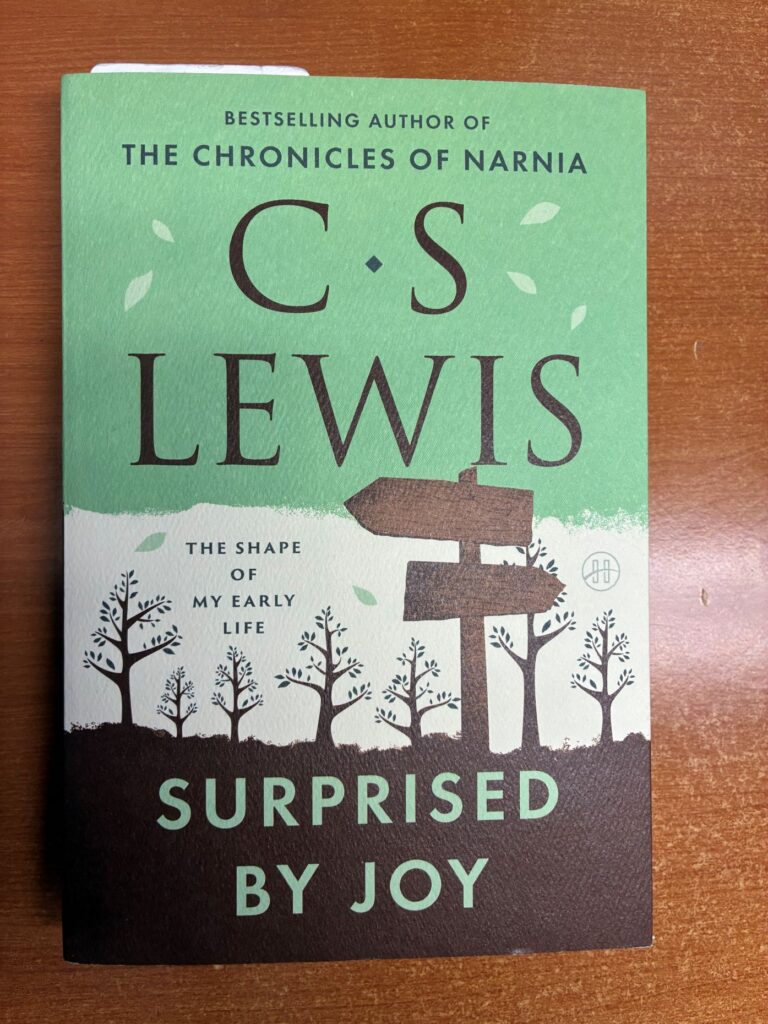
If I could say anything about this week, I would say that this is my favorite third of the book. Not only did we get the details of Lewis’s conversion but the subject manner was more than dry, ancient authors, titles and fantasy land. You have a bit of a war story, introductions to the likes of J.R.R. Tolkien and the final, happy conclusion.
I will save my overall opinion for next week. We will focus on the subject matter on hand. Here is a brief summary of the final five chapters. Last week we ended in what I would call high school in today’s parlance. We begin there again. There is one thing that I noticed in chapter 11 and that is kind of a change in tone. It is still primarily reading literature and poetry but an internal struggle seems to crop up. That struggle is the difference between fate and faith.
I think many non-Christians can relate to this. How can God be good and all powerful and yet bad things happen especially to good and faithful people? You hear that as a criticism to faith. That is a question that everyone has to wrestle with but I tend to side on the side of fatalism. I cannot diagnose any situation other than my own but I tend to look at it more like ‘your mission is done’. We cant see the future and only the individuals knows all of the details about their past. What may appear to be upstanding could only be a shell. I simply do not know.
Of course there are all kinds of nuances. Babies cannot be shells, right? Agreed, but it could be that death of an infant spurs some kind of reaction like starting a foundation or a sibling becomes a doctor or researcher. I simply cannot say the impact outside of the obvious ones.
From there, Lewis enlists in the Army and is eventually shipped off to the front in World War I. There is surprisingly little written about this time. It seems that this experience is so polarizing in those that have survived but it really does not seem to make much of an impact in Lewis’s life. I would characterize his attitude as ambivalent and certainly not galvanizing.
After getting wounded and subsequently discharged from the army he starts his life again, now at Oxford. The next chapters cover his life and changing attitudes as they are shaped by that experience. For example, Lewis starts to notice that Christian authors have more depth to their stories. And for that reason it starts to persuade Lewis that he needs to change his path.
I find this a little strange actually. I am not aware of many author’s religion but I cannot say that Lewis or Tolkien stories are any deeper than a lot of the fantasy I have read in my life. One reason that I stopped reading that genre is that I found it incredibly convoluted and nonsensical. Sure, I can suspend belief that magic can happen but when it comes to names, characters and events without definition or context, I simply kind of glaze over.
Another strange behavior is that Lewis admits to attending church without actually believing. I think in most cases, people lose their faith while attending church but never have I heard the other direction. The sensibility of it all is irrational. I shouldn’t have to explain that but dedicating time to something that has no significance is simply not what people do.
In the last chapter, Lewis describes that he doesn’t really know how it happened. Somehow throughout this process he became a Christian. Lewis’s description is Atheist to Theist to Christian. As a result, here is my synopsis of the book title. Joy is a synonym for faith and belief. The whole title is about being surprised to find faith despite the path to get there.
End Your Programming Routine: I would say the ending is a bit of a letdown. Based on how I started this post and where I am at, I bet that you can guess how I am going to come down next week. As evangelists, it makes no matter on how you come to faith but I find it hard to believe that reading literature written by Christians that would make it so. In fact, this might be the only documented case. Then again, people emulate those that they admire. Does that make genuine faith? I am not here to tear down Lewis. He most likely has done more good in his work. It is just that the story seems so improbable.
Recent Comments