Tag: Chapter 6

April 3, 2026 – Surprised By Joy, Chapters 6-10

I certainly can appreciate that C.S. Lewis is a famous and respected mind in the field of Christian thought. I also admire his desire to take on the philosophical debate about the existence of God. Talk about using your power for greater purposes. But, I have to say, the more I read this book the more that I am ready to move on. If I was not doing this series, I probably would quit the book. That is not somethings I never say.

I went to grade school in the 1980s. When we had some sort of media day, we looked forward to it with great zeal. Remember screens only came into the classroom a couple times a year. I remember that in fourth grade we were watching a rented VHS video. It was something about a boy and a seal. We got about ten minutes into the movie and the kid cussed a couple of times. I think he said something like ‘shit’. The teacher immediately turned the movie off and media day was over.

It made no difference how disappointed we were, movie time was over. The teacher deemed the whole thing unworthy because of a couple of bad words. I am not going to say that I would have made a different decision if I was the teacher. But, I am here to say that I had heard swear words before. It was the loss of what could have been that was more significant.

There is some bad stuff in this book. I am not necessarily ready to throw the baby out with the bathwater, C.S. Lewis that is. However, I what I am learning is that I am getting to the point that I don’t really care. I find myself drifting off while reading because I am not following all of the technical details. Before I started reading this book, I was expecting that there was going to be some kind of epiphany or Devine moment that we could all benefit from.

I applaud Lewis for being candid. I can understand that any victim of sexual assault would turn away from God. School sounds a lot like what I imagine prison to be like. A rigid hierarchy of status and expectations followed by a lifestyle of debauchery. Things are starting to change and we have to take Lewis at face value but it seems like getting lost in fictional la la land is not something I would prescribe to fix his situation.

Part of my attitude relates to my complete and utter inability to relate to the situation. Early on in the book, there was references to literature that either I read or at least was aware of. As the book goes on, those touch points become more frequent and more obscure. Lewis switches context between fantasy and reality using characters and plot lines that make it very difficult to follow.

On top of fading in and out of reality, there is this school hierarchy affectionately called ‘fagging’. I am aware that there are alternate definitions of the word fag but I can certainly see where today’s most common connotation has it’s origin. It is absolute adherence to to the made (typically older) boy having other’s as subservient, regardless of the ask or outcome. Today we would most likely equate fagging to slavery.

The concept is also distinctly un-American. In a culture where we all believe that the opportunity to pull up our own bootstraps is valued, having servants or slaves or at least not having our own autonomy is not relatable. I realize that this is a simplification of the situation, I also understand that this is an argument to be against the idea that God is Good. For that reason, I can see why Lewis continues in the path that he has been travelling.

Things have to change or at least I am hoping so. That is about the only hope left I have in this book. We can start to see that Lewis platonic relationship with the neighbor Arthur is leading in a more positive direction with an emphasis on more and more esoteric book titles. I say that because I have heard of a lot of them but I have no idea what the plot line is about so more fantasy time.

End Your Programming Routine: I would have to say that in the book to date, it is a wonder that Lewis came back to Christianity at all. Today, we are ultra sensitive to mental health as well as equality. I suspect that in those days, if you weren’t born into privilege then your social position was pretty static. In some ways, accepting that position is far healthier than wishing you were somewhere else and everything being someone else’s fault. We will have to stay tuned to next week for that big event.
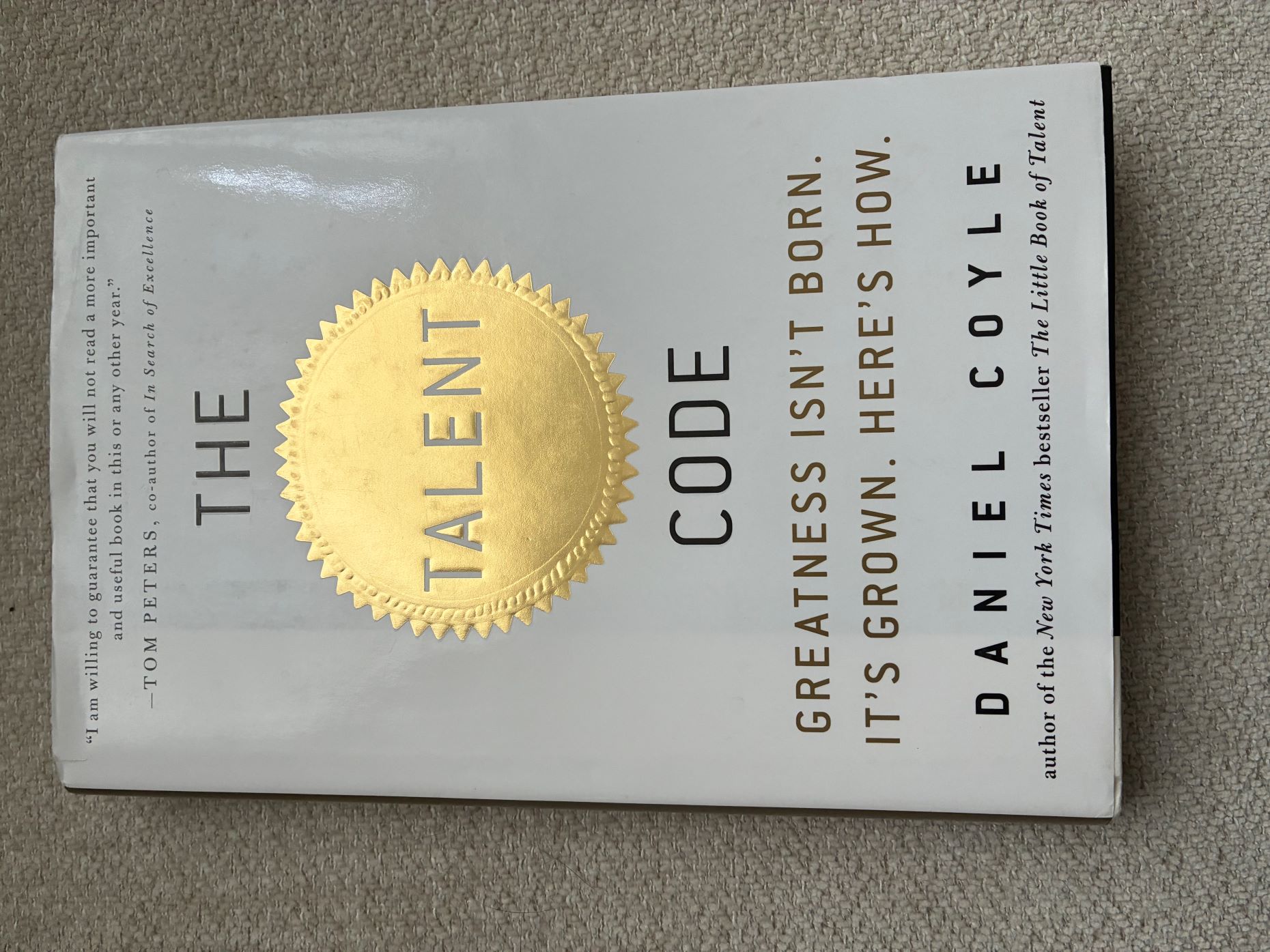
February 6, 2026 – The Talent Code: Part 2

OK, so we know that deep practice is the key to building myelin. Myelin is the key to performance. But, what is the trigger for this phenomenon. Yes, I am certain that there are cases where it is just dumb luck. I think about my own situation and areas that I perform and I didn’t get there by reading a book and then putting it into practice or going to elite academies. It was just luck. But then there are simply hotbeds that cannot be ignored.

Coyle uses the example of why there are so many Major League Baseball players from the Dominican Republic. The DR is a hotbed of baseball. I am sure that you can find that some players went to the same school or played in the same leagues. There is a phenomenon called ignition. Certain teachers, coaches possess the ability to get the best out of people. More on ignition next week.

Going back the the nature versus nurture argument, it can be said that there is some of both in high performers. Following the theory, anyone can build myelin, but some build it more intuitively. For instance, there is a high correlation to birth position and performance. The more kids in the family, the more likely the younger ones are going to naturally accelerate.

I think that we can all see why. It is the younger children that are trying to keep up with the older ones. They want to prove that they can do it too. This is the motivation for deep practice. Also a little oddly, children that lost a parent at an impressionable age also accelerate faster. I guess that they are trying finish what was started or prove that they are worthy of head of household status or something.

Hotbeds seem to be more pervasive in underprivileged areas. I suppose maybe we tend to remember them more because they are remarkable. That is really not the reason, the real reason is that people in those socioeconomic demographics tend to be more singly focused. They do not have the distractions of outside influences to take away from the ability to do deep practice.

Something that I believe is that the best primary school students, straight A’s through high school are not generally high performers. They are good citizens, probably good at their careers and probably make good incomes. But, they are not disrupters more so they are good rule followers. If you follow the rules, you will get good grades. Good grades translate into college completion and ultimately professional and monetary success.

To follow that strategy does not take deep practice. Do what you are told, play the game and you will be rewarded. It is that combination of struggle, failure and striving to master that makes up deep practice. Growing up upper middle class like I did has very little struggle. I followed the rules, got good grades and stayed out of trouble. There is nothing wrong with that but I doubt that I am going to be labeled remarkable for those things.

I wouldn’t exactly call my town a hotbed. That being said, there have been several NFL players that came out of our high school. It is a low socioeconomic level, there is relatively nothing to do and football season is anticipated and important in the community. You have all the conditions to meet the definition of hotbed.

Hotbeds of success are born of assimilation. What does the US military do? Assimilate. When you are the coach, you want a team that is selfless and mission oriented. Yes, The Dream Team clobbered the Olympic competition when they first appeared on the scene since there was such a disparity of skill. But a couple of cycles later, they found out that they could be beaten by an average team that didn’t let ego get in the way.

Assimilation breeds an attitude of us versus them. It seems to make the participants care more about the team mates which in turn causes them to put out more effort and sacrifice. Everyone would want a team of LeBron James (at his prime) but only if that means that they all are willing to contribute equally. LeBron 1 could take a contested three point shot or he could pass it to LeBron 2 who is open under the basket and will slam dunk the ball.

Michael Jordan is arguably the best basketball player of all time. He had phenomenal fifty plus point games where it seemed like he was unstoppable. However, without Scotty Pippen feeding him the ball, Jordan’s career wouldn’t be quite as stellar. He still would have been a super star, but at what level? Imagine if there were three other Scotty Pippens on the floor how much better would Jordan have looked? Pippen was no slouch himself but he was the ignition source.

End Your Programming Routine: Hotbeds themselves are born out of chance and the right environmental conditions. There is nothing saying that the source of the best baseball players couldn’t be Indonesia instead of the Dominican Republic except that it isn’t. I think what is more important is to be able to recognize the factors that play into talent. It makes it much easier to make up for those deficiencies with deep practice.

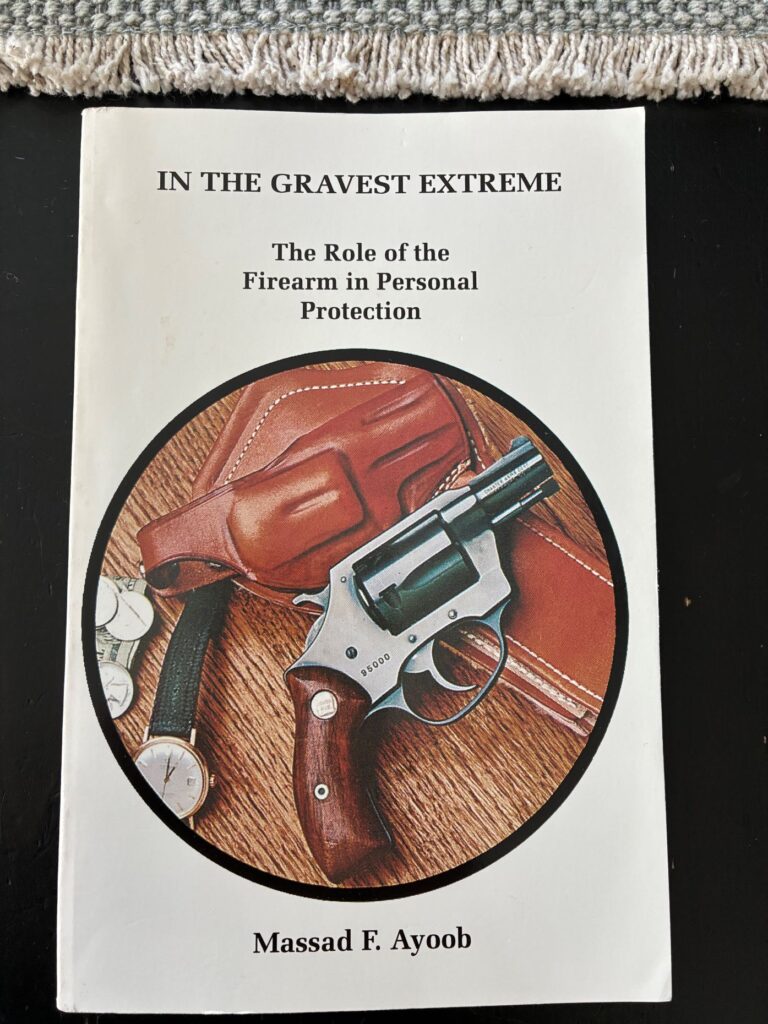
May 23, 2025 – In the Gravest Extreme: The Role of the Firearm in Personal Protection, Chapters 6-9

**Note: May 26, 2025 is a holiday. I am taking one, you should too.**

This week gets into the tactics of concealed carry. It covers the basics of where you might possibly have or use a firearm. I do think what is conspicuously missing is our interactions outside of our own business, home, street or car. We are missing things like church, restaurants, stores and all the places we might be besides the four that he talks about. That being said, we were years away from ‘shall issue’ concealed carry when this book was written. As a result, it is understandable the focus and the omission.

I never knew this but apparently, Ayoob grew up in a family business. A jewelry store to be specific. Rightly so that he was exposed to potential conflict while at the shop. I don’t know but that is possibly as risky of a proposition as being a convenience store owner operator. For most of us, I would guess that having a firearm stashed at work is probably a no go. Likely, carrying concealed would be a better proposition anyway.

My grandfather was a sole proprietor in an shady business. He was a landlord that dealt in the lower tier of renters. As such, he was robbed several times in his career during office hours. Unfortunately, they did get away with his Purple Heart awards from World War II. I would say that he could have benefitted from a gun at his office.

A gun in your home is the most likely place that it will be. While there are many people that are permitted to carry, I suspect that few will actually do it. But, having protection around at home is much more likely which is what makes going into somebody else’s home so risky. Ayoob offers what I think are reasonable tactics still today for dealing with a home invasion and family protection.

When we were living in South Carolina, I don’t think concealed carry was a legal construct. I didn’t investigate thoroughly, but I was told by many residents that it was legal to have a firearm in the glove box. I do know that was the case in other states and so I had no reason to doubt that. This has never been a practice that I have ever been comfortable with or employed.

Today in Oregon, to have a firearm in the glovebox would require you to have a concealed carried permit. Surely others will do this as well but it still doesn’t make it a good idea. I was home a few years ago when the police rang the doorbell. They said that the neighbor had a firearm stolen out of the car and wondered if we had any doorbell footage. I told him I would check and didn’t see anything.

The point being, is that leaving a firearm in the car leaves it out of your control. Run of the mill break-ins can have your property ending up in the black market. It also would be hard to reach when you really need it too. That being said, I could see putting a firearm in the car when going on a road trip or something. Where legal of course.

I know that I skipped around a little bit but the last chapter I am going to talk about is the gun in the street. Ayoob really is focused on the tactics of deploying a firearm in the streets but this is really the run of the mill concealed carry. I suspect that it is pretty sound advice but I do think that it should be taken with a grain of salt. A lot of this has changed but you do need to be aware of the term brandishing.

Brandishing is flashing a firearm with the intent of intimidation. I am more than sure Ayoob is not implying that you brandishing is a valid technique, but the wording and the way that it is written kind of, sort of seems that way. Once again, in states where that is a crime you are only legal to display a firearm when you are legal to use one. States that permit open carry typically do not have brandishing laws. The point remains that you need to know your state laws down pat.

There is a concept in this chapter that is talked about but it also comes up later in the book in a big way. That is, it is cheaper to not get in an altercation than to be in the right. I will save most of that for next week. Suffice to say, carrying a gun is a tool in the toolbox. It doesn’t mean that it is the first or best or only tool.

End Your Programming Routine: Good stuff. I keep saying that with all that has changed in this landscape, the tactics remain good and legally defensible. It helps to know and understand the history and evolution to be able to pick out the nuances and changes. Reading this book has inspired me to get the updated book that Ayoob has published because I suspect that most of what is wrong here gets corrected. It won’t be the next book but it will be soon.