Tag: Chapter 10

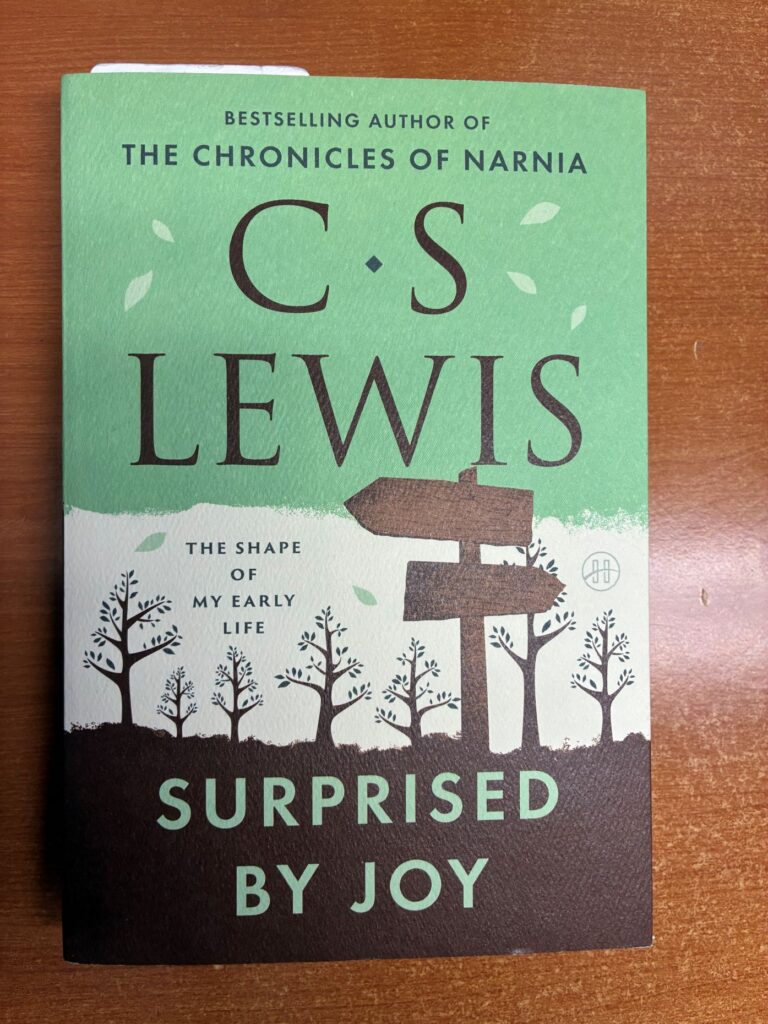
April 3, 2026 – Surprised By Joy, Chapters 6-10

I certainly can appreciate that C.S. Lewis is a famous and respected mind in the field of Christian thought. I also admire his desire to take on the philosophical debate about the existence of God. Talk about using your power for greater purposes. But, I have to say, the more I read this book the more that I am ready to move on. If I was not doing this series, I probably would quit the book. That is not somethings I never say.
I went to grade school in the 1980s. When we had some sort of media day, we looked forward to it with great zeal. Remember screens only came into the classroom a couple times a year. I remember that in fourth grade we were watching a rented VHS video. It was something about a boy and a seal. We got about ten minutes into the movie and the kid cussed a couple of times. I think he said something like ‘shit’. The teacher immediately turned the movie off and media day was over.

It made no difference how disappointed we were, movie time was over. The teacher deemed the whole thing unworthy because of a couple of bad words. I am not going to say that I would have made a different decision if I was the teacher. But, I am here to say that I had heard swear words before. It was the loss of what could have been that was more significant.

There is some bad stuff in this book. I am not necessarily ready to throw the baby out with the bathwater, C.S. Lewis that is. However, I what I am learning is that I am getting to the point that I don’t really care. I find myself drifting off while reading because I am not following all of the technical details. Before I started reading this book, I was expecting that there was going to be some kind of epiphany or Devine moment that we could all benefit from.

I applaud Lewis for being candid. I can understand that any victim of sexual assault would turn away from God. School sounds a lot like what I imagine prison to be like. A rigid hierarchy of status and expectations followed by a lifestyle of debauchery. Things are starting to change and we have to take Lewis at face value but it seems like getting lost in fictional la la land is not something I would prescribe to fix his situation.

Part of my attitude relates to my complete and utter inability to relate to the situation. Early on in the book, there was references to literature that either I read or at least was aware of. As the book goes on, those touch points become more frequent and more obscure. Lewis switches context between fantasy and reality using characters and plot lines that make it very difficult to follow.

On top of fading in and out of reality, there is this school hierarchy affectionately called ‘fagging’. I am aware that there are alternate definitions of the word fag but I can certainly see where today’s most common connotation has it’s origin. It is absolute adherence to to the made (typically older) boy having other’s as subservient, regardless of the ask or outcome. Today we would most likely equate fagging to slavery.

The concept is also distinctly un-American. In a culture where we all believe that the opportunity to pull up our own bootstraps is valued, having servants or slaves or at least not having our own autonomy is not relatable. I realize that this is a simplification of the situation, I also understand that this is an argument to be against the idea that God is Good. For that reason, I can see why Lewis continues in the path that he has been travelling.

Things have to change or at least I am hoping so. That is about the only hope left I have in this book. We can start to see that Lewis platonic relationship with the neighbor Arthur is leading in a more positive direction with an emphasis on more and more esoteric book titles. I say that because I have heard of a lot of them but I have no idea what the plot line is about so more fantasy time.

End Your Programming Routine: I would have to say that in the book to date, it is a wonder that Lewis came back to Christianity at all. Today, we are ultra sensitive to mental health as well as equality. I suspect that in those days, if you weren’t born into privilege then your social position was pretty static. In some ways, accepting that position is far healthier than wishing you were somewhere else and everything being someone else’s fault. We will have to stay tuned to next week for that big event.
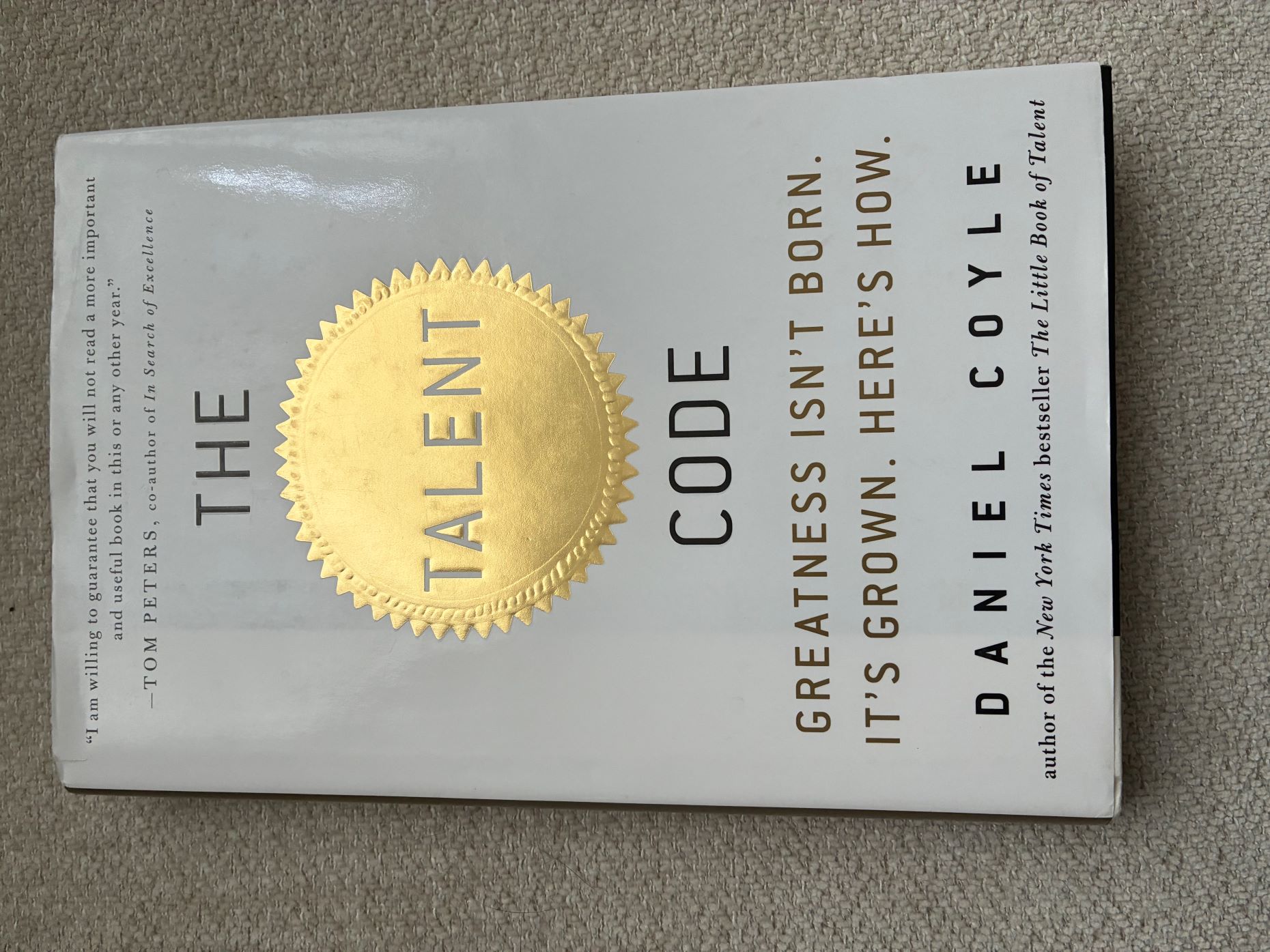
March 6, 2026 – The Talent Code: Part 3

I am sorry about this one. I should have just bit the bullet and written Part Three in a timely manner. I finished this book in early February and it was just my life getting in the way. Now, I have to go back to the time machine and try to remember what was going on in the book because now it is packed up in a box somewhere. Fortunately I took some notes weeks ago to kind of jog my memory.

Since it has been so long, I could spend a few words trying to summarize where we have been. Part One was all about how greatness is built. Part Two is about where to find talent and now Part Three is about harnessing it. Or said another way, it is coaching greatness.

I think the timing on this is pretty good. It would have been even better if I was actually writing this to come out during the Olympics like I should have. Nevertheless, I was watching one of the twenty something, American, gold medal athletes talking about how it is a dream come true and that this is what they have been working their whole life for this when it hit me. This is where this Part of the book comes to life.

Actually, what really hit me is that these athletes were enabled by choice or by circumstance. Circumstance is what the book talks about but I have to think choice is just as helpful. What I mean by choice is that a gold medal may be an athlete’s dream but it started well before this moment. The winners didn’t just show up to the Olympics and win. There was years of practice going into this moment. And to be frank, an eight year old is not getting to the mountain alone. Somebody opened the door and kept it open at least until emancipation.

OK, I was talking about the parents and not exactly the theme of today. But, coaching is what Coyle asserts as the third component of greatness. Chapter nine deals with a study of John Wooden and his habits. For those of you that weren’t around in the 1960s and 70s you don’t know how UCLA won ten of twelve championships. That is dominance.

What did Wooden do? He had two traits that were effective. The first one was that he did not treat players equally. The ones that needed riding got that treatment and the others were left alone, even if it seemed crazy. The second trait was constant but short feedback. Those two things were his keys to success.

Chapter ten was different but the same man. A good coach is able to navigate the matrix of relationships and performance. They are some how able to figure out what is important in the big organic blob called a human being. They are able to get to the root of motivation and correction. And they do it with theatrical honesty meaning that it is load and very readable.

Chapter eleven is one of those that probably would be re-written today. It was all about the (Las Vegas) Raiders evaluation of Jamarcus Russell prior to drafting him as the number one pick in 2008. I hope that they are reading this book this year as well. Russell had tremendous physical ability, it was said that he could throw a seventy yard pass on his knees with precision.

I think today we would look back and say that while there was no doubt Russell’s athleticism was unparalleled, however he was a terrible quarterback only lasting two seasons. The second of which he was benched early in the season. He had no ability to lead the team resulting in poor performance. After being dropped by the Raiders, he never played professional football again.

This book was written as that was all unfolding and I suspect that Coyle (as we all did) thought that he was going to be one of the greats. However, something so poignant was said in the book by the pro scout. Even greats need coaching. And, this is why Russell failed, coaching with the Raiders has been abysmal (mostly).

You know, you don’t have to look very far to find coaches and success. Think about who is considered one of the greatest current quarterbacks, that would be Patrick Mahommes of the Kansas City Chiefs. And yet, who is the coach, Andy Reid someone that has been perennially successful wherever he has been employed. Coincidence? I don’t really think so.

End Your Programming Routine: So, this is the book. It makes a lot of sense to me. Next week I am going to wrap up “The Talent Code”. Looking forward to what is next I am planning “Surprised By Joy” by C.S. Lewis. It seems to be a memoir from what I can surmise. I will plan to cover three chapters per week. I am relatively certain that next week is going to happen but I wouldn’t be surprised if there is a gap after that.

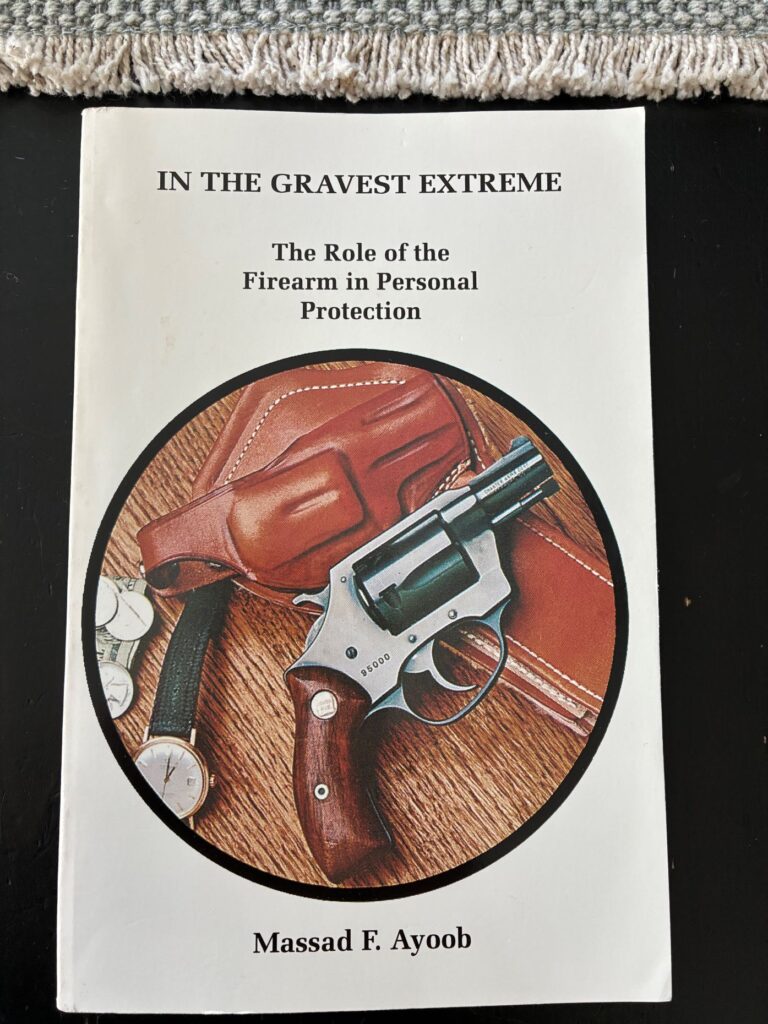
May 30, 2025 – In the Gravest Extreme: The Role of the Firearm in Personal Protection, Chapters 10-12

This week we have three chapters that are all about personal protection in action. Some anecdotes are personal while others are first hand. I will spend the majority of today’s work talking about the last one but each chapter will get a little bit of analysis at least.

Before we actually get into the specific chapters this week, I have been reading mention of the term “Super Vel”. I figured that it must be some sort of ammunition but I have never heard of it. I decided I would look into it a bit. As it turns out, Super Vel is a brand of ammunition. Based on the history (in the link), I would say that it was one of the first boutique, high performance cartridge manufacturers. Today’s equivalent would be Double Tap or Buffalo Bore. Sadly, Super Vel went out of business in 1981 right after this book was published.

The good news, a contemporary of Ayoob at Guns Magazine purchased the name and is producing Super Vel again. I have never seen it in the stores but looking around it can be purchased over the internet at what appears to be reasonable prices to me. It is 50% cheaper than the Underwood, hard cast lead .38 special I just purchased. Cool, retro packaging and story, now I know.

Chapter ten, I think is about justifying an informed choice to carry a handgun. While I am no Massad Ayoob and I do not claim to be, I don’t think that the advice is that good. What Ayoob is implying is that flashing your firearm (brandishing – see last week) can be a deterrent all on it’s own. While I believe that can be true, what if there was another assailant behind that I didn’t see. I repeat again, only show a firearm when you are justified to use it. An intimidating guy leaning against a car does not meat that standard.

There is also another phenomenon in self defense. The first person to contact the police is the victim. It would not be beneath a low life to call the police on you for flashing a firearm and all of the sudden you are arrested. Show your firearm only when you draw it. Draw it only when you are justified to use it. If you cannot shoot them on the spot, best to turn around if your are feeling intimidated.

In the next chapter, it talks about two things, discretion and competency. I made my feelings known about discretion already. As to competency, I whole heartedly agree to the concept. Some states require competency for your permit. But, going deeper than that a well placed shot beats misses every day.

When it comes to caliber or capacity, there are a lot of mall ninjas out there. The fact of the matter is that if you cannot hit your target, then all of that is moot. But even more than hitting the target is hitting the target to stop it. I have seen enough animals hit in less than lethal spots to run off or hole up to be dangerous. An animal is enacting the fight or flight reaction where as a person hellbent on suicide by cop might start coming for the person shooting at them.

Finally, the last chapter this week is the gold treasure of the book. You can do all the fundamentals right, a justified shoot, no other injuries and lose nearly everything. As soon as the ‘victim’s’ family decides to file suit, your second hell is about to begin. This happens with police departments all of the time. They have a nice insurance policy to accommodate the situation.

Criminals have figured out that they can get one more payout from the state. Generally, it is in the form of a settlement rather than invest all the resources in a trial. If $10,000 makes the problem go away then that is saving a week’s worth of lawyer fees. Hence, this is why Ayoob’s advice on cash wrapped in a matchbook is a cheap insurance premium.

Who has cash and needs matches these days? Don’t be an idiot, figure out some token that you can sacrifice to potentially eliminate years of pain (if you make it out of the situation). There are also concealed carry insurance funds out there. It would be wise to belong to one of those if you have made that choice to carry a firearm. The principle that I always go back to is “If you think that you are walking into a place that you will need to use your firearm, then it is best to avoid that place”.

End Your Programming Routine: If you are reading the book along with me and you are having a hard time with me contradicting Ayoob, I would say that you need training. I will admit that I also need more training and do not consider myself an expert. But, my words are coming from years of multiple, consensus sources in a developing field of civilian concealed carry. Don’t forget that this book was written before any of that began.