Page 128 of 135

May 8, 2020 – Ever driven with no headlights, in the dark?

Since the quarantine began we haven’t been out much. On occasion we have something that has to get done. In this case, we needed to get our exchange student to the airport at three AM. I was driving on the freeway and I thought to myself… “Wow, it seems the headlights are really dim. In fact, are they on?” So, I flipped the switch and the headlights came on again.

During that trip, it happened at least three different times. But, it wasn’t always both headlights. Sometimes it was one on either side of the vehicle. My first instinct was that it was an electrical problem. This Lincoln Navigator is a bit of a gremlin with electrical problems. There are what appears to be phantom errors with the parking sensors, check engine light, suspension monitor, etc. I check them with a code reader and reset and they seem to disappear.

Today’s headlight is a complicated and potentially expensive proposition. Not only are the bulbs expensive, but there are also ballasts and igniters, that is to say a bunch of electronics as part of the assembly. A big shout out to p38fln on f150online. The advice was that if both are going out within 2-5 minutes of startup, that it is likely the bulb. So, I ordered two new bulbs at $54/ea. The worst case scenario was that I replaced the bulbs for no reason, but they are ten years old at this point.

There are a number of good videos on YouTube on how to change the bulbs. It actually is pretty easy to access them. By far and away, the most difficult item is to remove and re-install the T-10 screws that hold the headlight in place. It is not a real accessible place and little screws tend to be difficult to start.

Start by removing the two 10mm bolts holding the assembly in. Once those are out, there is a tab on the left (or right depending on which light you are working on) that needs to be lifted. Pull the unit straight out.

With the assembly free, remove the three inserted light bulbs by twisting and pulling. Then remove the connection to the headlight by pressing the tab and pulling straight out. Now the assembly is out to remove the headlight.

Remove the rubber cover to the headlight. With at T-10 screwdriver, remove the two screw that hold the bulb. Pull the lamp out and disconnect the electrical connection. Finally, remove the metal clip at the base of the bulb and swap it onto the new bulb. Reverse the process to install.

I am happy to report that I have had no headlight outages since replacement. This is a limited data set and I have driven the vehicle three times since. But, it was happening every time the lights were on before I changed the bulb.

From this experience, I would recommend doing your research. I saw a lot of effort and cost expended by others when a bulb change was the solution. Replacing wear parts make sense when troubleshooting and repairing anyway. I dont know what a shop cost would have been, but I would guess several hundred dollars, plus the hassle.

May 6, 2020 – Covid-19 has turned my 5.0 GT into a commuter car

My son sees a medical specialist every couple of months for monitoring. That specialist works at the research hospital in Portland. For us, that is over an hours drive on a good day. Normally, I make the next appointment when we are at the doctor’s office. I try to make it where it will have the least impact on the school day or in other words ‘as late as possible’. That leaves us at the whims of rush hour traffic during most appointments.

As a life-long, small town guy I find rush hour traffic extremely frustrating. This is born largely out of my belief of the colossal waste of time commuting is. My two years living in the suburbs or Portland cemented that for me in the 1990s. I have tried very hard not to live or work where I had to deal with those frustrations.

First, I needed to get fuel before we left. The Mustang has a small tank to begin with at 16 gallons. With the low price of gasoline I filled the car up for $32. I almost always reset the trip counter when I fuel up because I monitor the fuel economy during that period. It is a habit that I have always done as a double check on the gas gauge.

During our trip, traffic was incredibly light. I would characterize it as Saturday morning. I think that we stopped at two lights in Salem on our way to the freeway and two lights once in Portland. For an appointment at three PM, we would start to encounter the afternoon rush hour at this time, however typically not terrible in the mid afternoon.

Our round trip spanned from 1:30-5 PM. I would have expected 1:30-6:30 PM so I was really happy about that. Now, the best part… the Mustang’s overall fuel economy. I averaged 29.2 MPG on that trip. I have never seen the economy that high before. I usually average about 20-22 MPG. For that trip specifically I have seen it as high as 26 MPG.

The net of this is that the Mustang can be more than double as efficient as my other two vehicles. I am typically no lead foot nor am I a hyper-miler. I enjoy the power sometimes, but it is hard to find a place where I can safely exert it because usually there are too many people about. That usually leaves me with merges or passes when I flex it the most. But, when there is little traffic, it is nice to see what can be done at a steady pace.

May 5, 2020 – Project Update for the week

I may sneak one more in this week, just because rapid visual changes are about to happen. I have the lap siding to finish the south side. Nevertheless, I will talk about what has been accomplished since the last update.

It has been a structural journey over the last week. Sill replacement has been the focus. I replaced eight feet of sill from the south east corner of the window all the way past the front door. I started with completing the demo in the front. That took two days.

I continue to preach… the root of this problem is poor building practice. I believe that the reason I am dealing with this problem is that the driveway was laid right against the house. Wet cement touching non treated wood will lead to rot. The sill was cedar, which was good, but no match for bad decisions. Six inches of soil should have been removed before the driveway was laid so that it wouldn’t be against the structure.

I removed and reset the door. The rough opening barely allowed the door to fit (they were exact measurements – opening and door). Fortunately, the framing around the door was rotting anyway, so I restructured the framing to allow for 1/4″ clearance around the door.

Because of the thickness of the sheathing and siding, the door did not fit properly into the opening with the trim. That was all rectified so that there will be a unified trim look and hopefully a better fit inside.

The door also needed new structure under the threshold. The last opening was actually hacked out of the sill. Not only was the sill rotten, but the height and angle left the threshold sagging and a gap under the door.

This whole process was a slow go with jacking and temporary supports. I needed surgical cuts with butchery grade tools and cancer of unknown spread. I think we are through the worst of it and look forward to putting it all back together.

Also exciting news, we have agreed on a price and scope of work to reconfigure the bathroom, the entry door will no longer be in the kitchen, stubs of pipes will no longer be out of the floor and there will be space to add a washer and dryer.

May 4, 2020 – The continued legacy of ‘Techno-junk’

I had another occasion to dig up what I call Techno-junk this weekend. It happens to be an old desktop computer from the Windows XP era. There is a circuitous route for why I wanted it in a minute.

I am having a problem with the headlights on our 2010 Navigator. They will just shut off without warning. Sometimes it is one side, other times it is the other side and sometimes it is both. When driving in town, you may not notice that your headlights are out, everything seems dim however. So, I wanted to use my scanner to check for any codes that might be present.

I didnt get any codes at all. My scanner is only configurable to the model year 2007. This scanner is upgradeable, by connecting it to the computer via serial cable otherwise known as COM. This is an old connection style, today it would USB. In fact, there are COM to USB converters, but I do not have one.

This machine we used three generations of operating systems ago. I think we probably used it from around 2005 – 2012. It does have a COM port and I have connected this scanner before. This computer has kind of lagged around, not for this reason but because it has personal information on it, including a lot of old photos. I have made efforts to remove these items but the total status remains unclear.

The first problem I had was that the BIOS battery was dead. Apparently, I knew this because a new battery was installed, but the protective sticker was still on the back of the battery. I installed the battery and set the BIOS clock. Then the cover was off, and there is some sort of proximity switch that prevents boot up without the cover.

I did get the computer running, I navigated through all of the errors and warnings to update the scanner. Then I started looking around to see what was still on this computer. I found a lot of music, iTunes worked perfectly and it notified me that the newest version was available for download. It even downloaded current versions of podcasts that I am still subscribed to.

When I launched Rhapsody, it blue screened. After reboot, it launched but it was a program that wasn’t used much so it really didn’t have a lot of data or function. While I was messing around, updates were prompted to install.

Twenty-eight updates were attempted to install. At least six failed, they were .NET framework service packs and things of that ilk. But I was sure surprised that there were any updates. I had several blue screens during the process so I am not sure what the real problem is. Now, the machine wont boot passed the BIOS check.

There are some warning lights on the back of the case. The status indication is that there is an ‘other problem’. Troubleshooting steps are to verify the connections of the hard drive and disk drive are solid. It kind of acts like a hard drive failure though.

One trick that I have used in the past is to remove the hard drive and plug it into a working machine. That bypasses all of the other hardware issues. If I can offload the data (one more time), this machine will finally be headed to the scrap heap.

Because my scanner is OBD II specific, there are no other updates that it will receive and the COM port will no longer be necessary as that protocol was ended in 2012. The scanner is as up to date as it will ever be. Some things will be lost forever like music downloaded with the Windows Music license format. That idea was not carried forward and will only play on devices originally downloaded. Tax years 2011 and 2010 are no longer relevant. Only photos are the prize.

I guess what inspired this post was my amazement that six years after support ended, I still had pending updates. I know that this machine has been on and connected in that time. This experience has driven a few planned posts as well 1) headlight resolution of the Navigator 2) repair of the Yamaha sound systems – I know what is wrong there.

I am still very much busy with my housing project. That is partially why last week was so barren. But I will be back.

April 27, 2020 – The legacy and disappointment of ‘techno-junk’

One of the side effects of this quarantine period is a constant reorganization of furniture and settings in the house. The latest rendition of our TV area no longer has a place for the surround sound receiver and DVD player. The Xbox has replaced the Blue Ray player and the receiver doesn’t seem to be working.

Back when I first ‘made it’, we made an investment in a home entertainment center. This was the late nineties so the center piece was a nice Yamaha receiver and surround sound speakers. Later, a CD carousel was added and finally a cassette deck. I even spent numerous weekends building a custom entertainment cabinet

As technology advanced, there was a change in the configuration and usage of the equipment. The first real crack at obsolescence was when we replaced the tube TV with a plasma screen. The audio output on the new TV was digital fiber optic. I had to buy a special converter to change the optical signal to analog. That worked until it had to be reset every year or so.

To be honest, the idea of an nice audio system was stronger than the usage. Music has gone digital, despite having stacks of CD’s and cassettes. If I have a hankering for a particular song, I can look it up on YouTube. And my phone is much closer than the music in the living room. About a year and a half ago, I switched the CD player for the cassette deck for fun. We listened to some old mix tapes for nostalgia. That was the last time I heard it work.

I will admit that that I would get a little frustrated getting everything setup, then to move it and reconfigure it again. In our current house, I have wired the setup in four different places in two different rooms. For that reason, the system hasn’t been fully setup in the last year. We have pulled out the receiver for karaoke purposes from time to time.

$1000 of techno junk

There was no room for the audio system in the new TV setup. So I thought I would set it up in the basement. First I tried the tape deck – no sound. I checked the speaker wire, that seemed fine. I switched the audio cables, those seemed fine. Then I tried CD player, thinking the input might be bad and that was jammed. So I took it apart and found a CD lodged in the mechanism. But I managed to get the drawer stuck.

So, here is where I am at, I may be able to repair the CD player given enough time and effort. I am pretty sure that one of the electronic components is burned out in the receiver – but which one? The whole thing is frustrating and disappointing. Can I, will I and even if I do fix this will I even use it?

I hate to throw away something that was once so nice. I am not sure whether I will try to repair it. I am too deep in my remodeling project to spend any time on this at this time. So, for now it is going to get stacked with the other junk like college text books that haven’t been used in 25 years.

April 23, 2020 – ‘Tacticool’ Thursday

There is a saying in preparedness “two is one, one is none”. What does that really mean? It means, have redundancy in your life. Because if you count on one item/system and it fails, and you have no ability to fix it or work around it then you are in trouble. The other reason to look at redundancy gives you the ability to breathe and assess the situation. There is nothing more desperate than someone that has nothing to lose… so to speak.

During the pioneering era, it was said that an ax was life. With an ax, you could grow food, contain livestock, cook, build shelter, etc. Without an ax or the ability to use it you were in a tough situation. Looking out a bit farther than that consider a file to sharpen the ax, tools to replace the handle. That is the kind of planning that redundancy leads to.

If there is nothing that this pandemic situation could have taught us, that is having income that is resilient to the economy or multiple sources of income. This can be an intricate and deep subject however, having savings is one way to weather the storm. That is not redundancy per se but using this gap time to build redundancy would be a good idea. If you can get a little bit of traction going, then you have the ability to ebb and flow into making more or less of an income when you need it or want it.

To get a little ‘tacticool’, there is a saying that goes “There aren’t many situations that $5000 and Glock cant get you out of”. I am sure that you are not dense but you can only buy or force your way out of tough situations. I really don’t recommend force except for the gravest extreme self defense. As we all know, we live by exchanging money. It is the number one redundancy to have in place.

In today’s society, it is hard to justify items as a place to focus. Most people have enough in the way of clothes or cookware or even critical tools. I would say a vehicle is maybe the only ‘necessity’. It allows us to work, obtain food or seek help for medical or security reasons.

Nevertheless, examine your situation. You may have others that depend on you such as livestock or pets. What do you need to do to ensure their safety and security. Is fencing critical to protecting them? You might need to have the ability to repair a fence in the middle of the night. Having lights and wire and staples makes your fence redundant.

Municipal systems are fairly robust. In most cases water, gas and electricity will be the last systems to fail. But they do. Having a generator to run your freezer in the meantime so a year’s worth of meat isn’t ruined seems like a good idea. Having alternate ways to cook or heat and now you have the ideas to evaluate.

I hope that this makes an impression on your needs assessment and encourages a look at redundancy. Focus on the things that really matter in your life like food, water, shelter, safety and sanitation. Having a backup Xbox is great but you might get a little thirsty.

April 22, 2020 – Just because it is raining, doesn’t mean the work stops

Looking at the forecast for the rest of the week here, there is definitely rain all day today and it looks iffy until next Tuesday. There are supposed to be dry days but gray with mixed showers until next week. That is a real bummer when you are trying to button up the exterior of house.

So, I thought I would show some progress and then talk about how I am going to work around it.

First of all, I guess that I have been pretty lucky in the weather lottery. Many times in April, it can be just as wet and cold as December, just not as much light. So, the fact that I have had three weeks without a lot of rain is pretty remarkable.

The house wrap is on the back and side (as shown). I have barely touched the front as I can see there is rotten sill. That will have to be repaired before we can button it up completely. My current strategy is to work on those two sides until I run out of materials. I am guessing that will be at the end of this week.

I did drag some of the T-111 and trim boards into the basement for painting last night in preparation. Today, I am going to try and make some progress on pre-painting before installation. It is much easier to paint materials on the ground and touch up nail holes and such when installed than trying to paint everything in place.

Aside from that, I did some drywall damage cutting the rotten studs out and replacing so I can switch to inside. The window trim will have to be modified now that there is a new window. I am vacillating around replacing or cleaning the drywall in places. The main reason is that I think the carpet is in reasonable shape and I am worried that it will be ruined if I start cutting chunks of drywall out and mudding it up.

Lastly, there is always clean-up. At least the way I work, things come out of the shop and get thrown back on the bench when returned. Saw dust piles up and it is kind-of a mess to work in and around. I have been doing it on the weekends as preparation for the next week, so it is not horrible but it bugs me to see things in disarray.

April 21, 2020 – Truth in advertising, the $100 pantry?

Before I started on the pantry project, I had estimated for my wife, the cost would be $100. My estimation was based on my belief that I would need finish, hardware like drawer slides and some incidentals.

I was cleaning up the other day and I ran across the pile of receipts from the project. So, I was curious myself how I did. I knew that it was more than $100 based on some repair to the bandsaw, but how bad was it?

DateLocationReq. CostOpt. CostDescription
Jan 17True Value$19.85Dust collection, glue
Jan 20Home Depot$40.83Hardware, plywood
$55.12Polyurethane, dust collection
Jan 25Bi-mart$16.97abrasives
Feb 4Bi-Mart$8.49hardware
Feb 11Lowes$12.87knob, bandsaw blade
$17.17Extra blades
Feb 11Amazon$158.94Bandsaw blade release
Feb 11Do-It Best$4.99Electrical extension
Feb 14Woodcraft$45.97saw maintenance upgrades
Feb 14McGuire Bearing$10.56Thrust bearing
Feb 21Bi-mart$4.49Epoxy
Feb 25Bi-mart$4.99patching compound
Feb 26Home Depot$1.48shims
Feb 26Sherwin-Williams$22.07Paint
Mar 3Lowes$6.18Brads
Totals$275.89$155.08$430.97

So, the truth is that I didn’t make it under $100. Without the saw problems, I would have been much closer, more like $120. In addition to the required cost, some of the optional costs could have been avoided, like the polyurethane turned out to be an unnecessary purchase. I upgraded some parts in the bandsaw when I was dealing with the bearings.

I certainly never planned on dealing with a tool failure, but it happens. The other optional purchases were for productivity or replacing used stock items like abrasives. Productivity is hard to quantify but stock is not; I did not need to buy those items because I already had them. Technically, not part of the cost of the project, but realized as part of it.

So, it is a $450 pantry.

April 20, 2020 – Review: Kreg Accu-cut Fence system

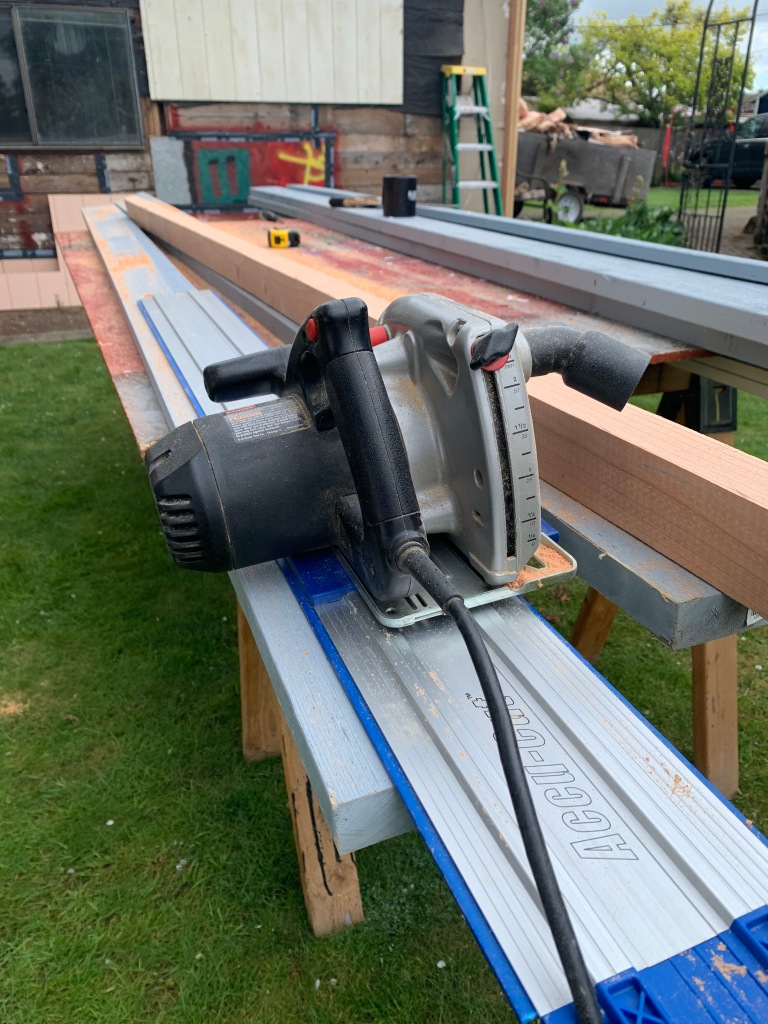
I have added some new products to my shop/tool stable to work on my latest project. One of them is the Kreg Accu-cut fence system to turn your ordinary circular saw to a more precise track saw.

The reason that I considered this option is that I wanted to make some angled cuts on 10′ long lumber. I could do it on the table saw, but I would have to be really careful as my shop is only 24′ in length. I would usually open the door to make sure I had extra length (with counter space). Also, I have some sheet goods to cut.

If you have ever priced one of these units, you would see why the Kreg system is so appealing. I saw entry levels around $400 and the high end at $1000. You supply the saw, so you can use your everyday circular saw which means that you don’t have to own a specific use tool.

The theory is that the saw rides on a track to create a straight cut. I have heard of cases where table saws have been replaced for track saws. I often times use a circular saw to break down sheet goods when working on projects because they are so much easier to handle. So, I thought this might be a good solution.

The setup was a little tricky. I usually read the instructions, especially when there are lots of small parts and screws. There were some errors in the instructions like diagram labels not matching the written text which left me guessing at times.

Getting everything indexed and aligned was a little bit fiddly. The saw had to be moved on the carriage, so as not to cut the rubber bumpers (edge). I also tried to get the saw as close to the bumpers as possible so I could plop the track down on the line and know where to cut, but it is about a sawblade off. I suppose when you make something ‘universal’, you have to leave margin for every saw possibility.

The carriage seems a little flimsy made of plastic and the hold down of the saw a bit tenuous with two pointed screws holding the saw into place. When on the track there was a bit of side to side play. There is not a real good feeling of positive connection when the saw is on the track. What I can say is that none of those things caused a problem for my cuts.

The track has a sticky back and a rear stop, so it stays in place pretty well with friction and forward pressure. You do have to watch to make sure the front is not moving away from the line as you cut. This is remedied by watching the track ahead, not the saw. If you want to make a cut longer than 50″, you need to stop, remove the rear stop, slide the whole track back before cutting again.

By far and away, the biggest downside to this product is the screws that hold the track together back out with use. I saw a lot of complaints about this on the internet, After using it yesterday, I put some thread locker on the screws.

Score ProsCons
Value4/5Compare to other track saws the cost of $80 vs $450-1000A 50″ track is not long enough to rip a full sheet of plywood
Allows the use of one circular saw to be more preciseAdding tracks are expensive. If I used routinely, I would have an 4′ and a 8′ track ($160)
Quality3/5The sled glides nicely on the trackThe set screws holding the track together, tend to back out with used
The friction pads hold the track on the wood without clampsSaws with a thick base plate do not mount securely
The setup instructions had some errors that were not totally intuitive
Performance4/5I got nice results on cutting panels in half, tapers and ripping lumberEverything was as advertised, I just didn’t do enough research on this before purchasing. I think full panel cutting capability would be better.

The bottom line, this is a worthy product for someone like me. I have three electrical circular saws already, I sometimes cut sheet goods and accuracy is important. If I were a professional using a track saw, I would most likely consider a more expensive option for durability reasons. I really wish that I could rip an entire sheet of plywood easily, extra track lengths are available for purchase at $80/4′.

I will continue to use this because I like the results that I got and I don’t regret the purchase.

April 17, 2020 – Making Vanilla Extract

Enough of the heaviness. Because this has been a hard week, lets end on a happier note.

On my shopping list this month was vanilla extract because we have been doing a lot of baking lately. I almost fell over when I saw the price. I swear it was more like $15 the last time I bought it. Last time I checked, I think it was around $8 for 2oz. at the grocery store. Thirty-one dollars for 16oz. seems reasonable given that comparison.

Interestingly enough ‘America’s Test Kitchen’ did a comparison several years ago comparing real vs. artificial and the various options for vanilla extract. You can watch the video here.

I figured that I could make it cheaper and get the real thing. Will it be as good? Time will tell.

I ordered some beans online. I dug out some old bottles, that I plan on making root beer in the next couple of days. I bought some cheap whiskey, and then I topped it off with cheap vodka. In a couple months, it will be ready.

Researching recipes, I found quite a bit of variation in the ratios. But it all came back to the same theme: Beans, alcohol and time. Some of them suggested refilling the containers when the alcohol is empty… I don’t know about that unless we cant wait to break into the first one.

IngredientUsageCost
Vanilla Beans3 whole beans/cup of alcohol$18
AlcoholBourbon or Vodka or Rum or Brandy, fill to the top$13
Let sit for at least two months

It wasn’t totally sure, but I thought I had 16oz bottles. They turned out to be 24oz. I originally bought one 750ml bottle of Canadian whisky, but I was about 350ml short so I topped it up with vodka. So, I made 48oz of extract for $31.

Using my formula above, I probably should have put all of the beans into one bottle. The other wildcard is whether the bottle I am using will be adequate for dispensing. When I run across another bottle that will work better for dispensing, I may transfer out of the current container.

At the worst, you can drink the bottle if you don’t like the results. Enjoy.