Category: Review

September 22, 2020 – Review: Rigid 12/3, 50 foot extension cord

How many people actually read the little instruction manual provided with electrical powered tools? Probably not many people, but if you did, often there is a chart that lists the minimum size cord per distance of run. It would follow something like 25′ needs 16 gauge, 50′ needs 14 gauge, 100′ needs 12 gauge.

Why is that? The thinner the wire in the cord, the hotter the cord gets with more amperage draw because the resistance over distance reduces the amount of delivered amperage. That is why they heat up, the lost current is turned into heat. Reduced power chokes the motor, or said in other words not enough amperage to properly drive the motor.

Generally, this is not a big problem because most tools draw way less current than a circuit (or cord) can provide. Typically, I use any old extension cord to get the right length (and I don’t consult the chart ever). However, there are certain machines that really is not the case. And a good hint is how long and how big the cord on the tool is. For instance, the wisdom with an air compressor is that it is better to get more hose than plug it into an extension cord because they draw near 15A when running.

I once watched painting contractors try to use an 18 gauge household extension cord on an airless sprayer and it tripped the breaker about every two minutes until I gave them an appropriate extension cord. Talk about not having the proper tools for the job. I recently decided to add a 12 gauge extension cord to my stable because I was borrowing someone’s paint sprayer and I wanted to have enough distance and not burn out their tool.

One of the first things to appreciate is how supple the cord is despite it’s diameter. Cheaper cords are stiff and when rolling often have a mind of their own. Not this one. It also has a lighted plug so that you can see the power is on the cord, kind-of nice.

ScorePositivesNegatives
Value4/5Spending on extension cords protect a much more expensive tool or prevent a fireThe worst thing that I can say is that these thicker cords are expensive. $80 for fifty feet or $120 for 100 feet
Quality5/5Fit and finish, everything as expected
Performance5/5Rolls and bends nicelyVery heavy. But all cords of this size are.
Lit plug indicates power to the cord

What else can you say, extension cords are not sexy or fun. They can be pricey and bulky. At best, a necessary evil. But it pays for your job and your tools to have the right cords when you need them.

September 9, 2020 – Review: HingeMate 350

I have been saving this one for a while. I have been waiting for a day where I needed a topic quickly, today isn’t that day but I have been sitting on this for over a month. I am going to discuss the finer points of the HingeMate 350 today.

What is the HingeMate anyway? It is a template set that is used to create mortises for doors and hinges. It has pretty much everything you need to do that job, except the router. I purchased it at Lowes for $38.50.

There are plastic templates for the router to use from 2 1/2″ to 4 1/2″ hinges. It can accommodate three different styles of hinges in those widths, 5/8″ radius, 1/4″ radius and square. In addition, you can also mortise strike plate mortises as well as lock plate mortises.

This was a job that was traditionally done with a mallet and chisel. And it can be done, it is not too hard. But it is tedious and takes quite a while (at least for me). I recently replaced doors on my project after spending hours truing up the frame and opening, so I wasn’t too excited about ripping out the frame along with the finished trim, I thought that I would give this a try.

When would you replace a door only? I would say that if you are happy with the swing operation and the trim detail, it is a perfect scenario to only replace the door. The trick is that this is kind of a precise operation, hinge placements need to be exact in order for the door to work. It is easiest to transfer measurements from the old door to the new door for the best results.

The way that this product works is that you select the template that you want to use and place it in the template holder. The template holder is adjusted for the door thickness and placed in the precise spot that you want to work on the door. The whole apparatus is screwed to the door. The bit is put into the router (not included) and then you adjust the depth of cut for the hinge thickness.

Rout the hinge mortise, remove the template and test hinge fit. If you are satisfied, drill the holes for the hinge screws and mount the hinge. Here is a tip, for best door operation, the top of the hinge face should be completely flush to the door edge, not proud and not inset. Otherwise you get into all kinds of binding and geometry problems.

How did it work? Well, it worked perfectly on my first door. It fit on the first test. My second door I had to make modifications to the door in order to make it fit, but I dont believe that it was a problem with the HingeMate but rather the opening was still a half an inch out of plumb.

So, what is the verdict for the HingeMate?

AdvantagesDisadvantages
Value4/5You cant argue with the price. The professional Porter-Cable version is over $250You need to supply your own router. That is another $100 if you do not already own a 1/4″ collet router
I bought this to cut hours of chiseling, I felt that I could do an entire door in the time it would take to do one hinge by hand.If you are only cutting one hinge size (or hinges only) you get a lot of extra pieces that aren’t necessary
Would like to have a storage case for all the parts. You have to cut the packaging open to get them out and there are a lot of loose parts around.
Quality3/5Followed the included instructions and got acceptable results. No flex, no wanderI noticed that the compression fit of the templates tended to loosen with repeated installation into the fixture. I fear over time, the fit would become too loose. That is not substantiated at this time
It was fairly persnickety to accurately place the fixture, the marks are not very precise and required a lot of verification measurements.
Performance3/5Hinges fit tight and flush. I was very happy with the mortises and the speed of the job.The precision of this jig depends on how good you are at measuring and setup. 1/8″ will be extremely difficult to set the door (or repair). I measured four times before cutting.
The only real thing I didn’t like was the screw holes that remained after the fixture was removed. Those had to be filled. It is a cheap and effective way of holding the fixture in place.
The trim router that I used was too small for the template and wanted to fall through in the middle of the cut so I had to freehand. Use a full sized router or an extended base plate to eliminate this problem.

The bottom line is that price for performance is there. I wonder about the durability of this product, but for me I am don’t really see using it much more. Again, my main motivator was saving time on installing the new doors, check that box. If you have a need, I can recommend this product. If you are a finish carpenter, go for the Porter-Cable.

May 27, 2020 – Review: Makita Cordless Circular Saw (XSS02)

I have been using this tool for the last couple of months. I have got to say that it has become the go-to circular saw in my inventory. I am going to give some ins and outs of my experience.

A cordless circular saw should not be your only circular saw, but probably your first one. Once a certain level of efficacy is achieved with the engineering of the tool, all the additional drawbacks are secondary. What I mean is that a smaller overall blade means less cutting capacity and a battery means limited runtime. But, for the ‘one’ cut or the awkward cuts you cannot beat a small, lightweight and cordless tool.

I am going to compare and contrast some of the other saws in my line-up to try and build a case for this one. My first saw was a traditional home-owner grade Skil. Nothing really wrong with that, I have done a lot of projects and it is serviceable. The number one thing that improves accuracy (for a right hander) is having a blade to the left so you can see the blade cutting the line as you push the saw.

I upgraded to a Porter-Cable about fifteen years ago. This is a much beefier, contractor oriented saw. It has the blade on the left, a really wide base. This saw is ear splitting loud and I have some trouble with the blade wandering, could be me but it doesnt seem to be an issue with other saws. However, the first thing that broke was the ‘tool less’ nut to hold the blade on. This happened mid-project so I ended up buying the Skil worm drive saw while I waited on a replacement nut.

The Skil is a beast. If I am cutting framing lumber all day long or concrete block, this is the saw that I want. It is quiet and powerful (and really heavy). Now, I am going to review the roles that each of these saws’ play. The regular Skil is now attached to my Kreg track. The worm drive is for heavy duty cutting and the Porter-Cable I use largely for demolition. That leaves the Makita for everything else.

I think most people in this realm know that once a brand is chosen, you are smart to buy other tools in the same brand because you can share batteries between them. Hence I have the Makita tool system and a number of tools that are in the family. In true disclosure, I dont have a lot of recent experience with other brands. But after fretting for several months on what brand to buy, I think that you probably cant go wrong with any of them. I will say that DeWalt is available at both major home centers whereas Makita is not. The same is true for Rigid, Milwaukee, Ryobi, Bosch and Craftsman, being store specific.

Now, I only have 3 aHr batteries, so to get more run time, an upgraded battery would be an improvement. However, on a full charge I was able to work on siding all day long without changing batteries. The light an compact nature of the saw is extremely useful in tight situations.

On the more downside of things, this saw does not have a ton of torque so it needs a runway to get started with cutting. It can bind relatively easy so you need to pay attention to the cut. Because of the light weight, kick back is much more real because it doesn’t have the mass behind it to counter act the forces of binding. If you add to it more risky support because of the light weight of the saw you need to be careful not to get injured.

ScoreProsCons
Value3/5Uses batteries for my existing 18V toolsCosts as much as a high output electric saw
Batteries requires brand loyalty
Quality5/5Good ergonomic fit
Performance4/5Very happy about the performance of a lightweight, cordless sawHigh battery draw, the brushless saw (for 50% more) would be more efficient and powerful

It should be noted that this was a tool only purchase. At $129 that is fairly steep for convenience. There are options to buy kits where the most common is drill, driver, reciprocating saw and circular saw that would come with batteries and a charger. The saw can be purchased with battery and charger as well, but you are now getting up to the $250 range. At that price I don’t think this is worth the money.

To sum it up, I am very happy. Despite the many drawbacks not having a cord is sure convenient.

May 12, 2020 – Review: Hunt, Gather, Cook

Hunt, Gather, Cook: Finding the Forgotten Feast by Hank Shaw was the April book selection in the Left Coast Cellars Culinary Book Club. Unfortunately, the club has been on hiatus since mid-March but that doesn’t mean that the reading doesn’t go on.

Hank Shaw is an author, blogger, podcaster and general media person. His focus is about cooking with wild sourced ingredients. He tends to collaborate with others in this space like Steven Rinella. If you are into this sort of genre, then you probably already know about him and his contemporaries.

The book is organized into three sections. Section one is about foraging, section two is about fishing and section three is about hunting. Each chapter in the section is grouped by a theme such as wild berries. At the end of each chapter there are five or so recipes focusing on the type of ingredients the chapter is about.

This is one of those books that I would consider a gateway into the subject. There is no possible way that a person can safely learn everything about foraging by reading this. Every microclimate and region in the country could support it’s own botanist/mycologist/herbologist from the vast diversity that is present. There is no mention of mushrooms, which is probably a good thing. Instead the focus is on high value, low risk choices like seaweed and day lilies.

Another potential roadblock to successfully implementing ideas in this book are access, equipment and knowledge. For example, in my state there is no ‘season’ for rabbit hunting. It does require a license to do so. There is public land about ten miles away, but I have rarely seen a rabbit. I think that to really do this successfully, having a flushing dog would be the only viable option. Dogs are not allowed in the public land without a leash.

Instead of focusing all of my energy into why any of these ideas can’t be done I think the best use of this book is to read through it and look for things that can be done. Almost everything has a season to when it is available and or legal (including a lot of plants). Plan times to obtain these items as family activities. A family charter for bottom fish and crab is something I can do in my area. Then be prepared to feast when the trip is complete.

I enjoyed reading this book because it is about 25% technique, 25% cookbook and 50% inspiration. So, it is not a page turner but it does get the mind stimulated about the possibilities. Over the years, I have learned that it is much more enjoyable to pursue the activities rather than read about them. But I find that I can more easily find the time to learn and think than I can do. For that reason, it is exciting to think about that next fishing trip or making blackberry wine.

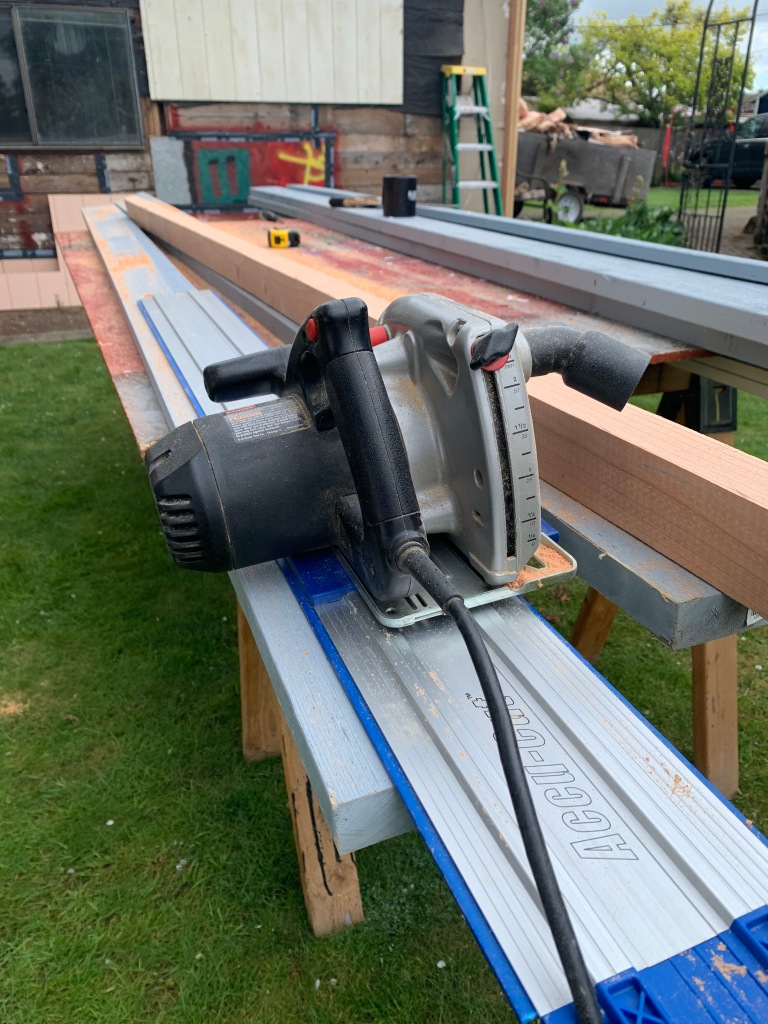
April 20, 2020 – Review: Kreg Accu-cut Fence system

I have added some new products to my shop/tool stable to work on my latest project. One of them is the Kreg Accu-cut fence system to turn your ordinary circular saw to a more precise track saw.

The reason that I considered this option is that I wanted to make some angled cuts on 10′ long lumber. I could do it on the table saw, but I would have to be really careful as my shop is only 24′ in length. I would usually open the door to make sure I had extra length (with counter space). Also, I have some sheet goods to cut.

If you have ever priced one of these units, you would see why the Kreg system is so appealing. I saw entry levels around $400 and the high end at $1000. You supply the saw, so you can use your everyday circular saw which means that you don’t have to own a specific use tool.

The theory is that the saw rides on a track to create a straight cut. I have heard of cases where table saws have been replaced for track saws. I often times use a circular saw to break down sheet goods when working on projects because they are so much easier to handle. So, I thought this might be a good solution.

The setup was a little tricky. I usually read the instructions, especially when there are lots of small parts and screws. There were some errors in the instructions like diagram labels not matching the written text which left me guessing at times.

Getting everything indexed and aligned was a little bit fiddly. The saw had to be moved on the carriage, so as not to cut the rubber bumpers (edge). I also tried to get the saw as close to the bumpers as possible so I could plop the track down on the line and know where to cut, but it is about a sawblade off. I suppose when you make something ‘universal’, you have to leave margin for every saw possibility.

The carriage seems a little flimsy made of plastic and the hold down of the saw a bit tenuous with two pointed screws holding the saw into place. When on the track there was a bit of side to side play. There is not a real good feeling of positive connection when the saw is on the track. What I can say is that none of those things caused a problem for my cuts.

The track has a sticky back and a rear stop, so it stays in place pretty well with friction and forward pressure. You do have to watch to make sure the front is not moving away from the line as you cut. This is remedied by watching the track ahead, not the saw. If you want to make a cut longer than 50″, you need to stop, remove the rear stop, slide the whole track back before cutting again.

By far and away, the biggest downside to this product is the screws that hold the track together back out with use. I saw a lot of complaints about this on the internet, After using it yesterday, I put some thread locker on the screws.

Score ProsCons
Value4/5Compare to other track saws the cost of $80 vs $450-1000A 50″ track is not long enough to rip a full sheet of plywood
Allows the use of one circular saw to be more preciseAdding tracks are expensive. If I used routinely, I would have an 4′ and a 8′ track ($160)
Quality3/5The sled glides nicely on the trackThe set screws holding the track together, tend to back out with used
The friction pads hold the track on the wood without clampsSaws with a thick base plate do not mount securely
The setup instructions had some errors that were not totally intuitive
Performance4/5I got nice results on cutting panels in half, tapers and ripping lumberEverything was as advertised, I just didn’t do enough research on this before purchasing. I think full panel cutting capability would be better.

The bottom line, this is a worthy product for someone like me. I have three electrical circular saws already, I sometimes cut sheet goods and accuracy is important. If I were a professional using a track saw, I would most likely consider a more expensive option for durability reasons. I really wish that I could rip an entire sheet of plywood easily, extra track lengths are available for purchase at $80/4′.

I will continue to use this because I like the results that I got and I don’t regret the purchase.

April 13, 2020 – Valuing the software to run the hardware

This comparison is probably a stretch, but I feel like it will work so I am going for it. I suppose that there are a couple of inputs that make this opinion come alive. In the old days, say pre-Windows XP, hardware was upgraded more often. When hardware was changed, there was a driver that also needed to be installed. That driver may or may not have actually worked. Sometimes it required re-installing service packs and rolling back to move forward. There also wasn’t a video for everything or a forum or ideas to help you get started.

Today, unless you are upgrading your video card or something for a specific reason, you don’t need to add another hard drive or faster DVD drive or more RAM. If you are one of those people, you probably know more about this than I do. However when it didn’t work, which was frequent, what would you have paid to make it work? My point being that without software to run that device, it was worthless. But it wasn’t like you had a choice for vendors, nor could you really pay to have a better or different experience.

I can remember whole Christmas presents not working; never could figure out how to make that game load or that modem work, etc. For those that cant relate to this experience, this is precisely where I am going. Our value of the software is free, because that is our perspective and experience. Yet without it, it doesn’t work at all.

Ker-chunk, Shifting gears. I recently picked up a set of Bora 1100 mobile work bases. Until my recent pantry project, some of the nicety features or accessorizing like dust collection and mobile bases were not in the plan. It was true that my machines could be moved without that mobile base. I really didn’t like to do it and hassle has been some of the issue with previous projects.

Quickly, the pluses on the product are 1) relatively inexpensive at $45 per pair 2) flexible and customizable size accommodating 400 lbs of weight. The minuses were 1) the assembly was time consuming 2) supplying your own frame.

So, unlike the driver situation my tools will work without mobile base. What I will say about it is that I am hoping that I will have much less hesitation to get started when they are easier to move. My shop is small, so having the ability to utilize the space effectively is important. Completing the task is more important than owning the hardware.

April 7, 2020 – Review: Save Me the Plums

‘Save Me the Plumbs’ by Ruth Reichl was the March selection for the Left Coast Winery Culinary Book Club. It is a short book detailing the time that Ruth spent as Editor in Chief at the magazine Gourmet.

This is the second book of hers that we have read as part of the book club. The first one ‘Garlic and Sapphires’ was a great introduction to Ruth as an author and a fascinating look at a food critic in an highly competitive environment. In many ways, this book is a continuation of that story because when she left the New York Times, it was for this job at Gourmet.

Ruth is a great writer. Her books are short with quick chapters and she pulls the highlights into each one. Even though this is a good book and a quick read, I have had a hard time making time and prioritizing this given the current circumstances. It has been hard to concentrate and be normal with quarantine as the norm and ‘Family Time’ as the expectation.

The focus of luxury and high cuisine from a magazine such as Gourmet feels a bit before my time. As someone in my forties, I am just beginning to appreciate (or be able to participate) in such things. I didn’t grow up around the magazine and am not really familiar with it since it went out of business in 2009. It does seem like the kind of magazine that that I would be the editor of where the story of the food was told, not just the recipes.

I finished the book last night and the ending made me wish that I had read it faster. I will spare the complete spoiler, but I can totally relate to the situation. This is an enterprise where everything seemed like it was going great only to have extenuating circumstances ruin a good thing. In the end, a person is grateful to have the opportunity to prove success but bittersweet that it isn’t more appreciated and recognized and at least allowed to continue.

Opportunities open doors when others are closed. I suppose Ruth may still be Editor of Gourmet rather than writing books and we still wouldn’t have these great stories. I enjoyed reading this book and there are a few recipes in it, some of which I have made. I think more than food, this is a book that is about a person’s self doubt, will to succeed and humanism. I liked this book because I liked ‘Garlic and Sapphires’ first.

March 5, 2020 – ‘Tacticool’ Thursday

We have an exchange student for the year from Spain living with us. Unfortunately, part of his agreement to be here is that he cant participate in the things that are the most uniquely ‘American’. For instance, no shooting, no driving, no ‘high risk’ activities. We spend a fair amount of time enjoying those activities.

However, for Christmas, he purchased this book for me called ‘100 Deadly Skills: The SEAL Operative Guide to Eluding Pursuers, Evading Capture, and Surviving Any Dangerous Situation’ by Clint Emerson. I have been slowly reading this over the last couple of weeks.

Now, I like to learn and I believe in the philosophy of preparation. Given the recent COVID-19 hysteria, I am noodling going quite a bit deeper into this next week. The title ‘Tacticool’ is denotes something that might look better on the surface than it really is as well as bring a little humor into my work.

Quite frankly, a lot of this book is mental masturbation such as how to ditch a plane, use a flight suit and swim into another country without detection. I learned a few things like cell phone cameras can pick up IR light or how to make a polymer from milk (casein). I think the value of this book is around the idea of situational awareness: where weak points in hotels could be or tactics around kidnapping and escape. Of course the likelihood of this ever happening is extremely small.

If you are a budding Mall Ninja or an untrained SEAL then this is a manual for you. Otherwise, it is primarily for fun. Remember that your brain is your biggest tool/weapon/asset and keep exercising it because you never know when you need recall the best technique to survive a grenade attack.

February 24, 2020 – Review: My Paris Kitchen

“My Paris Kitchen: Recipes and Stories” by David Lebowitz is the February 2020 book selection for the Left Coast Cellars Culinary Book Club. David is an American food blogger that has lived in Paris for the last ten years. You can check out his work in the link.

This work is a cookbook, where the stories are largely about some aspect of the recipe in focus. There were a few interesting factoids that I picked up reading the book like most apartments don’t have kitchens in Paris, service at most stores is curt to nonexistent, mustard is the French salsa and the most prevalant cheese used is Gruyere (which is Swiss).

The section that interested me the most was the appetizer section. It has the most variety of recipes and is not strictly French cooking. Influences of Africa and the Middle East are very apparent in this section, like the use of Harissa.

David does a good job of Anglicizing the recipes as there are ingredients that do not exist the majority of the United States. He talks about what is considered proper and what he would use (in some cases does use) in its place.

The photography and food stylizing make the recipes look very appetizing. This month, the host of my book club will not be available. So, we will not be focused on a specific meal but just appetizers. I think that I will make ‘Sardine Spread’ as my first foray into this cookbook.

Truthfully, I don’t see myself using this cookbook much. I think that it is largely the lack of classic French dishes and the plethora of cultural fusion in the book. My go to cookbooks are written by subject matter experts on the particular cuisine, like Rick Bayless for instance. Nevertheless, I want to try a few things before it gets filed away.

February 18, 2020 – Review: Amazon Warehouse

What an epic hassle dealing with bad thrust bearings on the bandsaw has been. Today I will be discussing my experience with Amazon Warehouse and not the guide upgrades that I had ordered. I think that it will be clear when I am done why.

First, for the uninitiated, Amazon Warehouse is a division of Amazon that resells returned items from Amazon. These items are supposed to be inspected, cleaned but otherwise in ‘like new’ condition.

In my case, the Jet JRBG-14 were bandsaw guide upgrades that cost $153 from Amazon. I noticed that Amazon Warehouse had them for $112 with Prime Shipping. Rather than trying to see if they were stocked locally or find a replacement thrust bearing, I decided that I would work around the problem for four days while I waited for a significant upgrade, according to reviews.

When the package arrived on Thursday, I eagerly opened the package and to my surprise there was a problem.

I wont make you guess or wait too long to get to the point. So, upon closer inspection, I was sent two parts that do not match the diagrams or my expectations. And worse, the bottom bracket was missing the blade guide as well. What it appears to me is that someone ordered this upgrade and returned the OEM guides back to Amazon. The dope that supposedly inspected this clearly did not do their job.

Needless to say that I was pretty PO’d. I lost four days waiting for this to not get a usable part. To top it off, some dishonest actor got away with this. And quality control at Amazon Warehouse must be very poor. This has got to be one of the few items that is returned with a diagram of what the item is supposed to look like. The next day I drove up to Portland to solve my problem for good, costing me about three hours to get the replacement bearing (but not the upgrade).

I think the Latin phrase Caveat Emptor should be put into place when buying from Amazon Warehouse. I would be skeptical ordering anything complicated or expensive in this manner. Unfortunately, you cannot actually see what you are buying and there is no guarantee that getting what you bought.