Category: Review

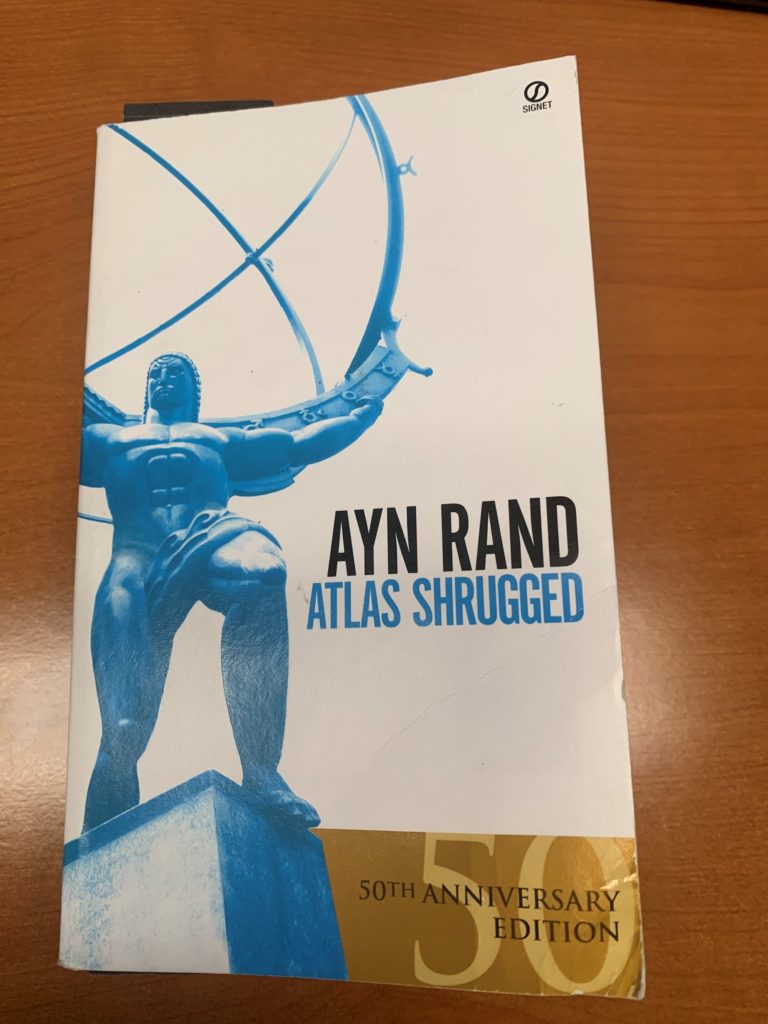
November 18, 2022 – Atlas Shrugged 2:10

This is the last chapter in part 2. Things seem to be no where near resolved at this point, so we will have to stay tuned for the last 400+ pages of the book.

Dabny meets a transient. He used to work at Twentieth Century Motor Company. He describes the process where the owner died and the factory was taken over by the workers. Part of the process was need based voting on wages and other issues.

“Remember that none of us may now leave this place, for each of us belongs to all others by moral law which we all accept”. One man, stood up and as he left the meeting and disappeared forever said “I will stop the motor of the world”. That man was John Galt.

After that conversation, the train stopped, the crew abandoned the train, possibly in Oklahoma or Kansas. Dabny walks with Owen Kellogg a former employee to find a telephone which is every five miles down the track. During the walk, she discovers that he is in possession of cigarettes with the dollar sign on them. He refuses to talk about the origin, but says that they can only be obtained by gold.

I suppose that these are the main two themes in the chapter. However neither is really new. This chapter is forty pages of marking time. Sure we learned the back story of John Galt and the Dollar symbol (in the book). It kind of reminds me of a podcast I heard years ago about the origin of the dollar. Apparently, the origin of the US dollar was based on the Spanish dollar when it was adopted as currency in 1792.

Kellogg draws some comparisons of the symbol, much like history or politics. There are facts and then there is how those facts are interpreted. For instance, there are those that use the dollar symbol as a weapon to mark greed and selfishness. While there are others that see it as a symbol of creativity and output.

I suspect that people that use the 1% moniker would not refuse a $100 bill if I handed them one, no strings attached. I have never heard of anyone refusing a raise solely on principal. For that matter, those same people do not work for free. So, it is not the money itself that is evil but more likely jealousy. And even more likely hypocrisy meaning who wouldn’t trade financial situations with someone in the 1% assuming that we could handle the transition?

Is everyone that rich a nice, hardworking and deserving person? I doubt it, in fact I would be willing to bet that a lot of them worked in some sort of gray area to get there. So let us look at my version of the Facebook story.

Back when MySpace was the top social media site, the internet was much more undeveloped. Because MySpace was adopted by the newest tech generation (pre-teens and teens), it drove slightly older people to Facebook. These also happened to be the population segment that had money unlike teens. Facebook used mining technology to gather information on it’s users to sell. It was a twist of fate that Facebook conquered MySpace.

As a result, Zuckerburg grew wealthy by a gray area activity. Was it legal, yes. Was it ethical, yes as long as the user agreement disclosed it. Was it proper? I dont know, I don’t use Facebook partially for this reason. Do I like Zuckerburg? No, but not for this. I don’t like the fact that Meta is in the business of manipulating speech.

Enough of that, let me remind people how you get rich. You do this by paying people less than what you make. For instance, I am not rich but I don’t pay the person that mows my grass the same wage that I make. This allows me to focus on the things that I want to do. If the price of the job ever came to my current wage level, I will quit my job right now and start mowing grass. I certainly respect and appreciate the job. They can do in one hour what takes me all day to do. But, my time is worth more to me than the cost of mowing the grass.

Whether it is the Waltons, Musk, Buffet, Gates, etc they all payed people around them less than they made so that they could use their talents in other areas. And let us not forget that there are a lot dull people employed at XMart making $18/hour that would struggle to find a replacement job that is as good. Before we get too judgmental about who did what to get where, it would be good to refresh ourselves with the the tenth commandment: ‘thou shalt not covet’.

End Your Programming Routine: I will say that I struggled today. I kept writing until something quasi-impactful emerged. It all starts with the book and this thing is starting to get a little long in the tooth. I certainly don’t regret doing this and it has definitely been worth it so far. It’s just that some of these chapters don’t add any value to the overall work. I will save the rest for when I finish.

November 11, 2022 – Atlas Shrugged 2:9

I would say happy Veteran’s Day, but I don’t really think this is an appropriate statement. I have spoken about feelings on veterans on Memorial Day. And to get more technical, a veteran is a living person that served in combat, not just spent time in the military. Despite my feelings on whether our country should have been involved or not, I can appreciate the sacrifice of service.

Growing up, we had a parade in town that was billed as the largest Veteran’s Day parade west of the Mississippi. I was in band, so I was marching in the cold and the rain every year. Since leaving home, I have never had it as a holiday so I really haven’t seen it in a long time. But, I assume this is not the reason that you are here so let’s get into it.

I had in my notes “short chapter, kind of worthless”. What happens is Francisco goes to Dabny to see if she will change her mind about going back to working for the railroad. Of course she will not. This conversation is interrupted by Henry Reardon coming in and loosing his cool.

I won’t say that there is nothing of value in the chapter, the conversation and debate between Dabny and Francisco was pertinent. There are two camps: either don’t support the looters by continuing to work or don’t let the looters win by quitting. Which side is correct? I suppose that it has to do with where you stand on confidence with your abilities, pride in outcome and stubbornness to continue.

I know which side I fall on. Maybe you can guess what it is, but I can relate an anecdote to highlight my stance. I have spoke of this before, but I once ran a program. The people above me were extremely poor running their own programs, hence I would call them looters. In fact, the company was taking money out of my program to prop up these other failing programs. In the end, it was all from the same bucket but the point was taking from me to make them look better.

These people made my life miserable. Misery at work translated to misery at home. But, I was running a successful program. I was happy with my team’s results. We were named a ‘Center of Excellence’ for the company. Along with that success came more meddling to the point where the company took that program away from me in a way. They hired someone to run and expand the program I was running, in effect pushing me away.

That move was explained to me as ‘making my life better’ by reducing my interactions with the looters. What they didn’t realize was that my fundamental success running the program was the only thing keeping me satisfied with my job. In my mind, it simply gave me no possible way to happiness because instead of making my life better, I was more miserable. I had reason to keep fighting when I had something to prove. By being relegated to team lead instead of a program lead, I no longer had that motivation.

So, I quit. The program failed within six months. In fact within a year, the company imploded. I don’t claim that this was all me. Mismanagement left a structure riddled with holes like termites in wood. I was simply a part of the structure that was no longer sound and when I crumbled, so did the rest.

It is not in my nature to quit. For right or wrong, this is one of the few things I have ever quit. I was devastated to surrender my identity but I was also at a point where staying was self-destructive. I no longer wanted to prove something, I wanted to take the whole thing down. I had no other success criteria than a total re-write of the company in my own image. That wasn’t realistic, so I gave into the looters and natural consequences took their course.

End Your Programming Routine: I think that you can see that I side with Francisco. At the time, I didn’t do it with the same intent, it just happened to prove his theory. On my last day, I walked out the door with a small box of my personal belongings. I didn’t leave a single item that was mine, including the business in which I was engaged. I choose the path of force disrupter rather than head on battle for change.

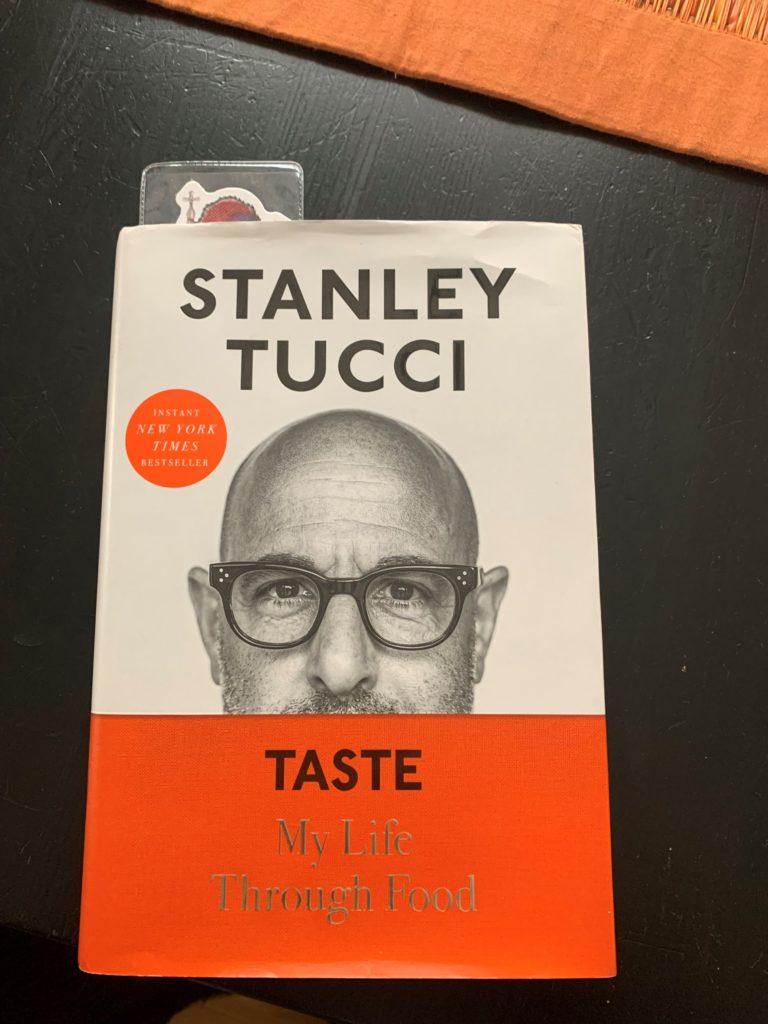
November 8, 2022 – Taste: My Life Through Food

Taste by Stanley Tucci is the June Left Coast Culinary Book Club selection. Yes, I said June. I ordered it in May. By the time the book was delivered, we were getting ready to leave for Spain. I looked at the page count and I knew that it wasn’t going to be long enough for the trip. I left it home for weight purposes and then all of a sudden I had two books to keep up with all summer and fall.

Since we missed the book club gathering in June, I just waited until I got ahead on Atlas Shrugged and didn’t have a second book to go back to. Now was the time.

I am certainly not a big Hollywood person. Most of Stanley’s movies I have never watched. The most famous include Prizzi’s Honor, The Devil Wear’s Prada, Lovely Bones and Julie & Julia. This book is a memoir of sorts that traces his life through food memories.

There are probably 25-30 recipes in the book, nearly all of them are of Italian origin. Typically, they come near the end of each chapter. However, there are sometimes two recipes in a chapter. And some, don’t have any. I would describe it this way, there is some sort of anecdotal story about a period of his life ended by the recipe involved in the anecdote.

How to be kind here? Let’s just say that unless you are a Stanley Tucci fan, this book is pretty much a train wreck. It very roughly follows his life from childhood to current day. Knowing nothing about him, the book cuts right into some situation where he talks about food and then usually punctuated by a recipe. It jumps back and forth in time with unfamiliar characters after about the first third of the book.

I suppose part of my irritation of the book is that I certainly didn’t appreciate the politics whitewashed throughout the book. I would characterized him as New York City liberal turned ex-patriate feigns interest in traditional dishes. He does talk both about Thanksgiving and the Fourth of July with what feels like contempt. I get it to a degree, you like what you like but why bring it up at all?

I started out enjoying the first third of the book. These were largely about the nostalgia of childhood and certainly more innocent and varied. The recipes were interpretations of memories. After that, the book turned into a wandering, food triggered grab bag.

He seems to have a propensity to talk about restaurants that no longer exist. It is written as if it is still available until you read the entire story and then there is a footnote that this is now closed. I think it could have been written in a more agnostic fashion such as “the best XXXX I ever had was at YYYY” and not “Go to YYYY on ZZZZ for XXXX *It is now closed”. I guess for me, New York City or Sicily is just as foreign as the moon so I don’t feel the need to follow all of his restaurant suggestions. Nor would I expect something from the 1980s to even be available 30-40 years later.

It is not that often that I am this critical about something. I personally give this a ‘not recommended’ because the book was expensive at $25, boorish and just too neurotic for me. But, to each his own.

End Your Programming Routine: Stanley bills himself a foodie. I can respect and appreciate that. It is clear that he strongly leans towards Italian food which is way more diverse that the Olive Garden menu. I am not a big pasta person at all, so I can appreciate recipes that go deeper into the cuisine than what everybody knows. We are brother’s in that respect.

November 4, 2022 – Atlas Shrugged 2:8

It’s not a spoiler if I talk about something that has already happened in the book. It is however if you have not read it. So, you have already read the book, you are reading along with me or you just don’t care. Dabny hears about the train crash on the radio and immediately returns back to work.

Immediately before the news was put on the radio, Dabny was having a conversation with Francisco D’anconia. Francisco is this enigma that I can’t tell if he is orchestrating all of this or he just happens to be like Nathanael Green and the right place at the right time (on purpose).

The title of the chapter “By Our Love” is again double entendre. There is the love between Dabny and Francisco. But their conversation is really about the love of the work and how that is being harvested by the Looter’s for profit. Without the industrialist’s passion, the entire economy will disintegrate.

Time for opinion again. Using generalizations here, have you noticed that the left wants more taxes and the right wants less taxes. No one is arguing that we should have no taxes at all. Why is that? Because they are different degrees of the same thing. The premise is that we all have some sort of civic duty to fund schools, roads, parks, libraries, welfare, etc. If you are picking a side, then you are choosing your degree of civic responsibility and not the premise in the first place.

This all dovetails together by the end, so hang in there. What do you suppose is more profitable: healthy, dead or chronic illness? Using our brains, you got it right chronic illness. If you can be kept ‘in the system’ then you have prescriptions, testing and follow-up visits. This is literally a money printing strategy for life.

What if there was a professional duty that said doing harm was immoral? Now, what if there was a pharmaceutical that kind of worked? And what if you scared the crap out of someone to never stopped taking it? What if the food you ate for your entire life caused the condition in the first place? So, now we have food industry, medical and pharmaceutical industry all working hand in hand in profit.

Are you hanging in there? My favorite subject to pick on is Covid vaccines. Did you know the fourth booster is out? Did you know that these vaccines are pursuing approval for ages 5-18? Did you know that once approved for children the vaccine no longer is considered experimental? Did you know that once accepted, liability is suspended. This is in the wake of pharmaceutical executives admitting that vaccines efficacies are dubious at best. And yet, the CDC is now adding the Covid vaccine to the recommended list of routine shots.

When Dabny goes back to work, she demands to talk only to Mr Weatherby not Wesley Mooch. She is not going to be hamstrung by Directive 10-289 to get the railroad back on track after the disastrous crash. She essentially dares him to stop her. His response is that law’s today are not rigid, but elastic. That should be read as ‘rigid for all people’. Because when you have something that they want then they are going to compromise, otherwise get in line.

So, we have the lawmakers writing the rules as they please. Like for instance US congress members are the only people legally allowed to engage in the practice of insider trading. Literally the people making the laws are the only people that can legally profit on the outcome of the law (with intent). How is that for fair?

In case you didn’t follow the lines. There is collusion between government and industry at the whim of those currently in charge. The rules are being written to endorse certain products and practices. Meanwhile, those on the outside will be kept there. Only with a force disruption will change.

End Your Programming Routine: Reading the book on the surface, you get some romantic mumbo jumbo with a barely interesting story. This post came about as I was trying to relate the conversation between Francisco and Dabny to a current situation and it just flowed. I am not saying that the I think the pharmaceutical industry is intentionally doing harm, but this is all a convenient side effect. It’s worked out pretty well for them, don’t you think?

October 28, 2022 – Atlas Shrugged 2:7

If you pay attention to the title of each chapter, it kind of gives you insight into what the chapter is going to be about. This one is titled, “The Moratorium On Brains”. More on that in a minute.

The last chapter was titled “Miracle Metal” which was about forcing Reardon to give up his intellectual property. Reardon metal will be renamed Miracle metal. Makes sense. The chapter before that was titled “Account Overdrawn” which was the production threat that lead to the initiation of Directive 10-289. The next chapter is titled “By Our Love”… I wonder what that is going to be about?

As with all chapters in this long book, there are multiple things going on. The title of this chapter refers to the incident in the second half of the chapter. An entitled bureaucrat is travelling on a Taggart train to a political event. The train is stopped at a station in Winston, Colorado because of track conditions and derailment. The bureaucrat insists that this is some kind of political ploy and demands that the train continue.

Taggart employees afraid of changing rules, sliding scales of justice and unclear authority are afraid to do the right thing. Ultimately, the parties involved barrel to their death. Hence, some knew this was going to be the case, the others refused to believe that this was a real problem. Either way, the result was the same.

Normally, I would pick that part of the chapter to draw some analogy to current day issues. But, it is so easy to kill sitting ducks. That is why we have the phrase in the first place. Make no mistake, this is the major theme of the chapter. However, I am going to talk about the first part of the chapter instead.

We have heard a little about Ragnar Danneskjold. Apparently, he was a peer of Francisco D’Aconia in school and a general enigma. The word on the street is that he is also a fearless pirate. In this chapter Henry Reardon meets Danneskjold and it was rather interesting.

We grow up with the paradigm that the story of Robin Hood is just and correct. Danneskjold bills himself as the anti-Robin Hood. And his reason being is that we have our Overton Window in the wrong perspective. It’s not the rich stealing from the poor that is the problem, but the poor stealing from the rich.

Huh. I had never considered to perspective that the fairy tail is actually a classist agenda. I really think that there are points on both sides here. On one hand, there is no doubt that this country has a large welfare state. That is certainly stealing from the rich (the government that is). Does the rich actually steal from the poor?

I would contend, that both sides steal from the middle class. One, the middle class is the largest socioeconomic group. Two, the rich are the ones writing the rules (read loopholes) as well. They can afford to hire attorneys and accountants as well as build tax shelters on a routine basis. The poor of course have nothing to steal. The middle class has no time to fight, not enough assets to protect and not enough insight to know that they are getting screwed.

To make things worse, class warfare works perfectly. By keeping the middle class siding with one side or the other, they are so busy fighting in their hypnotic trance for the side they believe represents them that they are missing the fleecing that is happening.

For instance, the “Trump Tax Cut” that occurred in 2017. Without the SALT deduction (that was the deduction for mortgage interest), I now pay $10,000 a year more in federal income tax. I have heard business owners say that they now have a significant reduction in taxes (35 -> 21% on profits as well as a increased expensing allowances to lower profits). Nothing especially precludes me from becoming a business owner, but that doesn’t pivot on a dime. My point is, business owners are more likely to be high income earners, maybe rich. There are a lot more middle class home owners that fall into the strictly middle class ranges and the burden was shifted with that tax change.

End Your Programming Routine: I cannot be convinced that the rich do not pay their fair share. If we are only talking about income taxes maybe, but all the businesses certainly donate, pay, employ, etc. That is certainly fair share in my book. The truth of the matter is, as long as we all have equal access to take advantage of the rules, then who can really complain? Honestly, what I think the middle class needs to focus on is not getting rooked into picking a side when either choice looses.

October 21, 2022 – Atlas Shrugged 2:6

As I said last week, it seems now that we have passed the high tide line for hope. In fact, in this chapter Dabny quits her job as Vice President for the railroad. It isn’t written explicitly, but it has to do with the outcome of a special council of industrialists and government have produced. I am going to talk about that today.

By Executive Order and declaring a State of Emergency, it is officially titled directive 10-289. Below is a synopsis of the contents.

  1. No wage earner is allowed to leave their job nor be terminated under penalty of jail.
  2. No business owner is allowed to fail and cease to exist or to transfer the entity in any means.
  3. All patents, trademarks or intellectual property will be surrendered to the government for the free use by all.
  4. Nothing new is to be invented or marketed or even investigated
  5. All manufacturing is to maintain the exact same output year over year.
  6. Prices will remain the same from this point forward.
  7. Wages will remain the same from this point forward.
  8. Any disputes of edge cases will be overseen by an entity called the Unification Board.

To me, this is clearly a larger than life framing of the transition from free market to communism. Not being a total expert, I assume that all of these things are an exaggeration of state controlled economic system. Will prices never change? I don’t think so, but they wouldn’t change without governmental review. Will nothing ever be invented? I doubt that is even desirable. At the very least, new military technology was invented but I think that science was highly valued in the USSR (granted it was probably state generated).

There is nothing like doubling down on failed policy to make things fail harder. If we look at our current financial system we can see the madness of it all. At a high level, this is how it works.

Banks qualify someone for a loan and they create a ledger entry. That loan then creates money into existence because they don’t actually have the cash liquid in the bank. This is the entire concept of fractional reserve banking. The US government borrows that money from the bank (also creates money), which they are charged a fee. They then raise money to cover the debts by issuing the bonds, which largely the banks purchase. So the banks make money ‘selling’ it to the government and they also make money by buying the debt. This is a Ponzi scheme.

When we have inflation, we have too much money in the system. Interest rates are raised to slow down some of the borrowing and additional creation of money. Inflation devalues the currency and while a small amount of continuous inflation is desirable (from a monetary policy standpoint), a large amount is not.

I suppose that you might be asking what does failure and our current financial system have to do with each other? Well, it hasn’t failed yet, but it will because there is no possible way that it will not. We cannot create money from loaning it to someone else and charge for it both ways as any sort of rational logic. The relative strength of the US Dollar is only backed by force.

What is the Petrodollar? Did you know that all oil transactions from everywhere in the world needs to be done with the US Dollar? This means that every country needs to convert their currency into USD to perform the transaction. That activity keeps the value of the dollar relatively high compared to most. This is the activity that requires force to maintain. Why do you think we are in the middle east in the first place? It is certainly not to promote freedom and liberty.

Bringing this all back around now. The central economic control of communism like the USSR, the move to communism in Atlas Shrugged and the US financial policy are all flavors of the same thing. They are all attempts to manipulate a systems for goals. The goals may not all be the same but the results are. There are too many variables and inputs for this to ever work in perpetuity.

End Your Programming Routine: At this point, I am not sure that there is a perfect economic system. I want to say free market is the best, but that has a lot of issues itself. You cannot predict boom/bust risk free. Who knew that Beanie Babies was going to be a thing? So, when you invest your entire retirement in those things and they become worthless on the whim of a trend, things go south in the entire economy. It is looking like an un-manipulatable currency like Bitcoin is looking like the way to go, but it still wont avoid the Beanie Baby crash. So, emulate the people doing well; make money and build wealth within the framework available but keep your eyes and options open.

October 11, 2022 – The Kitchen Counter Cooking School

The Kitchen Counter Cooking School: How a Few Simple Lessons Transformed Nine Culinary Novices into Fearless Home Cooks by Kathleen Flinn is the Left Coast Culinary Book Club selection for September 2022. In many ways, this is a follow up to The Sharper Your Knife, the Less You Cry. It picks up where that book left off in Kathleen Flinn’s timeline.

I have found this book very interesting because I identify very much with Kathleen’s psyche. Here she goes to Le Cordon Bleu kind of on a whim, gets her credentials and then immediately writes a book. She is interested in food and cooking but really doesn’t want to put those skills to work traditionally. She even says it herself that she doesn’t know what she want’s to do. Sounds like someone I know.

I don’t want to spoil the book, but Kathleen has an epiphany while grocery shopping. She observes how much junk people are loading into their carts and begins asking the question of why. The most pervasive answer is that people don’t know how to cook. This book describes a social experiment, bringing in nine people that had little to no skills to see what happens. I will let you read the book to find out the methods and how it went.

This made me think about our current society. We live in a world that is surrounded by information. We take in the information as entertainment and so my analysis here is that whatever happens on the screen is not reality. Therefore, we have programmed our brains to say ‘that all happened in fantasy land, I will now operate in the real world’. What I am trying to say is that we cannot make the link between what I can do and what I see. Channels such as Food Channel, HGTV and MotorTrend can be entertaining and informative. But, I feel like their best disposition is really as inspiration.

Couple that with product marketing and misinformation. Unless people really study the information and use critical thinking, of course they are misguided. I hate to take this back to the tired old Covid analogy, but here we go. We are entering the ‘flu season’ of 2022. Pretty much what I see now is that everything is back to the way things were pre-Covid with the exception that masks are now permitted in banks, schools, etc. I just heard the commercial to get your fourth booster.

How do we rectify the crisis that was with the ambivalence of today? In my opinion, what we thought we knew in 2020 was wrong. Notice, no one is talking about why we are behaving differently today then we were two years ago. This is what brings us back to food. Even the supposed experts on health were wrong with Covid. What make us think that they are right about die?

Kathleen Flinn is not getting her due from my side trip. But, she did inspire it and she is right that the vast majority of people don’t know how to cook. Some of it is their fault and some of it is not. For instance, even I have heard numerous chefs recommend soup base as a starter. To me, that is fine for a restaurant because their number one priority is profit whereas a home cook’s number one priority is nourishment; and that ain’t in soup base.

I want to be careful, I am not denigrating anyone’s choices. I sometimes use shortcuts too. But, I know how to cook and my choices are made by circumstances like I don’t have time to defrost stock so I use soup base, not by lack of skills. It’s like I wrote about salad dressing in the past. Back when I was a child, buying salad dressing was a convenience but now it is a lost skill.

This is a book that is an easy read. To get the full impact, you have to be ready for it. It’s like watering dry ground, it is just going to run off. But, if your soil is a little bit moist, then it is going to soak that water deep to the roots.

End Your Programming Routine: This is the last scheduled book of the year. I have to say that I was really not excited about any of the selections, surprisingly I have warmed up to all of them. I am really glad that this was how we finished the year because this is the kind of stuff that I am really into. I love a good dinner, but I really enjoy changing the status quo, even if it is for nine people.

October 7, 2022 – Atlas Shrugged 2:4

The fact that I am already looking at the other Ayn Rand books leads me to believe that I am going to be reading more from her. I can say that I am astounded at how astute she was and how this all dovetails together with today. Look closely, this is social justice at work. It is just cloaked in a less, in your face manner.

The chapter starts out at Thanksgiving which happens to be the night before the Reardon trial. The family members behave as poorly as normal with their normal snarky platitudes. Henry listens to one last jab and lays down the line for his brother.

This is human nature. It also seems to be the way that ungrateful dependents act. Having raised a number of other people’s (adult) children, they either get it or they don’t. And when they don’t, they are pretty self righteous about how their problems are someone else’s fault.

But when you look at it objectively, you can understand. They wouldn’t be ungrateful dependents if they didn’t have some sort of deficiency. A lot of it is the lack of ability for self-reflection, accountability and a drive to do better. This causes them to be deluded into the fault of the problem. Of course, they forget about how they got into a shouting match with their boss because they were doing something they weren’t supposed to do which got them fired.

I almost feel sorry for them until I remember what indignant assholes they are when they are in this mode. At some point, you have enough with their pity party and get tired of them not taking a wiser counsel. After being threatened with violence or just tired of confrontation and volatility, you just have resolve yourself that you have done what you can. It is time for them to leave. I don’t consider that a major theme of the chapter, but clearly it struck a nerve in me.

So, now the real theme, the Reardon trial strategy. During the trial, Reardon offers no defense for his trial. That tactic befuddles the judges, who cannot comprehend the situation. Now, as a quick aside, I do not believe that this would ever work in some sort of trial. But, it is an allegory for life.

When you are in the pool, it is customary that when someone yells ‘Marco’ the other people respond with ‘Polo’. If you don’t respond, you have broken the object of the game and it doesn’t work. I talk a lot about the left/right dichotomy and this is the perfect strategy. Picking a side puts you in the game and no matter what side it is, you are involved. Once in the game, the only way to play is with the established rules.

Naturally, if you want to break the game, you cannot operate within the boundaries. You have to stay outside of the game to change it. If you catch my drift, you cannot elect the right people out of the game because they are all playing it right along with you. I suppose that if it your desire to win ‘Marco Polo’, then you have to play in order to win.

Using something more colloquial, imagine a fantasy football league. Assume the premise that all of the players are motivated to win, all are ostensively educated in the rules and ‘game pieces’. What are your chances to win? What happens when someone quits actively playing mid-season and how does that effect the overall outcome?

There is some skill but also luck in winning. If I was tied for first place and lost to the guy that quit earlier in the season, yet my competitor is playing the guy that quit and I am playing the second place guy, he will likely win and I might lose, My point with all of this is we can’t go into a season and know the outcome because we can’t predict how the other players will act, let alone injuries, etc from our teammates. Enough fun and games, I think that you get the point.

End Your Programming Routine: Some very interesting revelations in this chapter. I debated even cutting the enough is enough comments before I started writing. Then, I thought I would just mention it but once I started writing, I debated writing the entire post about that and cutting the second section out. Not playing the game is a theme that was too important to not give full attention. I think that the enough is enough is on my mind, because that is the podcast on that I talked about on Monday.

September 30, 2022 – Atlas Shrugged 2:3

There is some interesting stuff in this chapter. In fact, we get the explanation of the book title here. I won’t spoil it for you but I am going to talk all around it.

In a related note, I was looking up the other books by Ayn Rand and I ended up reading a little bit of bio on Wikipedia. She is originally from the Soviet Union so that explains her super keen insight into socialism/communism. I guess what I find bizarre is that 2020’s USA is following in the very same footsteps (insert forehead slap .gif).

If I skip what I think are the inconsequential events like Reardon gets caught cheating by his wife Lillian, that will keep me focused on the heart of the events of the chapter. This is what happens of significance.

Reardon refuses Dr Ferris’ (SSI) blackmail attempt. Reardon purchased more coal than allowing under Fair Competition Act. Ferris tries to use that information to get Reardon to sell the SSI the metal that he previously refused. Ferris implies that everyone who is successful (and not going to jail) falls in line with this quid pro quo line of actions.

Ken Danagger of Danagger Coal who was Reardon’s co-conspirator in the situation also was threatened by the SSI. The pair of them are put on trial for refusing to cooperate in the blackmail situation. As a result, Ken abruptly quits his business after a visit from a mysterious stranger. This is reminiscent of the Wyatt Oil situation at the end of section one, ‘Let er Burn’.

Finally, I will end the chapter summary with another insightful conversation between Hank Reardon and Francisco d’Anconia. Francisco seems to see the world here as Reardon just plows on through it. Meaning, he is just going to keep going no matter the obstacles in the way. Francisco term’s it as morality or that Hank is willing to work harder to make up for other’s deficiency.

This is eerie. When I look back at my un-happiness at my previous job, this is precisely why I was unhappy and I just figured it out after reading this chapter. I kept working harder to make up for other’s deficiencies. The more I worked, the more success I had but it still didn’t change the paradigm. Once you realize that the situation will never change no matter how hard you work, the only thing left is to pull the chute.

My mental state was definitely a result of morality. I am not going to expose anything here but there was definitely some shady dealings going on. Nothing was illegal, but morality is usually not a legal question but an ethical one. In my book, an unethical action is also a stupid action and that I can’t stand to be around. I see it as guilt by proximity. I guess that is why I kept fighting for change. And because it never did, I was miserable.

Don’t get me wrong, I am not happy with my new job either. The difference is that I am not really vested in the outcome. I have no power or responsibility other than to do my job. It very well may be the same thing, but ignorance is bliss.

End Your Programming Routine: Wow, I really got a lot out of that chapter. I don’t know whether to be angry or cry or be triumphant. In some ways, this book is getting depressing because all of these things are happening despite what we know. Rand wrote about this in the 1950s, we saw the fall of communism, we heard the stories of depravity and dysfunction yet we double down on the path of failure. I suppose the path to happiness is staying aloof of the outcome, just like my job.