Admittedly, I did not know anything about this book before I purchased it. It came from a co-worker recommendation a couple of years ago. If I remember this conversation correctly, I was telling him about my former position at another company. I believe that he said something like, you should read this book that I just read. I wrote the title down and then I just waited until I had some time to fit it into my reading.
Honestly, I was expecting the book to be about techniques to get the best out of people as a leader using teambuilding skills. At least, that is the conversation I was having with my co-worker. I didn’t even read the dust jacket and just jumped into reading the book. To my surprise, it has nothing to do with that. The book is all about how the individual masters skills.
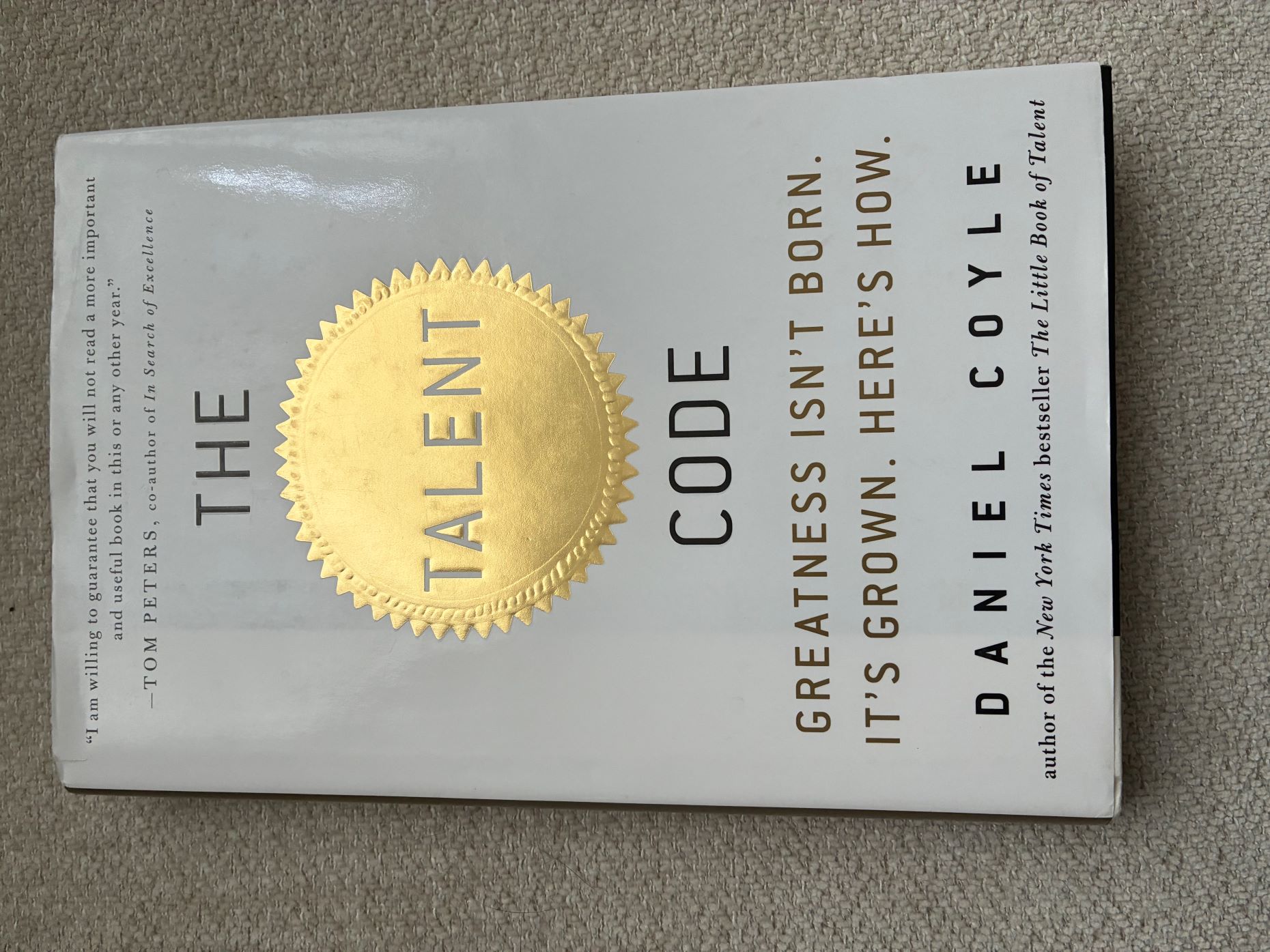
Because I was expecting something different, I was puzzled when I read the introduction. What do high performance teams have to do with a middle schooler practicing the clarinet? It is no surprise there, nothing really. OK, I am going to change my paradigm now, we are going to get educated on how to learn skills well. This is up my alley.
This is going to sound a little spacy but Coyle’s assertion is that the way we master skills is by something called deep practice. That act of deep practice in turn causes a bio-chemical reaction for the body to build a compound called myelin. This is the material that wraps nerve fiber. The more the deep practice, the thicker the myelin gets. This then causes the message transmissions to become faster and more precise. That is mastery.
The phrase deep practice has a specific implication. Deep practice is the act of working until a mistake is made, stopping and analyzing the problem and starting again at that point. Coyle uses a word exercise to try and prove a point. If you struggle with something then you are more likely to recall it and in turn master it. The list of words that he provided with missing letters was more memorable then the list where everything was filled out.
Coyle’s also asserts that there is a phenomenon out there that seems to line up with the theory anyway. Why do so many major league baseball players come from the Dominican Republic? It is because the culture has mastered deep practice when it comes to baseball. They are not a super race of baseball phenoms and certainly pound for pound when you look at Olympic medal totals it not because of genetic athleticism and deep population pools.
He also maintains that poorer demographics are more likely to use deep practice because they don’t really have any other options. They are less likely to have analytics and coaching, not discounting those things but they are making mistakes and learning from them which is what then leads to greatness.
If that is then true, I am reminded of several misguided coaches that I have had over the years. They boldly assert that the phrase “practice makes perfect” is wrong. It should be “perfect practice makes perfect” when in reality the first statement is actually more true. Someone cannot get to perfect practice without practice. And it should also be noted that using this theory, repetition holds no value. If you are not trying to do it faster or better or some other variation then likely you are actually repeating the same mistakes in your ‘perfect’ repetition.
Another novelty to me is the 10,000 hours theory does not play a role but not as big as you would think. Remember that is that it takes 10,000 hours to master something. But, combine Deep practice with 10,000 hours and you will be a master. That make sense for me because when I think about certain things like reading, sometimes I have a difficult time remembering what I read. I am sure that I have probably read that many hours in my lifetime and yet that information is only temporarily available. It goes into my brain and then six months later I would have to read the book again to even know what that is about.
And yet, I think that I am a pretty good programmer. I struggled and struggled to get it. After months of debugging I sometimes found that the program did not work like it should. Things that technically were correct did not execute in ways that they were supposed to. I learned from that particularly to be a better programmer and test my work in smaller chunks to the point that I didn’t need to do that anymore because I had mastered the nuance.
End Your Programming Routine: Despite the fact that this is not the book I was thinking that it was going to be, I actually think that it might be better than that. Sometimes, things that matter are comfortable and familiar, but sometimes they are stretching us and making us better. While a business book is interesting, this may not be the right forum. Next week, we will cover chapters 3 and 4.
Recent Comments