After my recent podcast about music, I got inspired to get my cassette tapes out. Since moving, I really had not even tested my full music setup. I have done a lot of record playing but I have not played any cassettes. I also haven’t used the CD player either. On Friday afternoon, I started organizing my cassettes and cassette organizer, image that.
While I have a lot of commercial albums, I also have a lot of dubbed cassettes. In all but the simplest cassette players, they would have two players. You could load two different cassettes for an extended music readiness, kind of like the 5-disk CD carousel. But the real purpose of having two cassette players in one device was to record while playing. That way you could duplicate one whole album. Or, you could create your own custom playlist i.e. the mix tape.
I many ways, the cassette was the most user friendly media of recent times. It was universal for all players, it was durable and portable. While the Compact Disk later had the ‘better’ cache in most ways it was not. The most prevalent type of CD was CD-R which meant that it was recordable. From that standpoint it could be recorded (or “ripped”) once.
The idea was that there were digital/perfect copies of the source with no audio quality loss. That is if you could get them to work. To this day, I still have my doubts as to the success of a CD recording. My experience has been half or less success factors. I have gone through stacks of blank CDs to get one recording made. Not with cassettes.
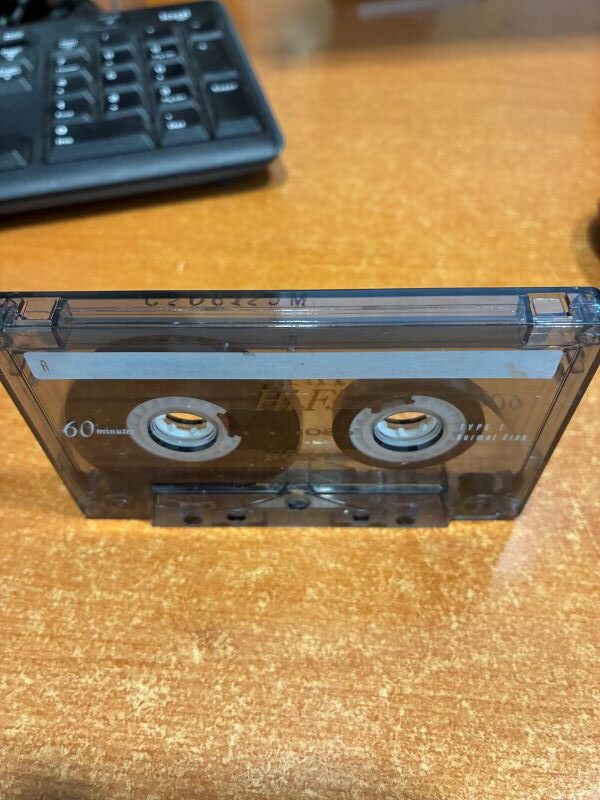
When you look at the top of the cassette, there are two tabs. Those tabs are the write protection. If you had a cassette that you were going to commit to, you break the tabs at the top so it would no longer be recordable. Of course, nothing is forever. If you really wanted to record over the top of a cassette, put a piece of scotch tape where the tabs are and it would allow the mechanical trigger to write again. Incidentally, the same was true with VHS tapes as well. A commercially produced cassette would not have tabs of course. But, it turns out that you could record over them by putting tape over the blank holes as well.
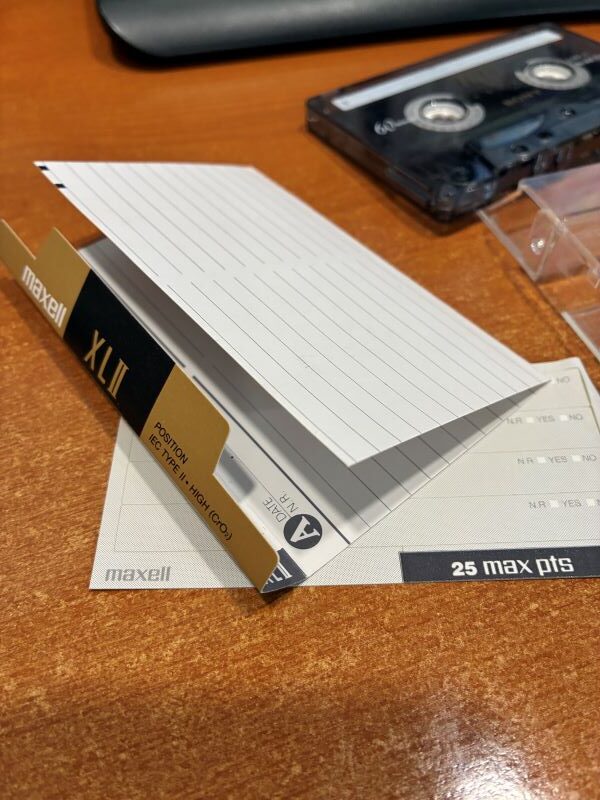
The best cassettes came at the peak of popularity. By that point, reliability and durability as well as affordability were completely worked out. They were also a system. If you see above, one cassette came with four labels. There would be a label per side but then the two extras were for when or if you were going to record on top of the first recording.
You can also see that there is a nice empty log so that each track could be written on the order of the cassette. If you were super cool or organized, you could note the song length or maybe the start time of the song for searching purposes. The liner note card were also perforated. A typical 60 minute cassette could hold seven, four minute songs. Clearly, there was plenty of room to document all of the songs on the first sheet. However, if you were to record over a cassette, you could throw out the original sheet and use the second.
On that topic, many high quality tape players offered a length counter. Usually it was simply some kind of meter that could be reset at the beginning. That way, there was some sort of indication of location on the tape. However, there was no standard so a counter reading on one brand had no correlation to a meter of another brand of player. Some of the smartest counters came at the end of a cassette with a time based counter. That was extremely rare because it meant that the gears that drove the counter had to be calibrated to the sped of a tape.
Cassette tapes were not just for copying music. You could record voices as well. People would record interviews, speeches, etc. they were also in answering machines. The advent of the audio book as well as self directed learning became possible. People could make a mixture of songs and music and it was really the first device that you could do your own self distribution for music.
End Your Programming Routine: When I look at my cassette tape collection, it represents a select slice of my life. That would be the mid-1980s to the early 1990s. There are many specific images that come to mind when I see a cover. It takes me back to middle school gym class or weightlifting in my senior year or a Boy Scout camping trip. If you don’t have any cassettes hidden away I wouldn’t go out and buy a whole setup. But, if you do have one go ahead and break it out to go back to a simpler time.
Recent Comments