These are the last two chapters of part one. I am going to spend most of this post talking about chapter five rather than six, for reasons that I will explain when we get there. The author’s rightly claim that to be successful in any endeavor, you must know ‘the rules’ of the game. Chapter five is all about the ten rules of boundaries.
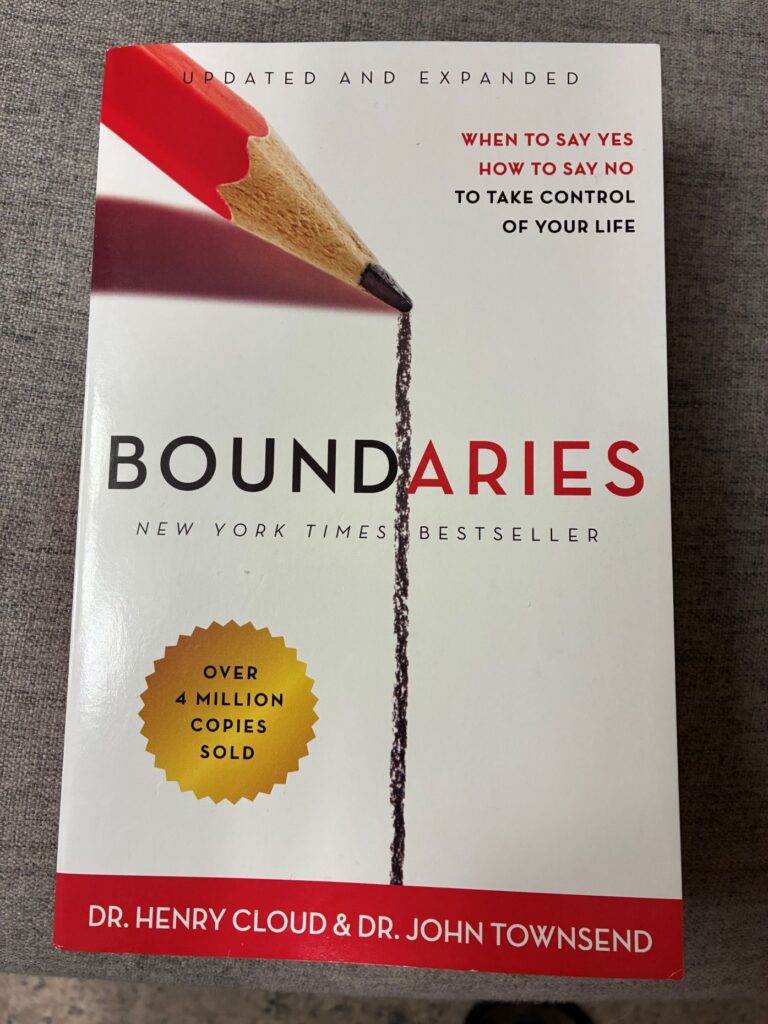
I will quickly list the ten rules below.
- Sowing and reaping
- Responsibility
- Power
- Respect
- Motivation
- Evaluation
- Proactivity
- Envy
- Activity
- Exposure
I don’t really feel like duplicating the work already printed in this chapter. It is redundant and I am not any sort of expert in the topic. In case you are not reading the book, it is probably worth putting some definition on each of these rules. It also helps me remember in two or three years what this book was all about. I do that sometimes.
- Sowing and reaping – This is pretty evident what it means. The one thing that struck me as unique is that sometimes people do not reap what they sow because someone else does it instead, see responsibility below.
- Responsibility – We cannot have successful boundaries if we do not take responsibility for our actions. A classic failure is the idea of codependency.
- Power – Just like the 12 steps idea, we have to acknowledge that there are some things that are completely within out control. By the same token, there are issues that entirely out of our hands.
- Respect – I think that this is two fold. The first is that we won’t get respect if we do not give respect. Similarly, we have to trust that others will respect boundaries if given meaning that if we don’t state our boundaries, some people may realize that there is a boundary.
- Motivation – We have to have desire to set boundaries. Usually that lack of desire is a result of fear of action like it will hurt someone else or make them angry. Our motivation has to be independent of what we thing the actions of others will result.
- Evaluation – This law is more about the how and when to express boundaries. It is true that setting down the line can cause hurt feelings but what are the repercussions of not doing it? Sensitive subjects demand sensitive conversations.
- Proactivity – State your boundaries up front. I do think that the trick is to perform the proper Evaluation before blurting something out that is out of context.
- Envy – The best way that I can describe this is that it is the opposite of what we want. We need to be aware of our own hang-ups to be able to effectively communicate what we do want.
- Activity – If I understand this correctly, this law is intended to keep moving forward. After you state your intentions, you have to follow through with enforcing the boundaries as well as staying in relationship.
- Exposure – Clearly, values and boundaries have to be known.
I think that the part that kind of bothers me about these laws are they are not clearly distinct. For instance, Proactivity, Activity and Exposure are closely related. Sowing and Reaping along with Responsibility are closely related. Envy seems like an anti-law. I will be honest, I think that this would have way impact if the laws were tidied up quite a bit. I cannot clearly say a particular scenario fits one law or the other.
Moving on to chapter six. I suppose that maybe this chapter was necessary. It is about the hang-ups for having boundaries. I kind of found it a weak, whine fest which is why I chose to not spend much time on the chapter. This is the list from the book.
- Boundaries are selfish
- Boundaries are disobedient
- Boundaries others will hurt me
- Boundaries hurt others
- Boundaries mean that I am angry
- Boundaries injure me
- Boundaries cause guilt
- Boundaries burn bridges
End Your Programming Routine: I had read to this point when I started writing about this book a few weeks ago. It probably explains my kind of sour start. Some of the earlier chapters I felt relatively insightful. Unfortunately, these two feel bloated and need refining. I suppose the alternative is that I am just not getting it, I guess that you can be the judge of that.
Recent Comments