Read along: http://www.ntslibrary.com/PDF%20Books/Mere%20Christianity%20-%20Lewis.pdf
I think I am on the wagon again. Maybe it is just that the holidays have actually provided a little bit of downtime and so I have been able to find a little time to read. That being said, I only have twelve more chapters to go. I am going to do my darndest to see this book through, in successive weeks. This week makes six out of twelve, so only one more week to go.
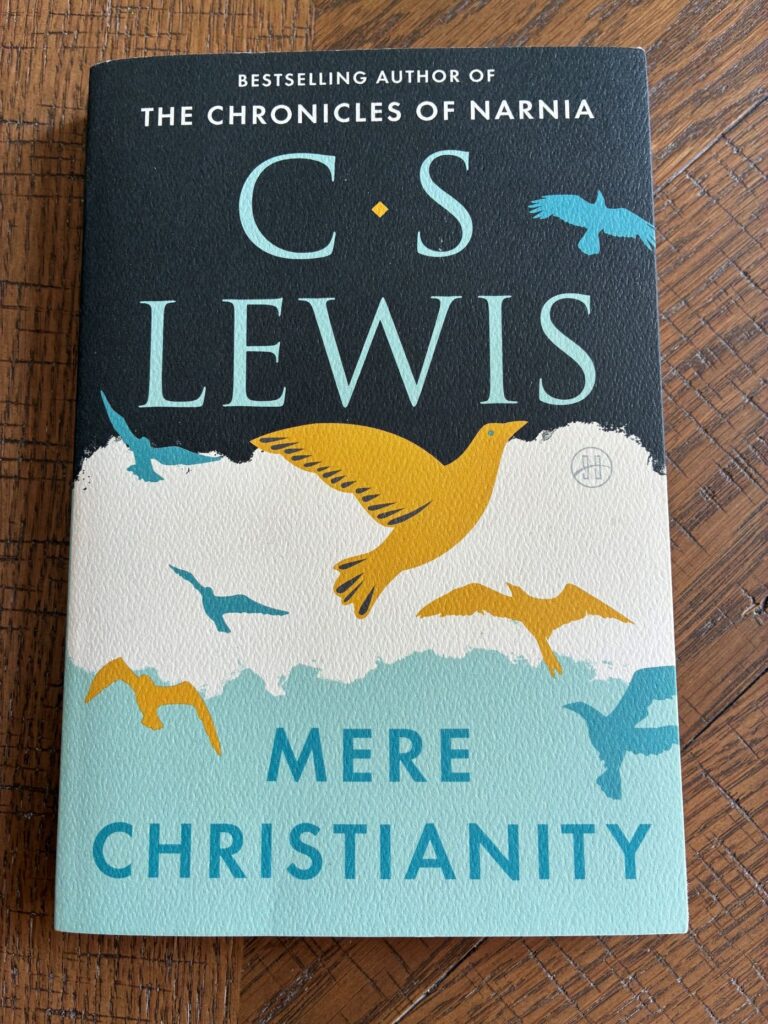
So far, I admire Lewis’ attempt to do something that has seemingly been impossible over 2000 years of history. That would be make a logical argument for the existence of God. Although I am already a believer, I cannot say that this book would have done it for me, yet. This section might tip the scales one way or the other. What I can say is that theology from an Anglican point of view probably won’t get it done.
Before I get ahead of myself, I want to throw a super quick summary of this week. Once again, this is a chapter per bullet Point.
- Introduction to Lewis’ take on theology
- The terms Bios – earthly life and Zoe – spiritual life
- Lewis chooses the idea of predestination over free will
- An introduction to the trinity – father, son and holy ghost
- Jesus is of God, man is from god.
- Salvation takes work. This is on purpose given that god could have created a perfect species, like Jesus.
I grew up going to church in a moderate, protestant denomination. In contrast, the Anglican church is a highly nuanced slice off of Catholism. This means that there are some relatively significant differences in Theology between the Christian belief poles of Catholics and Protestants. I would say now I lean toward more evangelical Protestantism which is probably even more different. One of those beliefs is in the trinity: Father, Son and Holy Ghost. Conservative sects treat each one of the trinity as individual units whereas the contemporary Protestants consider them one and the same.
I would say that is not worth going to battle over. But it is illustrative of something that is so fundamental in one interpretive of Christianity. For that reason, it is going to be difficult for a non-Anglican to take theology from an Anglican.
My family on my mom’s side is French. My grandfather was the son of two French immigrants. That makes me one quarter if you are doing the math. But the point being is that he was a dyed in the wool Catholic, church every Sunday no matter where you at. He even refused communion for almost forty years because of his divorce. I took a church official in Europe to re-instate him.
My mom has explained that the family felt that attending church was punitive growing up. It didn’t mean that she didn’t believe, it meant that she wanted to go about it in a different way. For that reason, she got caught up in the early 1970s crusader movement of the likes of Billy Graham. That is when she moved from Catholism to Protestantism. It never struck my Grandfather well as leaving the one and true religion. In fact, when I introduced my girlfriend as of Mexican descendance, he was over joyed that we might come back into the fold. He kept giving me Catholic publications to read and get educated. Sadly for him, her family also switched to Protestantism in the same time frame.
This is no slight at Catholism. I have a ton of respect for what the church continues to do for society, I just don’t quite go along with all of their beliefs. I would also be remissed to say that this is an organization that is made of people and has done a ton of bad things as well. That doesn’t take away from the potential to do good by acknowledging bad and working to be better. That is true Christianity.
All those words above are to say the it is difficult to take theology from only one perspective, especially one that I am already not totally jiggy with. Again, I should reiterate that Anglican is not Catholic, but it is so darn close. But heck, I should be giving Lewis props for attempting something so high brow.
There is more to this week than disagreeing over theology. I found some of his arguments very intriguing. Specifically over the word beget. God beget Jesus, meaning Jesus was of God. Whereas man is from god. This is why we are imperfect. If we were of God, then sin would not be an issue. The challenge to live a godly life is the test for immortality and it is not easy.
End Your Programming Routine: Some day, we will all know the answer to all of this. Rather than throwing the baby out with the bath water, I think it is best if I just read on and form my complete opinion after I have gotten the whole context. That is the fair thing to do. I had never considered that God could have just made a world of him and then none of this would be a discussion. I wonder why? I think we will find Lewis’ answer this week.
Recent Comments