I am trying something new this year for hunting. It is called a binocular harness and it straps over your shoulders so that the binoculars are securely stored on you chest. It is the number one piece of gear that is recommended by the Meateater staff. They say that it has revolutionized their hunting. Since they seem to be much more successful than me, I think that it is worth a try.
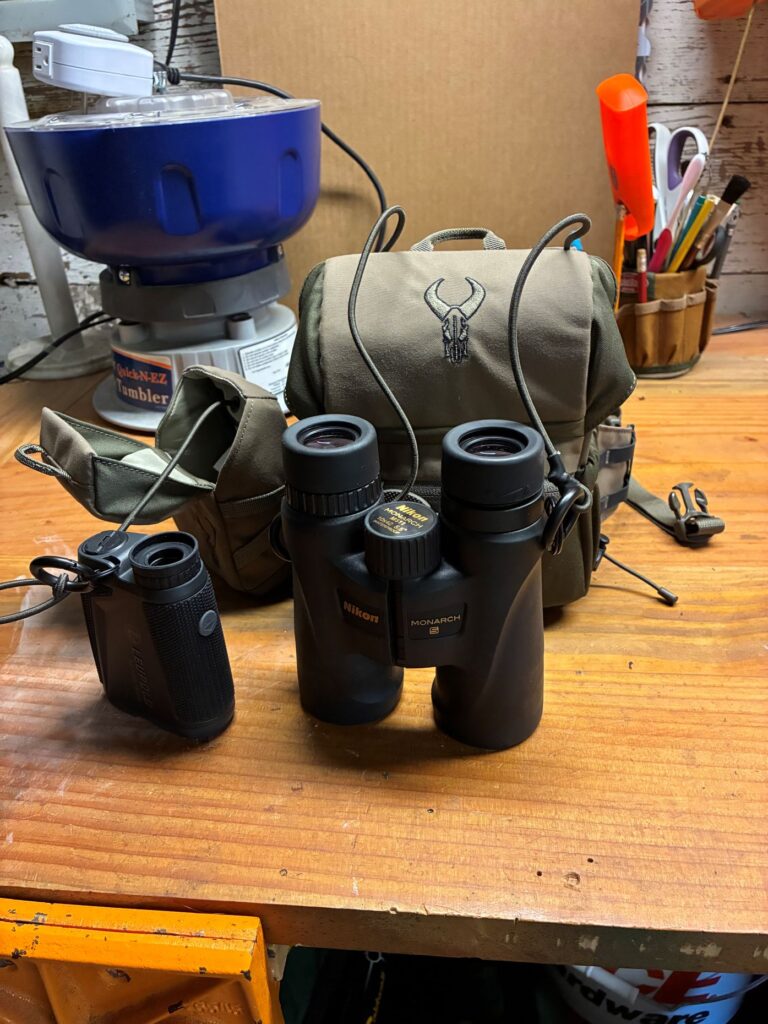
Meateater is not the only one that has noticed a problem. I have typically left these binoculars in the car because I cannot wear them around my neck and be agile in the woods. I have tried carrying them in my backpack but then I never have them when I want them. That leaves me doing the bulk of my work with mini-binoculars (8×30) which is less than ideal. But even those swing around wildly unless I have a breast pocket to put them in.
Some makers of these packs are also modular. I purchased the Badlands brand and it is. I recently added the rangefinder pocket. It attaches with the MOLLE (MOdular Light weight Load carrying Equipment) system. My rangefinder ran the similar fate as my binoculars, never there when I wanted it and too inconvenient to want it. I rationalized it by using it only when I was sitting to get distance bearings on certain landmarks.
I do plan on adding more accessories. There is a bear spray holster, a multipurpose pouch, a bottom pouch and even holster attachments available through Gunfighters Inc. This way the gear can be setup for recreational hiking, bicycling, hunting or whatever since the chest is typically free space. I do plan on packing it for some practice hiking before the season starts. I think a full, after action report is appropriate in October.
There are lots of cheaper options out there than the Badlands brand. Believe it or not there are more expensive options too. All of them have the same basic premise, mount the binoculars on the chest so it doesn’t swing around. Most of them also have a rangefinder pouch as well. That makes price ranges from $50-250. Of course, I wasn’t able to handle and try on all of the options but it was the Badlands that seemed to be available at every retailer.
The features that I liked were magnetic lids. This makes for a quick and quiet removal of the optic. Each unit comes with quick connect rings and tethers so the expensive things are safe from dropping as well as can be kept out for ready use. But, the quick connect doesn’t keep the optic chained to the harness semi-permanently. It can be removed very easily and quickly for other uses.
They come in different sizes and mine is a pretty stuffed 10×42, size medium. I think that you want them snug because you certainly don’t want stuff bouncing inside the pouch. That being said, it doesn’t leave a lot of room for things like your phone or GPS. This is why the accessory pouches are necessary.
I think another advantage of the Badlands brand is that modularity and their other products. I know for sure that the MOLLE accessories can be attached to their branded packs. I assume that some accessories can go the other way. But realistically, any MOLLE attachment should work as long as it fits the space.
I want to be careful and not fall into toolbox fallacy. You don’t need this to be successful. In fact, most of western Oregon hunting is temperate rain forest and optics are not that useful. The very best tactic is to be out there looking with or without binoculars. But, this year I am hunting the significantly more open central Oregon and I am hoping that having my better optics with me is a tactical advantage.
End Your Programming Routine: I still have to try out the harness but I think the best use case for this is when you want to be beating the bush with quick access to binoculars. That means that if I was just a hiker, I think just sticking with the 8×30 binoculars and save the bulk. But, I could see serious birdwatchers or nature lovers finding them convenient. They are really purpose built for hunters.
Recent Comments