Tag: Japanese

December 11, 2025 – Nobu: A Memoir

Do you know Nobu? I really didn’t until I read this book. Nobu: The Memoir is the Left Coast Culinary Book Club for November. Yes, I know that it is mid-December and that is how far behind I am. The good news is that this month we will be doing a comfort themed book with everybody using the Betty Crocker cookbook. I am not reading that one.
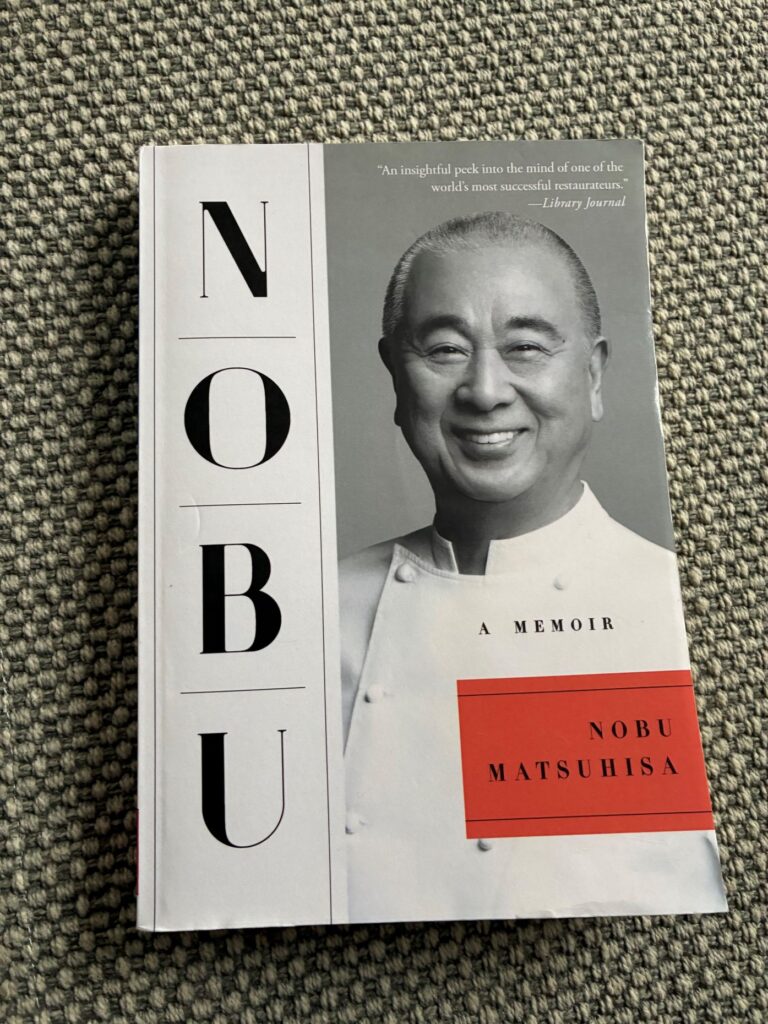
So, who is Nobu? He is the celebrity chef that is credited with popularizing Japanese food in America. According to his story, he opened his first and flagship restaurant in the LA area in the mid-1980s. My truth is that I have never heard of him until I read the book, but I am certainly aware of his protégé Morimoto from Iron Chef fame.

I think that his fame to me is a bit circuitous in my life. Living on the West coast, we have always been closer to Asia. When I was in early middle school (about that time frame), we hosted a Japanese Exchange student. My wife had a Japanese student as a roommate (mid-1990s) and they are still close today. This is a long way from eating and liking Japanese food but it was exposure.

This was also the time frame that Japanese cars became main stream acceptable. You have to understand that there was a lot of anti-Japanese bias prior to this point. There were too many long memories about war in the Pacific as a result of World War II. My own grandfather, refused to even be passed on the road by a Volkswagen. But, he did buy a brand new Honda Accord in 1982. As new generations succeed older generations, that icy acceptance starts thaw.

None of that has anything to do with the book but I was setting the table about how this was something new. I won’t give away all of the book but Nobu’s path was interesting. As a result of getting in trouble as a teenager, he was sentenced to supervised training as a sushi chef. That foster relationship turned out to be a globe trotting opportunity for Nobu.

Adherence to principals, proximity and providing something unique were also fortuitous to Nobu as well. This is where he met Robert DeNiro and where his celebrity status became solidified. With DeNiro financially backing exclusive expansion Nobu went from being a principled establishment to a luxury brand.

It is kind of surprising that I had never heard of him before. But then again, I don’t live my life by the Food Channel or food media; I participate in it I suppose. Unfortunately, I didn’t get to the point in the book where he had an establishment in Las Vegas until after we came home. Otherwise, I would have made a point to go there considering I was reading the book on the plane there and back.

I never want to attribute success to luck. I do think that there was a bit of luck involved but I do not want to discount that Nobu created a lot of that luck. He is a big believer in craft mastery and good ideals. This would be things like making sushi to the best of his ability as well as greeting all of the guests at some point in the meal. If he would have just stayed behind the prep station, he possibly would never had met DeNiro.

I think that Nobu’s personality really resonates with me. He has no faith in pedigree. A person may not have all of the ultimate abilities to become a head chef when they are a dishwasher. But, on the other hand they are almost always capable of more. Master one skill and take the opportunity to do the next thing. There is a lot of grounding in that methodology as well. It helps a person have compassion for others.

I have found this in my own career when I started working for these mega corporations. My experience got me hired but my degree status has kept me pretty static over the last five years. I don’t have an MBA and I am not really that interested in it. But because I don’t, I just keep doing what I am doing regardless of the fact that I am capable of so much more. Nobu definitely doesn’t run my company.

He also talks about the concept of fusion as well. Nobu says that fusion is not two dissimilar things put together but a respect for local ingredients adopted under the practices of a Japanese restaurant. He used an example of a popular slider that got nixed from the menu because the Japanese palate traditionally doesn’t use bread buns. They instead developed a rice cake version. I respect that.

End Your Programming Routine: I like this book because I found it inspirational. It is a true American success story. It doesn’t talk too much about the food, but it definitely has inspired me to respect the craft of sushi more than I have. With my experience being almost exclusively national chains and ‘Asian’ restaurants, I really would like to try something made with passion and an eye toward excellence.
June 26, 2025 – Finding Something New

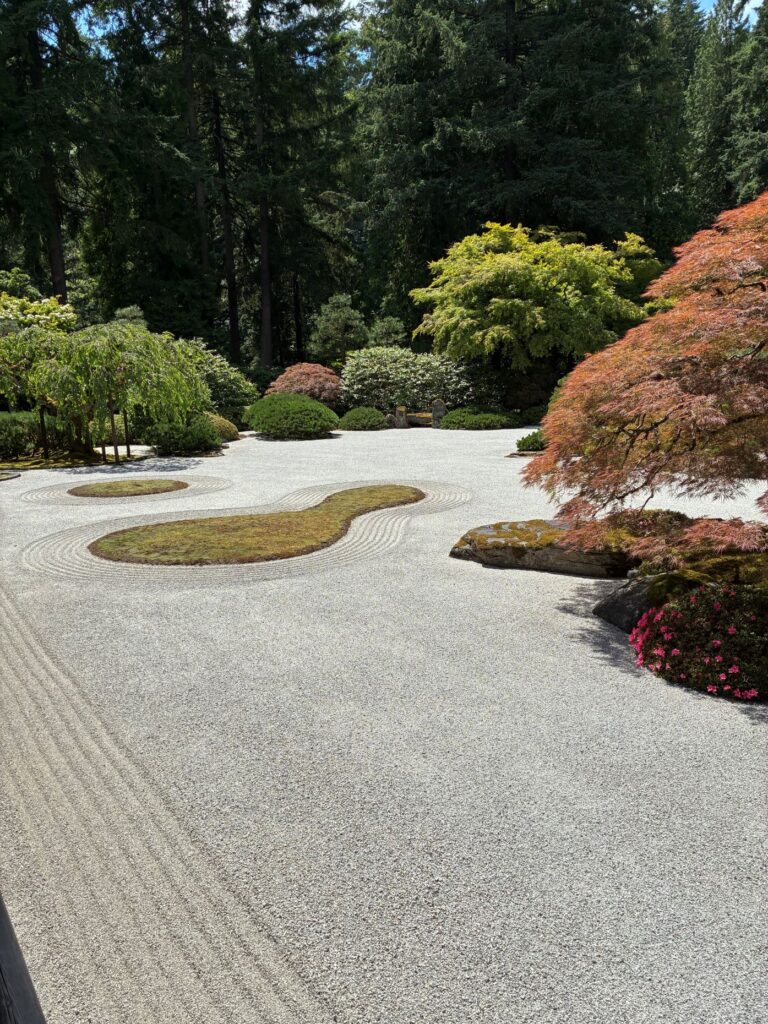
Touring out of town visitors can sometimes be a boon for local discoveries.  We took a Portland day on our recent vacation to see some of the local sights.  It is not that I didn’t know about the Portland Japanese Garden, it is just that we don’t go up that often.  Probably the bigger thing is that at $22 per person, it is something that you want to commit to.

One of the things that we take for granted on the west coast is our proximity to Asia, relatively speaking.  What seems relatively foreign in say the Midwest is everyday normal here. Of course, I am speaking primarily of things like food and culture and not so much ‘Made in …’.  Even so, I think that goods like cars were much earlier accepted here than in other areas of the country.

What binds us and Japan is multi-pronged.  One of which is a very similar maritime climate.  It makes the vegetation and the landscape look very familiar in both.  The wood-built society resonates strongly with both and the evergreen backdrop that is carpeted with moss is our world.

What I respect about Japanese culture is the attention to detail.  It seems like many things are specifically deliberate.  It could be things such as tea or calligraphy or food preparation or gardens.  The idea of efficiency is to make sure that everything has a purpose versus our idea of efficiency is to get more with less.  It is no wonder that they invented concepts like Lean Manufacturing and total quality management.

I am not necessarily in love with everything Japanese.  For instance, they have a wood working culture that is every bit as deep and respectable as the western one but I find myself always leaning more European than Asian in tooling, methods and design.  I know that my thoughts are biased from a lifetime of cheap, mass produced junk rather than the respect that a true artisan can muster.  When I see great execution, then I acquire a newfound respect and seeking more inspiration in far eastern techniques.

The gardens are beautiful.  They were created in the 1960s as homage to our connections that I talked about above.  The thing that I will say about it is don’t expect to get the full experience as intended.  I found that there were just too many people running around to get into a zen state.  That probably says something about my westerness as well that I am unable to fully block out distractions. 

When you enter the gardens, there is a short walk up the hill into a faux, simulated village.  There is a gift shop, concessions, offices and conference rooms and a small art exhibition.  The gift shop was closed due to a technical, card processing glitch.  The art display was pretty minimal with dyed textiles and finely cut paper stencils.  Leaving the village was a bonsai display which was very cool but the volunteer could literally answer no questions about the art.  I was starting to feel pretty underwhelmed at that point.

Leaving the village takes you into the garden proper.  There are five distinct rooms or gardens each with their own focus on landscape, plants and features.  In some ways, I feel kind of bad because a lot of what is used is native or common but just pruned to look good and fit in with the vibe.  It makes me feel like this type of environment could be affordably achieved if I just put in some effort.  

One time, I purchased what was labelled as a Japanese Maple at a local plant sale for $0.50 and it just kept growing and growing.  Talking with a local landscaper, he told me it was actually a sweet gum tree.  Now it is too big for where it is placed.  I am kind of in a dilemma of whacking it extremely and trying to keep it small or taking it out completely.  So much for my tip of the hat to the Asian garden.

About five years ago, I purchased a bonsai tree at a local nursery, it was some kind of elm variation.  I placed it in a terrarium for my touch to our home décor as Asian in a Victorian go well together.  It looked great for about a month and then it started to die.  My theory was that the humidity level was whacked due to the enclosure.  But, this trip has inspired me to try again.   Amazon seed kits start at $25 and you get at least five different chances.

End Your Programming Routine: According to Trip Advisor, the Japanese Garden is the #9 attraction in Portland.  It is beautiful and it is expensive.  I would say that if you could get in relatively alone and take your time then it would be worth it.  If you are in Portland for a week and looking for things to fill up the time, it is probably worth it.  My bottom line is that if you cannot meet those criteria, then I probably wouldn’t go out of my way to squeeze it in.  To that end, if you live relatively close to Portland and haven’t done it make time to see what it is all about because it is pretty inspirational.