While training for my half marathon ten years ago, my wife bought me this Garmin Forerunner 10 as a birthday present. As I have stated many times, it really wasn’t my goal to run a half marathon but I committed because it was something that she wanted to do. We could do it together. It couldn’t hurt my health any.
Garmin promised seven days of GPS on runtime and two or three weeks of regular operation. The way it worked is when you pushed the ‘go’ button, it would record a bunch of GPS coordinates as cookies. When you synced the watch, it would put those events into maps and then you would have your runs plotted. Those could be accessed when you log into the Garmin website.
I have to admit, I had no desire to be some sort of athlete. But, I did use the watch each time I ran. I would periodically check the maps to see if my pace was getting better. Honestly, the best part about the watch is that it would track your distance from the time the start button was pushed. That made training much easier because I could run halfway and then turn around to get my intended mileage.
The watch never lived up to it’s advertised runtime. When it was new, I could track one or two 5K length runs and it would be depleted after two days. It started getting to the point where it would die before the end of a half marathon with the GPS on and a full charge. By the time I did my actual race, the watch was unusable for tracking. I had to go back to the old fashioned way of timing my pace. It did work as a basic watch for about a week in between charges. So, that is how I used it.
You know how I hate to throw things away. I inquired about the ability to repair the watch. There are no serviceable parts. Where have I heard that before? My son’s e-Bike. The watch gathered dust form quite a few years until I looked up online and there are plenty of how-tos on how to do this. I never realized that there were rechargeable and non-rechargeable CR2032 batteries. The trick was that I did not want to order 10 of them, just one good one. That is what I did, I ordered one battery.
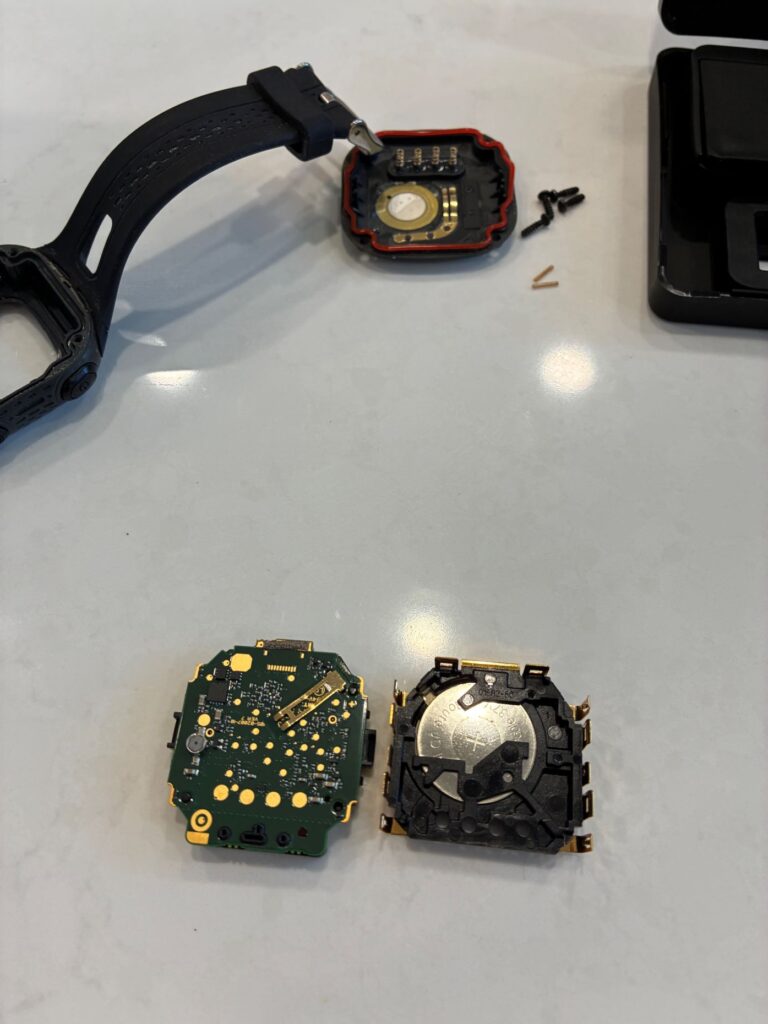
Why Garmin would say that there are no serviceable parts is beyond me. It actually looks pretty straight forward. You open the case, carefully disassemble the electronics and then swap the battery. It is assembled in the reverse order. This was a lake house project that I did. I took all of the stuff with me and I did it in the afternoon.
I plugged the watch in and it appeared to be charging. That is where I left things until the next day. When I took it off of the charger, all I got was a triangle, the sign that it is off and charging. Pressing the power button yielded not change. I did further research to say that it needed to be synched but I didn’t have my computer with me to do that. I tried to sync it when I got home and the watch was dead.
The battery indicator shows that it has a full charge but the watch does not function. The whole point of this was to see if I could sell it for $10 to some aspiring runner. I have to say that is certainly not going to be the case. I should probably spend some more time troubleshooting this watch. Now that I am home, I could certainly try some multimeter tests and another attempt to disassemble and re-assemble. But is it really worth it?
I have already moved on to a new model watch. I have also invested $6 for a new battery and time to do this battery swap, not to mention a $10 watch band replacement all in the name of keeping this watch out of the landfill. I also hate to be defeated and I cant simply admit that something so seemingly simple does not work.
End Your Programming Routine: It could be that I did not put this together correctly. It could also be that this thing has ran it’s course. I don’t really know the reason. My problem is that I have bigger fish to fry now. The time to wheel and deal cheap electronics has past. I have to get onto the business of moving to the new house. I haven’t fully conceded yet but maybe sometimes no serviceable parts actually means what the phrase implies.
Recent Comments