Tag: fall gardening

July 29, 2025 – Let’s Try These Reusable Cubes

I went into a chain farm store the other day on a whim. It has probably been six months since I had last been there. I stopped buying dog food there a couple of years ago because it was $10 a bag more than another local store. I would buy it there if that was the only local option but the price savings is nothing to sneeze at.

When I went in, I had it in my head that I was going to peruse the news stand. They carry lots of titles that I enjoy namely Backwoods Home and Self-Reliance but really lots of things like that. This is when I ran across these reusable seed trays by Burpee. Clearly, I don’t know how they are going to work, but the idea sounds good at least.
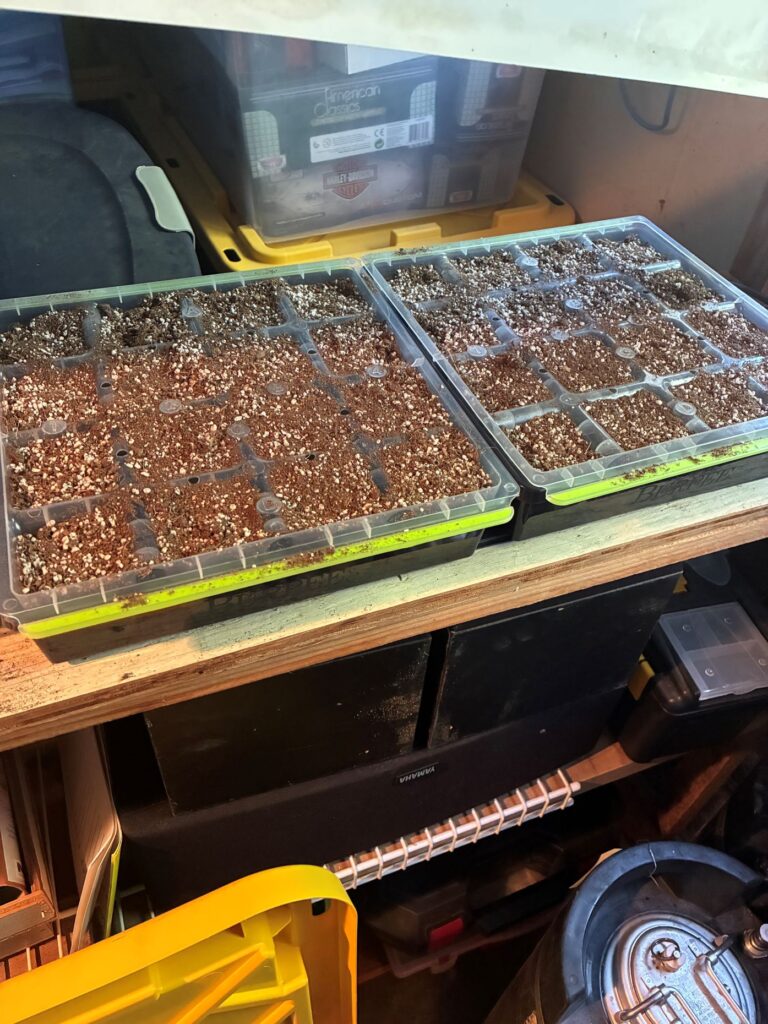
In recent years, I have been using peat cells that fit perfectly into proprietary trays. They are pretty small so each tray holds 72 cells. That is a lot of starts for me. They do work but based on my propensity for negligence, I feel like optimally they should be transplanted into larger containers before planting.

These reusable cells are significantly larger which translates into a much larger plant and more likely to take off when planted. I think the theory is that the root wad will hold the cube soil together which allows these trays to be re-useable.

There are several features about these trays that I like. The first one is that they are re-useable. One of the problems with the peat cubes I find is that they are a seasonal item. Once the season is over, they are gone from the stores. The last time I bought a bunch of them, they had to be found and taken down from the high stock shelves on a fork-lift. This big box was the only place I could find them in retail and not exactly ideal when you are looking to start out of cycle. I know, Amazon is a thing and it is largely season agnostic. But again, I would like to do this with less inputs. I don’t like really relying upon consumables for success.

The second thing I really like is that the cells are gridded. This means that you can easily and accurately keep track of what seeds are in what cell by the label. I have tried all kinds of things, none of which I love. If each cell is not identified then you are confined to a row of one variety or devising some other method. For instance, this year I made a ton of straw markers for a bunch of seeds that never germinated.

The third thing that I like is that the water is in a tray below the cells. This eliminates the flash flood type watering when using a can. I have often had seeds end up in other cells because the watering process was too aggressive. Then, I am guessing about what is actually growing and I question myself about thinning.

There is one thing that I am going to have to see. There is no humidity dome to cover the trays. I think that they pose two advantages in this situation. One is they keep the water from evaporating, especially when the trays are on a heat mat. The other is that I believe they help keep the temperature inside the tray. This is the we’ll have to see part.

As soon as I get results from my seed germination testing, I am going to start planting. I already have a pretty good idea but I don’t want to spoil the results here. I wish that I had started the seed testing weeks ago because I don’t know if I am going to have enough time to get a root ball to solidify the cube. I will have to roll with what I have.

End Your Programming Routine: I’ll be the first to say that technology does not make the expert. It doesn’t make you the best golfer or chef. Once you have the fundamental skills, technology makes things faster, easier, better. I am still working on those gardening skills but I am hoping that these new cubes will make bigger, better plants when they actually get into the ground.
July 24, 2025 – The Seed Test

I have spent some time soul searching and have come up with some answers. A large part of why I failed at getting motivated to plant a garden this year was because I had so few seeds germinate. I had new tomato seeds, new tobacco seeds and and kale that actually sprouted. Everything else was just dormant or dead.

The urgency to get a bed prepared was tempered by the fact that I would have to buy pepper starts and it was too early (at the time). Things remained at a stand still because this weekend was too busy, I’ll think about next weekend until that came and went. Pretty soon it was really too late to get started.

I was looking at my seeds and I was on a kick to pickup free seed packets at the library at one point. Many of the seeds I have, came from that mechanism. Most of them are at least seven years old and the truth is that I have been struggling with successful germination since I have started using library seeds.

I find it hard to believe that they have mistreated their seeds any more than I have the ones I purchased. Before library seeds and my germination station, I used to keep them in my garden shed where it would get to freezing in the winter and 120 degrees in the summer. I never really worried about germination because it was never a problem. Keeping them at room temperature for a year seems like a no brainer compared to what I was doing.

Now I keep them in the basement in my seed starting area. It is always dark and cool varying from 35 – 60 degrees. This should be even better than room temperature at the library. What I really need to find out is if this is a seed viability problem or some other factor. I am going to describe a seed test that I have used in the past in just a second.

But first, is there any other problems to consider? I think possibly yes. One of the things that I have noticed is that I am trying to start a batch of different things with different germination times. I use a humidity dome and heat mat that is supposed to jump start or optimize the process. I usually remove the dome when the first plants start to touch the top. It may be that those longer germinating seeds just don’t have optimum conditions to germinate when competing in the same conditions. Ideally, I would have more granular control over the humidity than all or nothing.

It is quite possible that I am trying to use a one size fits all approach inappropriately. Meaning, I started one tray of different things and they all got the same amount of water, light, humidity and temperature. I do know for a fact that different seeds optimally need different conditions.

What seems more likely to me to be the problem is that the library seeds are just bad. I don’t know their origin, they could have been reject lots that were donated. Given that my new, purchased seeds seem to be viable and my seed collection has morphed primarily to library seeds, this hypothesis is supported by the data.

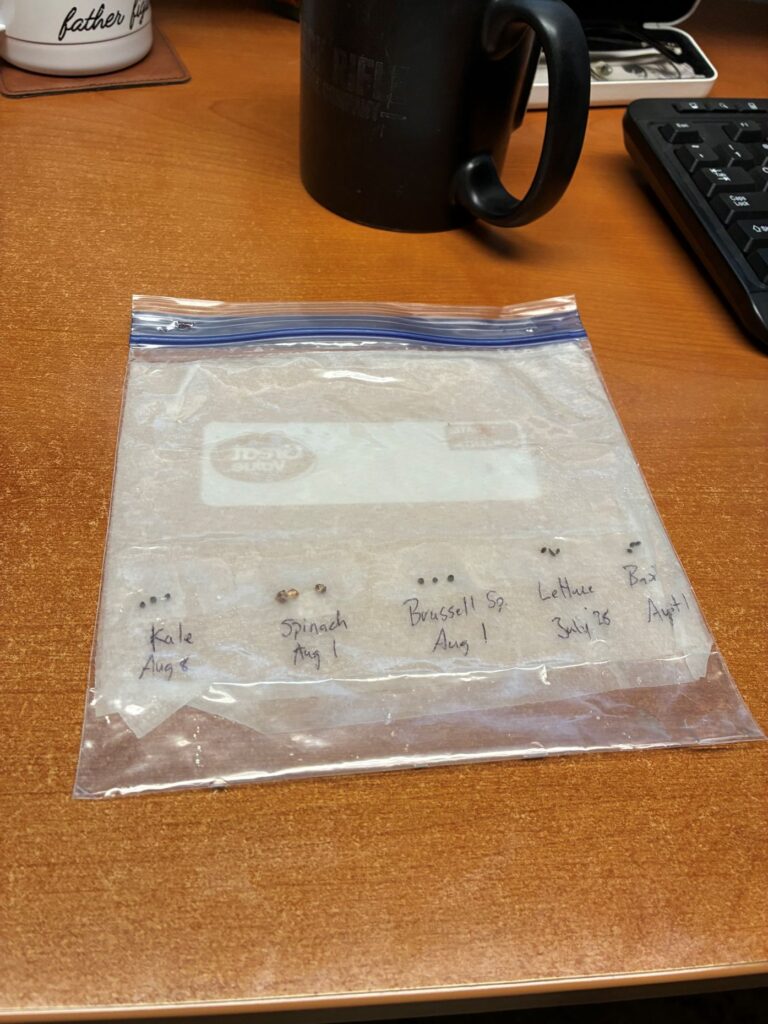
Like any good scientist, I designed an experiment to test this hypothesis. The apparatus consists of a wet paper towel placed inside of a plastic bag. The seeds were marked as to what they are and I dated the last expected germination date. That bag is placed in a dark and warm spot and left alone. The last time I did this, I put the bags above the refrigerator. This time, I have them on the subwoofer in my office (behind the couch). If they germinate, they are viable and if they do not I am throwing them out.

A proper experiment would use new and old seeds. I did buy some new seeds and I didn’t think that I was going to write about experimental design when I put this together. But, here we are. My plan is to start new seeds if these do not germinate by the date I have on the test card.

End Your Programming Routine: I am not badmouthing library seeds. In fact, I hope that this works and I have some other problem. The library is a great resource and I love the idea of picking up new things that I wouldn’t buy otherwise. Unfortunately, I just have not had good results to date and this seems like the most obvious source given my several years of anecdotal data. Maybe the truth is somewhere between my hypothesis and the other variables. But, it is not how I realistically do things so it would be good to find out what is going on with the seeds from the library.