This is one of those gems that gets found when you rent before you buy. As an aspiring coastal dweller, I know that it rarely gets above the mid-seventies in the summer. There are often times that when it is near 100 in the valley where I currently live, it can be in the 60s and sometimes even raining at the coast. I have no qualms about what the cooling capacity is needed for comfort at the coast and I would have expected that the heating question is solved in spades.
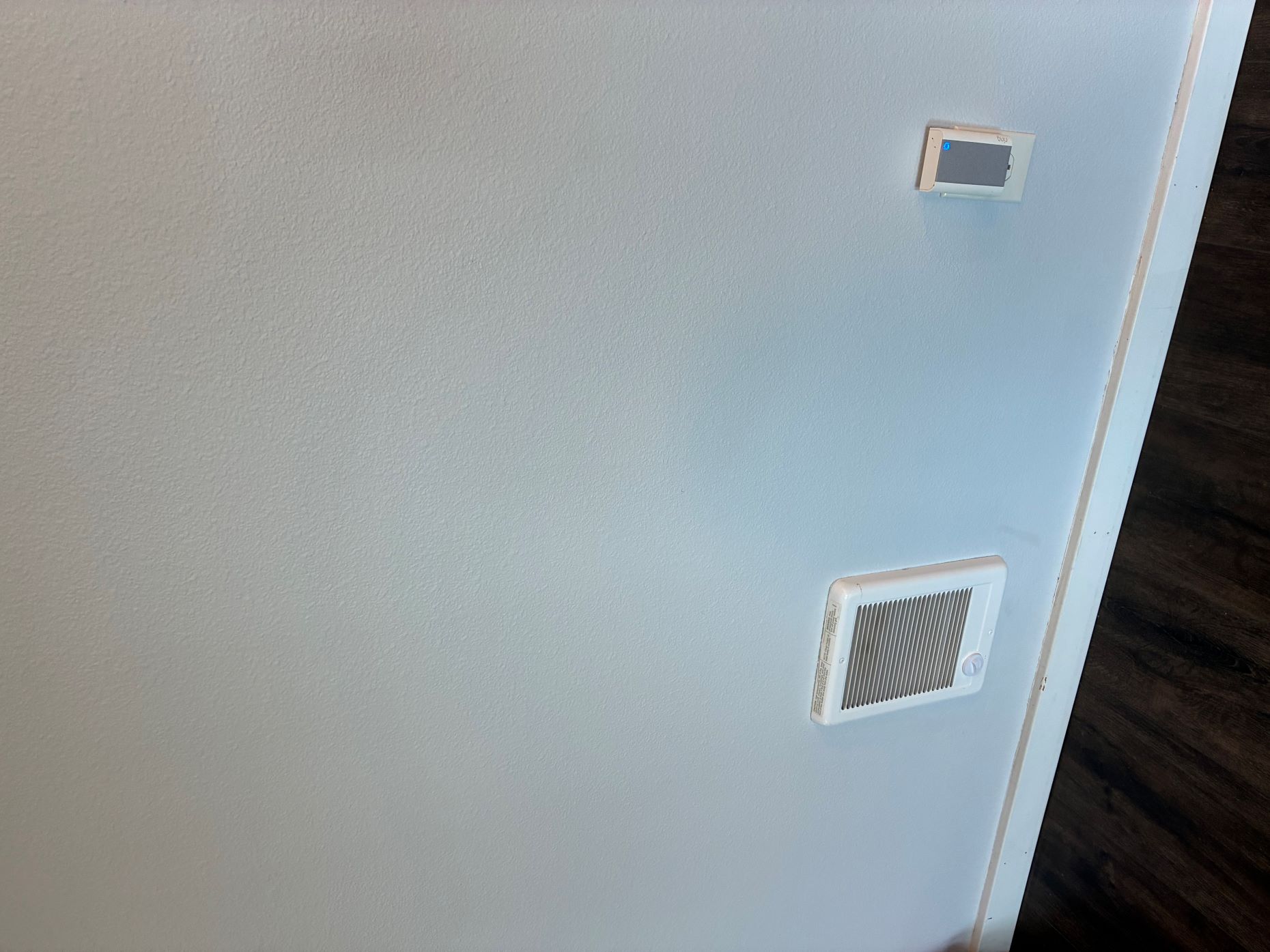
After we made our offer and toured a second time, I discovered that our new house really has inadequate heat. The picture above is one of two units in the living space on the main floor. The problem that I have observed is that it takes up to 24 hours to get the living space comfortable and that is because a lot of the heat goes up the stairs (mind you, this is with all of the doors closed).
It has been almost thirty years since I have lived in a unit with electrical resistance heating. They are pretty common in rental units, I put them in my own ADU. In fact, I used a double sized unit in the living area of my 650 square foot space. You can see why I am skeptical that two of these will be enough for 1200 square feet.
It will make a difference when we are living there and not trying to heat a space from 45 to 70 in a couple of hours for a quick overnighter. Our New Years stay was our first multiple night stay and we installed one of those weather stations to try and get a handle on how long it actually takes. I would say a good day to get comfortable.
I won’t say that we cannot live with it, because we can and we will. As long as things keep up, it will be alright. The worst case scenario is I have propane, kerosene and space heaters if needed. My wife won’t like it and those will mess with the Feng Sui of the home but we won’t have to be cold. Adding mass such as furniture will make a difference in the operational duration of the heaters. I have observed that they pretty much run from the time they are turned on until we shut off the lights to leave in an overnight stay in an empty house.
Let’s not get too rash until we move in and see how it goes. While the climate is always cool, fortunately it is rarely severely cold. It will occasionally snow and by that I mean once every couple of years. Temperatures below freezing is a couple of times per year but not extended days on end. I am looking at my temperature while I am writing this and it is 32 degrees here and 40 degrees at the lake.
Electrical resistance heating is cheap to install but very expensive to operate. Hence why it is seen so often in rental units. The landlord never has to reap the consequences of the installation decision. That doesn’t mean that it doesn’t work. I do think it is ideal in small spaces particularly interior ones. Those would be things like bathrooms, laundry rooms and occasional bedrooms. I don’t love them for bedrooms because of the potential fire hazards and they are a poor substitute for a furnace. They just don’t have the power to heat things quickly and have to run a long time, think spinning dollar signs as they operate.
Think about it this way, two of those heaters can be put on one standard 20 amp 110v circuit (yes, there are lots of different models this is one example). That is 2000 watts of of electrical consumption. Our heat pump is on a 60 amp 220 volt circuit. Whether it uses all that power or not it has a potential to consume 13,200 watts of power. Doing that math, that is 13 individual resistance heaters. The unit cost of those heaters are currently $167 each meaning the overall materials cost is roughly $2,200 whereas a full size heat pump furnace is at least $10.000, not counting duct work.
I don’t have time to go into all of the technical details today however heat pumps pull heat out of the air and into a carrier fluid over a coil to be blown throughout the house. Only when the outside temperature is cold (less than 35) does a resistance coil kick in to add supplemental heat. This is why operating a heat pump is significantly more efficient than electrical resistance heating because you are mostly using electricity for a fluid pump and two fans.
Heat pumps are not the only technology choice. The advantage of heat pumps over furnaces is that they offer cooling in the warmer months with the same technology. In our case, an all electric home, it seems like an obvious choice without having to connect gas or find a place to put a wood/pellet stove. To further subdivide the category, a mini-split is a certain type of heat pump that doesn’t use ducts (think hotel room). They also tend to be at least half the cost of a traditional heat pump without the footprint or infrastructure.
End Your Programming Routine: In our future, I actually see two things, one is propane and the other is a mini-split. I will talk about the reasons why in some future post. I know that electricity is going to be expensive but so is retrofitting this house and we are tapping pretty hard on reserves to do all of the inspection items like replacing the sewer line and new porch railings. All told, we are about $15,000 in repairs to date and we haven’t sold the house yet. Wait and see is not just practical, it is also necessary.
Recent Comments