Tag: Developing Healthy Boundaries

September 19, 2025 – Boundaries, Chapter 17 and Conclusion

When I was planning on how I was going to break this week out, I really didn’t know what was in chapter 17. The fact that it is a fictional story of the women that previously did not have boundaries and how she was buffered around by life and now she is promoted and in control I find to be a little bit pedantic. With that said, I am not going to address chapter 17 any further.
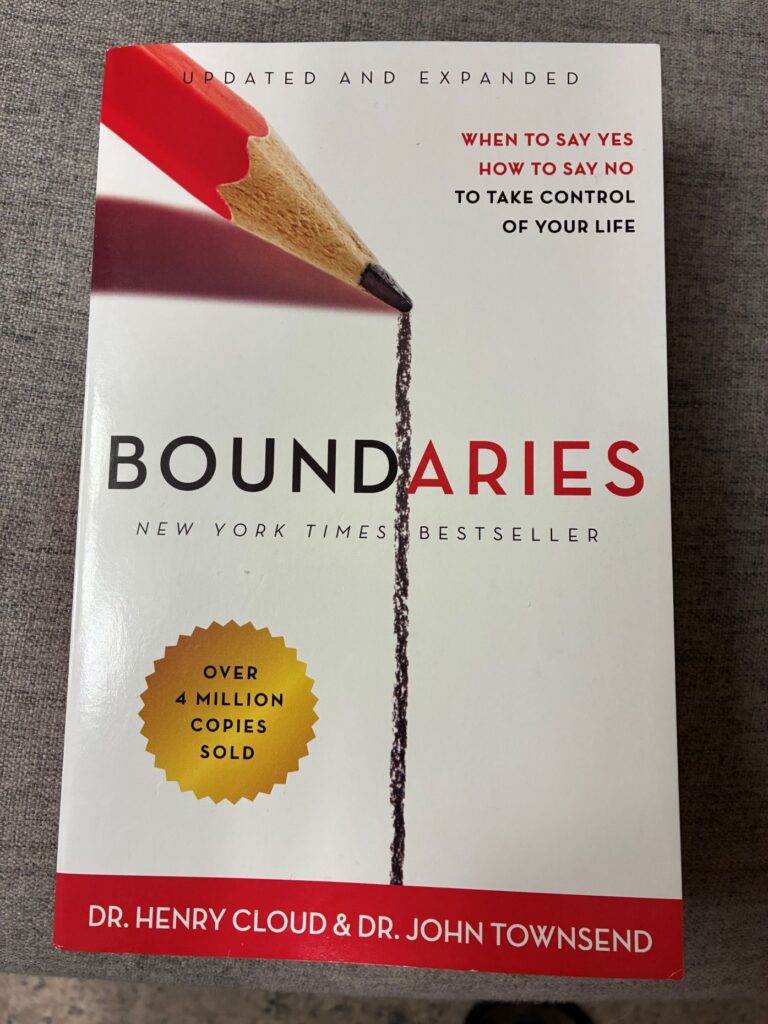
I won’t say that I did not learn anything from this book because that is not true. But, what I will say is that I found myself annoyed reading it sometimes. The bent toward being too Christian to have boundaries and the anecdotal fiction that ‘read this book and everything is going to be alright’ is problematic. I don’t think that if Dave Ramsey wasn’t constantly pushing it that it would have ever made the sales numbers that it did and for good reason. It just is not that good.

Let us not throw the baby out with the bathwater though. I know from personal experience that when you have deficiencies, it is extremely difficult to change even with cognizance. I really appreciated the perspective that you cannot fix it yourself. Even when you read chapter 17, Jean didn’t change her boundary problems alone, she had a therapist and a support group. I think that is what to take out of this book, serious boundary problems need help.

If you think that there might be a problem, reading this book is a good step in sort of getting a baseline. This also requires that you read it with intellectual honesty. It should be read, digested and contemplated. If you do that, then I think you will eventually come to the realization that there are things that can be done but real change cannot be done alone.

What more can I say? I guess that if someone were to ask me what to do about addressing boundary problems, this would be my first suggestion and really because it is the only one that I know. That being said, this is really not a recommendation. I think that if you knew nothing about anything, “Seven Habits of Highly Successful People” would be much more valuable even though it is not a one for one subject replacement. It is just that if you think of life holistically, one situation shares many similarities with many others even if they are not related.

Another thing about this subject is that there is only one person that can be changed and that is yourself. It is very difficult to deal with someone that is overbearing, especially if you are a pleaser like myself. They have to have the same realization that they have boundary problems and want to do something about that in order to have a day with boundaries.

As I said in the opening week of this series, I have been wanting to read this book for over ten years. I was married into an entire family of significant boundary problems. Just one example was that when my sister-in-law got married, that night they were paid a visit by the parents at their hotel. Years later, they laughed about it because they intuitively knew how wrong that was and yet they never internalized how damaging their constant inappropriate behavior was.

Quite possibly if I had read the book ten years ago, I would have realized that I should probably done some things differently. That is unfortunate because the primary reason for wanting to read the book is no longer with us. Possibly, I missed an opportunity to be a better person earlier then when I realized I also have boundary problems, just of a different nature.

End Your Programming Routine: Let me bottom line this book. I am glad I read it but I really don’t recommend it. I get it that it is intentionally marketed to Christians but I found the biblical case and support too weak. I also think that waving the Christian flag was a crutch for the not addressing the significant numbers of secular interactions we have every day. As an example, nearly every single person I interact with at work is from India and not Christian. It is just not someone trying to be overly godly that I am interacting with. If you have a problem, seek therapy now, don’t read a book.

August 22, 2025 – Boundaries, Chapters 15-16

I am on the ragged edge, I finished reading this week’s reading with one day to spare last week. I technically had time to complete this entry but I was too busy to be able to write. It is funny that three weeks ago my mind was occupied with organizing my sporting goods and backpacking area and planning my hunting season to the only thing I can think about is this bathroom refresh. It has caused me to be thinking, scheming and working all of my waking hours. Because my mind was consumed, I had to do a heavy refresh on the content.

In theory, we have made it through identifying what boundary issues look like and what those issues are. This week we have moved on to doing something about it. Of course, before you can do something about it then you have to understand why you would not. Chapter fifteen is all about why you would not or struggle to set boundaries.

I haven’t been in this exact situation so I am using speculative language. But imagine that your partner is an abusive alcoholic. What might be preventing you from putting up boundaries is fear of repercussions. What if they hurt me? What if they hurt themselves? It is a pretty compelling excuse not to push boundaries.

The book breaks these resistance reasons into categories of external and internal. External resistances are things that others do as a result of us wanting to set boundaries. Those would be things such as anger, guilt, consequences and physical resistance. Internal resistance would be things like human need, guilt and fear of the unknown.

I know that I have been guilty of both internal and external resistance. The first and most significant hurdle for me is always internal. I do a lot of thinking before acting and that has a habit of building up in my head. I also tend to be way more passive then most others and I rationalize that I will ‘put up’ for a certain amount of time. What I don’t really realize is that action of ‘put up’ also tends to build up. It also feels like after I have put up for a certain amount of time that it then seems insignificant or too late to bring up boundaries. What a mess.

It is all well and good to have a bunch of new information and potential skills, but how do we know that we are making progress in our new boundary filled lives? This is what chapter sixteen is all about. I would simplify the chapter by saying that there is a progression of life becoming happier and more fulfilled. To be a slight more succinct, you find yourself gravitating away from the boundary violators and more toward like minded people. While boundaries are becoming solidified you start moving towards more personal freedom and satisfaction.

I often wonder why I have a tendency to live and let live. In contrast, there are others in my life that insists on intervention and confrontation. Both have their virtues for sure, but I am probably way too laissez-faire. On the other hand, I find this other person way to contentious. But, when the two are effectively combined, probably the right outcome. The way that I rectify my attitude is that my boundaries with others are well established. And what I mean by that is that I am content with where I am at.

This is not to say that I have a good grasp on all boundaries. Because I am hands off and this other person is confrontational, it often leads to conflict. While I have previously seen it as borderline bullying, I have come to understand that I have not setup good boundaries with this person. The confrontation doesn’t come from a bad place but a place that is comfortable and normal. Effectively communicating better ways to address issues is really on me. As you can see, I put up with it until the situation is over and then we move on again, not solving anything.

There is an old folk saying that I will paraphrase. Never measure with a micrometer that is marked with chalk to be cut by an ax. Setting boundaries is one thing but seeing them in motion and feeling better takes time. Many times we are often so busy fighting the battle that we don’t even realize that we have made progress. We have to use the right tools and perspective for the situation. That also requires some grace.

End Your Programming Routine: Now that we are 2/3 of the way through Developing Healthy Boundaries (section 3), I feel like this section is a bit of a misnomer. Chapter fifteen was all the reasons that we struggle with boundaries and I feel like a lot of this was covered earlier. Chapter sixteen was a mythical outcome of successful boundaries. I am no expert but I suspect that the path can take many forms and still be successful. Next week we will finish Boundaries and the following week we will be starting Mere Christianity by C.S. Lewis.