Tag: Daniel Coyle

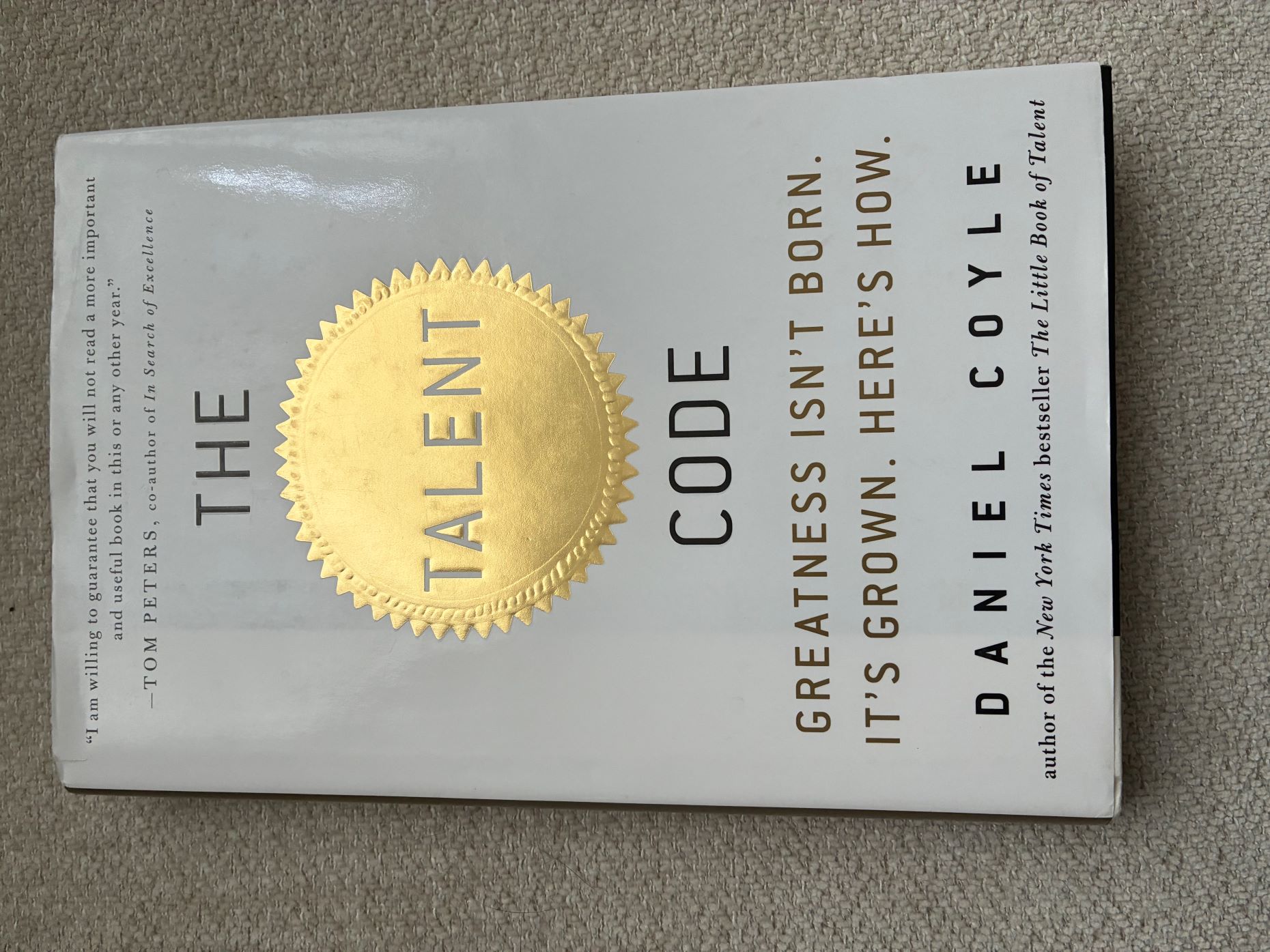
March 6, 2026 – The Talent Code: Part 3

I am sorry about this one. I should have just bit the bullet and written Part Three in a timely manner. I finished this book in early February and it was just my life getting in the way. Now, I have to go back to the time machine and try to remember what was going on in the book because now it is packed up in a box somewhere. Fortunately I took some notes weeks ago to kind of jog my memory.

Since it has been so long, I could spend a few words trying to summarize where we have been. Part One was all about how greatness is built. Part Two is about where to find talent and now Part Three is about harnessing it. Or said another way, it is coaching greatness.
I think the timing on this is pretty good. It would have been even better if I was actually writing this to come out during the Olympics like I should have. Nevertheless, I was watching one of the twenty something, American, gold medal athletes talking about how it is a dream come true and that this is what they have been working their whole life for this when it hit me. This is where this Part of the book comes to life.

Actually, what really hit me is that these athletes were enabled by choice or by circumstance. Circumstance is what the book talks about but I have to think choice is just as helpful. What I mean by choice is that a gold medal may be an athlete’s dream but it started well before this moment. The winners didn’t just show up to the Olympics and win. There was years of practice going into this moment. And to be frank, an eight year old is not getting to the mountain alone. Somebody opened the door and kept it open at least until emancipation.

OK, I was talking about the parents and not exactly the theme of today. But, coaching is what Coyle asserts as the third component of greatness. Chapter nine deals with a study of John Wooden and his habits. For those of you that weren’t around in the 1960s and 70s you don’t know how UCLA won ten of twelve championships. That is dominance.

What did Wooden do? He had two traits that were effective. The first one was that he did not treat players equally. The ones that needed riding got that treatment and the others were left alone, even if it seemed crazy. The second trait was constant but short feedback. Those two things were his keys to success.

Chapter ten was different but the same man. A good coach is able to navigate the matrix of relationships and performance. They are some how able to figure out what is important in the big organic blob called a human being. They are able to get to the root of motivation and correction. And they do it with theatrical honesty meaning that it is load and very readable.

Chapter eleven is one of those that probably would be re-written today. It was all about the (Las Vegas) Raiders evaluation of Jamarcus Russell prior to drafting him as the number one pick in 2008. I hope that they are reading this book this year as well. Russell had tremendous physical ability, it was said that he could throw a seventy yard pass on his knees with precision.

I think today we would look back and say that while there was no doubt Russell’s athleticism was unparalleled, however he was a terrible quarterback only lasting two seasons. The second of which he was benched early in the season. He had no ability to lead the team resulting in poor performance. After being dropped by the Raiders, he never played professional football again.

This book was written as that was all unfolding and I suspect that Coyle (as we all did) thought that he was going to be one of the greats. However, something so poignant was said in the book by the pro scout. Even greats need coaching. And, this is why Russell failed, coaching with the Raiders has been abysmal (mostly).

You know, you don’t have to look very far to find coaches and success. Think about who is considered one of the greatest current quarterbacks, that would be Patrick Mahommes of the Kansas City Chiefs. And yet, who is the coach, Andy Reid someone that has been perennially successful wherever he has been employed. Coincidence? I don’t really think so.

End Your Programming Routine: So, this is the book. It makes a lot of sense to me. Next week I am going to wrap up “The Talent Code”. Looking forward to what is next I am planning “Surprised By Joy” by C.S. Lewis. It seems to be a memoir from what I can surmise. I will plan to cover three chapters per week. I am relatively certain that next week is going to happen but I wouldn’t be surprised if there is a gap after that.

February 6, 2026 – The Talent Code: Part 2

OK, so we know that deep practice is the key to building myelin. Myelin is the key to performance. But, what is the trigger for this phenomenon. Yes, I am certain that there are cases where it is just dumb luck. I think about my own situation and areas that I perform and I didn’t get there by reading a book and then putting it into practice or going to elite academies. It was just luck. But then there are simply hotbeds that cannot be ignored.

Coyle uses the example of why there are so many Major League Baseball players from the Dominican Republic. The DR is a hotbed of baseball. I am sure that you can find that some players went to the same school or played in the same leagues. There is a phenomenon called ignition. Certain teachers, coaches possess the ability to get the best out of people. More on ignition next week.

Going back the the nature versus nurture argument, it can be said that there is some of both in high performers. Following the theory, anyone can build myelin, but some build it more intuitively. For instance, there is a high correlation to birth position and performance. The more kids in the family, the more likely the younger ones are going to naturally accelerate.

I think that we can all see why. It is the younger children that are trying to keep up with the older ones. They want to prove that they can do it too. This is the motivation for deep practice. Also a little oddly, children that lost a parent at an impressionable age also accelerate faster. I guess that they are trying finish what was started or prove that they are worthy of head of household status or something.

Hotbeds seem to be more pervasive in underprivileged areas. I suppose maybe we tend to remember them more because they are remarkable. That is really not the reason, the real reason is that people in those socioeconomic demographics tend to be more singly focused. They do not have the distractions of outside influences to take away from the ability to do deep practice.

Something that I believe is that the best primary school students, straight A’s through high school are not generally high performers. They are good citizens, probably good at their careers and probably make good incomes. But, they are not disrupters more so they are good rule followers. If you follow the rules, you will get good grades. Good grades translate into college completion and ultimately professional and monetary success.

To follow that strategy does not take deep practice. Do what you are told, play the game and you will be rewarded. It is that combination of struggle, failure and striving to master that makes up deep practice. Growing up upper middle class like I did has very little struggle. I followed the rules, got good grades and stayed out of trouble. There is nothing wrong with that but I doubt that I am going to be labeled remarkable for those things.

I wouldn’t exactly call my town a hotbed. That being said, there have been several NFL players that came out of our high school. It is a low socioeconomic level, there is relatively nothing to do and football season is anticipated and important in the community. You have all the conditions to meet the definition of hotbed.

Hotbeds of success are born of assimilation. What does the US military do? Assimilate. When you are the coach, you want a team that is selfless and mission oriented. Yes, The Dream Team clobbered the Olympic competition when they first appeared on the scene since there was such a disparity of skill. But a couple of cycles later, they found out that they could be beaten by an average team that didn’t let ego get in the way.

Assimilation breeds an attitude of us versus them. It seems to make the participants care more about the team mates which in turn causes them to put out more effort and sacrifice. Everyone would want a team of LeBron James (at his prime) but only if that means that they all are willing to contribute equally. LeBron 1 could take a contested three point shot or he could pass it to LeBron 2 who is open under the basket and will slam dunk the ball.

Michael Jordan is arguably the best basketball player of all time. He had phenomenal fifty plus point games where it seemed like he was unstoppable. However, without Scotty Pippen feeding him the ball, Jordan’s career wouldn’t be quite as stellar. He still would have been a super star, but at what level? Imagine if there were three other Scotty Pippens on the floor how much better would Jordan have looked? Pippen was no slouch himself but he was the ignition source.

End Your Programming Routine: Hotbeds themselves are born out of chance and the right environmental conditions. There is nothing saying that the source of the best baseball players couldn’t be Indonesia instead of the Dominican Republic except that it isn’t. I think what is more important is to be able to recognize the factors that play into talent. It makes it much easier to make up for those deficiencies with deep practice.

January 30, 2026 – The Talent Code: Part 1, Chapters 3-4

Alright, alright, alright as Matthew McConaughey would say. I am starting to get into this book a bit. Chapter Three examines hot beds of excellence and Chapter Four is about how to get the benefit of deep practice. This is both the facts and the myths about what we think we believe about life if we are paying attention.

Coyle starts off chapter Three with the Bronte sisters. Now, I am pretty well read including a lot of the classics but I had never read Jane Eyre, Wuthering Heights or heard of the likes of any one of the three Bronte sisters. I recognize the titles and I am peripherally aware that they are considered amongst the best literature. I guess I always perceived them as a little too feminine for me. Even though I will admit I don’t know anything about the plot so I could be dead wrong.

That being said, Coyle asserts that they became great authors by starting out writing quasi-nonsense. Poor spelling, poor sentence structure, poor punctuation and stories that were almost plagiarized from popular magazines is where the development of greatness occurred. This is the attack on the gene theory that some people are simply born great and hence three sisters are the best authors of the mid 19th century.

It would seem like nurture has a much stronger connection to greatness then nature. Renaissance masters were connected to each other via apprentice to master and master to master within the Florentine guild structure. I suspect that this is why college athletes are frequently from the same high school. Professional athletes are often from the same colleges. The athletes are in proximity to deep practice.

Recently Indiana beat Miami for the college football championship. It was said that prior to two years ago, Indiana was the losingest Division I football team in history. I can bet you that at the beginning of last year the new coach did not go out and replace the entire team. No, he worked with what he had. This year’s success will certainly make it easier for Indiana to remain on top with better recruiting and retaining top talent, but what shifted was mindset.

Nobody thought that a 3-9 team in 2023-4 would become an 11-2 team in 2024-5. In fact, when it came to playoff selection, they were deemed a fluke, had a soft schedule and not really worthy. Yes, they did lose their one playoff game to Notre Dame who went on to play in the championship against Ohio State (Indiana’s other loss on the year). You might say that they probably earned a number three ranking for 2025 based on those results. This team stayed together and became a juggernaut. The way they dismantled Oregon in the semi-finals was embarrassing for all of my Ducks fans (I only accept family in that category). Not used to losing badly like my Beavers, most of them gave up by halftime.

I strongly suspect that Coach Cignetti has unlocked the ‘Talent Code’ at Indiana. I wish that I could say that about my team’s coaches. Enough of football though, Chapter Four are the three elements of deep practice. They are chunk it up, repeat it and feel it. I will explain.

To chunk it up, you have to look at the whole picture and figure out where logical breaks can occur. Then you set about mastering any one of the chunks, that is the repeat part. Once you master a chunk you move on and combine the chunks, that is the feel it. It is that kind of thing where when you are right handed and you try to do something with your left hand.

I have tried this with several things like batting, shooting and writing. The first time is comically awkward. Then after hundreds of repetitions, it starts to feel normal. Keep practicing after that and all of a sudden, it is not just natural but intuitive. I sometimes try experiments like that when I am struggling because of bad habits. My logic is that if I relearn it on my other side I can start fresh and hopefully get away from the limitations I have on my primary hand.

While reading this book it has started to occur to me that there is a reason why I was a mediocre to poor high school athlete, musician andcollege student. I always thought that my super power was never give up. Sure, I would outlast the people that would give up and if I stayed long enough I would be the longest tenured and probably the best in comparison. But in those areas, I never did deep practice following the three rules.

But when I look at my success in other areas like leadership, I kind of do that intuitively. I am always more successful when I am allowed to to see the whole picture and I pretty much flail when I only have a myopic understanding. It leads me to speculate on the order or importance of certain aspects.

It is the reason that I always write with so much context. I want the reader to understand the why this thing is so important. Sometimes I even look at my podcast notes and wonder if I have put enough emphasis on the topic over the context. The punchline can sometimes be so subtle that it gets lost in the story. I should work on that but I see why this works for me. It is my talent code process.

End Your Programming Routine: I am glad to find out that we are strictly bound by our genes to our destiny. Yes, I will never be an NBA player and I have come to terms with that but it doesn’t mean that I could be the best at 95% of other things in life. I think I would rather be the best steelhead fisherman than and NBA star anyway. Next week, we will cover all of Part Two.

January 23, 2026 – The Talent Code: Part 1, Chapters 1-2

Admittedly, I did not know anything about this book before I purchased it. It came from a co-worker recommendation a couple of years ago. If I remember this conversation correctly, I was telling him about my former position at another company. I believe that he said something like, you should read this book that I just read. I wrote the title down and then I just waited until I had some time to fit it into my reading.

Honestly, I was expecting the book to be about techniques to get the best out of people as a leader using teambuilding skills. At least, that is the conversation I was having with my co-worker. I didn’t even read the dust jacket and just jumped into reading the book. To my surprise, it has nothing to do with that. The book is all about how the individual masters skills.

Because I was expecting something different, I was puzzled when I read the introduction. What do high performance teams have to do with a middle schooler practicing the clarinet? It is no surprise there, nothing really. OK, I am going to change my paradigm now, we are going to get educated on how to learn skills well. This is up my alley.

This is going to sound a little spacy but Coyle’s assertion is that the way we master skills is by something called deep practice. That act of deep practice in turn causes a bio-chemical reaction for the body to build a compound called myelin. This is the material that wraps nerve fiber. The more the deep practice, the thicker the myelin gets. This then causes the message transmissions to become faster and more precise. That is mastery.

The phrase deep practice has a specific implication. Deep practice is the act of working until a mistake is made, stopping and analyzing the problem and starting again at that point. Coyle uses a word exercise to try and prove a point. If you struggle with something then you are more likely to recall it and in turn master it. The list of words that he provided with missing letters was more memorable then the list where everything was filled out.

Coyle’s also asserts that there is a phenomenon out there that seems to line up with the theory anyway. Why do so many major league baseball players come from the Dominican Republic? It is because the culture has mastered deep practice when it comes to baseball. They are not a super race of baseball phenoms and certainly pound for pound when you look at Olympic medal totals it not because of genetic athleticism and deep population pools.

He also maintains that poorer demographics are more likely to use deep practice because they don’t really have any other options. They are less likely to have analytics and coaching, not discounting those things but they are making mistakes and learning from them which is what then leads to greatness.

If that is then true, I am reminded of several misguided coaches that I have had over the years. They boldly assert that the phrase “practice makes perfect” is wrong. It should be “perfect practice makes perfect” when in reality the first statement is actually more true. Someone cannot get to perfect practice without practice. And it should also be noted that using this theory, repetition holds no value. If you are not trying to do it faster or better or some other variation then likely you are actually repeating the same mistakes in your ‘perfect’ repetition.

Another novelty to me is the 10,000 hours theory does not play a role but not as big as you would think. Remember that is that it takes 10,000 hours to master something. But, combine Deep practice with 10,000 hours and you will be a master. That make sense for me because when I think about certain things like reading, sometimes I have a difficult time remembering what I read. I am sure that I have probably read that many hours in my lifetime and yet that information is only temporarily available. It goes into my brain and then six months later I would have to read the book again to even know what that is about.

And yet, I think that I am a pretty good programmer. I struggled and struggled to get it. After months of debugging I sometimes found that the program did not work like it should. Things that technically were correct did not execute in ways that they were supposed to. I learned from that particularly to be a better programmer and test my work in smaller chunks to the point that I didn’t need to do that anymore because I had mastered the nuance.

End Your Programming Routine: Despite the fact that this is not the book I was thinking that it was going to be, I actually think that it might be better than that. Sometimes, things that matter are comfortable and familiar, but sometimes they are stretching us and making us better. While a business book is interesting, this may not be the right forum. Next week, we will cover chapters 3 and 4.