Tag: Cookbook

September 20, 2022 – Cannelle et Vanille, Part 2

I wasn’t the only one confused. It seemed as though most of the book club members weren’t sure if it was one book or both. So, most of them looked at both. This was the first cookbook that Aran Goyoaga wrote and it is all about dishes but includes baking.
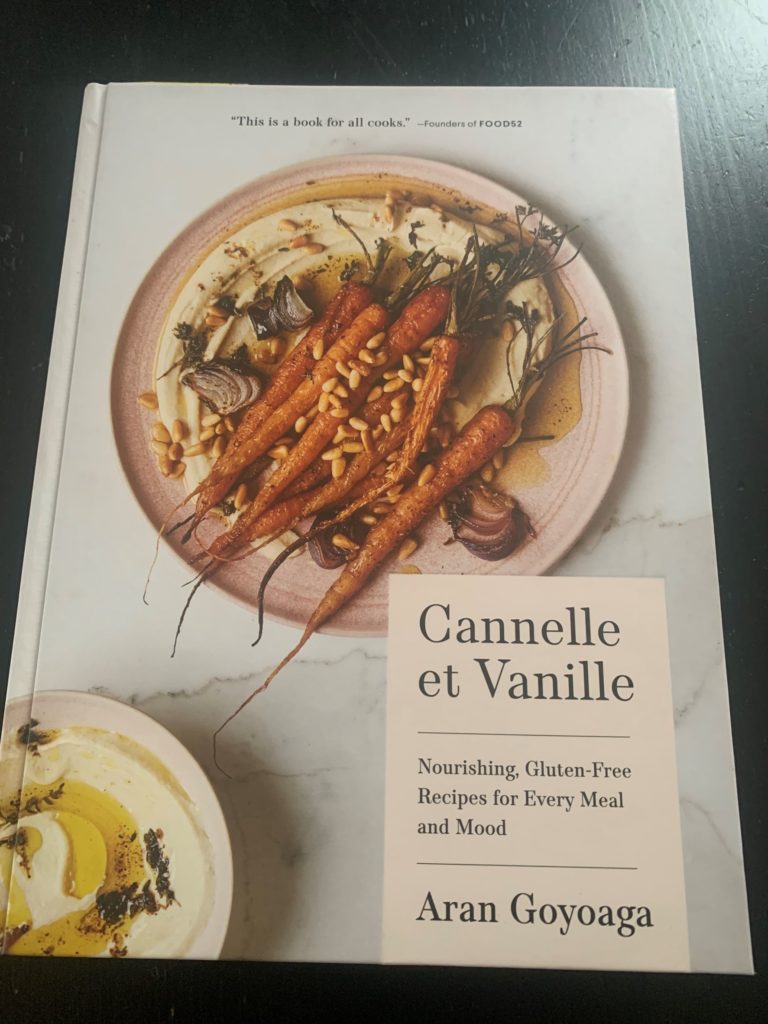
I think that it is natural that everyone wants to put a stamp on their work. In this case, I saw something that I had never seen before which was about ten different meals. They included the entre, salad and drink/desert/side. This was the last third of the book. I suppose kind of like wine, pairing everything together.

I kind of like the concept. At least it makes the decision making kind of easy. I guess what makes the book speak to me more is that the ten dinners seem to have a Spanish bend. There is paella, tortilla de patata and various seafood, pasta and Mediterranean vegetable dished that are in Aran’s culture. I made the tortilla for our dinner and I feel closer to these Spanish recipes than I did with the Jose Andres cookbook.

If there is any downside to the cookbook, I would say is that it shares content with the baking cookbook. So, there is some duplication in the introduction fundamentals and the baking sections. I suppose that it is nice to know that she sticks to her principles and has found something that works. The other thing that I found a little too much gluten free baking in this particular cookbook. Since this one was written first, this is a much more comprehensive cookbook and I could see the other one as a niche reference.

Just like the others, there are a few things I am interested in trying. I am definitely going to give paella a whirl. I have made it before and after feeling disappointed in Spain, I feel like I can do it better. I mentioned after reading Self-Reliance magazine that I would like to try to make yogurt. There is a recipe here as well. I also saw a very approachable ragu using beef roast. I am always looking for more ways to focus on the primal cuts besides just Sunday roasts.

Once you start getting so many cookbooks, it is difficult to invest much unless it speaks to you. I was not excited when I saw the list and this one included. However, after giving it a chance and our connection to Spain, this one is stack ranking on the higher third on the list. What I am saying is that I don’t think that this cookbook is going to appeal to everyone but it seems to be the right mixture for me.

End Your Programming Routine: I feel for those that have a severe gluten intolerance. I know other chef’s that are absolutely tortured by situation. So, for that reason alone, I applaud Aran for attempting to solve the problem. As I said last week, I am going to keep trying things until we can eliminate some of the extra ingredients around or give up. If this is you, then I would give a recommend to the book at least for experimenting.

August 9, 2022 – Salad Freak: Recipes to Feed a Healthy Obsession

This is the August selection for the Left Coast Culinary Book Club. This book is a cookbook for Salads by Jess Damuck. Who is Jess Damuck? From what I read, she is a food stylist that primarily worked with Martha Stewart.

Once again, this book is divided by seasons. The one thing that I thought was really brilliant was that there is a master list of ingredients broken into categories. Then, each salad draws on the ingredients in the category. So recipes are organized by ingredients in the category, with the assumption that (1. you are into salads) you have options if you are working from a standard pantry.

Because Jess is a food stylist, all of the photos are vibrant and look great. One of her technique suggestions was to use similar items in different shapes. Think carrots and parsnips. Think rounds and julienne. In my opinion, this is more of a presentation tip than a taste improvement.

This is about where the compliments end from me. I wasn’t present when the voting happened and I probably wouldn’t have protested anyway but I find it hard to get jazzed about salads. Jess uses a lot of jargon, techniques or ingredients that I have never heard of. When I last went to the store, I checked on a few of these things and nope, not there. So, unless you are growing yourself, good luck with duplicating.

Maybe it is because I already know this but she frequently uses a lot of combinations of textures such as leaves, nuts, cheese, proteins, etc. It therefore feels like most of the salads are a random catchment of ingredients than deliberate combinations. In the foreword, Martha Stewart says that her marker of a good cookbook makes her hungry. So far, I haven’t marked a single recipe yet.

Given that I think making a cookbook about salad new and fresh is going to be difficult, I think probably 10% of the recipes are a stretch. Here are two examples gazpacho and esquites (Mexican corn) that I wouldn’t call a salad at all. There are other things that are called salad but I would call sandwich spreads or toppings like arugula pizza or egg salad.

To be fair, I haven’t made anything out of it yet. If you remember last month, I have tried a couple more and was very pleased with Corned Beef Dinner for instance. So, maybe I will soften up. The truth is, I don’t see myself really making much. But, all it takes is a handful to be worth it. So, I owe it to the book club to try a few things.

End Your Programming Routine: What can I say? I am not looking forward to the next one either. It is about gluten free cooking. I am not really big on gluten anyway but I feel like trying to substitute never works well. I have to give Jess credit that she did something different. Just because I am not into it, doesn’t mean that this isn’t for someone.

March 1, 2022 – Far Eastern Cookery?

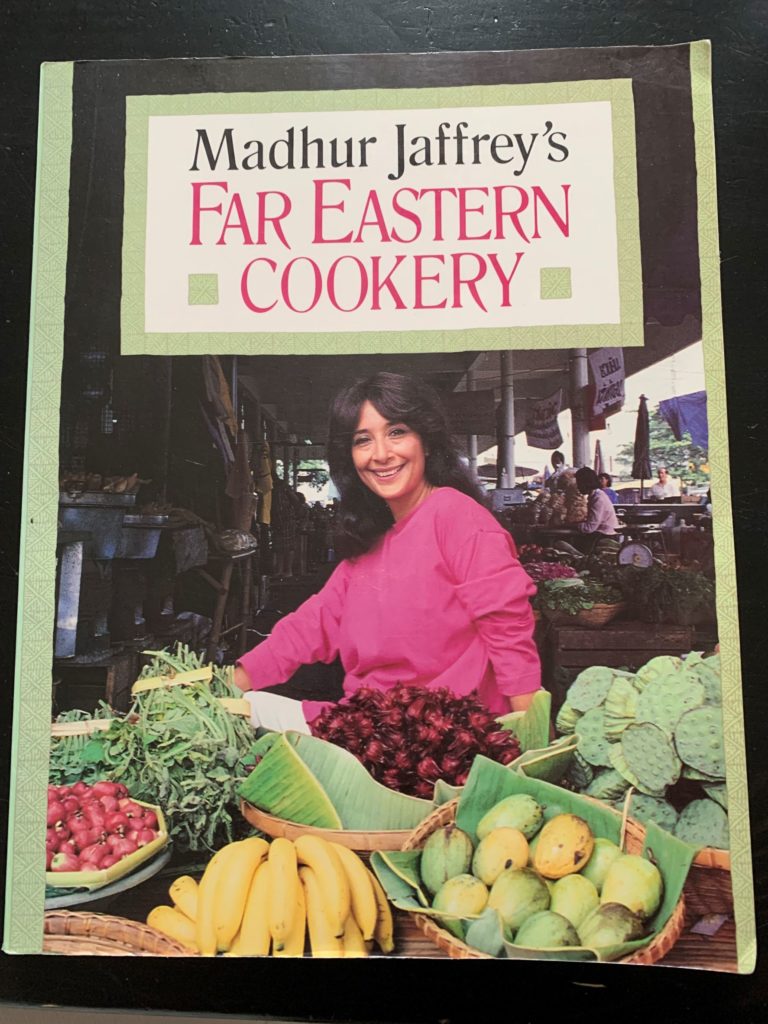
That seems like a funny name. Well it is the title of the latest book I finished reading. My son bought me a couple books from the local used book store for me to read for my birthday in January.

Apparently, Madhur Jaffery has had several TV shows on PBS in the 1980s. She is a James Beard award winner and primarily writes about Indian food. I have never heard of her or saw any of the shows. but definitely seems well credentialed.

What I like about this cook book is that it was written in 1990. This means that it was pre-internet and pre-access to everything, anytime we want it. Consequently, there are a lot of substitution suggestions and simple ingredients. One thing I really appreciate is not having an exhaustive inventory of exotic ingredients that get used a couple times a year.

This cookbook is a smattering of all Asian foods: Chinese, Japanese, Thai of course but also Korean, Malaysian, Indonesian, Vietnamese and also Filipino (had to look the spelling of that one up). The ingredients and the techniques are very simplistic for the most part. That makes things pretty approachable.

I plan to try a few things. I am going to make Filipino Menudo for sure. I made a Chinese hot and sour soup the other day that my family really liked. I personally like Thai, Vietnamese and Korean over the others but I am anxious to try some other cultures for something new.

It appears that book is widely available on the used market and pretty inexpensive at less than $10. Since I haven’t used it a bunch, I can recommend it yet. However, I like what I see and I think it fits well into my style of cooking.

End Your Programming Routine: The next book I am going to read is fiction. In fact, I am already a third of the way through it. I took that with me on my business trip rather than the unwieldy cookbook. Sometimes, it is just best to unplug and enjoy rather that reading for a purpose. A chapter a day and eventually I will make it through.

November 18, 2020 – Updates to the Virtual Book Club today

Yesterday, the thinking about 1984 by George Orwell left me partially excited to go into that book again and partially disgusted to think about what has happened on my watch. I am going to save the stronger editorials to another time to get to a happier place today.

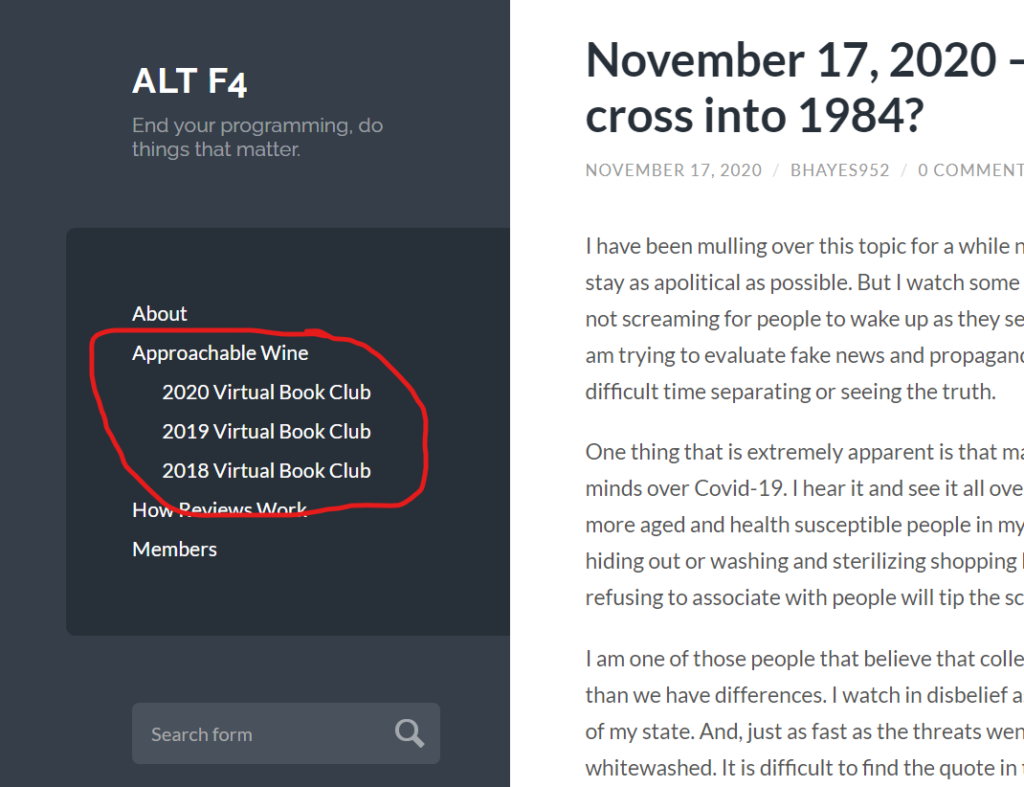
I spent this morning backdating the progress of the Left Coast Cellars Culinary Book Club. With the impending second lockdown and the weather really getting wet, it is a good time to read and cook. I have created separate pages, by year on where we have been as a club in case someone was interested in where we have covered. Those links are on the left hand margin.

I am strongly thinking in the future that I will repurpose the ‘Approachable Wine’ page and change that into a ‘Resources’ page for people interested in the things that I am such as freedom, gear, skills and books. That page was really intended for a different purpose. I was wanting to build an app and tie all of this together, but I didn’t get started and probably wont.

So, we have bunkered up into our ‘two week freeze’. Our Thanksgiving shopping is done and the menu is largely set. There definitely won’t be more than six people at our table. As Thanksgiving signals the end of the harvest season, it is time to appreciate the year behind and look forward to the year ahead. Do some reading in your free time.

May 12, 2020 – Review: Hunt, Gather, Cook

Hunt, Gather, Cook: Finding the Forgotten Feast by Hank Shaw was the April book selection in the Left Coast Cellars Culinary Book Club. Unfortunately, the club has been on hiatus since mid-March but that doesn’t mean that the reading doesn’t go on.

Hank Shaw is an author, blogger, podcaster and general media person. His focus is about cooking with wild sourced ingredients. He tends to collaborate with others in this space like Steven Rinella. If you are into this sort of genre, then you probably already know about him and his contemporaries.

The book is organized into three sections. Section one is about foraging, section two is about fishing and section three is about hunting. Each chapter in the section is grouped by a theme such as wild berries. At the end of each chapter there are five or so recipes focusing on the type of ingredients the chapter is about.

This is one of those books that I would consider a gateway into the subject. There is no possible way that a person can safely learn everything about foraging by reading this. Every microclimate and region in the country could support it’s own botanist/mycologist/herbologist from the vast diversity that is present. There is no mention of mushrooms, which is probably a good thing. Instead the focus is on high value, low risk choices like seaweed and day lilies.

Another potential roadblock to successfully implementing ideas in this book are access, equipment and knowledge. For example, in my state there is no ‘season’ for rabbit hunting. It does require a license to do so. There is public land about ten miles away, but I have rarely seen a rabbit. I think that to really do this successfully, having a flushing dog would be the only viable option. Dogs are not allowed in the public land without a leash.

Instead of focusing all of my energy into why any of these ideas can’t be done I think the best use of this book is to read through it and look for things that can be done. Almost everything has a season to when it is available and or legal (including a lot of plants). Plan times to obtain these items as family activities. A family charter for bottom fish and crab is something I can do in my area. Then be prepared to feast when the trip is complete.

I enjoyed reading this book because it is about 25% technique, 25% cookbook and 50% inspiration. So, it is not a page turner but it does get the mind stimulated about the possibilities. Over the years, I have learned that it is much more enjoyable to pursue the activities rather than read about them. But I find that I can more easily find the time to learn and think than I can do. For that reason, it is exciting to think about that next fishing trip or making blackberry wine.