Tag: Chapter 3

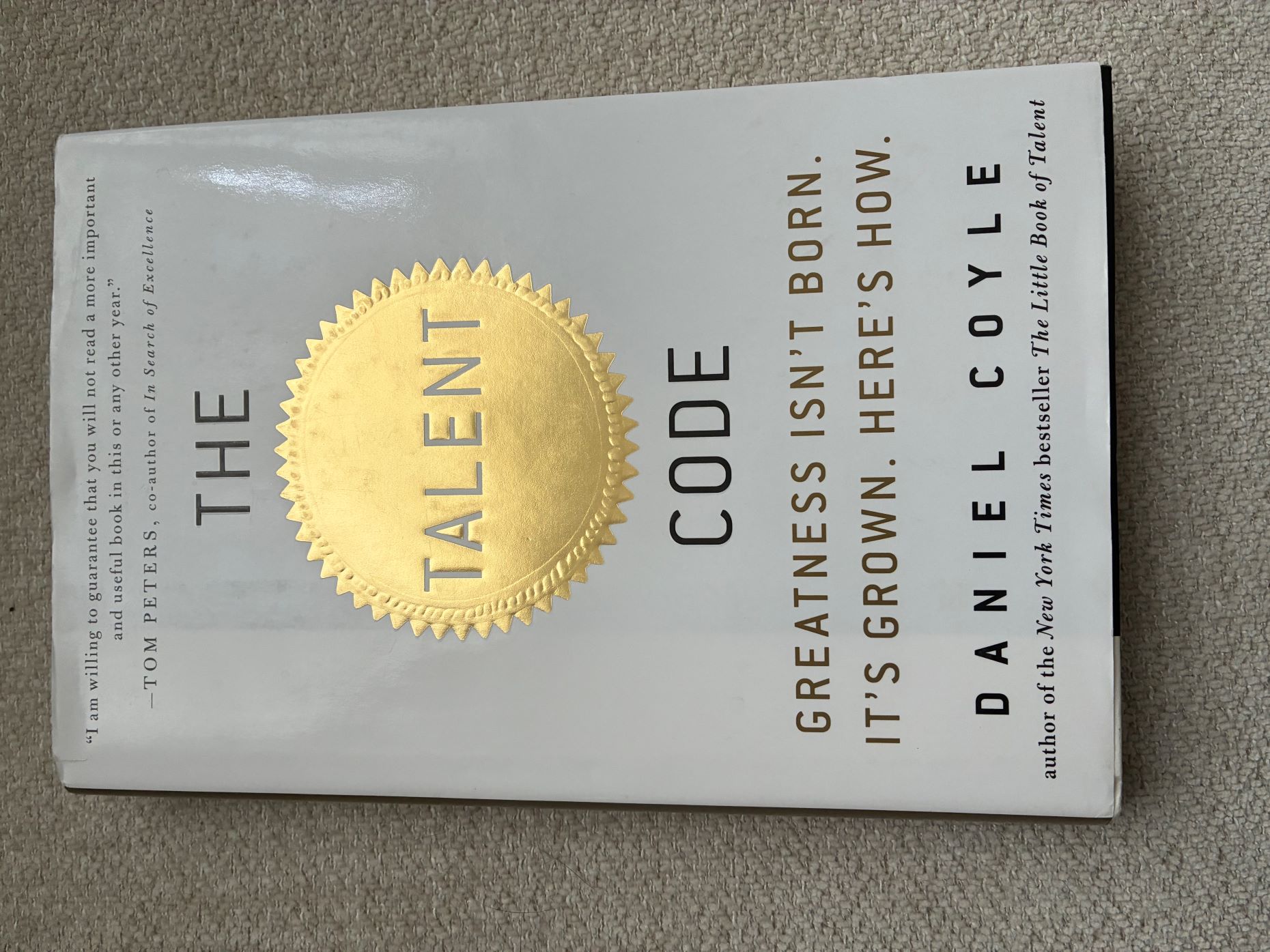
January 30, 2026 – The Talent Code: Part 1, Chapters 3-4

Alright, alright, alright as Matthew McConaughey would say. I am starting to get into this book a bit. Chapter Three examines hot beds of excellence and Chapter Four is about how to get the benefit of deep practice. This is both the facts and the myths about what we think we believe about life if we are paying attention.
Coyle starts off chapter Three with the Bronte sisters. Now, I am pretty well read including a lot of the classics but I had never read Jane Eyre, Wuthering Heights or heard of the likes of any one of the three Bronte sisters. I recognize the titles and I am peripherally aware that they are considered amongst the best literature. I guess I always perceived them as a little too feminine for me. Even though I will admit I don’t know anything about the plot so I could be dead wrong.

That being said, Coyle asserts that they became great authors by starting out writing quasi-nonsense. Poor spelling, poor sentence structure, poor punctuation and stories that were almost plagiarized from popular magazines is where the development of greatness occurred. This is the attack on the gene theory that some people are simply born great and hence three sisters are the best authors of the mid 19th century.

It would seem like nurture has a much stronger connection to greatness then nature. Renaissance masters were connected to each other via apprentice to master and master to master within the Florentine guild structure. I suspect that this is why college athletes are frequently from the same high school. Professional athletes are often from the same colleges. The athletes are in proximity to deep practice.

Recently Indiana beat Miami for the college football championship. It was said that prior to two years ago, Indiana was the losingest Division I football team in history. I can bet you that at the beginning of last year the new coach did not go out and replace the entire team. No, he worked with what he had. This year’s success will certainly make it easier for Indiana to remain on top with better recruiting and retaining top talent, but what shifted was mindset.

Nobody thought that a 3-9 team in 2023-4 would become an 11-2 team in 2024-5. In fact, when it came to playoff selection, they were deemed a fluke, had a soft schedule and not really worthy. Yes, they did lose their one playoff game to Notre Dame who went on to play in the championship against Ohio State (Indiana’s other loss on the year). You might say that they probably earned a number three ranking for 2025 based on those results. This team stayed together and became a juggernaut. The way they dismantled Oregon in the semi-finals was embarrassing for all of my Ducks fans (I only accept family in that category). Not used to losing badly like my Beavers, most of them gave up by halftime.

I strongly suspect that Coach Cignetti has unlocked the ‘Talent Code’ at Indiana. I wish that I could say that about my team’s coaches. Enough of football though, Chapter Four are the three elements of deep practice. They are chunk it up, repeat it and feel it. I will explain.

To chunk it up, you have to look at the whole picture and figure out where logical breaks can occur. Then you set about mastering any one of the chunks, that is the repeat part. Once you master a chunk you move on and combine the chunks, that is the feel it. It is that kind of thing where when you are right handed and you try to do something with your left hand.

I have tried this with several things like batting, shooting and writing. The first time is comically awkward. Then after hundreds of repetitions, it starts to feel normal. Keep practicing after that and all of a sudden, it is not just natural but intuitive. I sometimes try experiments like that when I am struggling because of bad habits. My logic is that if I relearn it on my other side I can start fresh and hopefully get away from the limitations I have on my primary hand.

While reading this book it has started to occur to me that there is a reason why I was a mediocre to poor high school athlete, musician andcollege student. I always thought that my super power was never give up. Sure, I would outlast the people that would give up and if I stayed long enough I would be the longest tenured and probably the best in comparison. But in those areas, I never did deep practice following the three rules.

But when I look at my success in other areas like leadership, I kind of do that intuitively. I am always more successful when I am allowed to to see the whole picture and I pretty much flail when I only have a myopic understanding. It leads me to speculate on the order or importance of certain aspects.

It is the reason that I always write with so much context. I want the reader to understand the why this thing is so important. Sometimes I even look at my podcast notes and wonder if I have put enough emphasis on the topic over the context. The punchline can sometimes be so subtle that it gets lost in the story. I should work on that but I see why this works for me. It is my talent code process.

End Your Programming Routine: I am glad to find out that we are strictly bound by our genes to our destiny. Yes, I will never be an NBA player and I have come to terms with that but it doesn’t mean that I could be the best at 95% of other things in life. I think I would rather be the best steelhead fisherman than and NBA star anyway. Next week, we will cover all of Part Two.
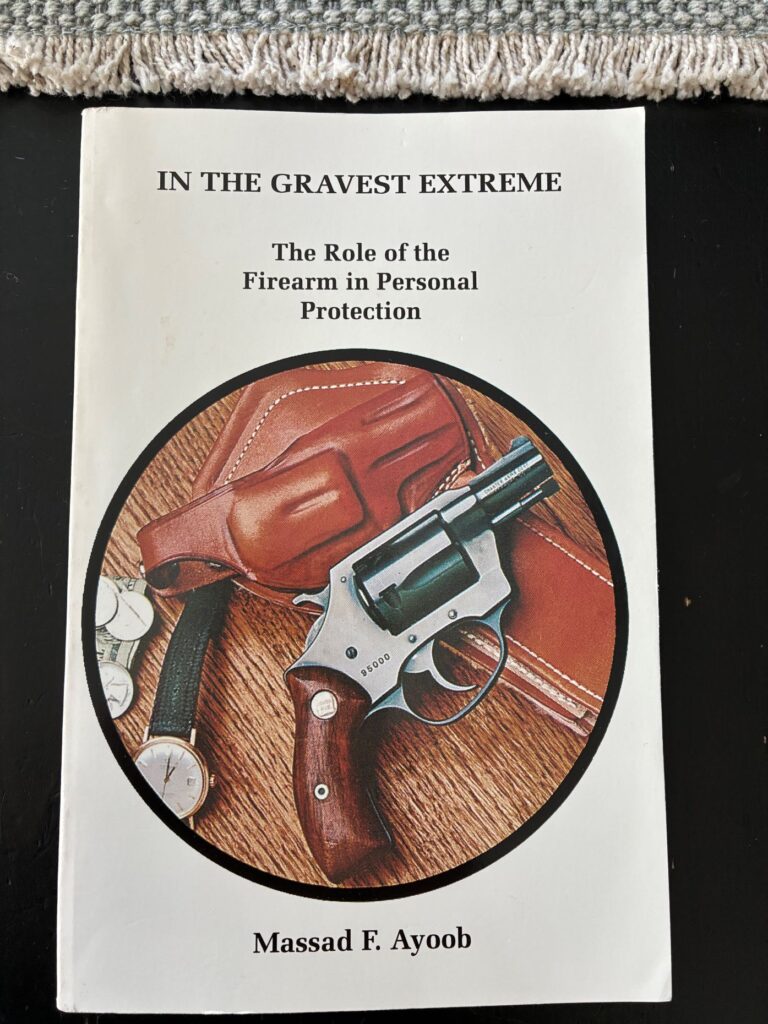
May 16, 2025 – In the Gravest Extreme: The Role of the Firearm in Personal Protection, Chapters 3-5

I know that I keep saying this but I feel like this group of chapters is another where time has probably changed prevailing attitudes. For one thing, the deregulation of concealed carry has created an industry of specialized civilian training. And with that, has come a plethora of resources that didn’t exist in 1980 like the internet and podcasts as two examples. I think that those resources have spread a broader net of better information.

I remember as a kid, we would say things like ‘shoot bad guys in the knee’. Of course, I grew up under the shadow of the early westerns and every TV show with a bad guy had a good guy. There was no such show concepts like Breaking Bad where the good guy was also a bad guy or you couldn’t quite draw clear lines. As such, we wanted to do the proverbial ‘shoot ’em in the shoulder’ because the thought of taking life would put us in the bad guy category.

With that strong desire to be a good guy, there was also the idea that we would put the bad guys away with a citizen’s arrest. This is probably the result of too much A-Team or MacGyver. Ayoob did a pretty good job of cautioning the bad guy could turn the tide from captive to captor. That is a pretty valid point because the best practices today would say you shouldn’t draw a gun unless you are justified to shoot in the first place. Holding a perpetrator at gunpoint changes the force equilibrium.

More so than the risks of a captive, if a third party calls in a 911 call, how do the police distinguish between a good and a bad guy? We assume that we are talking about the good guy holding the bad guy at gunpoint but it could be just as easily the other way (for lots of reasons). For reasons of both safety and liability, it is just best to not emulate TV shows with a Citizen’s Arrest.

Regardless of what the police would do, what are you going to do? There is probably a 95% chance that a man beating a woman in the parking lot is the aggressor. But what if you were wrong? What if it was two men fighting, now who is the aggressor? What if one is stabbing another, is that assault or self defense? We just don’t know. It is sad and selfish but it is best for self preservation to not try to pick.

An active shooter is a different story. In that case, there is a clear aggressor. When I talk about concealed carry, I am also talking about a handgun. If you are unfortunate enough to be around an active shooter event the best you are going to do is have a loaded handgun. Handgun against handgun and you have a chance if they are an average marksman. Handgun against a rifle and you are going to need some luck.

Every person needs to make the calculus on what you would do. My values are to get myself and anyone with me away from the shooter. That means that I am not typically looking to engage. If you did, what if the shooter is dead but you also hit a bystander? Are you legally prepared for a lawsuit? It doesn’t matter if the victim should be thankful, he might be looking to cash in or maybe he can no longer work. These are all of the tough choices that need to be made.

Really the last chapter I want to talk about today does not fit into the first two nor next week’s so it ended up here. One of the largest growth factors in firearms has been women. I have to say that his suggestion of a snub nosed 38 special is superseded by many, many better choices today. As an owner of one, it is difficult to shoot well. It also recoils like a getting kicked in the hand. That was probably the best you could do in 1980.

You all know that I am not a woman (even in today’s culture) so it is hard for me to really identify with those particular struggles. That being said, the number of products for women’s concealed carry is a lifetime away from where it was when the book was written. I know for a fact that 5.11 makes yoga pants with integrated holster as an example.

End Your Programming Routine: The fundamentals are definitely 1980s sound. There isn’t much that has changed from the legal standpoint. We are really talking about legal standards that go all the way back to middle ages England, what is another forty-five years? It is the gear that have made exponential improvements. From bullets, holsters, laser aiming devices, flashlights, red dot sights, glow in the dark (tritium) sights, magazine capacities, new calibers, etc. The one right choice in 1980 has a bunch of potential better choices today.

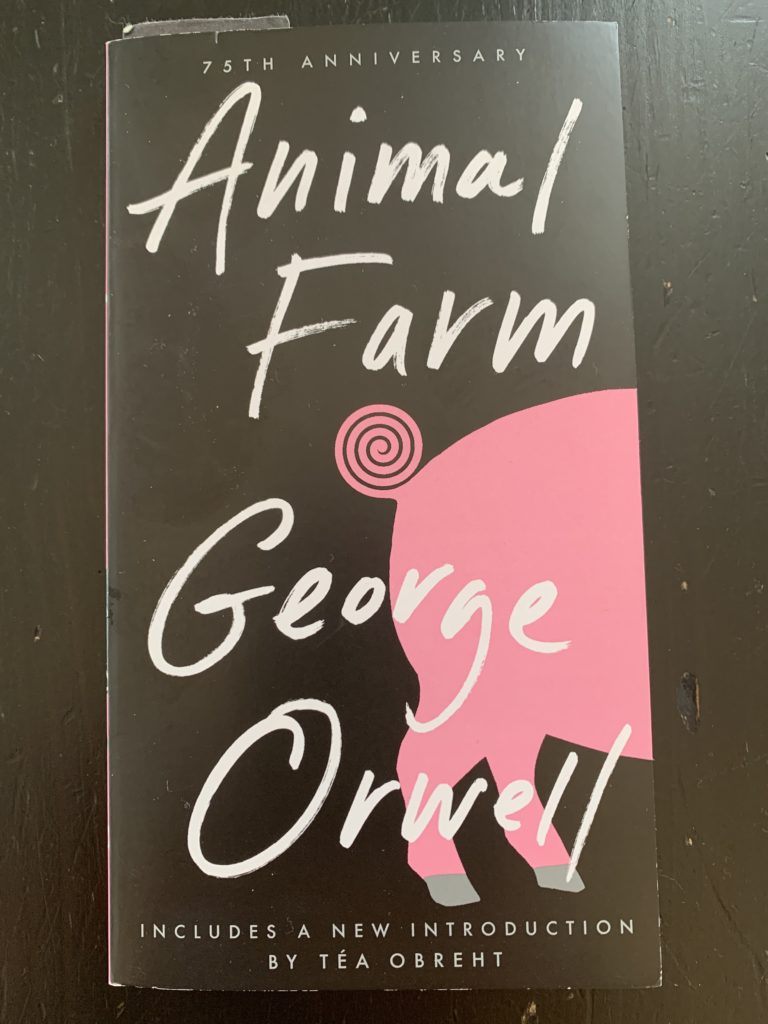
March 24, 2023 – Animal Farm, Chapter 3

This is week three and things are progressing pretty much the way that history has taught us. More on that later but maybe this book isn’t as revolutionary as it was when it was written in 1945. Because I grew up in the 1980s, there was a lot of talk/movies/propaganda about how people thought the USSR was, maybe not how it actually was. I would say that it was pretty hard to imagine from the outside what life was actually like under the Soviets in 1982.

We all know the arc, trajectory and result of the hard, Marxist movements. Instead, I want to focus more on movements themselves rather than one specific one because I think that they share the same similarities as the conclusion of the USSR. Now to the the book.

The chapter starts out with the animal doing harvest. It was performed with exuberance and better than normal results. I think that this is a pretty normal situation. Participants are excited to be part of something. There are lots of hands for work. The momentum carries the animals not just on an emotional high of the task but a phyiscal high of the results, more hay put away.

For some, the exuberance dies rather quickly. I am speculating that for those individuals, they were not really committed to the cause in the first place. It was more likely that that they were ignorant of the goals and aims and the excitement of newness to everyone was the result of initial commitment. Some animals are starting to shirk their equal contribution i.e. the cat.

As the movement matures, changes in the fire and brimstone of the core values sometimes change. Sometimes they are refined but other times they are edited to retain adherence to the group. In this case, it was stated that not all the animals could read or understand the seven commandments. As a result they were simplified to to one “Two legs bad, four legs good”.

As the pigs start to take ownership of the leadership roles, some interesting things start happening. For instance, Snowball is sequestering all of the offspring for ‘education’. It is not just that, but the pigs are carving out special exemptions for themselves, because they can and no other animal realizes what is happening.

The United States has been full of movements. Religious utopias, racial and women’s rights, temperance, labor and political to name a few. In my opinion anyway, movements either have an endpoint or they are point in time. What I mean by that is that Movements that are results oriented, like temperance or women’s suffrage I would say were successful because the had specific, targeted outcomes. Things like the ‘Tea Party Movement’ of 2009-2012 failed because they had unrealistic, non-measurable outcomes.

There is one more concept to take in with this. That is The Iron Law of Bureaucracy. There are those within any organization (including movements) that committed to the cause and those that are committed to the organization. Tacitly, when an individual is committed to the organization, they start making decisions on what is best for the organization and not necessary accomplishing the mission. I think that the pigs belong to the second group.

End Your Programming Routine: I will let that sink in. What we have in US politics is people committed to the organization. To make it worse, most legislation or regulation is wrapped up in paper that tries to make it look like what is being proposed is for the mission. Why else would we have 80 year old senators? Is that what is best for representing the state or is that what is best senator? I really can’t imagine working sixteen hours a day six to seven days a week at that age when the average life span is less than that.