Tag: C.S. Lewis

January 16, 2026 – Mere Christianity, Conclusion

We have made it to the end once again. I have to apologize that my focus has not been nearly as good as it should have been. This is only a 220 page book that took me over four months to read. On one hand, when something is dense and thought provoking, speed is not a good metric. But, my plan was not to read and ponder each word but to read a reasonable length block a week. This should have been approximately one short chapter a day.

I think what is pretty telling is that I read about a third of the book before I even started writing. I had a huge jump start at the beginning of fall which lagged and lagged. On both fronts it is telling about how I approached things. One being how late I am and the other about what I thought about the book.
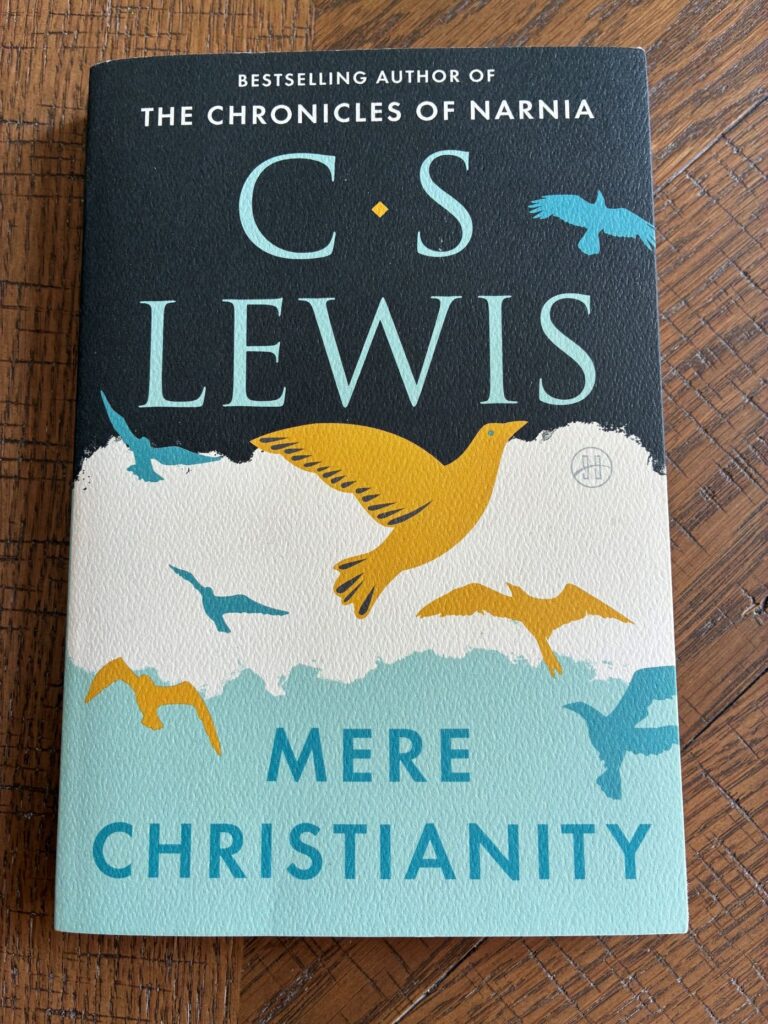
I started out with pretty high hopes. Not only did Lewis attempt to do something nobody else has ever done, but he went about it in a way that was disciplined and secularly approachable. After a quick and spectacular start, the book and the argument got bogged down. That is as good a place to start as any.

In the introduction to this book, it was stated that this was originally a radio broadcast to the British people during World War II. The stated purpose of the broadcast was to provide hope to a nation under a looming cloud of war, specifically the early German bombing London. I think that it is a pretty good strategy to reassure everyone that there is something better than this life if things don’t go well.

I think where I got stuck on a hump is after book one, it is pretty much assumed that the point was sufficiently made. From Book 2 forward, it is all about doctrine. I suppose that if you were a brand new convert you might be at that point of tell me more, tell me more. It is probably a pretty good bet that this radio broadcast landed best with the non-believers followed by the conservative Protestant denominations. That more than likely is the majority of the British citizenry.

I definitely don’t want to argue theology. One, I could get my behind whipped by someone educated and prepared. And two, I don’t really care. I might not agree with doctrine such as the trinity but you can be darn sure that I am open to it and I respect your right to believe differently. I also strongly agree with the better good position rather than pick at nuance.

Despite what I said above, the rest of the book didn’t do that much for me. I am aware of biblical virtues and the supposed way to eternal salvation. I am aware of theology and beliefs and where they differ from mine. I think also that we have to look at mindset. Because I am already a believer and this does not reinforce my beliefs already, the whole things kind of fall flat.

The way that Lewis presented his case, he of course took from his own line of belief as defacto truth. Sitting from where I am, I would have been more interested in going deeper into the justification for those items. I am not opposed to challenging my own beliefs, in fact I would welcome that. But, then again I guess this is not the intent of the work in the first place.

OK then, who is this book for? I would say that it would appeal to Lewis fans, historical fans and people questioning the existence of God but are open for the possibility. I am not going to say that I didn’t get anything out of it but where it started and where it ended were disappointing for me. In that vein, I am glad to say I read it and I can recommend it circumstantially.

End Your Programming Routine: This is one of those books that I should come back to in a couple of years. Now that I know what to expect, it is likely that I will come back to a different opinion. It is short enough to read pretty quickly and I wouldn’t be surprised to have a more favorable outcome or at least new perspective. When something is labeled one of the greatest at anything, it is only an opinion. Just like this.

January 2, 2026 – Mere Christianity, Book Four: Chapters 1-6

Read along: http://www.ntslibrary.com/PDF%20Books/Mere%20Christianity%20-%20Lewis.pdf

I think I am on the wagon again. Maybe it is just that the holidays have actually provided a little bit of downtime and so I have been able to find a little time to read. That being said, I only have twelve more chapters to go. I am going to do my darndest to see this book through, in successive weeks. This week makes six out of twelve, so only one more week to go.

So far, I admire Lewis’ attempt to do something that has seemingly been impossible over 2000 years of history. That would be make a logical argument for the existence of God. Although I am already a believer, I cannot say that this book would have done it for me, yet. This section might tip the scales one way or the other. What I can say is that theology from an Anglican point of view probably won’t get it done.

Before I get ahead of myself, I want to throw a super quick summary of this week. Once again, this is a chapter per bullet Point.

  • Introduction to Lewis’ take on theology
  • The terms Bios – earthly life and Zoe – spiritual life
  • Lewis chooses the idea of predestination over free will
  • An introduction to the trinity – father, son and holy ghost
  • Jesus is of God, man is from god.
  • Salvation takes work. This is on purpose given that god could have created a perfect species, like Jesus.

I grew up going to church in a moderate, protestant denomination. In contrast, the Anglican church is a highly nuanced slice off of Catholism. This means that there are some relatively significant differences in Theology between the Christian belief poles of Catholics and Protestants. I would say now I lean toward more evangelical Protestantism which is probably even more different. One of those beliefs is in the trinity: Father, Son and Holy Ghost. Conservative sects treat each one of the trinity as individual units whereas the contemporary Protestants consider them one and the same.

I would say that is not worth going to battle over. But it is illustrative of something that is so fundamental in one interpretive of Christianity. For that reason, it is going to be difficult for a non-Anglican to take theology from an Anglican.

My family on my mom’s side is French. My grandfather was the son of two French immigrants. That makes me one quarter if you are doing the math. But the point being is that he was a dyed in the wool Catholic, church every Sunday no matter where you at. He even refused communion for almost forty years because of his divorce. I took a church official in Europe to re-instate him.

My mom has explained that the family felt that attending church was punitive growing up. It didn’t mean that she didn’t believe, it meant that she wanted to go about it in a different way. For that reason, she got caught up in the early 1970s crusader movement of the likes of Billy Graham. That is when she moved from Catholism to Protestantism. It never struck my Grandfather well as leaving the one and true religion. In fact, when I introduced my girlfriend as of Mexican descendance, he was over joyed that we might come back into the fold. He kept giving me Catholic publications to read and get educated. Sadly for him, her family also switched to Protestantism in the same time frame.

This is no slight at Catholism. I have a ton of respect for what the church continues to do for society, I just don’t quite go along with all of their beliefs. I would also be remissed to say that this is an organization that is made of people and has done a ton of bad things as well. That doesn’t take away from the potential to do good by acknowledging bad and working to be better. That is true Christianity.

All those words above are to say the it is difficult to take theology from only one perspective, especially one that I am already not totally jiggy with. Again, I should reiterate that Anglican is not Catholic, but it is so darn close. But heck, I should be giving Lewis props for attempting something so high brow.

There is more to this week than disagreeing over theology. I found some of his arguments very intriguing. Specifically over the word beget. God beget Jesus, meaning Jesus was of God. Whereas man is from god. This is why we are imperfect. If we were of God, then sin would not be an issue. The challenge to live a godly life is the test for immortality and it is not easy.

End Your Programming Routine: Some day, we will all know the answer to all of this. Rather than throwing the baby out with the bath water, I think it is best if I just read on and form my complete opinion after I have gotten the whole context. That is the fair thing to do. I had never considered that God could have just made a world of him and then none of this would be a discussion. I wonder why? I think we will find Lewis’ answer this week.

December 12, 2025 – Mere Christianity, Book Three: Chapters 7-12

Read along: http://www.ntslibrary.com/PDF%20Books/Mere%20Christianity%20-%20Lewis.pdf

Two weeks in a row, what is happening? Did I get my mojo back or have major roadblocks been removed? No. But, I have gotten this far in the book and I would really like to keep the rhythm of at least the Friday reviews going. My neck is feeling a little better than it has in week’s past but this recent flurry of activity really has more to do with topics stubbed out months ago. Don’t hold your breath because we have a valid offer for this house which means that the move is one step closer.

This is the conclusion to virtues that we started last week. When I look at these six chapters as a whole, these are supposed to more important then the ones from last week. There are a couple of things jumbling around in my head, including pride is not actually a virtue but a sin and the opposite of the rest of the group. That weakens the overall argument when things are not completely buttoned up. Below is a couple words on the points of each chapter.

  • Love your neighbor
  • Pride is the worst sin
  • Love without like
  • Christianity is focused on Heaven without any real knowledge
  • Faith is a prerequisite to be a Christian.

When I look at this group, I see all of the most popular sermon topics. Faith, charity, hope, forgiveness and fighting pride are all of the tenants of Sunday morning. This is not to say that chastity or or marriage virtue are not important but they are typically not the focus in my experience. It seems appropriate that Lewis would put the focus on these virtues this week as they are in line with the typical Christian dogma.

I think that Lewis actually make some really good points this week. The Christian focus on things that we have no knowledge such as Heaven are pretty good fodder for non-believers. We like to come off as authorities in things that we really have no basis. In fact, we barely even have sources inside of the Bible and hearsay. While I choose to believe in the Bible, I will admit that the text has some dubious origins. I guess that is the very definition of faith.

Speaking of faith, this is an interesting topic. My definition of faith is belief in something that is not fully provable because of the desire to want it to be true. This can have what I would call good intonations and bad ones. We use that word in context of belief that a new coach will recruit better, hire better assistants, be able to see things other coaches did not. In other words, there is no definitive proof that the future will be better but that we want it to be.

We use faith as a transference of things that are too distant or outside of our circle of influence. I have faith that the fund managers for the mutual funds in my 401K are being executed to the best of their goals. I have no idea if this is true or not, but I want to believe it and as long as the funds are meeting my expectations. I have no idea whether those funds could have made 50% more and I never will because I am not there.

Faith has to have some ambiguity to it. If it is 12AM, it is not really faith to say that by 9AM the next day there will be daylight (in most months). Unless the sun explodes overnight this is more of a fact than faith. We can have faith that we will wake up the next morning, but that is not guaranteed. People of all ages go to sleep and don’t wake up. This is not to mention that there will come a day that will be our last. That being said, the probability that I will go to sleep and not wake up is extremely low. It is not nothing so I have faith.

I used the word dogma earlier in this post. That was intentional. I think where Lewis’ arguments here break down is the overall purpose of the work. You cannot use circular logic to prove something. God exists because you should take care of people less fortunate than yourself. It is commanded through the Old Testament and approached in softer ways through Jesus. That is not proof, the supporting the argument is reinforced by the very subject in doubt.

I don’t think anybody ever said that Lewis was a trained philosopher. Maybe his reputation as a celebrity was the best way to make a convincing argument. It happens all the time in this current culture. I guess what I am saying is that the overall argument is weakening for me. We will see if by the time we get to the end things hold up.

End Your Programming Routine: It is not explicitly stated in the book or in some of the other analysis that I read that we have shifted from proof completed to what is inside of Christianity. I am speculating that this where we are at this point. That being said, I go back to this work being a message of hope during the Nazi air raids of WWII. Strict adherence to Christian chastity doesn’t really do that for most. They might have wanted some faith that their bomb shelters were good enough. I don’t know, I am getting a little lost in the point now.

December 5, 2025 – Mere Christianity, Book Three: Chapters 1-6

Read along: http://www.ntslibrary.com/PDF%20Books/Mere%20Christianity%20-%20Lewis.pdf

Hopefully you have all finished the book by now. I have not but maybe you listened to my podcast of excuses yesterday. I really did not plan to just go silent for weeks but my life runs me at this point. Those are the the things that I can do along with the things that I have to do and limited by the things that I am able to do. Enough of that.

Below are the bullet point summary. One for each chapter.

  • Morality is a set of rules that attempt to regulate individuals internally as well as between each other. All rules are equally important and not to be picked and chosen.
  • Prudence, temperance and justice are three virtues essential to Christianity. These are not binary, all or nothing ideals but have degrees of gray that have to be weighed.
  • Biblical views should support political opinions and not run them.
  • Psychoanalysis, very popular and up and coming academic idea is separating the unconscious from free will. This is controversial idea when equating self worth and sin. Those were Lewis’ thoughts.
  • Sexual morality; repress it and get more of it. Yet, Lewis subscribes to the traditional idea of celibacy outside of marriage. It does seem a little counter intuitive.
  • Being in love and relationship love are two different things. This is the concept that relationships change or progress over time. Interestingly, the begins the chapter with divorce and that is why it is important to recognize the progression of love.

It is good that I did this chapter summary weeks ago because I have a hard time remembering what I read two months ago. This is really half of what Lewis was trying to get across but it makes it more convenient for me to split this section in two. What is he saying anyway? I say that the message is that morality is necessary to the human race.

You might say what does morality have to do with proving that there is a God? I would probably be in your camp as well. Lewis tries to make the connection between God and morality. After all, the Old Testament is generally many, many pages of Jewish laws largely about morality. The new covenant sends Jesus to edit many of those laws.

I think that it is an interesting idea that Lewis comes up with that morality is not to control people or sort them out per se. Rather, he has this idea that morality is a training ground for Heaven. Meaning, these are the skills necessary to be successful in Heaven. I suppose that you could say people self select entrance to Heaven by being moral or not. I really do not know how this could be proven.

I really do like the idea that virtues are not binary. When I learned the ten commandments as a child, I learned the words “Thou Shalt Not Kill”. But, I have heard the more modern “Do not Murder” which I think is actually more appropriate. If the commandment was more in my language, then so many biblical heroes would have violated that commandment and could have never been in favor of god. That is also presupposing that there are exceptions for things like war and self defense. My personal feeling is that it would be better to stick to “Thou Shalt Not Kill” but then there are always those gray areas like what if it was an accident? Therefore, I have to agree that morality is not binary.

The world is full of paradoxes. I mean what about surrogate parenting. I really don’t believe that it is infidelity but by the strict definition of fidelity we have somehow agreed that this is a place where a woman bears a child that does not belong to her is morally OK. To play devil’s advocate, what if God was saying that particular couple was not supposed to have kids for whatever reason? And what if that reason was that one of the parents poisoned their bodies with diet or drugs or whatever? Or what if the person just did not want to go through the pregnancy process (Paris Hilton anybody)? The permutations are endless.

End Your Programming Routine: Next week we will get the full effect of this Book and what Lewis was trying to do. It seems amongst the literary analysis there is some speculation that this is a weaker argument then the first two books. I tend to agree but that doesn’t mean that we cant refine a little value out of this. Let’s keep going into pride, hope and faith next week.

November 7, 2025 – Mere Christianity, Book Two

Read along: http://www.ntslibrary.com/PDF%20Books/Mere%20Christianity%20-%20Lewis.pdf

I have to feel a little bit bad about going dark for over a month. It was never my intention to do absolutely nothing and in fact, I read Book Two in September. That was plenty of time to at least keep this series on schedule as this was supposed to be posted October 4. I kept reading still and there should be no reason to delay any longer.

I have plenty of reasons why I took a break, but a lot of it was that time just slipped away. I was getting ready for hunting and then I was gone for a week and then I had to clean-up as well as a host of other things that needed doing. So, I really had to shake the cobwebs out of my head to try and remember what this book was about as well as the poignant points that Lewis made.

I have to admit, I was born a Christian. I don’t know if my mom still has the audio tape but I was a toddler reciting The Lord’s Prayer as well as some of the Ten Commandments. For that reason, faith is ingrained in my being. There is no question about my beliefs but unlike many faithful and unfaithful alike, I am open to the idea that I am wrong. That is the scientist in me.

Since it has been so long, let me refresh a minute. Mere Christianity was a radio broadcast made for the British people during the WWII German bombing raid as a way to keep hope. Lewis claims that this text is a direct translation of his words without any editing. It would be interesting to see if there is an audio file out there somewhere. I bet so. The bullet points below are the highlights that I took out of each chapter.

  • God has many believers regardless of religious origins.
  • How can bad things happen in a world with a good god?
  • Acceptance of good automatically implies that there is evil. Good has to have evil but evil does not have to have good.
  • No free will, no choice. Without free will then there would be no choice because it would just be pre-programmed.
  • Jesus was manifested as man to better relate to people. God was already supernatural this was a different approach.
  • Without Christianity, it does not necessarily mean damnation. This is Lewis’ interpretation of theology.

There are probably a lot of different analogies I could use here. The one I am going to use is when you are sick. Now, I am fortunate that I have never had anything serious like my wife has gone through but at least it is something everyone should be able to relate to. The last time I was sick (early June) I felt cruddy but not so bad that I kept working and doing what was in my social calendar. You know that when you are living that way, you take for granted what not being sick feels like.

There have been times for me that I have been quite a bit sicker. I felt like all the energy I could muster was to go to bed. I might get up to have some soup or get some water or take more medicine so I could go back to bed. My whole point is that feeling well is very difficult to describe but when you are sick, you sure recognize that sick feels terrible compared to well.

This is my attempt to relate what Lewis is saying without evil there is no good. Just like without sickness, there is no wellness. Without the dichotomy we would probably have no concept or any such vocabulary. Suppose that there were areas of the planet that had air that was not 77% Nitrogen and 16% Oxygen but some combination of poisonous gas. We would have to make a special term for good air versus rotten air. But, since we do not it is not even a concept.

Free will is a very similar argument as good as evil. This is why I focused primarily on that aspect Lewis’s commentary. I have often heard the argument that how can there be a good God when such evil exists in the world? You know, I can’t really answer that but to use Lewis’ philosophy. On my scale at least, I don’t know if there is an equal level of good to evil in this world. I will take solace in the best is yet to come.

End Your Programming Routine: What a bold thing to do. Try to come up with a philosophical argument for something that is nearly unprovable. I know that Catholics claim saints and divine miracles and the like but something extraordinary does not prove the existence of God. But the way that Lewis goes about the argument could only be done by a converted Athiest.

September 26, 2025 – Mere Christianity, Book One

http://www.ntslibrary.com/PDF%20Books/Mere%20Christianity%20-%20Lewis.pdf

In case you didn’t buy, borrow or check out this book good news, it is in the public domain. I posted the link above for you to read along. I wish that I would have known it before I purchased it. Sure it was cheap, but free is always better.

I will be honest, I didn’t know a stitch about this book before I read it. It was recommended because of some of my other purchases on Amazon. It turns out that this is a compilation of radio broadcasts that CS Lewis did during World War II. It was meant as a morale piece for the British citizens and soldiers who had impending gloom and fear over possible Nazi invasion. I have to admit that I have been enjoying it tremendously because it is a very logical and composed argument for the existence of God.

It’s funny that I get to use my inner scientist and Christian now. They are two things that are not distinctly compatible. But, this Book (1) is all about merging the two. A huge theme is this idea of Natural law and a debatable concept of moral law. Natural law is scientifically provable such as gravity and believe me you can do a lot of math if you want to prove it.

If you need a less technical description, drop something on earth and it will always fall to the ground. There is no choice by the object be it rock or person. Notice I didn’t say if you were in the upper atmosphere or anywhere in the universe and drop something, That is also part of Newton’s Law of gravitation but it puts too many variables into a laymen’s argument. But that makes it absolute, observable proof of natural laws existing and there is no possible, logical argument otherwise.

If we as humans can agree that there are some absolutes, then we can agree on some other things such as morality. Democrats, Republicans, Independents and non-voters alike would agree that you should not walk-up and punch a baby. Before someone says that it happens, I would have to say that those people are not right as in normal. We can fins supporting evidence because the belief is held in China, India, Zimbabwe and everywhere as well.

Humans can agree that there is some universal morality such as don’t steal and don’t hurt other people. So, while I understand the pro abortion argument that a fetus is not a living being, I do believe that it is a warped justification for not taking personal responsibility for the consequences of sex. And this is the counter argument for natural moral law is that it can be argued or debatable.

Despite it’s flaws, the fact that we can acknowledge morality existing without being scientifically provable is a sign of an external force. Why do we agree that stealing is wrong? Animals do not hold such beliefs. This is because they do not hold humanity. Sure, they might be trained not to steal or they might be afraid of the pack leader or whatever analog I am talking about but animal behavior is about instinct. I want food, there is food there, I am going to take it when I get a chance even if it is possibly detrimental to me and my existence. My dog is trained not to eat of the counter and yet if I leave something overnight there is a good chance it is gone in the morning.

Life force is unique to our known world. It is going to be a pretty tough sell to me to say that all rocks will someday be some sort of living entity. I will admit that it’s very existence cannot be measured but on the other hand, we can see the results of when it is destroyed and therefore can empirically see that it exists. I am not completely turned off to evolution theory but I have not seen a link that life consistently strives to improve moving completely from a single celled organism to a human.

If that were true, I don’t believe (and neither does Lewis) that we would have moral law. In that case, people would steal because they can get away with it. Sure, plenty of people do but then what happens when they are stolen from? They don’t like it too much hence they also believe in moral law, just a perverted version of it.

End Your Programming Routine: Pretty cool huh. Next week I will discuss Book 2. It is no wonder this book was popular, it is a well laid out argument without resulting in name calling or condemnation. The book really doesn’t try to justify human existence using the big bang but to use human nature itself to support the existence of God. It is the best argument I have ever heard and the best defense against the lack of hard proof because it is right under our noses.