Last week I wrote about what it means to not have boundaries. I think that we can all imagine such things. As promised, this week I am getting more technical with the types of personalities define boundary issues. And then in chapter 4, it talks about how boundaries are defined and recognize as us individuals.
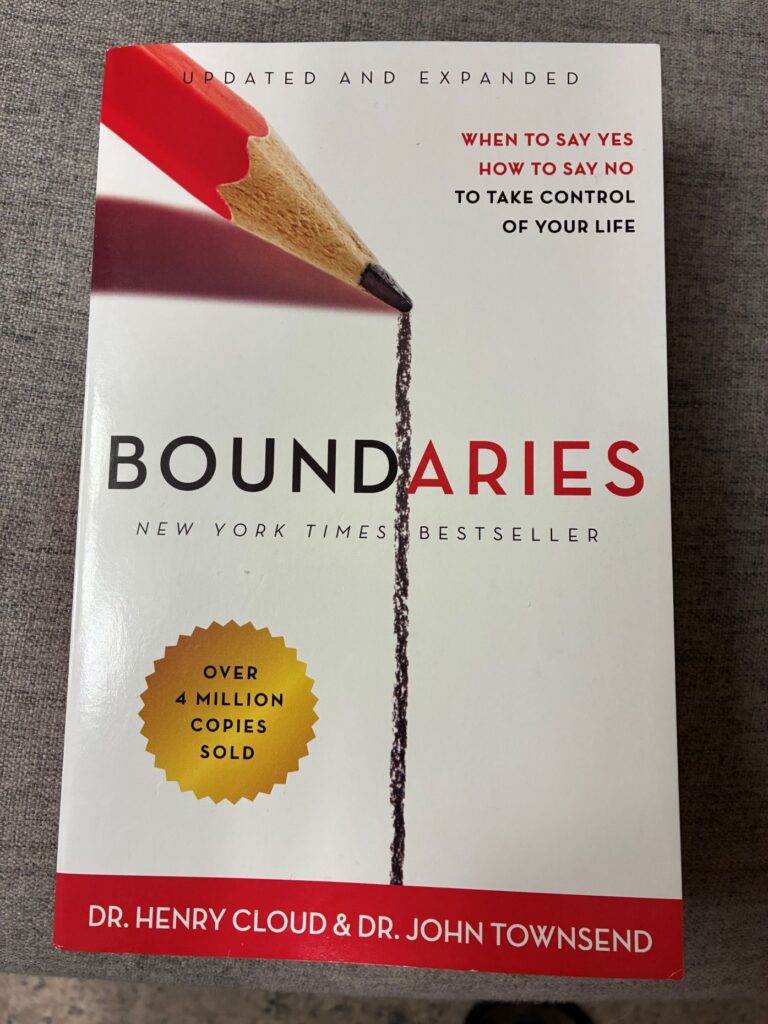
At some point, we all have boundary issues. Maybe you are not the aggressor but the one aggressed upon. Only one of those situations do we have any sort of control which is why we all have boundary issues. Depending on your personality type is how you default to boundary situations.
Chapter Three is titled “What are boundaries”. There are essentially four different types of boundary definitions. Here they are.
- Compliant – Feels guilty and/or controlled by others. Can’t set boundaries.
- Avoidants – Sets boundaries against getting help from others.
- Controllers – Aggressively or manipulatively violates boundaries against others.
- Non Responsive – Sets boundaries against the responsibility to love.
In the book, these types are placed in a table. The Compliants can’t say no and the Non-Responsives can’t say yes. The Avoidants can’t hear no while the Controllers cannot hear yes. When you look at the four types, do you see yourself? I sure do, Much like the Myers-Briggs tests and other such personality tests, I don’t necessarily find myself squarely one category all of the time.
Ironically, I can see myself with all of them from time to time. In my marriage, I am almost completely Compliant. In my non-working time outside of my marriage, I am almost completely Avoidant. While I am at work I am a combination of Controller and Non-Responsive. I can think of times that I have knowingly ignored subordinates requests to try and grow at the expense of trying. But, that has been rare and far and few between.
I don’t think that I am an alien or something not human. I am not sure that it is normal to have all four traits but I also don’t think it is abnormal to have different responses in different situations. It probably is a good indication of why I am always striving to be fiercely independent and self-reliant. It probably explains why I have issues ‘fitting in’.
That being said, my dichotomy speaks to the two types of boundaries, functional versus relational. Functional boundaries are things related to task completion whereas relational has to do with people. I won’t lie, I do think that my functional boundaries are stronger than my relational. I don’t have as much of an issue standing up for myself in a work situation because I feel like I have less to lose.
Chapter four is titled “How boundaries are developed”. This is an very interesting chapter in that it describes the necessary states to not only grow up but also to develop healthy boundaries. When boundary problems develop, it is often a trauma or stunting at a particular stage. Examples of those causes from the book are things like withdrawal from boundaries, hostility against boundaries, overcontrol, lack of limits, inconsistent limits, trauma
There are five developmental stages that have purpose. They are:
- Bonding (birth) – mother and child bond
- Separation (6 mos – toddler) – recognizing that independence is necessary
- Hatching (child) – developing independent personality
- Reproachment (child) – establishing boundaries with safe limits
- Practicing (pre-teen to teen) – Acting within boundaries with ever increasing control
I look at this list and I can see exactly where my development diminished. Since it is biological, bonding and separation happen. I think that my development slowed in Hatching and severely stunted in Reproachment. This seems to be an extremely common occurrence with strict parenting. When a child is not allowed to safely say no then they do not develop the skills to set personal boundaries.
Clearly, not everything remains static. My sister (youngest) had much less in the terms strict boundaries than I did. My brother rebelled and had much more friction. His personality was stronger in determination to become independent whereas my sister really did not have to try that hard.
End Your Programming Routine: I am not complaining, it is just the way it is. And it certainly is not an excuse to not address the problem. This book has already changed my perspective on boundaries. I now realize that I have issues as well rather than strictly thinking I am the victim.
Recent Comments