As I mentioned last week, it was the last chapters of the part one. This of course means that these are the first two chapters of the part two. I guess I would describe this part as scenarios with the different social groups that we frequently interact. For instance today we read about boundary conflicts with family (ch7) and friends (ch8).
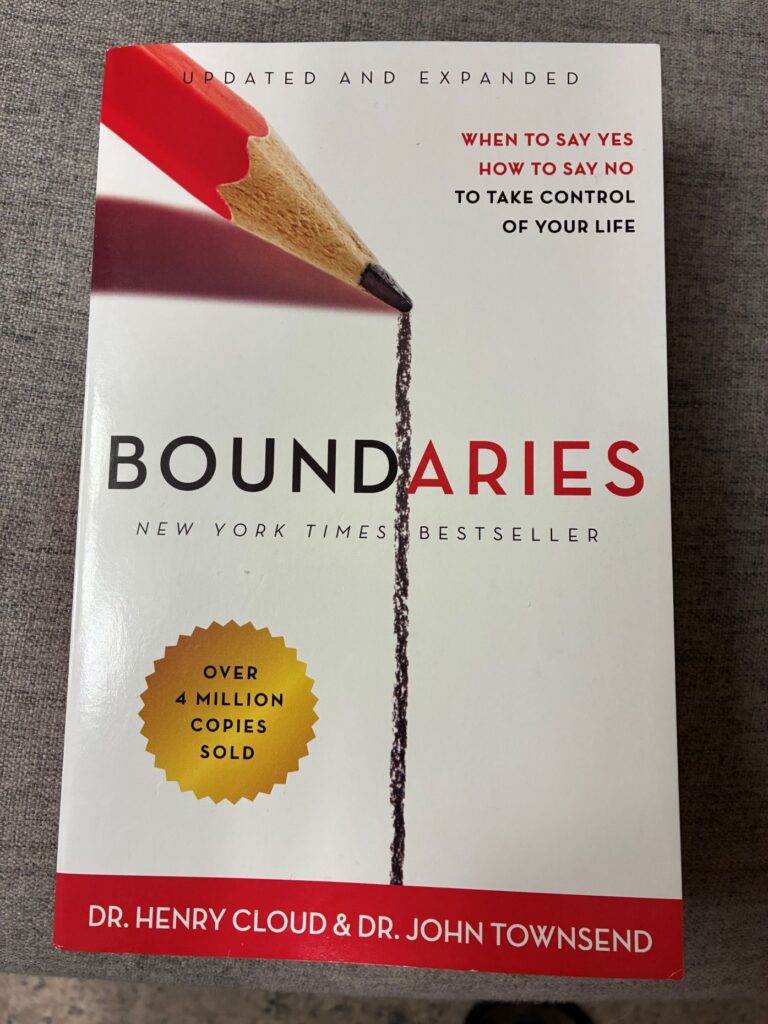
It shouldn’t be any wonder that boundary issues with family start with them as well. The term arrested development is probably a pretty good descriptor. If steps are not made to mitigate old roles and problems then it is pretty likely that they carry forward.
Dave Ramsey has this term of Powdered Butt Syndrome. In his case, he is referring to any person that has powdered your butt will never see you as an authority figure. I don’t find that to be completely true but it is definitely niche. In my case, my dad is frequently coming to me for technology issues. He sees me as an authority in that space.
I also secretly suspect that he likes and trusts my approach better than other helpers because I don’t just push buttons or click the mouse. I am cautious and deliberate when I am working on his computer. But, the fact remains that this phenomenon is real and my point is that boundary problems start right where they ended.
The thing that I like about this chapter is that it talks about boundary resolution. To me, it seems like it has nothing to do with family specifically. In my book, the concepts that the chapter talks about are pretty universal. They would be: Identify the symptoms, Identify the conflict, identify the need that drives the conflict, take in the good, say no to the bad, forgive the aggressor, respond don’t react, live in the freedom
Switching gears into Chapter 8 now and boundaries and your friends. Back in chapter 3, we learned about the different types of personality disfunction. This chapter goes through some scenarios with your friends and what happens when one type interacts with another.
I don’t know for sure, but I assume by the type pairings that this book is targeted toward the compliant personality type. Otherwise, this chapter misses on what happens when an aggressive controller and a non-responsive get together. I hate to get too negative because I have to assume that the intent of the audience was everyone and not just compliant types.
- compliant/compliant – lack of leadership
- compliant/aggressive controller – takes without asking
- compliant/manipulative controller – always in a jam
- compliant/non-responsive – ignored
This is part of what bothers me about this book. When two compliant types are friends, the book makes a point of using an example of they both make conflicting plans. Each one agrees to the other despite the conflict. The point was each were so timid that they could not possibly say no to the other despite the looming disaster.
As I have stated repeatedly, I am not a psychologist or therapist. That being said, I have to say that scenarios such as what is used in the book has to be almost zero. Maybe it is hyperbole or possibly I do not have enough exposure to other people’s problems.
The other three types of interactions are pretty much as you would expect. As such, I don’t think that much explanation is required. Like the discussion in chapter 3, I find myself in between compliant and non-responsive. I don’t really have a ton of friends (surprise, surprise) but there have been some times when I really wanted to say no but I didn’t and so I ignored the decision. Remember that compliants cant say no and non-responsives do not answer.
You know, I am sure that it is dysfunctional but I really do not have many friends and I really do not value their place in my life. My attitude is sort of take them or leave them. A part of that has to do with some friends that I had 20 years ago. I did not recognize personality type before this book but I knew that I could not say no and if I stayed around long enough, I would eventually get into serious trouble.
End Your Programming Routine: I don’t mean to be disparaging, but I do recognize that my boundary issues are a result of my upbringing. Despite that, I have been an adult longer than not and I feel like I have outgrown my interpersonal boundary issues with my family. It wasn’t always smooth but they understand that I am an independent adult. That feels good and normal.
Recent Comments