It is hard to believe but I went from being weeks ahead to almost not making it this week. I really had to buckle down and get these chapters in the book read. Fortunately, my wife had a long doctor’s appointment allowing me to get half of my reading in the other day. That motivated me to finish the second chapter in time.
Even though the whole notion of boundaries is of personal nature, this week is even more so. Chapter thirteen is all about boundaries with yourself and chapter fourteen is about boundaries and God. I know that there is different theology at play here but I believe that essentially there is a lot in common between internal boundary problems and Christian relationship boundaries as they are largely one sided and often occur in private.
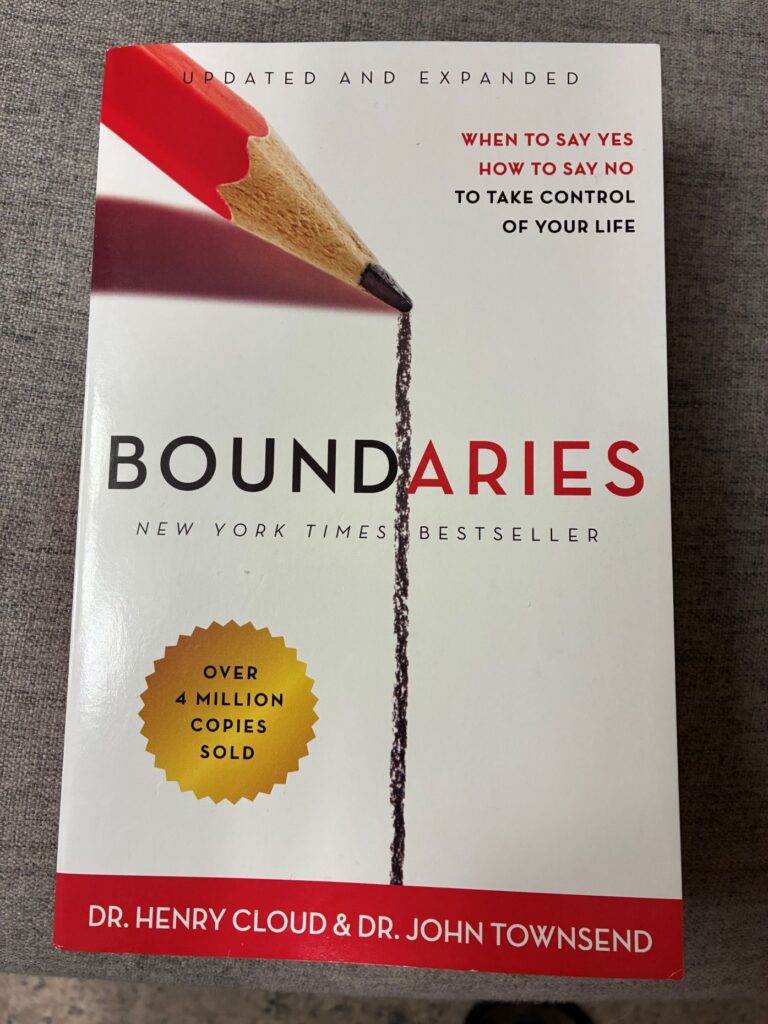
We will go chronologically in our review today. The idea that internal boundaries exist is kind of novel and I can certainly identify with that. My wife says that I always live inside of my head. Despite me writing every day and espousing opinions, I would wager that people really know nothing about me.
I am reserved and have a go along to get along personality. What that really means is that I play poker face pretty well. I generally tolerate nearly anything for a short duration with an eye toward the future. That means I may be really not meshing in social settings but I will change that in the next opportunity I get. Meaning I might say that I wish to never be in that position again. That doesn’t mean that I don’t make an effort to be cordial and social for the time being.
Cloud and Townsend claim that there are seven areas where people struggle with internal boundaries. Those would be food, money, time, task completion, words, sexuality and substance abuse. What is revolutionary to me is that they claim we need accountability to change and cannot be done alone. This is a nicer way of saying that there is no such thing as willpower. I have always been in the camp that you can do anything you set your mind to, but I can see this perspective as well.
It might seem obvious, but it is their claim that often these internal boundary conflicts are in response to external boundary issues. It is a form of self sabotage. I eat and gain weight to not be attractive because finding the right partner is difficult. That is just one example.
I believe that this is why I struggle with empathy. I have always believed that internal boundaries are largely within our control. With that, if you are not willing to put in the work, why should I? What was revolutionary to me was that this is a process of try and fail and the accountability partner not only has to understand that but also coach and encourage through that. That can be a very anguishing process for all parties and something that I am not particularly good at.
The steps that Cloud and Townsend say are necessary to change internal boundaries are as follows: identify the symptoms, find the root, identify the conflict, take ownership, ask for what do you need and begin. I won’t spend any more time with that as this is already running long but read the chapter for more details.
This was a great chapter for me. It ended with an opinion on victimization. They define real victims are in circumstance where they have no control. To me, that becomes a very small group of people. Overeating is not being a victim, a child being sexually abused is almost certainly a victim. In today’s diminishing woke world, there were a lot of people stealing TVs in a riot rather than having a boot on their neck. I am just saying that the claim of victimization needs to meet a defined set of circumstances.
Moving on to the next chapter I also got a new perspective. I never considered the idea that we have boundaries and god has boundaries. The chapter uses biblical examples of where boundaries were exploited. The whole idea of asking during prayer is a boundary issue. Is it justified? Have we ‘earned’ it? Is there a greater plan that we cannot see at work?
Just because we are not granted our prayer now does not mean that it is not going to happen. I thought that it was an interesting perspective to present that possibly the asker has not tried hard enough. Imagine what life would be like if every prayer was answered when asked? It is definitely the idea that there is no success without failure. Why is that? Because we need to learn the boundaries of what works and what does not and the variables that play into those situations.
Those of us with children will recognize the crocodile tears scenario. Let them stew for an hour and they will move on. If they don’t give up, then eventually we will come to recognize that this really is something that they want. And at that point we can make a plan to enable what they want like earning money to purchase. Giving up is a certainty that it will not happen. The same is apparently true with prayer. I never thought of it in such a way.
End Your Programming Routines: This week really resonated with me. I know that I have some personal boundary issues. They stem from my inability to confront something, I am not sure what that is yet. It is also really difficult to take a personal problem and ask for accountability from someone that may not even know that the problem is occurring. As I struggle with empathy, it seems like a bridge too far to ask for help. We will see how it goes.
Recent Comments