**Note: May 26, 2025 is a holiday. I am taking one, you should too.**
This week gets into the tactics of concealed carry. It covers the basics of where you might possibly have or use a firearm. I do think what is conspicuously missing is our interactions outside of our own business, home, street or car. We are missing things like church, restaurants, stores and all the places we might be besides the four that he talks about. That being said, we were years away from ‘shall issue’ concealed carry when this book was written. As a result, it is understandable the focus and the omission.
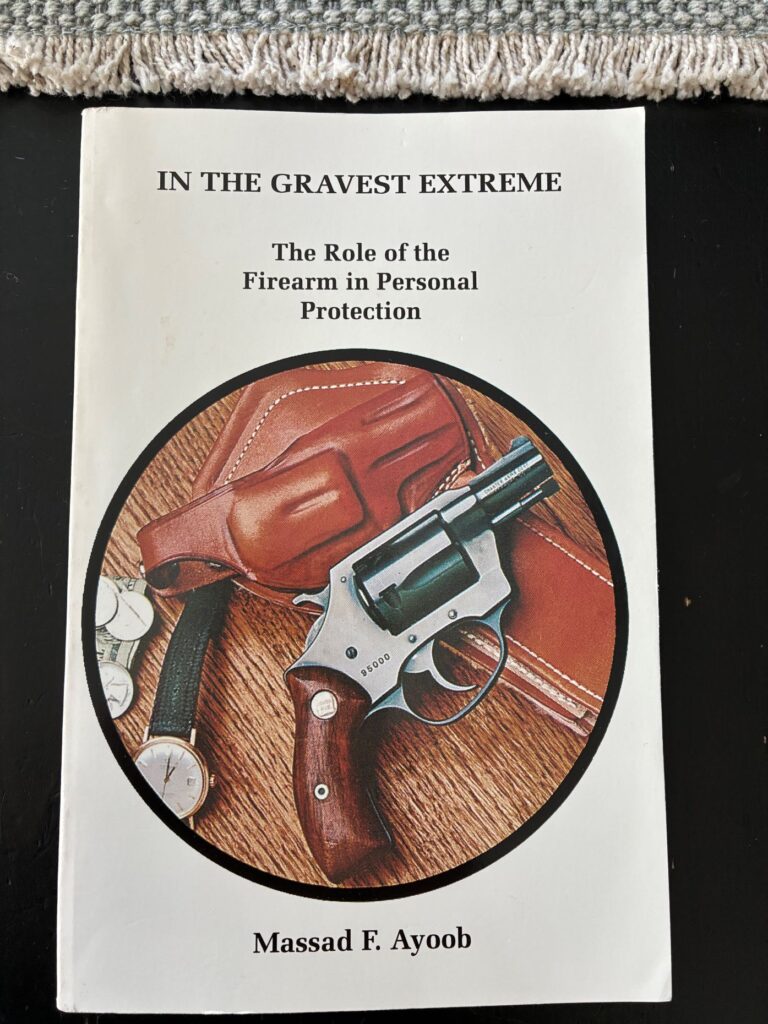
I never knew this but apparently, Ayoob grew up in a family business. A jewelry store to be specific. Rightly so that he was exposed to potential conflict while at the shop. I don’t know but that is possibly as risky of a proposition as being a convenience store owner operator. For most of us, I would guess that having a firearm stashed at work is probably a no go. Likely, carrying concealed would be a better proposition anyway.
My grandfather was a sole proprietor in an shady business. He was a landlord that dealt in the lower tier of renters. As such, he was robbed several times in his career during office hours. Unfortunately, they did get away with his Purple Heart awards from World War II. I would say that he could have benefitted from a gun at his office.
A gun in your home is the most likely place that it will be. While there are many people that are permitted to carry, I suspect that few will actually do it. But, having protection around at home is much more likely which is what makes going into somebody else’s home so risky. Ayoob offers what I think are reasonable tactics still today for dealing with a home invasion and family protection.
When we were living in South Carolina, I don’t think concealed carry was a legal construct. I didn’t investigate thoroughly, but I was told by many residents that it was legal to have a firearm in the glove box. I do know that was the case in other states and so I had no reason to doubt that. This has never been a practice that I have ever been comfortable with or employed.
Today in Oregon, to have a firearm in the glovebox would require you to have a concealed carried permit. Surely others will do this as well but it still doesn’t make it a good idea. I was home a few years ago when the police rang the doorbell. They said that the neighbor had a firearm stolen out of the car and wondered if we had any doorbell footage. I told him I would check and didn’t see anything.
The point being, is that leaving a firearm in the car leaves it out of your control. Run of the mill break-ins can have your property ending up in the black market. It also would be hard to reach when you really need it too. That being said, I could see putting a firearm in the car when going on a road trip or something. Where legal of course.
I know that I skipped around a little bit but the last chapter I am going to talk about is the gun in the street. Ayoob really is focused on the tactics of deploying a firearm in the streets but this is really the run of the mill concealed carry. I suspect that it is pretty sound advice but I do think that it should be taken with a grain of salt. A lot of this has changed but you do need to be aware of the term brandishing.
Brandishing is flashing a firearm with the intent of intimidation. I am more than sure Ayoob is not implying that you brandishing is a valid technique, but the wording and the way that it is written kind of, sort of seems that way. Once again, in states where that is a crime you are only legal to display a firearm when you are legal to use one. States that permit open carry typically do not have brandishing laws. The point remains that you need to know your state laws down pat.
There is a concept in this chapter that is talked about but it also comes up later in the book in a big way. That is, it is cheaper to not get in an altercation than to be in the right. I will save most of that for next week. Suffice to say, carrying a gun is a tool in the toolbox. It doesn’t mean that it is the first or best or only tool.
End Your Programming Routine: Good stuff. I keep saying that with all that has changed in this landscape, the tactics remain good and legally defensible. It helps to know and understand the history and evolution to be able to pick out the nuances and changes. Reading this book has inspired me to get the updated book that Ayoob has published because I suspect that most of what is wrong here gets corrected. It won’t be the next book but it will be soon.
Recent Comments