Page 127 of 135

May 22, 2020 – Heading toward a misunderstood holiday weekend

As an Eagle Scout, my patriotism runs deep. But as I often say, details matter and this is one of those things that is starting to annoy me more as I get older.

Memorial Day originally began as a symbol and remembrance of the horror of war. It was created as a holiday by President Ulysses Grant approximately at the end of the battle of Gettysburg. Gettysburg is considered the turning point in the US Civil War. This is a day to remember those who died in battle, in service to their country, period.

Like many people, I don’t actually know anyone that has died in battle. I know people that were wounded and I know people that later succumbed to their demons. Most of them were kids who’s lives have not yet begun. So unless you are a parent, spouse, sibling or served in combat it is not likely you will have a strong connection to this holiday either.

In this age of ‘woke’ and relative morality, culturally we have lost touch with actual right and wrong. In lieu of potentially offending someone, we just accept wrongness and actively perpetuate it. Patriotic groups are actually the worst at propagating the improper image. I will explain.

My sons’ Boy Scout Troop places flags at one of the local graveyards during the week of Memorial Day. The selection criteria for a grave getting a flag is whether there is an indicator that the person served in the military on the headstone.

That level of discrimination has nothing to do with actual Memorial Day. For the most part, I can tell that most of them did not die in the line of duty by how long they lived. I have also seen flags placed on empty graves because I know one person who’s spouse died and has the headstone mostly complete, including USMC.

At my church last year, everyone that served in the military was recognized during Memorial Sunday. I heard a local country music station say thanks to all that served, including now first responders. We have gone off of the deep end on giving recognition that is way out of context to the meaning of the event.

Service for the most part is a choice, not an enlightenment. I am thankful that people make that choice. But I also believe in supply/demand economics. The kids that I know that have enlisted are doing so for education, VA home loans, paychecks, signing bonuses and twenty years retirement. That is a great reason to do so and I support that decision methodology.

But, lets no kid ourselves here. A signing bonus is a long way from the Marine landing at Omaha Beach or the Pacific islands. Watching actual footage of kids throwing up out of fear and cut to bodies bobbing in the surf has little to do with each other. War is a business where casualties are expected, it is a matter of which ones.

I am all for expressing gratitude, its is a trait that I am not very good at. I just want us to actually take to heart this weekend that ‘Some Gave All’, almost universally not by choice. Strategic and tactical decisions were made and the consequences were death. Let us not cheapen their sacrifice because we are ignorant or are worried that someone is going to be left out of recognition.

May 21, 2020 – ‘Tacticool’ Thursday

Today’s subject is the ‘tactical dresser’. It is a place to store your ammo, holsters, (maybe) handguns, magazines and other gear.

Of course, I am being a little tongue and cheek. This dresser is something that we bought and used. It was in the apartment and in the way with all of the renovations currently. I am on the fence about whether to refinish it and resell it or donate it. However, with the purchase of a new refrigerator I had to reconfigure a bit of plumbing. Because of that, I had to move a bunch of stuff to access the piping in the basement and consequently, I stuck it in the dresser to get it out of the way,

Everyone needs a place to organize their junk and accoutrement that goes along with their hobbies and interests. For myself, I find a lot of joy in everything having a functional home. I have probably spent as much time building benches and storage furniture than I have actually pursuing the hobby that they were for. The bench that has appeared in multiple ‘Tacticool’ Thursdays posts was designed and constructed as a fly tying bench. It actually has been used as a reloading bench, but not yet to tie a fly.

I have constructed custom pantry, camping and propane storage shelves. I have made pegboard racks, ammunition shelves and potting benches. Maybe they will make it into future posts. I guess that it is the frugality in me, but I am always thinking about how ‘junk’ can be repurposed to into something that be used to further my organization and make life better. Because as much as I think it is good to clean out old stuff, I worry about donating unwanted stuff is still junk in the end.

The dresser pictured is something that we purchased second hand. It is a quality piece of furniture that was built in the 1980s and is made of ‘real’ materials like American Oak. It is dated, no doubt about it but it is well made and well built.

The dresser we used for twenty years was something that was garbage when I started. Contact paper wrapped the entire piece. There were cigarette burns and scars on the top. When I refinished it, it revealed a mahogany veneer. It turned out to be beautiful and I hated to replace it when we did. But there is a saying, “you cant polish a turd”.

Let’s bring this all around. Look at your cast offs, look at you needs. Make sure you are not making your problem someone else’s. Make sure when you are donating something that you are asking yourself, “would you buy this?” Can you integrate this into something that would benefit you? Make your life better by organizing and utilizing material that would otherwise end up in the landfill.

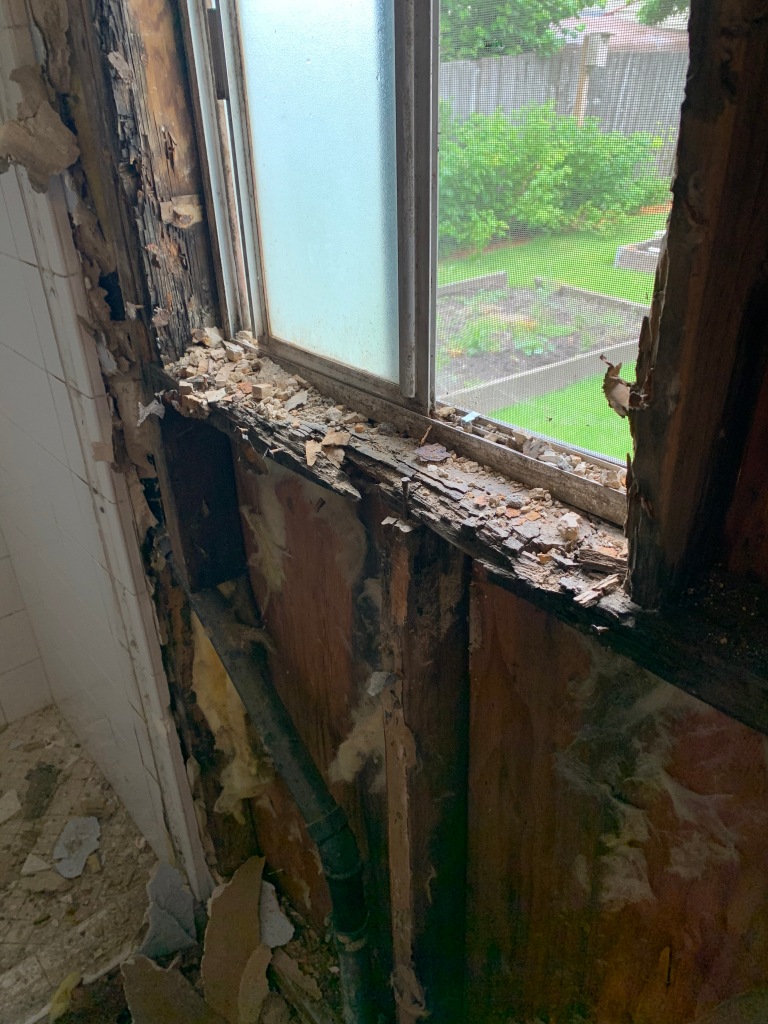
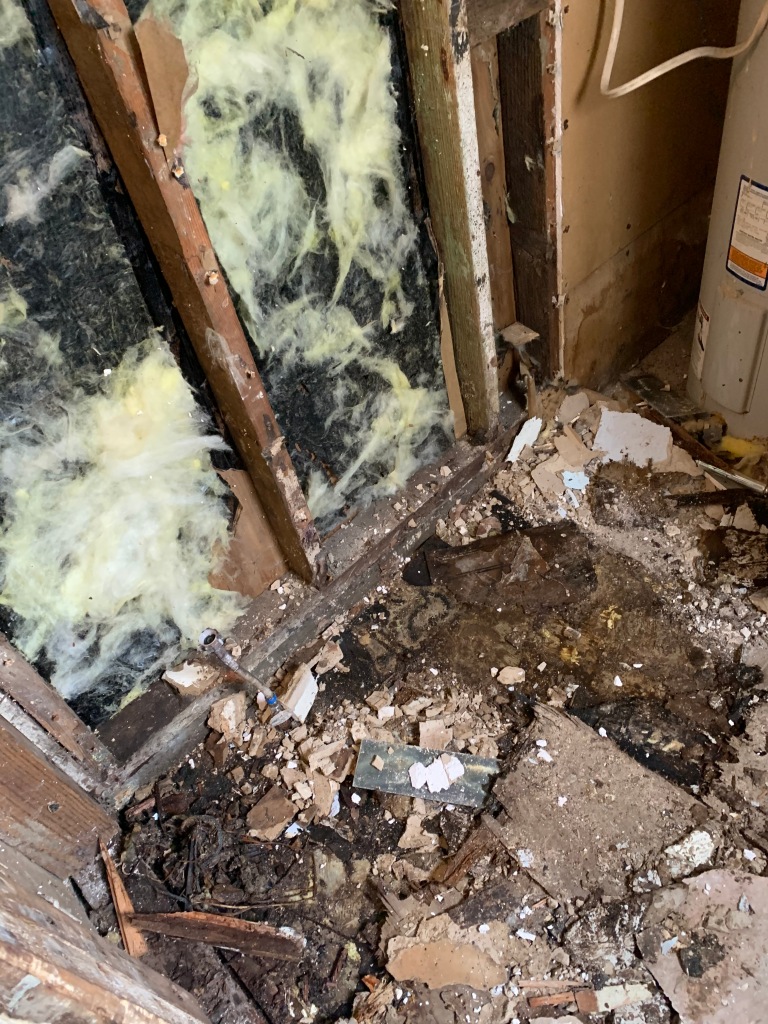
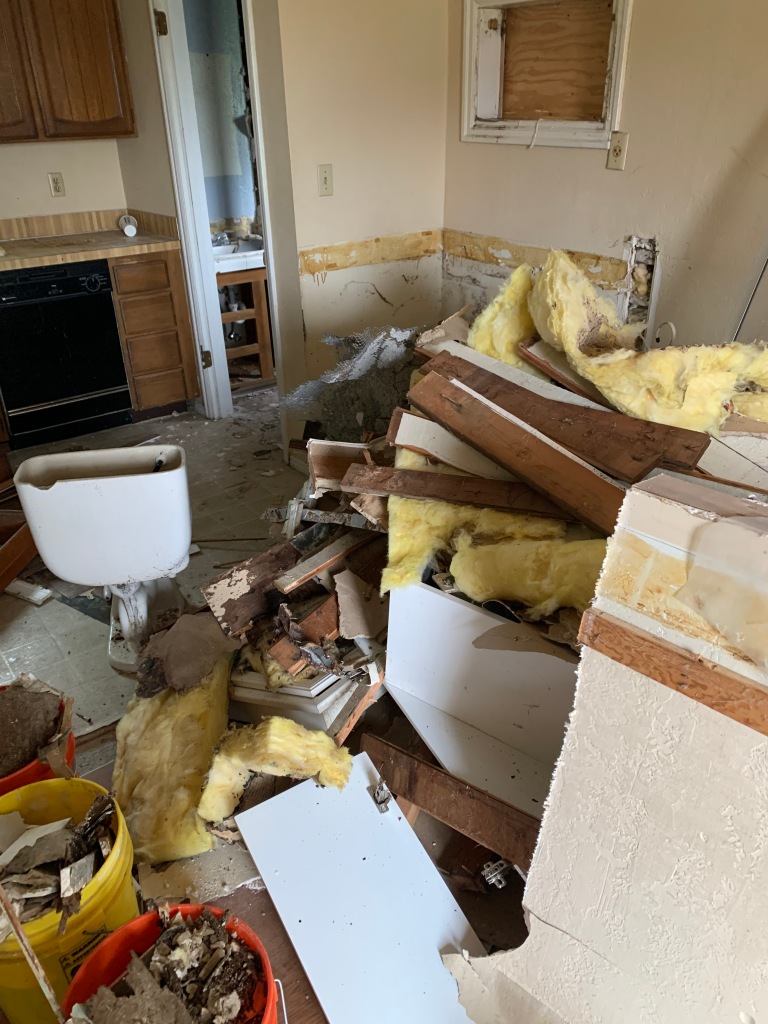
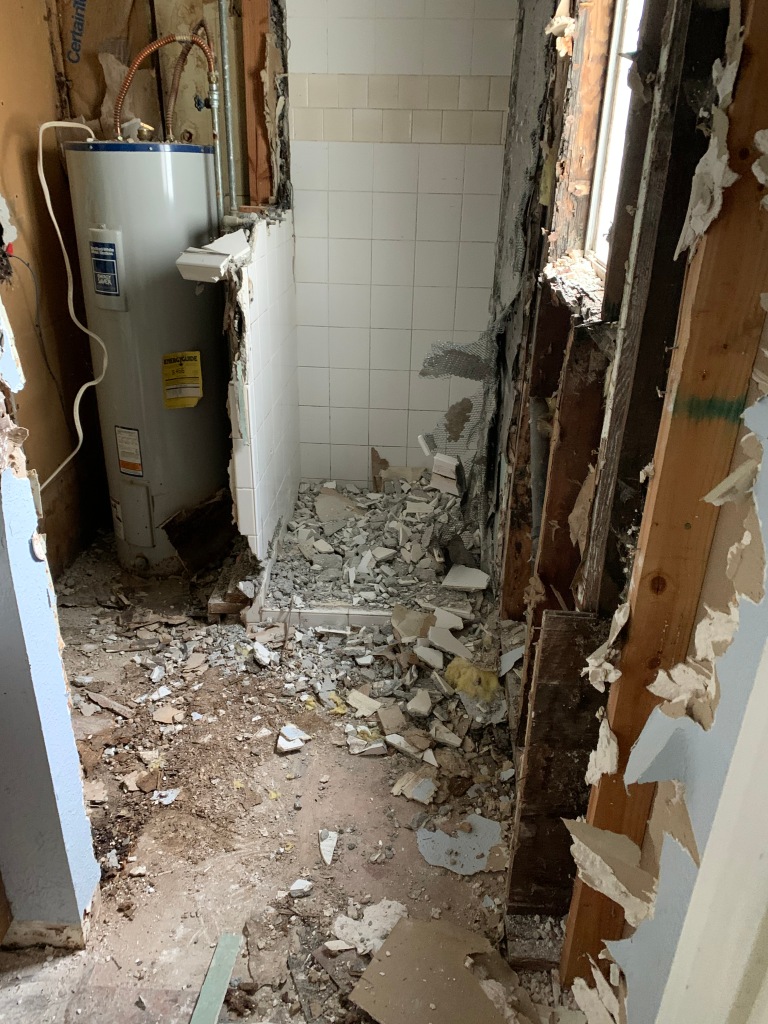
May 20, 2020 – Don’t anyone fool you that construction demolition is fun (or easy)

I feel like the role of demolition in a project, particularly on TV is portrayed as some kind of romantic process. There is a wild, passionate throw of ideas like “we can knock this down and open that up and replace these fixtures and those sets of cabinets”. Everyone will get out their pent up aggression and an hour later will be moving on to making everything nice and new.

In the real world, that just isnt true. Demo is long, tough, tedious and dirty business. The conditions are less than ideal sometimes downright gross. Rot, mold, mildew, excrement and even dead animals are part of the discovery.

In my case, I am always mindful of ‘over’ demo. If I want to use one sheet of drywall or plywood, I am calculating precisely how far to go so as not to need one and 1/8 of a sheet. I am thoughtful that molding profile may not be easy to match again, so unless I want to redo the entire room, I need to be careful removing it. Gentle demo can take days longer.

I try to be consciences about reuse and value as well. Cabinet and fixture removals are examples of that. Habitat for humanity will take items in serviceable and good condition, but not damaged. I try to reuse wood and minimize landfill fodder as well. We burn appropriate and clean wood in our fire pit for family entertainment. That minimizes waste and maximize use, but nails and things need to be removed first.

I don’t mind swinging a sledgehammer ten times. But eight hours of prying, cutting at odd angles, hammering and wrestling sharp heavy objects quickly removes the romance. It is probably my lack of experience, but rarely does any of this go as planned or easy.

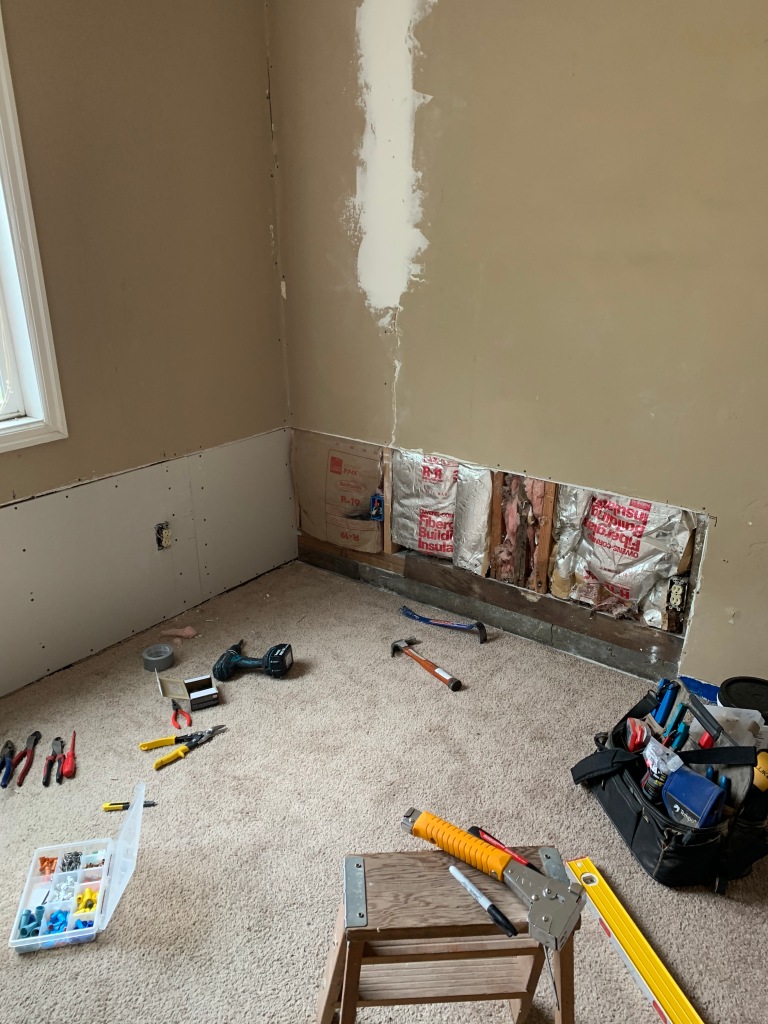
Yesterday’s progress on the bathroom. Boy is our work cut out for us.

May 19, 2020 – What the @#%! is a dipole?

This recent excursion into Audio/Visual equipment and electronics has gotten me looking around to the science of antennas. Boy let me tell you that from what is out there, this hobby is either a cult or dominated socially challenged individuals. It is very hard to get concise, novice level advice that isn’t filled with technical jargon.

The words cheap or DIY antenna conjure up some pretty ‘hacky’ results. Some of the first results found in such a search do bring up results, but they are very mixed up in technical details that don’t matter and use some techniques and materials that are lab worthy, but not something that will stand the test of time. I want to qualify before I get too deep that I am not an expert in the science nor do I have much (if any) experience in building antennas.

First, how do radio signals work? Each radio station has a frequency that they broadcast their signal. For example, 101.5 MHz is one particular radio station address. So what is a MHz?

  • M – Mega or 1,000,000
  • Hz – Hertz, unit of length of the radio signal in one second

That means that for 101.5, there are 101,500,000 waves in one second. All signals have an assigned band of frequencies that they can operate in. So, the smaller the number (of hertz), the the taller the wave is (because you are measuring the length in one second). Here are some examples from shortest to longest.

  • AM 535-1605 KHz (remember that kilo is 1,000)
  • FM 88-108 MHz
  • VHF 174-216 MHz
  • UHF 470-806 MHz

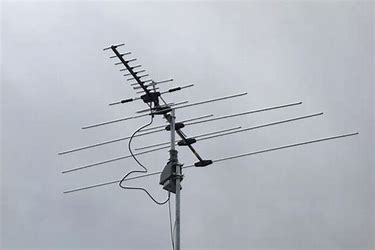
This is why antennas need to be specific size (length) to the signal that they are trying to capture. They are optimized for a frequency or band of frequencies, like a TV antenna. Also when looking at an outdoor TV antenna, notice that each conductor is a different length. This is to try and capture all of the frequencies that are available in the range.

So a dipole is a type of antenna that has a specific length of conductor that is optimized for one frequency. The most familiar dipole is the ‘rabbit ears’ type antenna. I wont go into all of the science on this version, however the principle is that you extend or adjust the length of the antenna and orientation to maximize reception of a particular frequency.

The length of a dipole is determined by matching the size of the radio wave to the frequency that you are trying to capture. Looking at the picture above, it would be an antenna that is one of the horizontal members sized for a specific frequency. There are calculators online that you can use to determine how long your antenna needs to be in order to capture the frequency you are looking for.

There is also a concept of directional or unidirectional. Directional means that your orientation of the antenna matters in the reception ability. Dipoles are directional, but it seems like the features where it matters, like Ham radio are not really affected for FM reception. We will find out.

The good news about all of this is that this is a novice look at all of this, so if you decide to build a dipole for FM, and your antenna is between 4’3″-5’3″ feet, you should be able to get most of the available stations. I will be posting about what I think makes a good antenna in the near future as I finish building it.

May 18, 2020 – It’s Alive!

I don’t have a ton of time lately. My schedule has been cruise the different job websites, apply for relevant jobs, write a blog post and then work on getting my rental house together. Even on the weekends, I have been doing this. I may get an hour or two some days and I have been spending it looking at my audio equipment.

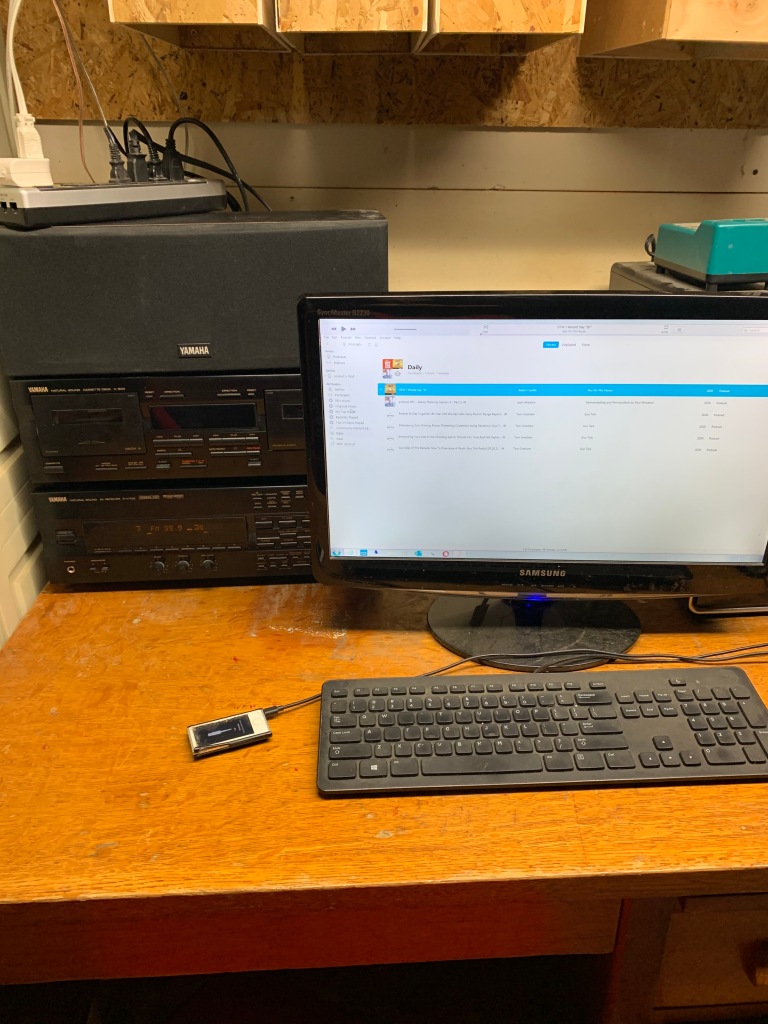
The receiver is now working, which means the receiver and tape deck are now working. I also replaced the connection from the computer to the OEM speakers and run the sound through the receiver. I hooked up the surround sound and did a Dolby test, wow it has been years since that experience. I also have been playing my podcasts through the receiver as I putter around in the basement. That has lead me into investigations into building antennas and other things that I will talk about in a later post.

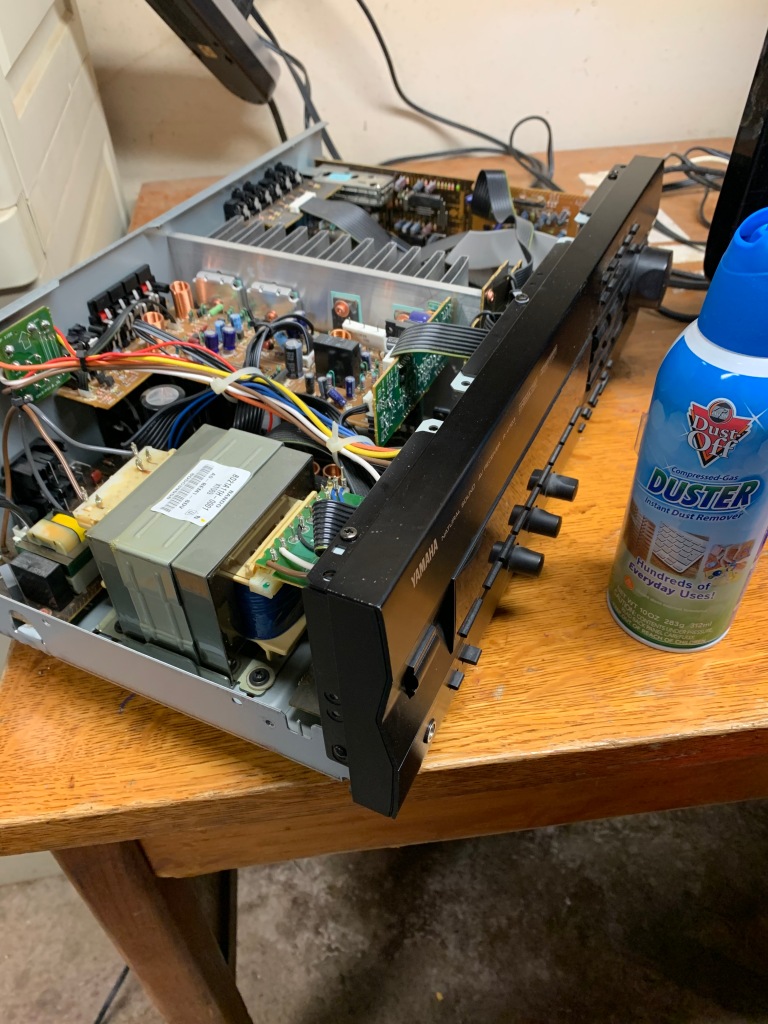
First, I thought that there was a component blown out in the receiver and that proved to not be true. Taking the cover off and looking around, I found a piece of dried grass that was laying across the speaker conductors (I couldn’t really get a good picture of it because it was too deep into the box). I used some compressed air to flush it out and viola, it works.

The same cannot be said with the CD player. That is currently in parts. I think I may have damaged it by not knowing what I was doing. A couple of things that I have learned so far… There is a downloadable service manual which has been helpful in not breaking things further. The CD player has diagnostics on-board which has told me that the table position sensor has failed (I think I damaged it when I tried to force the table back in). It is not easy to find parts outside of drive belt.

Looking around, there are some ‘local’ authorized service people. I may pursue that because it seems that this unit is still worth $200 according to Amazon. At the very least, I am going to look at the board and the sensor a little more carefully to see if a solder job is a quick remedy.

This journey has kind of fascinated me. There are people who are really into this sort of thing. I have to admit, seeing old units from the seventies next to an old magazine add is pretty cool. Learning the history and mystique that is attached to some of the old units is pretty interesting.

Lastly, unexpectedly and kind of serendipitously my wife received a record player for Mothers Day. It isn’t a real high end one, but I thought it would be fun anyway. I do still (think) that I have some records at my parents house, like “Thriller”. Unfortunately, the are travelling for a couple weeks, so I will have to wait until they get back to get them.

Last year, vinyl outsold CDs for the first time ever. It is definitely a growing trend. There is something in my head that seems wrong to play today’s music in vinyl. I am thinking of purchasing something like “The Very Best of Electric Light Orchestra: All Over the World”. That seems like an appropriate maiden voyage.

May 15, 2020 – Progress is faster than the documentation

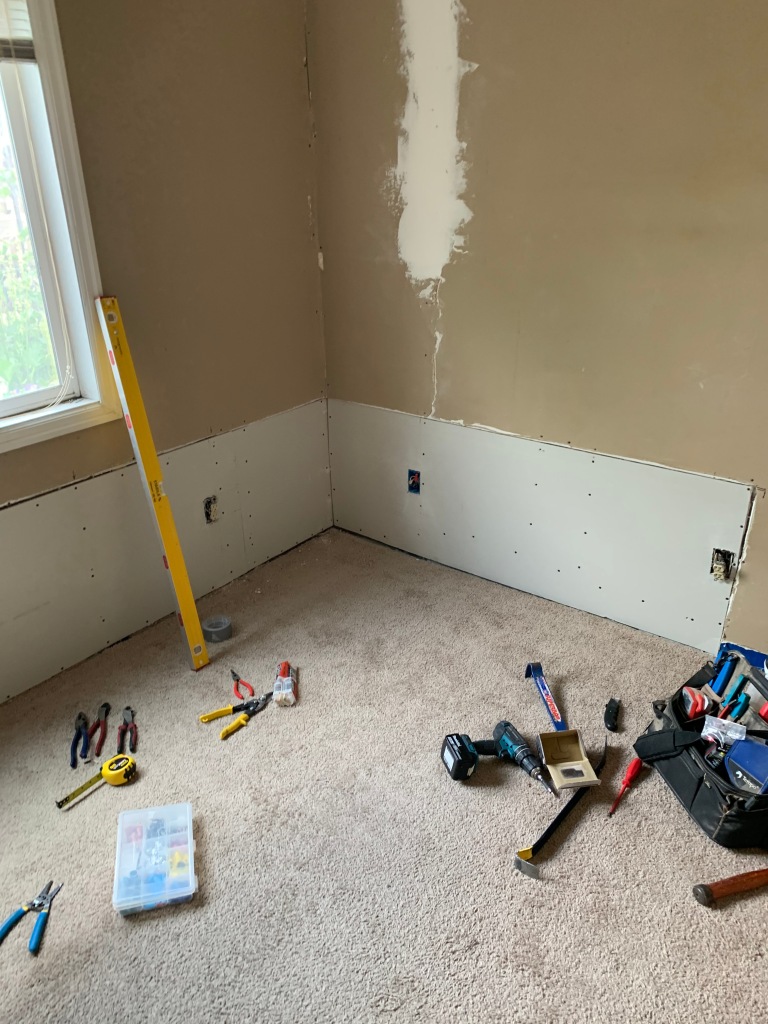
A quick update for today (I know that I need to do more than take pictures). So much has changed in the last couple of days. The siding on the south and east side is done, the island is demo’d, the new heater is in and the drywall is installed.

With rain in the forecast this weekend, I will probably spend more time on the drywall finishing. We also got a new refrigerator today. It doesn’t fit into the space it is supposed to go. I will have to shorten the water supply which will require a bit of modification of the plumbing.

More pictures and info to come… have a good weekend.

May 14, 2020 – ‘Tacticool’ Thursday

Back when I was a youth, I was in Boy Scouts. One of the things we did quite a bit of was rafting, mostly white water. There was a friend of the troop that was an outfitter in the summer time and he would let us use his rafts for short excursions in the offseason. I have gotten the opportunity to raft the Deschutes, John Day, North Santiam, Mackenzie and the the Willamette.

My first trip, was on the North Santiam and when the rafts were all blown up and ready to go, we were handed a fifty caliber ammo box for our valuables. This was our boats’ dry box. Military ammo boxes have a water tight construction and a durable seal that allows the box to float (as long as it is not full of lead).

It seems to me that in today’s world the surplus boxes have all dried up. I think for the one pictured, I paid $3 in the early 1990s. I remember distinctly paying $5/ fifty caliber box in the late 1990s. They can definitely be found online, but you will be paying $20 plus shipping. Fortunately new, non-surplus boxes can be found for around $12-20 if you are interested in picking one up. MTM makes a plastic ammo box for $10. It doesn’t quite stack the same with the metal ones.

I thought that I would talk a little bit about what they can be used for. Well, first of all you can put ammo in them. I like to put reserve ammo in them so that when there is a run, like now I know that it is safe and sound for when I want it. I already talked about using them for a waterproof container, very good use. You can buy trays to put inside the fifty caliber box, that turns it into a toolbox or parts box. I have seen them strapped to ATVs for that purpose. I know that there are plans so that you can build a self contained ham radio w/battery for grab and go use.

Surplus ammo cans come in a variety of sizes. Some of them are very large. Rafting companies on the Colorado have built mobile toilets on the largest of the boxes. They have to pack out waste to minimize the environmental impact of raft tours. I think that the most useful size is the fifty caliber. It seems to be the best compromise between size and weight.

I am always interested in what other people are doing or have seen. So let me know what you have done.

May 13, 2020 – Rainy Day, time to work inside

Since my update last week, probably 75% of the siding is now up. There is still some caulking to be done as well as most of the painting. There is consistent rain in the forecast for the next two days so I am going to be switching gears on the outside and working on the inside.

In the interest of ‘edutainment’, I figure I should be working a little harder than just posting pictures of progress and a short blurb about it. I am going to try and get some helpful information in these posts. So, with that, here is a starter information about siding.

Now, wasn’t that fun?

May 12, 2020 – Review: Hunt, Gather, Cook

Hunt, Gather, Cook: Finding the Forgotten Feast by Hank Shaw was the April book selection in the Left Coast Cellars Culinary Book Club. Unfortunately, the club has been on hiatus since mid-March but that doesn’t mean that the reading doesn’t go on.

Hank Shaw is an author, blogger, podcaster and general media person. His focus is about cooking with wild sourced ingredients. He tends to collaborate with others in this space like Steven Rinella. If you are into this sort of genre, then you probably already know about him and his contemporaries.

The book is organized into three sections. Section one is about foraging, section two is about fishing and section three is about hunting. Each chapter in the section is grouped by a theme such as wild berries. At the end of each chapter there are five or so recipes focusing on the type of ingredients the chapter is about.

This is one of those books that I would consider a gateway into the subject. There is no possible way that a person can safely learn everything about foraging by reading this. Every microclimate and region in the country could support it’s own botanist/mycologist/herbologist from the vast diversity that is present. There is no mention of mushrooms, which is probably a good thing. Instead the focus is on high value, low risk choices like seaweed and day lilies.

Another potential roadblock to successfully implementing ideas in this book are access, equipment and knowledge. For example, in my state there is no ‘season’ for rabbit hunting. It does require a license to do so. There is public land about ten miles away, but I have rarely seen a rabbit. I think that to really do this successfully, having a flushing dog would be the only viable option. Dogs are not allowed in the public land without a leash.

Instead of focusing all of my energy into why any of these ideas can’t be done I think the best use of this book is to read through it and look for things that can be done. Almost everything has a season to when it is available and or legal (including a lot of plants). Plan times to obtain these items as family activities. A family charter for bottom fish and crab is something I can do in my area. Then be prepared to feast when the trip is complete.

I enjoyed reading this book because it is about 25% technique, 25% cookbook and 50% inspiration. So, it is not a page turner but it does get the mind stimulated about the possibilities. Over the years, I have learned that it is much more enjoyable to pursue the activities rather than read about them. But I find that I can more easily find the time to learn and think than I can do. For that reason, it is exciting to think about that next fishing trip or making blackberry wine.

May 11, 2020 – Mom’s hand chosen picnic

I hope that you all had a great Mother’s day. I know that we did. It was more like a Mother’s Day Weekend. Friday, I hung a new chandelier. Saturday, we cleaned the house and hung pictures that have been sitting around. Sunday we had a picnic on the lawn, I installed a window treatment and we watched a movie to finish it off.

The picnic was delicious and while she chose the result, I went to work on how it was done. I thought that I would share.

The kids did a lot of the work, so I will help them develop their sense of presentation at some other time. But, the first item was a fruit salad.

  • Fruit Salad
    • Watermelon
    • Grapes
    • Pineapple
  • Charcuterie Tray
    • Assorted crackers
    • Cheese
      • Sharp Cheddar
      • Dill Havarti
      • Gouda
      • Parmesan
    • Cured Meat
      • Prosciutto
      • Salami, two types
      • Coppa
    • Pickled asparagus
    • Chocolate truffles
    • Salmon Spread – Mix ingredients for eveness
      • 8 oz cream cheese
      • 2 oz smoked salmon
      • 2 tbls capers
      • 2 chives, chopped small
  • Egg Salad Sandwiches
    • Sliced French Bread
    • Egg Salad
      • 10 hard boiled eggs, coarsely chopped
      • 2 stalks of celery, fine dice
      • 1/8 cp finely sliced red onion (very small amount)
      • 10 chives finely diced
      • 1/2 tsp dill weed
      • 1/2 tsp thyme
      • 1/4 cp french mustard
      • 1/2 cp mayonnaise
      • dash of cayenne
      • Salt and pepper to taste
      • vinegar to adjust acid

Mix the egg, onion, celery, chives, dill and thyme. Then add the mustard. Add the mayonnaise slowly so as not to make your mixture too sloppy. Adjust your additional seasonings accordingly.

I added a little more vinegar to increase the acid at the end. So keep tasting as you go along. You might even want to leave it a little dry if you know that is what you like. There is nothing worse than an over goopy egg salad in my opinion.