Page 121 of 135

September 22, 2020 – Review: Rigid 12/3, 50 foot extension cord

How many people actually read the little instruction manual provided with electrical powered tools? Probably not many people, but if you did, often there is a chart that lists the minimum size cord per distance of run. It would follow something like 25′ needs 16 gauge, 50′ needs 14 gauge, 100′ needs 12 gauge.

Why is that? The thinner the wire in the cord, the hotter the cord gets with more amperage draw because the resistance over distance reduces the amount of delivered amperage. That is why they heat up, the lost current is turned into heat. Reduced power chokes the motor, or said in other words not enough amperage to properly drive the motor.

Generally, this is not a big problem because most tools draw way less current than a circuit (or cord) can provide. Typically, I use any old extension cord to get the right length (and I don’t consult the chart ever). However, there are certain machines that really is not the case. And a good hint is how long and how big the cord on the tool is. For instance, the wisdom with an air compressor is that it is better to get more hose than plug it into an extension cord because they draw near 15A when running.

I once watched painting contractors try to use an 18 gauge household extension cord on an airless sprayer and it tripped the breaker about every two minutes until I gave them an appropriate extension cord. Talk about not having the proper tools for the job. I recently decided to add a 12 gauge extension cord to my stable because I was borrowing someone’s paint sprayer and I wanted to have enough distance and not burn out their tool.

One of the first things to appreciate is how supple the cord is despite it’s diameter. Cheaper cords are stiff and when rolling often have a mind of their own. Not this one. It also has a lighted plug so that you can see the power is on the cord, kind-of nice.

ScorePositivesNegatives
Value4/5Spending on extension cords protect a much more expensive tool or prevent a fireThe worst thing that I can say is that these thicker cords are expensive. $80 for fifty feet or $120 for 100 feet
Quality5/5Fit and finish, everything as expected
Performance5/5Rolls and bends nicelyVery heavy. But all cords of this size are.
Lit plug indicates power to the cord

What else can you say, extension cords are not sexy or fun. They can be pricey and bulky. At best, a necessary evil. But it pays for your job and your tools to have the right cords when you need them.

September 21, 2020 – Kiss my grits

Remember when that was a saying? I seem to remember that I was real young, so I looked it up and it came from a TV show called ‘Alice’ which ran from 1974 to 1985. I didn’t watch a lot of TV growing up, especially at that age but I would have been in grade school during some of that time but I sure remember that saying.

Anyway, that is not what I wanted to talk about today. But, I did want to talk about grits. If you have only had them at Cracker Barrel or never lived in the south, then I would wager that you probably don’t like them. Grits are ground corn, more coarse than cornmeal and very similar to Polenta. It is prepared as a porridge consistency, like cream of wheat and is typically eaten at breakfast time, although they can be a side for any meal.

My wife and I have been watching a show on TV about creative chefs and their restaurants. One of the dishes made is grits and liver. That really caught my eye because I have a lot of liver in the freezer and I am always looking for ways to use it. So, I put grits on the shopping list and my wife wanted some for breakfast. That is what I made today.

What makes these grits so much better? Well first of all it is all about the recipe. You can just boil the grits in water and a little salt but to do it up right, you need to do a more.

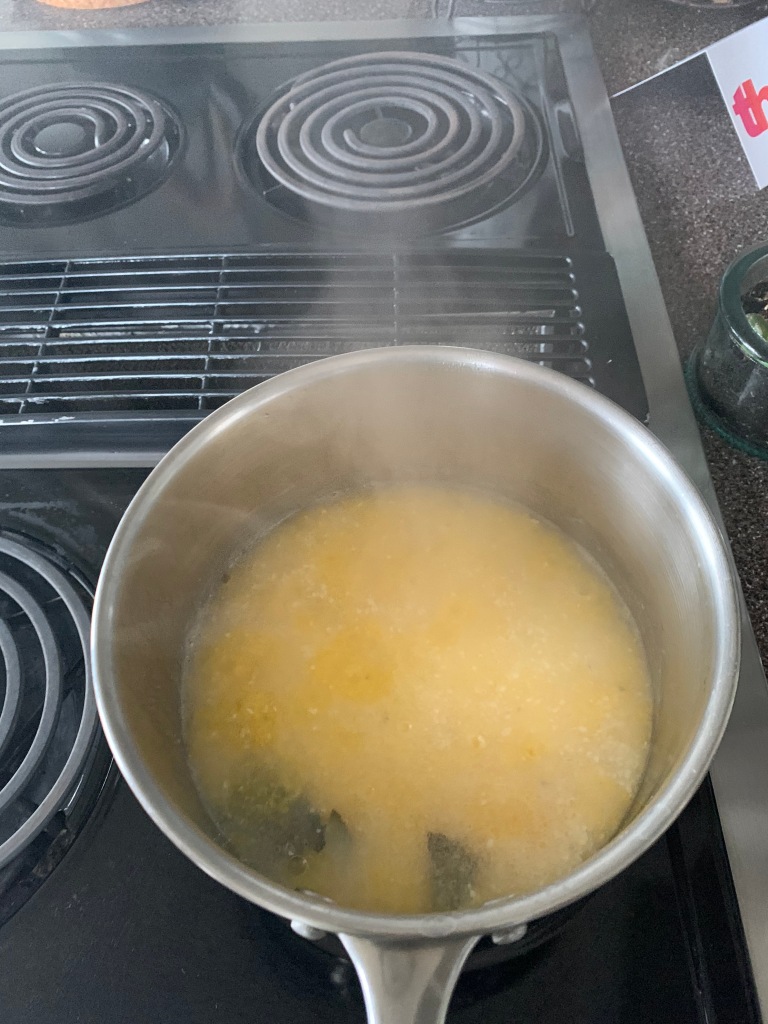
Start by bringing grits (3/4 cup), water (2 cups), salt (1/2 teaspoon) and a bay leaf to a boil and once it is there, set the pot aside for fifteen minutes.

After the grits have hydrated, bring the pot back to the stove and add butter (4 tablespoons) and cream (1/2 cup), I used half and half because I am trying to use it up before it goes bad. Keep the contents at a low simmer to reduce some of the liquid and grate some parmesan cheese (1/8 cup or 1 oz) into grits. That’s it, but so much richer than boiled in water.

I fried up some sausage links to put on the top. But you could also add eggs, like over easy, or some extra cheddar cheese, bacon and onion as other suggestions. When my wife worked for the state of South Carolina, they would have fundraisers in the morning where you would buy a bowl of grits and then add your own toppings to the bowl.

If you don’t live in the south, this is a simple and different breakfast idea. Give it a try if you are wanting something different than oatmeal in the morning.

September 18, 2020 – Mowing my lawn for the first time in eleven years

It’s no secret that we have been rescaling our lifestyle while I continue to look for work. One of the latest victims of our budget cuts was our landscaper Jose. I talked a little about him in an earlier post, so I will leave it at that.

We let him go at the end of August and it is now mid-September. It is a good thing that things are relatively dormant because I haven’t done anything in the meantime. The fire danger precluded the use of power tools. I have been watering the grass to get some seeds started and with the cooler weather, the lawn is really greening up again.

I actually found the grass (and ground) to be really wet, so I turned off the sprinklers for the year. That made mowing a chore as the bag was getting filled with one trip around the yard. Another bit of fun is the Hazardous air quality caused me to do this with an N95 mask. It was hard to breath with the mask on and not safe to work without it.

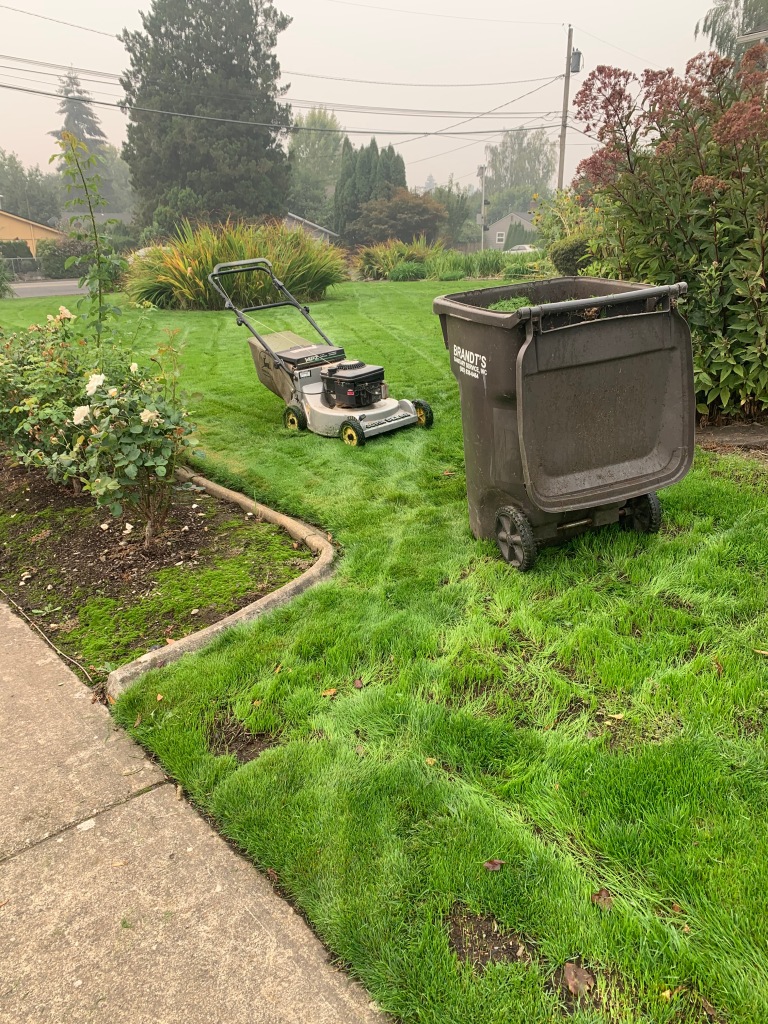
The mower is an OK unit, it was a cast-off John Deere that was given to my son to try and make some money but it is small (21″ deck) an is not self-propelled. It worked fine though once I finally got it started. I have no idea how old the oil is or how sharp the blade is. I traded my string trimmer for canning jars years ago so I will be on the lookout for an inexpensive or used replacement. For now, I will live without it. My blower is still not working even though I tore it apart.

I plugged into my podcasts and got to work. It wasn’t the glorious start to my new responsibilities as I quite expected with squishy feet and puffing through the mask. I really don’t mind doing yardwork but honestly I will need to make a mental shift from only doing the things that I want to do to keeping up with routine maintenance, especially the weeds in the flower bed. Those can get overwhelming quickly.

I have always enjoyed the leaf season. It is probably because I don’t have a lot of trees that drop leaves, but getting out after the cooler weather sets in and exerting some constructive energy is therapeutic. I am also looking forward to pruning the roses properly next year. If I don’t cut down the apple tree, saving the water shoots for more smoking fodder as well. I think it will be good to get the kids involved in the work for character building.

The calculus was always paying Jose for one to two hours a week was much more efficient use of money and time as this took me an hour and a half just to mow the grass. I can remember spending weeks weeding just the front flower bed. Now, my time is free and money is harder to come by. Now, looking forward to raking some leaves soon.

September 17, 2020 – ‘Tacticool’ Thursday

Today, I wanted to show an example target and how to use it. The target in the picture below has one inch squares. It is meant to zero in your rifle at 100 yards.

So, that means that if you are at fifty yards, your adjustments need to double or if you are at 200 yards, your adjustments need to be halved. What in the heck am I talking about?

Many scopes have an adjustment that says 1 click = 1/4″ at 100 yards. So, if you are off one inch at fifty yards, the adjustment needs to be eight clicks because the error (or adjustment) projects at a multiple of your distance. You see, if you were and inch off and the target was one hundred yards, then the adjustment would match the scope’s metering. But, because the scenario is one half of the expected distance then the correction needs to double the stated value.

OK, what if your scope is in Mils or Radians. Well, mils are 1/1000 of a radian and a radian equals pi (or 3.14). To ignore all of the complicated math, one mil adjustment at 100 yards equals 3.6 inches. So, at 200 yards that would be 7.2 inches. That means, adjust your scope according to the proper instructions to get a good sight in. The math can be figured out, but I think it would be too much for this post. For mils, multiply by 1000. For instance, what if you were shooting in meters?

When sighting in your rifle, you need to consider other factors like parallax and bullet drop. For reference, I am ignoring those factors today. But for super high level vocabulary purposes, I will address the definitions. Parallax is the distance of the scope above the barrel. Bullet drop is is how fast the bullet drops in relation to distance.

That means when you sight in your rifle, the parallax means that your scope is pointed slightly down. When your scope intercepts the bullet’s point of travel, then it is sighted in for that distance. Drop is a function of where your scope is sighted in.

I am willing to go through the math in the future, but I think that for now (I hope) that I got the gist across.

September 16, 2020 – Island living

As I mentioned yesterday, we took a trip to Washington. I think that my wife and family have visited five or six times in the last five years. We have been to Victoria BC, the San Juan Islands and Whidbey Island.

If it were up to my wife, she would like to live on the coast. For me, I would prefer not to. Our coast is gray, windy, wet and rugged. I am OK for a weekend, but that climate is really harsh on things (and people). The Puget Sound offers some of the benefits without the drawbacks.

Let’s face it, it is still coastal Washington. So, it will be gray and temperate. What seems to be missing are the winds and waves of our coast. For instance, I would not hesitate to put a kayak into the water whereas here I can hardly imagine a protected enough environment. I guess what I am saying is that the opportunity to get into the water has a lower barrier of entry. Less serious boats can take advantage of the access to the water.

What does island living look like? I would say things are more expensive and you need to be able to wait, take things slower and prepared to do without. Because everything is imported, ferries and boats are critical to a normal infrastructure. Some commutes are doable on a ferry like Whidbey Island to Everett is only 15 minutes, but it takes thirty. Maybe Coupeville to Port Townsend is thirty five minutes. Many of the other ferries are quite a bit longer in total duration, so not really realistic for typical commuting.

I am speculating here, but I imagine town living is kind of like village living. These are small and tight knit communities of locals that are used to lots of out of towners but I imagine that breaking into the circle could be difficult. They are of course reliant on tourism for income, but guarded in true acceptance. Everywhere I have visited over the years have well apportioned amenities, from a grocery standpoint but it comes at a cost like $5/gallon of milk.

Property can be awfully expensive as any coastal town. Many price tags I saw were over the million dollar range, including on the main land too. I haven’t looked too hard, but I imagine the farther you get from services like ferries and water access there are probably some more reasonable prices. That really isn’t too much different than desirable areas in our area.

One of our favorite things to do is get on the island and just drive around and imaging what life would be like if you lived there. We did the same thing on the Hawaiian islands as well. You can get some really incredible views and serenity without being on the beach. Looking for Orcas and other sea life, watching for boats including Navy ships and enjoying the dynamic weather changes are some of the other benefits of island life.

The politics of Washington and the surrounding area are very much in line with the rest of the west coast. There is civil unrest in the cities and a much more conservative outlook when you get out of the population zones. I will say that I have not seen as much political signage as I did on Whidbey Island. Unfortunately, I was driving so I didn’t take a good representative picture but suffice to say they were everywhere.

There are a few places that seem like a good compromise between what my wife and I would like. This area seems like it would be one of them. I could see a life taking advantage of the water. Who knows, maybe a job could be found in the future?

September 15, 2020 – What does bear meat taste like?

We just got back from an smoke escape to Washington. The air quality was quite a bit better, still not great. It was a good excuse to visit my sister and her family which we only see a couple times a year because of distance.

Before all of this wildfire madness began, my neighbors game me a little bear to try. It was my first time that I can remember. So, I wanted to cook it in a way that I could taste it, without a lot of sauce or covering spice. Steven Rinella has been said that pioneers moving west would eat deer and elk because they were plentiful, but they really preferred bear.

One other thing to note, bear is a carrier of trichinosis, the same parasite the can strike in undercooked pork. I don’t know how prevalent it is, but I do think that it is something you don’t want to have. Make sure that your meat is cooked to at least 150 deg F or more to eliminate the risk.

I decided to make some buttermilk biscuits, use up some left over gravy, fry up the bear meat with salt and pepper and some fried apples for breakfast. Even though I put the gravy on the biscuits, I put the meat to the side as to keep it separate.

My best description is that it tastes like part beef, part pork. There is an irony tint like you get from liver, but it was very faint and mild. No where near what liver is like. These cuts seemed to be a bit tougher, I am not sure what part of the animal they were, but I would liken them to tri-tip or sirloin in consistency.

I thanked my neighbor and told them about my experience. He gave me a pound of ground bear and ground venison as a result. I want to save that for something special.

September 11, 2020 – Staying productive in the midst of a new tragedy

Of course this is a day seared into my memory. For me, it was a different time on a different side of the country. My most vivid memories of that day were the photos of people that jumped off of the World Trade Center rather than risk getting burned (or as it turns out, lost to the collapse of the building). It also kind of makes me sick that this has turned into nineteen years of never ending and never winnable war. Isn’t that the very thing that caused the attacks in the first place?

Despite how tragic that was, there are many around that are engulfed in a new September tragedy. My own brother’s town has been evacuated and is in grave danger of burning. Speaking with him yesterday, he is planning for total loss. Literally no information is coming out of the area at this time as what appears to be the worst wildfires in Oregon’s recorded history.

I am safe, but the smoke is at the toxic level.

Being that this is harvest time, it is the absolute worst time to be picking crops or do anything outside. I guess that the silver lining is that since staying indoors is the safest option, preserving is a no brainer activity to pass the time with the radio (and TV) on monitoring the situation. I donned my N95 mask to harvest what little I had to get started this season.

For me, I don’t plant cherry tomatoes anymore. I find the return on investment of time and space to be lacking. But, they have a mind of their own and if they grow without my input, I let them. This year I had some volunteer plants.

The question in my mind is what to do with these types of tomatoes. There is only so many salads you are going to eat. I have made tomato pie before, it is not a wild hit at my house. I think the best use for them is to dehydrate them. I will cut the green off and slice them in half and dehydrate them for twelve hours or so. I usually store them in the freezer and then they can be added to salad over the year or added to pesto type sauce.

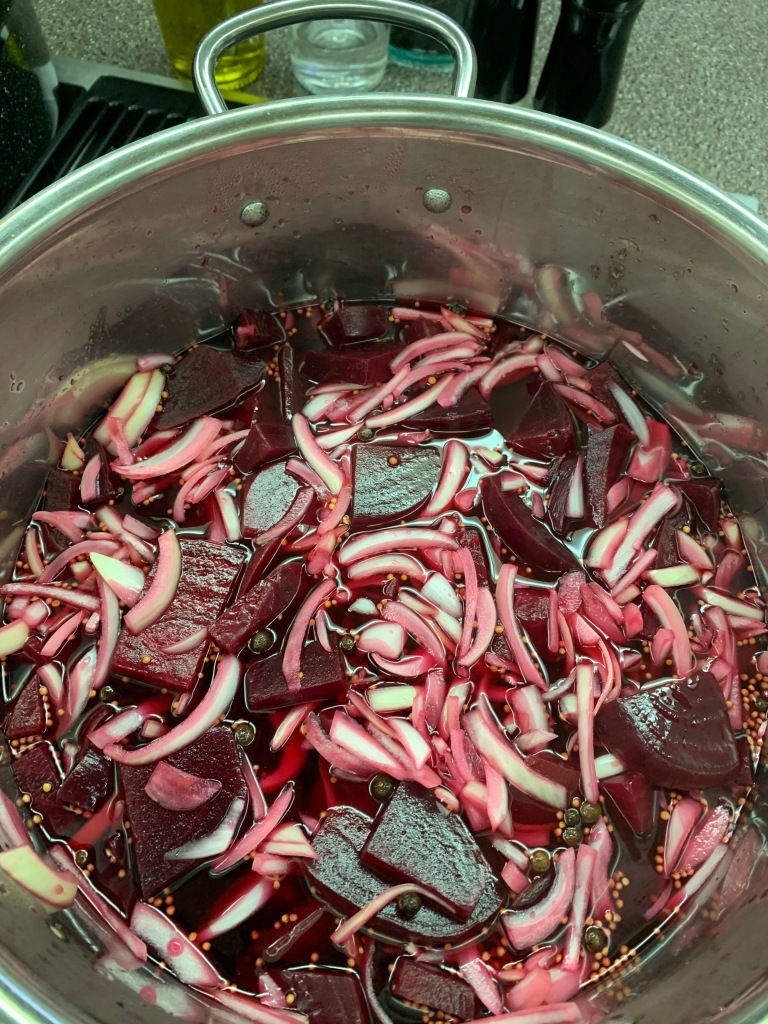
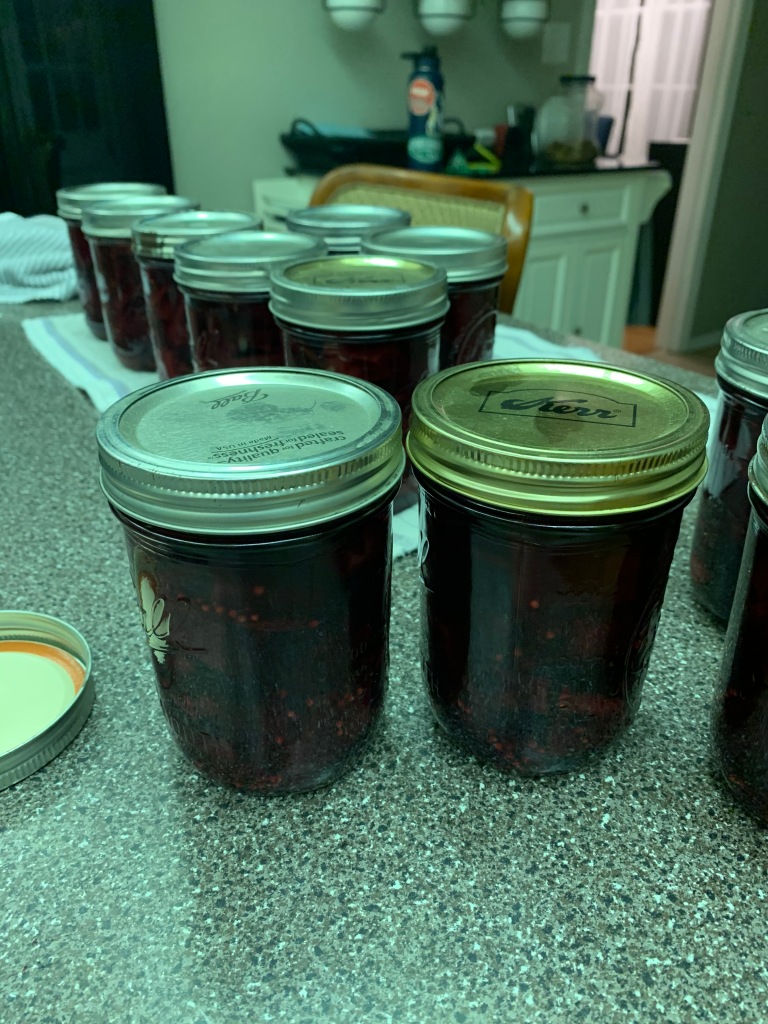
I previously mentioned my dad’s garden. He gave me eight giant beets. This is another plant that gets lukewarm reception at my house. When I have grown them, the kids will eat one slice of a beet (by force). My wife will eat one serving and I eat them for days. We usually have a jar of pickled beets in the refrigerator, although I don’t think that they are very good, so I decided to make my own.

This is a Ball recipe that I have not tried. It seems like a bread and butter type recipe with mustard seed, cinnamon, allspice and clove. I made a double recipe because it used all the beets so we should have pickles for at least a year to come and likely more than that.

I have apples on the tree that need to be picked. They are destined for applesauce as we usually eat 6-12 quarts a year. That is going to require more time outside, so I am holding off for the moment. I also have a big bag of jalapenos I bought at the farmers market with the intent of canning as well. We eat the heck out of those over the year too.

I like preserving and welcome the manual labor of the situation. I usually listen to podcasts of football games but not this year. It is news all the way.

September 10, 2020 – ‘Tacticool’ Thursday

We are in day four of the wildfire effects. Many small communities have been effected, including some completely burned to the ground. Fortunately, the weather is trending in our favor at this point, we are still safe and in no imminent threat, but that can change at any moment.

For today, I thought that I would talk about communication devices. It seems like the amount of intelligence is very limited at this point. It feels like unless you are in the line of fire, we are only getting evacuation information. To their credit, emergency officials have stated priority one is human safety followed by structure protection followed distantly by fire containment.

The number one device for information is the cell phone. Sheriffs and fire districts are putting out information over official Facebook pages and Twitter alerts. There is a reverse 911 system that is in place if you are signed up for alerts. Of course, we are getting hearsay information from people on or near the scene on various social media platforms. Don’t forget the voice and text functions for communicating with people that are in or near the scene. Keep it charged, have battery banks and cords available for your number one tool.

My number two tool is the AM radio. Local talk or news only stations have updates on the hour. They are also plugged into the Emergency Broadcast System for localize and targeted information. In fact, I just bought a new C. Crane radio yesterday as I have battled poor reception in my smaller ’emergency’ radio for years. I will probably review it later as I get some hours on it.

If you bug out, it is likely that you are going to take as many vehicles as you have drivers. Maybe the power is out, maybe the cell towers are down or maybe there is no reception in the area, two way communication can be helpful and comes in many forms.

  • CB (Citizens Band) radio – This type of radio has pretty good distance depending on your antenna setup and (in my experience) is primarily used in rural communication settings like logging.
  • FRS (Family Radio Service), GMRS (General Mobile Radio Service), MURS (Multi-Use Radio Service) – These are all small handheld walkie-talkie type radio devices. I have several types and despite what the package says, they have very short broadcast distance. Sometimes they have trouble communicating vehicle to vehicle in a caravan situation. I use mine primarily for household communication (like when you are shutting off breakers).
  • Short Wave – This can be a very powerful radio that can communicate around the world. There is quite a bit of knowledge that goes along with operating this device legally and effectively, but be aware.

Operating some of these devices require a license from the FCC, including FRS/GMRS type radios (depending on the frequency). I am not aware of anyone ever getting in trouble for not having a license, but the intent is to have an educated user and not clogging up the airwaves with non-sense.

Another tool that is a good source of local intel is the scanner. This is not something that I have, but my next-door neighbor does. Since, I live on Main Street, I see or hear probably half of the calls drive by. I usually can go talk to my neighbor to find out what the call is about. You can also judge the severity by the number and types of vehicles that pass by.

I have multiple tools running at the same time. Different perspectives provide different levels of information. Stay safe.

September 9, 2020 – Review: HingeMate 350

I have been saving this one for a while. I have been waiting for a day where I needed a topic quickly, today isn’t that day but I have been sitting on this for over a month. I am going to discuss the finer points of the HingeMate 350 today.

What is the HingeMate anyway? It is a template set that is used to create mortises for doors and hinges. It has pretty much everything you need to do that job, except the router. I purchased it at Lowes for $38.50.

There are plastic templates for the router to use from 2 1/2″ to 4 1/2″ hinges. It can accommodate three different styles of hinges in those widths, 5/8″ radius, 1/4″ radius and square. In addition, you can also mortise strike plate mortises as well as lock plate mortises.

This was a job that was traditionally done with a mallet and chisel. And it can be done, it is not too hard. But it is tedious and takes quite a while (at least for me). I recently replaced doors on my project after spending hours truing up the frame and opening, so I wasn’t too excited about ripping out the frame along with the finished trim, I thought that I would give this a try.

When would you replace a door only? I would say that if you are happy with the swing operation and the trim detail, it is a perfect scenario to only replace the door. The trick is that this is kind of a precise operation, hinge placements need to be exact in order for the door to work. It is easiest to transfer measurements from the old door to the new door for the best results.

The way that this product works is that you select the template that you want to use and place it in the template holder. The template holder is adjusted for the door thickness and placed in the precise spot that you want to work on the door. The whole apparatus is screwed to the door. The bit is put into the router (not included) and then you adjust the depth of cut for the hinge thickness.

Rout the hinge mortise, remove the template and test hinge fit. If you are satisfied, drill the holes for the hinge screws and mount the hinge. Here is a tip, for best door operation, the top of the hinge face should be completely flush to the door edge, not proud and not inset. Otherwise you get into all kinds of binding and geometry problems.

How did it work? Well, it worked perfectly on my first door. It fit on the first test. My second door I had to make modifications to the door in order to make it fit, but I dont believe that it was a problem with the HingeMate but rather the opening was still a half an inch out of plumb.

So, what is the verdict for the HingeMate?

AdvantagesDisadvantages
Value4/5You cant argue with the price. The professional Porter-Cable version is over $250You need to supply your own router. That is another $100 if you do not already own a 1/4″ collet router
I bought this to cut hours of chiseling, I felt that I could do an entire door in the time it would take to do one hinge by hand.If you are only cutting one hinge size (or hinges only) you get a lot of extra pieces that aren’t necessary
Would like to have a storage case for all the parts. You have to cut the packaging open to get them out and there are a lot of loose parts around.
Quality3/5Followed the included instructions and got acceptable results. No flex, no wanderI noticed that the compression fit of the templates tended to loosen with repeated installation into the fixture. I fear over time, the fit would become too loose. That is not substantiated at this time
It was fairly persnickety to accurately place the fixture, the marks are not very precise and required a lot of verification measurements.
Performance3/5Hinges fit tight and flush. I was very happy with the mortises and the speed of the job.The precision of this jig depends on how good you are at measuring and setup. 1/8″ will be extremely difficult to set the door (or repair). I measured four times before cutting.
The only real thing I didn’t like was the screw holes that remained after the fixture was removed. Those had to be filled. It is a cheap and effective way of holding the fixture in place.
The trim router that I used was too small for the template and wanted to fall through in the middle of the cut so I had to freehand. Use a full sized router or an extended base plate to eliminate this problem.

The bottom line is that price for performance is there. I wonder about the durability of this product, but for me I am don’t really see using it much more. Again, my main motivator was saving time on installing the new doors, check that box. If you have a need, I can recommend this product. If you are a finish carpenter, go for the Porter-Cable.

September 8, 2020 – Survived the Apocalypse, Now the Nuclear Winter

It’s late today. Without getting into too much irrelevant detail, we are currently surrounded by wildfires.

Growing up in the west, fire is an annual event. The mountainous and forested areas are the places that most frequently affected. Lighting and fuel combined with low population density are a common recipe for the big western fires. Typically the area of the state that I live in is a greener and wetter climate. But, when the coast is on fire, you know that there is trouble.

As my wife and I were enjoying a Labor Day drive, I got a reverse 911 call warning of high winds (known as red flag winds). In about two hours the smoke stared blowing in from fires in the central part of the state. Overnight, too many fires to mention kicked up and started burning out of control.

From what I have seen, the municipal services have done a pretty good job of jumping into action and keeping us to date. It’s no joke, towns have burned and my brother evacuated earlier today. I think that I am in a good position, but I wanted to talk about more concrete actions you can take.

First of all, have a plan. A plan is a place to go and a route to take that is going to be safe. If your party is going to separate, discuss alternate routes to arrive at your destination safely.

Be prepared for evacuation. I would recommend that you gather important documents, medications, glasses, mobile chargers and communication devices and essential non-replaceable items. Pack a bag for extended time away from home. Include items for pets as well like food, bowls, carriers, etc. Make sure your vehicle is fueled and serviceable.

It might be too late, but here are some of the things that are helpful to protect your home. Keep brush and vegetation away from structures. If possible, keep landscaping watered. It has sometimes been beneficial to wet structures with sprinklers or hoses. Native plants tend to fair better to fire either resisting or recovering.

There is too much information to summarize tonight, I will provide some information that I am aware of.

Don’t panic, this will pass.