Page 116 of 138

March 4, 2020 – ‘Tacticool’ Thursday

I finally made it to the range last weekend. It was the first time since August and I had some goals that I wanted to accomplish. For one, I have had a rifle that I have owned since 2016 and have only test fired, not sighted in. I also made changes to some of the parts and I didn’t really know if those changes effected the function or not. This trip was planned for April of last year before the pandemic closed the range so I have been looking forward to this for quite a while.

One of the problems for a reloader with a semi-automatic rifle is that spent brass is flung out of the rifle as it is fired. In the past, I have been able to find most of the brass, but sometimes it is muddy or you step on them as they are fired which is less than ideal. Fortunately in the AR platform, Caldwell has a solution for this. This range trip was also a first for this gadget as well.

I have to say that it worked pretty well. I didn’t get close to the 100 rounds before it was full. I would say that by about twenty or so, the weight was heavy enough to pull it out of place but it is pretty easy to unzip the bottom and empty it. I could have made some effort to make sure that the device was mounted more securely but I was mostly shooting off of a bench and working on sighting in so I rolled with it.

One downside I would say is that the brass catcher interfered with visibility of the action. I cant say for sure that it actually interfered with the function but I did have a few issues.

On two out of three magazines, I had issues with initial charging. That very easily could have been the magazine. I have heard that people typically load 28 instead of 30. Again, this is the second time I have shot this and I haven’t even tried all the different magazines I own. I did experience one failure to eject. At this point, I am going to attribute that to the brass catcher. I suspect that it can interfere with the flight path of the empty casing.

In the following years to come, I will pay more attention to all of these variables. The goal of this trip was to function fire all of the changes and get the sight reasonable at 100 yards. A firearm that is not sighted in is really not useful beyond point blank range. Plus, with the ammo shortage, the cost is astronomical at this point so I am going to put off more heavy shooting until things calm down a bit on the market.

My plans for the next range trip is to spend some time on shotgun slugs and sights. I have some new sights that I want to get sighted in and I figured that zeroing on a slug would be the best way even though I would primarily plan to use buckshot with it. After all, a shotgun is most advantageous with shot because I have better rifles.

Even though I have the shotgun interlude planned for next month, my goal this year is to get my Rossi 92 tuned up. It needs sighting in as well as it shot 10 inches to the right at fifty yards. I didn’t have a punch to make the necessary adjustments as this was the first time I have shot it beyond 25 yards. I need to spend some time deburring sharp edges and probably will spend some time smoothing the action as well. Those will be iterative efforts. Both this one and the AR were supposed to be more plinking toys with inexpensive ammo. So much for that.

March 3, 2021 – 1984 1:4

Chapter four was an interesting chapter. It was really kind of a day in the life of Winston at work. We have seen a little bit about the people that he works with but not necessarily what he does or how he does it.

We learn that work is Winston’s greatest pleasure, how newspeak is decoded and how you would go about putting it into function. We also hear speculation that people may work on the same items and after submission, the best version might be chosen for use. There is no way to tell exactly.

I suppose that the greatest refining that is done in this chapter is the description of what the propaganda is that Big Brother generates and how it is put into play. Below are the concepts that I drew as the highlights in the chapter.

Double standards – As with many totalitarian societies, the propaganda arm engages in the very activities that it prohibits the members from owning or viewing. The Ministry of Truth is involved in making material for the proles that has severe punishment for party members.

I do not know exactly why that is done. But I could speculate that it possibly brings in cash to the government. Likely, also the higher ups probably have access to the prohibited material and probably enjoy it at their whim. The principle being that control is much more important than actual morality.

The unperson– Individuals that cross the party risk becoming an ‘unperson’. Speculation from Winston is that person is dead rather than becoming reprogrammed. But it also means that all references to that individual are expunged. They sort of disappear through the Newspeak process.

Hero building – Comrade Ogivly– In some cases, it is necessary to to build people up in Newspeak. Interestingly enough, Winston is given some discretion to to create a character with (potentially) false commendations and a romanticized background. He knows enough about the system to carefully craft the hero’s bio because getting too extravagant can cause a lot of extra work and potentially causing Winston problems in turn.

We are getting a good handle on the dreary landscape of Winston’s world. Hero’s are not real, what we see is a made up as an uber caricature of the values of society. Villain’s do not exist other than the fictionalized and amorphous, race representatives. The effects of propaganda are working as all the misinformation leaves people to believe nothing.

For all of you Newspeak fans out there, I leave this today.

March 1, 2021 – Goalsetting Versus Priorities

I just realized that for the entire month of February, I had titled the date as ‘2020’ and not ‘2021’. I guess that I have been in la la land. Now that error is corrected, we can go on in peace.

I feel like goalsetting is a skill that I have a pretty good handle on and a source of pride. Like most people, I have been guilty of saying goals and not actually doing anything about them. In that scenario, the goal is actually not on a path to completion. For instance, I have said right here in this forum the following things

  1. Q1 I am going to develop a business and marketing plan for this sight
  2. I announced last fall that I was going to build front yard garden beds
  3. My current first priority is to build an office to work from

All three of these things I have made almost no progress. My first regret is that planting season is about six to eight weeks away. If I do not get garden beds made, even one, then I will not be able to keep practicing my food producing skills. Furthermore, this is the time to start seeds so that they can get into the ground. I am weighing whether I should even start seeds because I have a competing priority of building an office.

At least I have some excuses for the office project. I am waiting for a proper paycheck to start buying materials. However, there are tasks that require no money at this point such as clearing the space to build, producing the design and plan are essentially free. What it boils down to is priorities.

Most of yesterday, nearly half of my weekend I was pre-occupied with another task. I won’t get down into the nitty-gritty details but it had to do with my kids returning from an overnight camping trip. The stated issue was that there were some gear failures during the trip. We went through the gamut of not participating again to why this current gear wasn’t good enough. In one example we have gone through four different sleeping bags, none of which are adequate.

Again, this was a long conversation (and day). The problem with the gear failure is not the gear but the mindset of the use. Or said another way, it is my son’s toolbox fallacy. If I only had a better sleeping bag, then I would be comfortable instead of improving shelter skills or making a better bedding foundation or picking shelter location.

Bringing back to priorities, my priorities override my optional goals. Being a father is much higher on the list than building an office of a garden bed or setting up a business. Being a husband overrides being a father sometimes because that relationship will span longer than raising children. And without stability in those cases, it is difficult to be successful with goals.

I also consider my career as part of priorities of both husband and father. I wish that I was in a financial position to keep working on building a business rather than working a job, but that is not a reality at this time. In order to consider additional want’s and desires into the priority matrix, they must fit into my existing priority scales. Of course time is a limiting factor that we all have.

Here are some tips that I have for this scenario

  • Set your priorities first, that way you have the ability to triage how you handle your life.
  • Periodically review your priorities and compare them to recent events to determine if you are living according to your values
  • Set reasonable goals realizing that there is only so many things that you are going to be able to accomplish after priorities are handled.
  • Periodically review your goals to determine your desire to achieve them and the validity as actual goals.
  • You have the ability to refocus milestones within goals and deadlines (for the most part). To me, the most psychologically import aspect of achievement is making progress.
  • If you are not making progress be honest with yourself about how much effort has been made or maybe your milestones are too broad and need to be redefined to show progress better.

I also believe in accountability as a technique for success. If you state your intentions and someone is watching or waiting for results then you are less likely to to skip or do things half-hearted. It is true that some cases are successful with personal accountability, but that means that it has to be something that you really want. I know that has been part of my issue. I was hoping that when I say that I want to do something, it would push me to get it done even if I am dragging my feet.

Ultimately, desires wax and wane. I am periodically evaluating my goals against my priorities. But, goals also have to have priority. So, I haven’t fully decided what exactly will change but I can’t possibly do everything as fast as I would like to have it done. But, I am not going to feel bad about it because they are my goals, not anyone else’s.

I am going to go prune the apple tree that I was going to cut down during the winter now.

February 26, 2021 – 1984 1:3

Going through my analysis is kind of like watching paint dry, right? Of course, I am doing the best that I can but I do recognize that I am moving kind of slowly. I thought maybe we would savor one chapter a week or so.

Chapter three is another short chapter. It starts out with a dream that Winston has and finishes with another session with the telescreen. Instead of introducing new terms, this chapter starts to develop the idea of the effects of Big Brother.

Erasing Emotion- Strong themes are building that tie emotion to being human and how over time emotion is being stripped. Love and sexuality continue to dominate the list of emotions. There is the love of his mother and then the sudden appearance of a naked woman without context to the rest of his dream.

It is not the first time that we have heard that Winston pre-dates the transition to Big Brother. But he was young and therefore lives in a partial world of pre-governmental transition with some remnants of what we would consider family values. We are led to believe that his mother died as a result of loving her son, Winston. It is a thought crime after all.

Distinguishing emotion and function I would say differentiates humans from machines and possibly humans from other animals. So, by removing emotion it sort of homogenizes people as really an entity rather than an individual. Supervised activities such as periodic calisthenics further attempts to keep people’s minds from wandering but also unifies common experience; another standardization tactic.

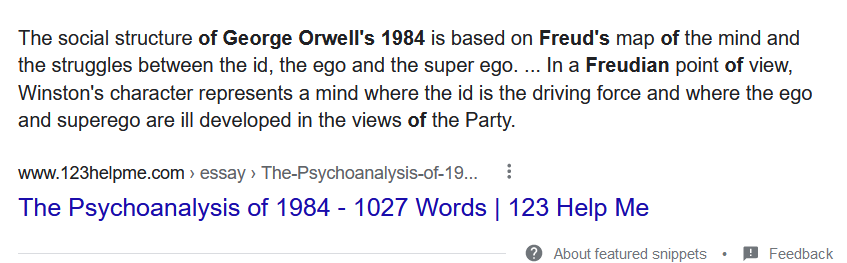
Dreams and sexual repression continue to build in the next couple of chapters. Those will be covered when we get there. I just had a wild hare and searched the connection between Freud and Orwell right now as I was writing this. It would seem like I am not the only one to have seen a commonality. Here is an example.

That is just one example of the multiple opinions and connections that people have made. It does appear that people have put much more effort into this than I have, for instance I saw a Master’s Degree thesis in my search. I have personally never studied psychology so I am not really qualified to speak on the validity of the argument. However, I do recognize the components of Freudian psychology and the connections to the story line.

Wow, that just twisted my mind. Here I was thinking that this story was a brilliant forecasting of the future and it could be much more dimensional then that. Maybe the story accidently predicted the future or maybe the Freudian theory really is driving the behavior of humanity? I am going to leave it there for today as something to think about.

February 25, 2021- ‘Tacticool’ Thursday

Another Thursday has rolled around, seems like we were just here. I have little to report as of the last week, I have spent most of my time adjusting to my new schedule. I am trying to target better bedtimes for appropriate rest. This is one of the things that I have identified as a success criteria this time.

I know that I was in a state of chronic fatigue. It definitely took some time, I would say probably a month to six weeks to begin to feel rested again. That is not typically a luxury that a working person has, taking a month off to recover. It definitely plays a role in what I am going to accomplish moving forward as well. Night time has overflow capacity to spill what you are working on into time that you should be getting ready for bed.

Maybe sleep patterns are ‘Tacticool’ to some, but they don’t fit my definition. This week, I have been advising my dad on some reloading tips. He is a reloader from way back. Reloading goes along with frugality, hunting and the rural lifestyle so it seems to fit the bill as something I was exposed to as a youngster. I should say too, we weren’t big shooters growing up, needless to say that we didn’t do it often.

That is why when I shot some of the loads he made up thirty years ago, I had some issues. I had bullets that weren’t well seated and cartridges that didn’t chamber to name a few issues. I mentioned it a few years ago and now that he wants to load some rifle cartridges, he was asking my opinion about what was wrong. Reloading is not difficult but does benefit from a meticulous approach. I would also say that it does require a minimum level of equipment to get started. Even the various starter kits don’t provide everything necessary to get started.

Take calipers for example. While not strictly necessary, case length and overall cartridge length are critical measurements to properly chamber a round. No kit that I know of contains calipers. And what if the case length is too long, how do you correct that? Brass has to be trimmed. My dad does not have a trimmer (good luck finding anything these days) so I loaned him mine.

Reloading is an entire hobby unto itself. Some obsolete cartridge brass can be manufactured out of others. You can get into bullet casting from lead. Then there is what load/bullet perform best for your firearm. Wildcatting is making your own cartridges.

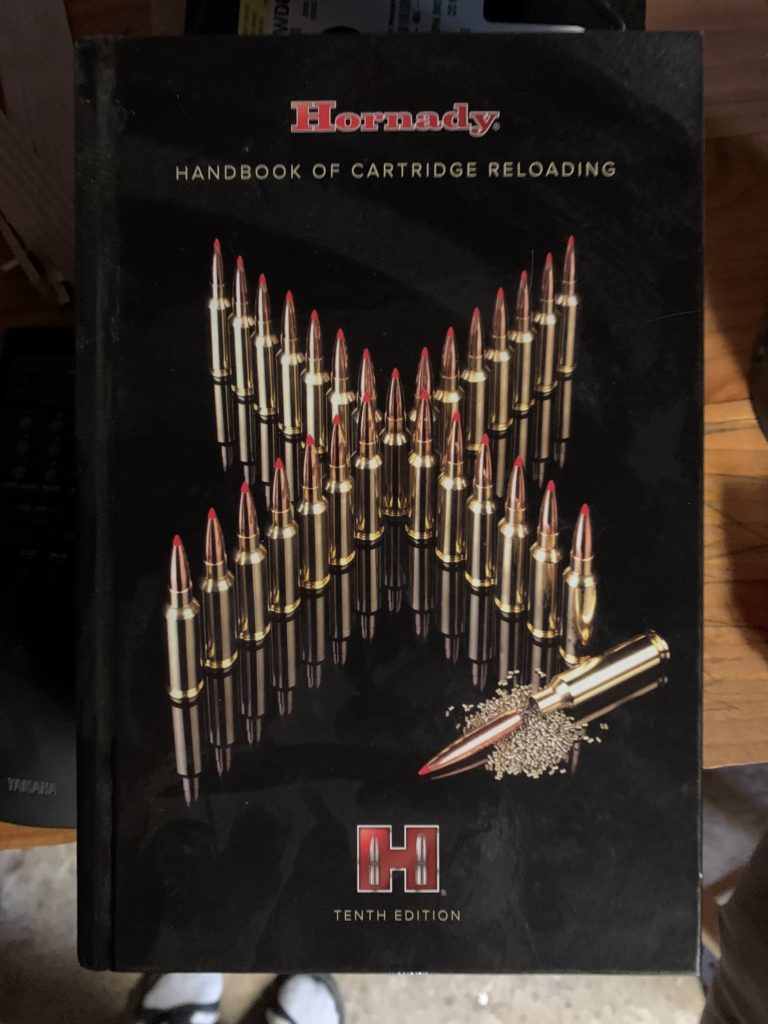
Even if you have zero interest in reloading, having a manual can be useful. I have several and I also use online manufacturers sources as well. There is always cartridge information, specifications and loads showing what is popular and potentially available. These days, the internet can do many of these things but I think that it is helpful when developing a load to cross check multiple sources because errors can have serious consequences. It should also be noted that there is a warning to only use current, professionally published data is recommended. Just because you can do something doesn’t mean that you should.

I also keep a log book of my loads because each firearm potentially performs best with a different load combination. I am not at the point where I can say that I have mastered all of those variables for each firearm so I keep track and make notes after shooting. The thought is that at some point I will aggregate all of the data points and refine my loads to the best performing suggestions.

Everyone in the firearms community by this point knows that everything is in scarcity and reloading components and tools are no exception. So, unless you have been collecting all of the materials pre-pandemic this is not a time that you will likely get started. I would say that I had all of the tools for four years before I made my first cartridge.

My long term strategy was to 1) set a minimum factory ammunition goal 2) shoot enough factory ammunition to build a brass cache for reloading 3) build enough reloaded ammunition to maintain a sufficient inventory (for times like these) and then 4) build enough components stock to weather a long term outage. You will probably never have everything that you want, but I would say that I have some. I think that I talked about the last shortage being only primers which I do have plenty for now but not bullets or powder for experimenting.

If you think that you might want to get into it at some point, save your brass, buy a manual and build a workspace. Secondhand reloading equipment is good value as well if you can find it. Maybe you know someone that does it and can teach you or help you or share equipment.

February 23, 2021 – Just as I suspected…seems like things haven’t changed much

This is going to be a quick one. I am going to do my best to keep these two worlds at bay with each other. But, it is probably worth some commentary after my first couple of days.

It was a two days over twenty-two months since I clocked into a desk job. There are definitely some pros and cons. I have to say that in some ways there have been some struggles. I am a contractor to a contractor and it can be a real sink or swim experience in this remote/Covid/big company atmosphere.

Sitting in on a couple meetings, I have seen where I can probably hit the ground running. It feels like old hat listening to project representatives sort of muddle through their assignments and not sure of how to proceed. I wanted to jump in an participate, but I don’t think that is exactly my role and it definitely wasn’t my assignment. I was just invited as a courtesy, something to do.

The culture seems positive. So far, it seems like there are reasonable amounts of work and the deadlines don’t feel killer. Often, that is a double edged sword leaving lots of time places for mediocracy to hide. It is one of my pet peeves, we will see.

I think that I mentioned this earlier, but my schedule is Central Time. So, I start work at 6AM but the nice thing is that I am finished by mid-afternoon. Being out of practice, the time in between end of work and bedtime sure does fly. I will have to get in the habit of more rigorous scheduling of my off time activities if I ever want to get anything done.

So far, we have managed to suspend the home office location in favor of not being sure where the best location would be. I haven’t started anything yet other than I bought a door over the weekend and it is not like I have had any time to do anything anyway. The weekend was packed and yesterday I committed to helping my son with his car.

Like I said at the top, I intend to go back to writing about skills and literature and all the things I have been doing over the year. But, I thought a couple of first impressions would make a quick check on this task.

February 18, 2021 – ‘Tacticool’ Thursday

My official transformation has begun, and no it’s not becoming a woman. I officially left my last day at Amazon on Monday and I started my first day at my new job yesterday. Things haven’t gone entirely smoothly or at least the way that I expected. The recent weather has thrown a monkey wrench into delivery services like Amazon and Fed-Ex to name a few.

I have been waiting for my computer to get started since Friday of last week. The tracking site has literally not change in over a week. So, in lieu of working right now I am am going to shift my day later and work later. That means I can do this right now.

Today, I was thinking about carrying my stuff around. I was thinking about this as I unpacked my work pack and put all my stuff away that I was using while I was a delivery driver. Some things went back to where they were before I was a delivery driver. Some things were specifically for that job and I am not sure if I will ever use them again and trying to figure out how to move on.

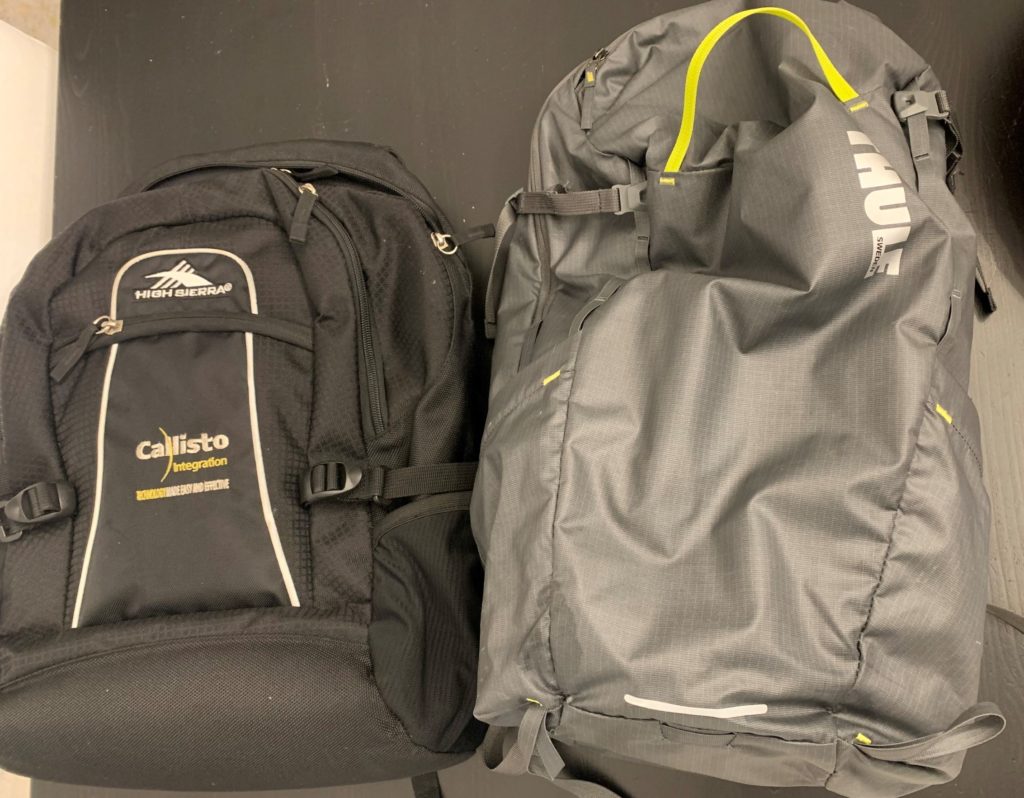
The backpack on the left I use to hold my computer. It was company swag. I switched over from a Swiss Army Pack because I thought that it was the right thing to do, showing the colors with the logo. My Swiss Army pack was quickly repurposed by my nephew who needed a new backpack and gone forever. I went along with this pack for probably three years at work.

Let me say, I hated it from the day I switched. The divider arrangements, the overall capacity (volume), the depth of the zipper opening all were not adequate. It was fine for light use and carrying a computer around, but not for carry-on travel or everyday carry (EDC). On some business trips, my backpack would be the only luggage I would take and I didn’t have the room for a book plus toiletries plus a change of clothes.

When I started working at Amazon, I said “I hate this bag but I can make it work because I don’t need to spend extra money right now”. And it is true, there is a bit of first world syndrome in my thinking. I got my lunch and water bottle and raincoat in there. But I could never get out what I wanted without pulling everything out. It was crammed and difficult to close. When I wanted to clock out, I had to carefully repack everything and squeeze. I couldn’t just stuff and dash to get home.

I started immediately dreaming about what I would want in a daypack. I wanted outside water bottle access, a sunglasses pocket, full access to the inside, one small item organizer compartment and no waist belt. I also didn’t want a huge logo or at least a globally recognized brand. Nothing says tourist or maybe this bag is full of cash like when the entire back says Oakley on it. When I was in China, I had a Dell backpack and I always felt self-conscious like that just added a little extra target on me.

I thought about life after Amazon and how I might use a new pack. Infrequent day trips or family vacations would be the primary mission in the future. I looked at very ‘Tacticool’ packs with concealed carry pockets and gear loops and things. But, I wanted to be the gray man, plus I don’t think that is the best way to carry anyway.

Another thing I have learned is that everything is a compromise. More pockets generally mean less space because everything still has to fit in the same overall volume. Once the bag becomes segmented, it restricts the amount of gear in each pocket in order to retain the integrity or function of the particular pocket. For example, either exterior water bottle takes from interior space for rigidity or it relies on some sort of elastic material to keep the bottle restrained. The latter design ultimately doesn’t hold up to hard use because the elastic stretches out of shape and then your water bottle starts falling out. My hunting pack has that problem.

One last consideration, it is fairly difficult to find a ‘Jack of All Trades’ bag. The hunting bags are camouflaged, the computer bags are made for pens and computers and tablets, the hiking bags are made for overnight trips, the school bags are made for textbooks and such. Stores that are oriented towards particular markets carry items that are oriented toward their customers and market. Online is the best option for model and color.

I found some packs that I almost bought that I would have gotten near lifetime use. Mystery Ranch was my top pick but it was $200 everywhere I looked. If I am going to spend that kind of money, I really want to see what I am buying because it is difficult to visualize the difference between the 24L and the 28L and the 32L sizes. I had some second choices with Patagonia and The North Face, but everything was above $150 that met most of my requirements.

I was very frustrated with my computer bag. After looking at REI and other outdoor stores on the more high end side I went to the discount store Sierra Trading Post and I found this Thule bag for $70. It met most of my requirements, so I bought it. It is 28L and has one compartment. It is sleek and doesn’t have a lot of straps and things to get hung up. It had a removable waist belt and it held all of my stuff I wanted when I was on the road.

It did not have an organizer compartment. But, I have a Maxpedition ‘NeatFreak’ organizer that I carried inside of the bag. I could put my pens, spare batteries, tire gauge, charging cables, etc into the organizer. Again, everything is a compromise and those things take up space too. But, once I switched over I felt immediately better. Getting to my lunch didn’t require a complete un-pack. I could grab my water bottle on the road. I had cold weather and wet weather gear with me at all times.

One thing I have been guilty in the past has been ‘make due’ attitude. Many times, that is to my advantage (from a financial standpoint at least) but sometimes it is not. I quickly bought quality footwear and then changed my bag and added a few things to make my life better while I was delivering packages. I can confidently say that it was a good decision because then I could focus on doing the work rather than the other perceived distractions.

Admittedly, this was a want more than a need. Consider how mood and attitude effects productivity and outside work activity. I think that it is worth evaluating your situation and making changes that could be relatively inexpensive for those ‘quality of life’ scenarios. Items like quality cookware, a comfortable bed or pillow or items used in your profession for safety and comfort can turn a miserable day into just another day.

February 17, 2021 – 1984 1:2

Chapter two of the first section builds on the first chapter. It peels back a little more of what life is like with a neighborly interaction and the struggles of rationing and substandard infrastructure. What’s more, a few concepts are further developed.

Propaganda- Once again, the slogans “War is Peace”, “Freedom is Slavery” and “Ignorance is Strength” are brought up. We learn that these slogans are ubiquitous are found on money, posters, tax stamps, etc. The use of propaganda is to unite the population on simple slogans. It might remind us of “Make America Great Again” or “Yes, We Can”.

Indoctrination- begins at a very young age. There are the Spies and the Youth League which seem to be these Cub Scout/Boy Scout analogs of kids organizations training into the system. The focus is on activities relating to eventual military or government service such as physical fitness and hard skills like bushcraft. There is reference to kids turning the parents into the “Thought Police” which is some organization for eradicating non-conformist thinking.

Scarcity- Another control mechanism to manipulate the population. From what I can gather throughout the book, the situation is real. By controlling diet, heat, living conditions and even pleasures Big Brother can exert some constant level of control. They can also use situational change to effect the citizens perception of reality. In essence, no one believes anything because everything is wrong making it difficult to know if something is really true.

This is a short chapter I feel to support that home life is as dire as work life was in chapter one. Minor character development paints similar interactions regardless of the circumstances or locations. Things don’t look to good for Winston as he is having wandering thoughts and treasonous writing.

February 16, 2021 – Lessons from a Winter Storm

It has been a long time since I talked about preparedness. We had a major storm roll through last Thursday and still feeling the effects on Tuesday. It really wasn’t too bad in my local area, we had probably 1/4″ of ice twice from freezing rain on Thursday night and Friday night. But the effects have been devastating around the region.

Of course, as an Amazon driver I was at the tip of the spear for trying to get life back to normal. On Sunday, I was sent to the hardest hit area of our delivery territory to try and deliver packages. I saw power poles broken off with lines across the road, many crushed cars, trees and limbs blocking state highways and cellular service was near zero.

First, I have to say that I have lived in my house for over sixteen years and have never seen a power outage more than a blip in that time. I can count the number of times we have have a blip on my hand. So, the electrical service is pretty reliable from that standpoint. We had an outage that lasted from 5AM-3PM Saturday. Other areas that I was delivering to yesterday were expecting to get service restored on Thursday, a full week after the event began. Those were the areas that were accessible.

People were generally cold and tired but in good spirits. There were neighbors helping clean up. People used their own resources to flag downed lines, danger areas and clear roads. Everywhere I heard chainsaws and generators. Brush, limbs and lines littered the roads and right of ways. Now that I have set the scene, I really wanted to talk about the lessons from the storm.

  • Leave refrigerators and freezers closed. A deep freeze can remain cold enough for several days with no power as long as the door is not opened. I would advise not to open it for any reason if you suspect that an outage will last more than several hours.
  • Keep your freezers full. The more mass that is inside the unit increases the time to thaw significantly. If your freezer is not full, fill old containers with water to add. You can always use the ice as block ice later as a secondary benefit.
  • If you don’t have the money to buy a generator, start with an inverter. One 800 watt inverter is enough to power one refrigerator or freezer and can be found for as low as $50. Then you can use your vehicle to power the inverter and in turn keep your investment safe. Freezers only need to powered for a few hours a day to stay frozen. One more thing, appliances draw more energy when they start so a refrigerator may only use 3 amps but may need up to 7 amps to start. For those of you non-science types Ohms law is Watts = Volts x Amps; 800 = 120 * 6.66
  • Don’t forget to have extension cords that can reach from your vehicle or generator to the device that you want to power. For power hungry appliances, thicker cords are better. There is a power drop over every cord so the inexpensive 16ga cords have a maximum wattage that they can power (something like 1000 watts).
  • If you are having an ice storm you can use the ice to put in a cooler and move the refrigerator contents if necessary. Ice is a much more efficient way of keeping those items cold that doesn’t require additional electricity. From an energy consumption standpoint, making ice is more efficient than trying to keep a refrigerator running, regardless of the method.
  • I live in an all electric house. I do have camping equipment and a kerosene heater for the shop. Do have a carbon monoxide detector that works on batteries. I brought in my detector to use in the house as we started a fire and cooked breakfast on the camp stove.
  • I never got to the point of starting the heater as the fireplace warmed the living area enough, but have fuel for heat and cooking. You need wood to burn, if you have wood burning appliances. You need propane or kerosene for heaters and stoves. That stuff can go fast. My 20000 btu heater will burn through 2.5 gallons of kerosene in about 40 hours. It heats up my 16×20 space nicely during that time but it’s only going to be effective in a room.
  • When the real work needs to get done, a gas powered chainsaw beats a battery powered saw hands down. Battery saws are great for day to day pruning, but underpowered compared to gas and when the power is out, you cannot charge your batteries (at least not without a generator, inverter or solar). That is not a great justification to own a tool that you rarely use but sharing or bartering with a neighbor might be in order. Don’t forget fuel for that either.
  • We never got to the point where we needed much lighting but have flashlights, lanterns and batteries. Headlamps are good for task lighting, lanterns are good for area light and handheld flashlights are good for carrying around. I also have lights that use my rechargeable tool batteries that mostly get used for job type work. But they are convenient, powerful and long lasting as well as share batteries with other tools. With LED, battery powered lights are some of the most efficient use of power conversion there is.
  • When the power is out, so are the Point of Sale (POS) and ATMs. Even though businesses may be running on generator power, it can often be a cash only proposition. Have cash on hand with change if possible to get those things that you really need.
  • Cell communications continue to be spotty. Carriers have different levels of service and towers are in different states of operation. The best service seems to be around major traffic corridors, which were also the clearest to drive. I cant speak to land lines however but our internet was down and by far and away it seemed like the biggest losers were the cable TV connections.
  • Stay home if you can. I am not one to be squeamish about much but I thought that it was kind of ridiculous trying to deliver packages when you cant drive on the roads or even use the software to deliver. I had to run over countless downed lines (that I didn’t see until it was too late) and maneuver around road hazards only to be turned around by a roadblock. Road updates were close to nil as data service was down everywhere. Unless you are part of the solution, you are part of the problem in the cleanup and restoration effort.

These are some of my thoughts and tips around my experience. Hopefully we will all be prepared better for a next time.

February 11, 2021 – ‘Tacticool’ Thursday

If anything is constant, it is change. My routine is going to get more consistent in the next week. That is because my schedule is going to be predictable; Monday-Friday. It is going to be a little unique in that I will be working Central Time. But that is OK because I will be working 6AM-3PM, I have always preferred to start and finish early.

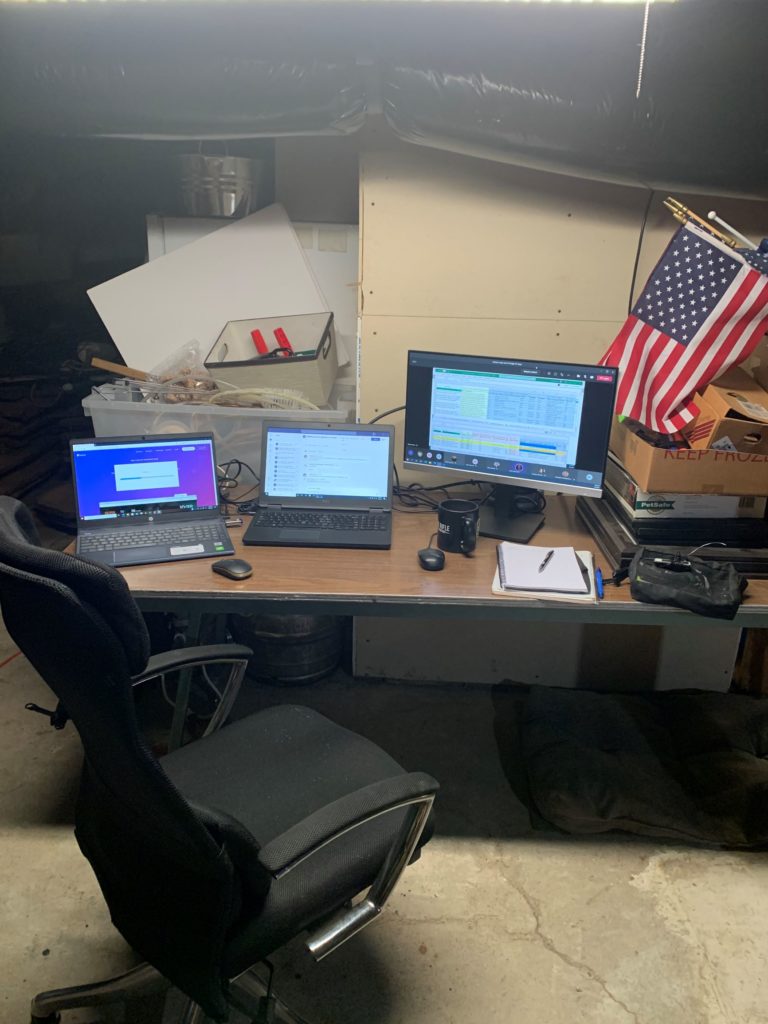
It also means that I will be shifting my writing time from the morning to the evening because I doubt that I am going to want to do too much that early in the morning. But, in the mean time, I am going to launch into another project. This project will be to build an office.

When I was last employed, I always worked at the dining table. I worked infrequently from home, it was the couple of snow days a year, the days when the car was in the shop or there was some kind of appointment mid-day and it didn’t make sense to do a lot of driving back and forth. My new job is 100% remote (for the foreseeable future) and everyone is home, it makes sense to have a dedicated space.

The location is less than ideal. It will be in my sometimes wet basement and is superseding the space that holds my fishing rods, firearms, shooting supplies, tackle boxes, frame packs etc. Which means that stuff needs to find a new home. On the bright side, I hope that I can make a podcasting setup, integrate some more secure storage and will be comfortable with heat and adequate lighting.

This is also a priority for me. It means that I am going to put dedicated effort and time into finishing it as soon as possible. Reading between the lines, it means that I am going to prioritize that work over writing for the duration of the project. My guess is that it is going to take at least a month to finish on nights and weekends.

Since this is ‘Tacticool’ Thursday, lets take a minute and fanaticize that I am building a “safe room” rather than an office. What attributes should I build into to make it happen? First what are the threats? In my area, the biggest threats are earthquake, flooding, fire.

Each threat might have different design considerations. Take fire, the best structure for fire would be one that doesn’t burn. Or for an earthquake, a wooden structure that can move but the framing elements are strapped so the parts don’t slide apart. Flooding would want to be sealed or at least have water management capability. So, from that standpoint, no one single structure is going to meet all of those requirements adequately.

But also in the room is going to be some supplies to wait out the emergency such as food, water, sanitation and entertainment. Depending on the duration of the event would be what to prepare for. My scenarios would range from a few minutes to several days.

I have always thought that if you were in the situation, you may need tools to get out of the safe room. Imagine that the house around you collapsed, you would want to escape from the place or at least be found, so some demolition tools and shut-off capability.

The Hollywood set would have you believe that this is the place to ride out the Zombie Apocolyse. This room would be hidden and fortified against outside threats. There are such things as ‘bullet proof’ panels (of fiberglass) or steel plates but they are heavy and expensive. You could add steel door frames with hidden doors. I think that in reality, those things are adding extra time until they are breached rather than so much as ‘proof’ anything.

Sometimes I see Youtube videos of fallout shelters and I watch because I am interested in seeing how problems are addressed. You can generate some power as long as you have fuel or you can have a bank of solar panels strung up somewhere. Many of them have some sort of charcoal air filter. My view is that you can probably survive some acute event, but sooner or later, the filters are going to fail. Charcoal is great at absorbing until it is full. Some sort of power source would be needed to refresh it. It would be impractical to live more than a couple weeks in that kind of setup.

So, I guess what I am saying is that everything is an act of compromises. The perfect structure for one scenario is largely imperfect for another. Building a structure for one type of scenario is potentially possible and could be successful. This office won’t be a saferoom, but if I lived in a tornado prone area, I do believe that having a place to go for that sort of thing would be on my list of wants.