Read along: http://www.ntslibrary.com/PDF%20Books/Mere%20Christianity%20-%20Lewis.pdf
I have to feel a little bit bad about going dark for over a month. It was never my intention to do absolutely nothing and in fact, I read Book Two in September. That was plenty of time to at least keep this series on schedule as this was supposed to be posted October 4. I kept reading still and there should be no reason to delay any longer.
I have plenty of reasons why I took a break, but a lot of it was that time just slipped away. I was getting ready for hunting and then I was gone for a week and then I had to clean-up as well as a host of other things that needed doing. So, I really had to shake the cobwebs out of my head to try and remember what this book was about as well as the poignant points that Lewis made.
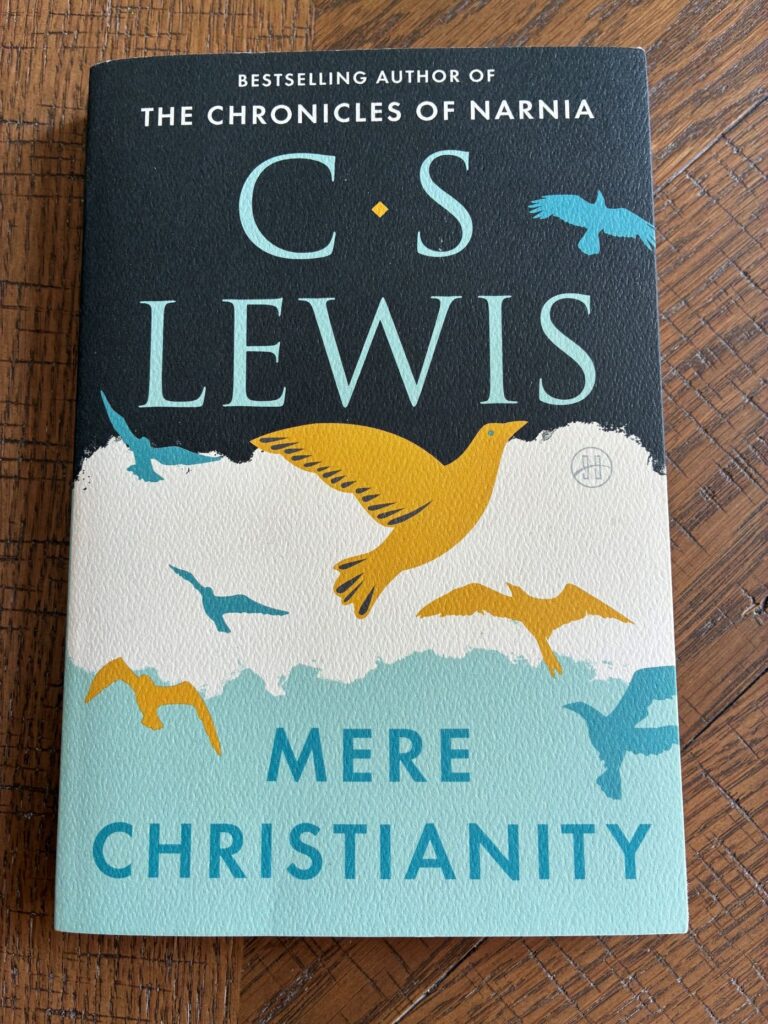
I have to admit, I was born a Christian. I don’t know if my mom still has the audio tape but I was a toddler reciting The Lord’s Prayer as well as some of the Ten Commandments. For that reason, faith is ingrained in my being. There is no question about my beliefs but unlike many faithful and unfaithful alike, I am open to the idea that I am wrong. That is the scientist in me.
Since it has been so long, let me refresh a minute. Mere Christianity was a radio broadcast made for the British people during the WWII German bombing raid as a way to keep hope. Lewis claims that this text is a direct translation of his words without any editing. It would be interesting to see if there is an audio file out there somewhere. I bet so. The bullet points below are the highlights that I took out of each chapter.
- God has many believers regardless of religious origins.
- How can bad things happen in a world with a good god?
- Acceptance of good automatically implies that there is evil. Good has to have evil but evil does not have to have good.
- No free will, no choice. Without free will then there would be no choice because it would just be pre-programmed.
- Jesus was manifested as man to better relate to people. God was already supernatural this was a different approach.
- Without Christianity, it does not necessarily mean damnation. This is Lewis’ interpretation of theology.
There are probably a lot of different analogies I could use here. The one I am going to use is when you are sick. Now, I am fortunate that I have never had anything serious like my wife has gone through but at least it is something everyone should be able to relate to. The last time I was sick (early June) I felt cruddy but not so bad that I kept working and doing what was in my social calendar. You know that when you are living that way, you take for granted what not being sick feels like.
There have been times for me that I have been quite a bit sicker. I felt like all the energy I could muster was to go to bed. I might get up to have some soup or get some water or take more medicine so I could go back to bed. My whole point is that feeling well is very difficult to describe but when you are sick, you sure recognize that sick feels terrible compared to well.
This is my attempt to relate what Lewis is saying without evil there is no good. Just like without sickness, there is no wellness. Without the dichotomy we would probably have no concept or any such vocabulary. Suppose that there were areas of the planet that had air that was not 77% Nitrogen and 16% Oxygen but some combination of poisonous gas. We would have to make a special term for good air versus rotten air. But, since we do not it is not even a concept.
Free will is a very similar argument as good as evil. This is why I focused primarily on that aspect Lewis’s commentary. I have often heard the argument that how can there be a good God when such evil exists in the world? You know, I can’t really answer that but to use Lewis’ philosophy. On my scale at least, I don’t know if there is an equal level of good to evil in this world. I will take solace in the best is yet to come.
End Your Programming Routine: What a bold thing to do. Try to come up with a philosophical argument for something that is nearly unprovable. I know that Catholics claim saints and divine miracles and the like but something extraordinary does not prove the existence of God. But the way that Lewis goes about the argument could only be done by a converted Athiest.
Recent Comments