I went into a chain farm store the other day on a whim. It has probably been six months since I had last been there. I stopped buying dog food there a couple of years ago because it was $10 a bag more than another local store. I would buy it there if that was the only local option but the price savings is nothing to sneeze at.
When I went in, I had it in my head that I was going to peruse the news stand. They carry lots of titles that I enjoy namely Backwoods Home and Self-Reliance but really lots of things like that. This is when I ran across these reusable seed trays by Burpee. Clearly, I don’t know how they are going to work, but the idea sounds good at least.
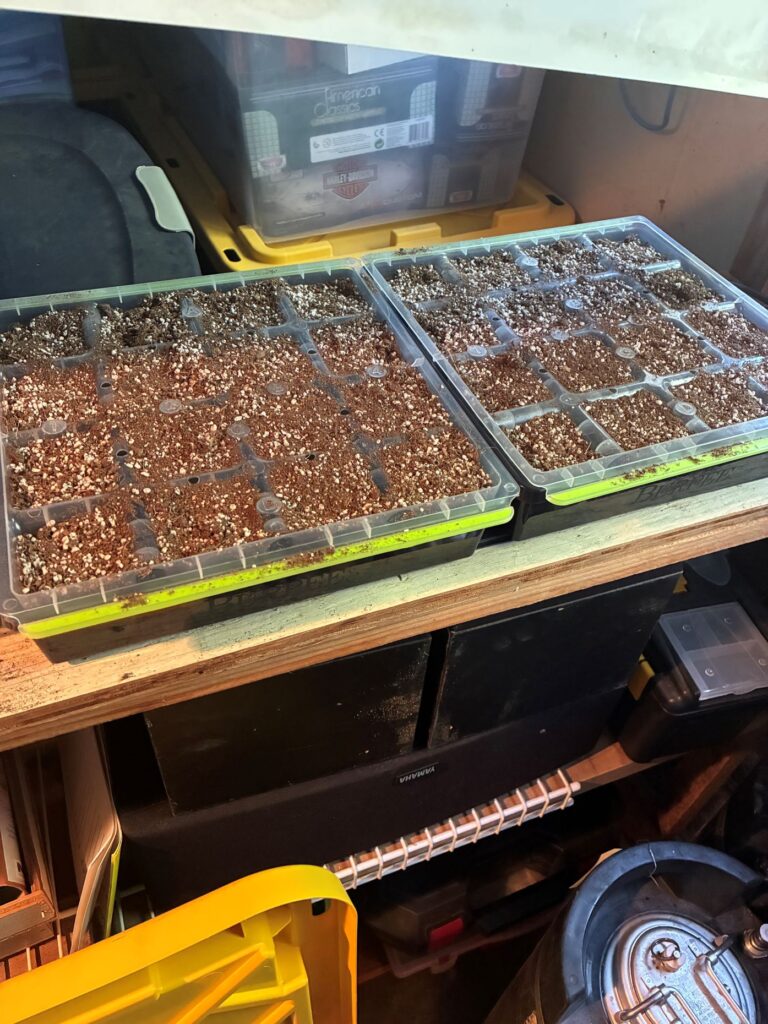
In recent years, I have been using peat cells that fit perfectly into proprietary trays. They are pretty small so each tray holds 72 cells. That is a lot of starts for me. They do work but based on my propensity for negligence, I feel like optimally they should be transplanted into larger containers before planting.
These reusable cells are significantly larger which translates into a much larger plant and more likely to take off when planted. I think the theory is that the root wad will hold the cube soil together which allows these trays to be re-useable.
There are several features about these trays that I like. The first one is that they are re-useable. One of the problems with the peat cubes I find is that they are a seasonal item. Once the season is over, they are gone from the stores. The last time I bought a bunch of them, they had to be found and taken down from the high stock shelves on a fork-lift. This big box was the only place I could find them in retail and not exactly ideal when you are looking to start out of cycle. I know, Amazon is a thing and it is largely season agnostic. But again, I would like to do this with less inputs. I don’t like really relying upon consumables for success.
The second thing I really like is that the cells are gridded. This means that you can easily and accurately keep track of what seeds are in what cell by the label. I have tried all kinds of things, none of which I love. If each cell is not identified then you are confined to a row of one variety or devising some other method. For instance, this year I made a ton of straw markers for a bunch of seeds that never germinated.
The third thing that I like is that the water is in a tray below the cells. This eliminates the flash flood type watering when using a can. I have often had seeds end up in other cells because the watering process was too aggressive. Then, I am guessing about what is actually growing and I question myself about thinning.
There is one thing that I am going to have to see. There is no humidity dome to cover the trays. I think that they pose two advantages in this situation. One is they keep the water from evaporating, especially when the trays are on a heat mat. The other is that I believe they help keep the temperature inside the tray. This is the we’ll have to see part.
As soon as I get results from my seed germination testing, I am going to start planting. I already have a pretty good idea but I don’t want to spoil the results here. I wish that I had started the seed testing weeks ago because I don’t know if I am going to have enough time to get a root ball to solidify the cube. I will have to roll with what I have.
End Your Programming Routine: I’ll be the first to say that technology does not make the expert. It doesn’t make you the best golfer or chef. Once you have the fundamental skills, technology makes things faster, easier, better. I am still working on those gardening skills but I am hoping that these new cubes will make bigger, better plants when they actually get into the ground.
Recent Comments