These are two chapters that I have been interested in reading, boundary issues with the spouse and children. I feel like the two are kind of joined at the hip considering that one might have issues with one that bleeds into the other. I am pretty convinced that people don’t just have boundary problems in one area, at least I don’t.
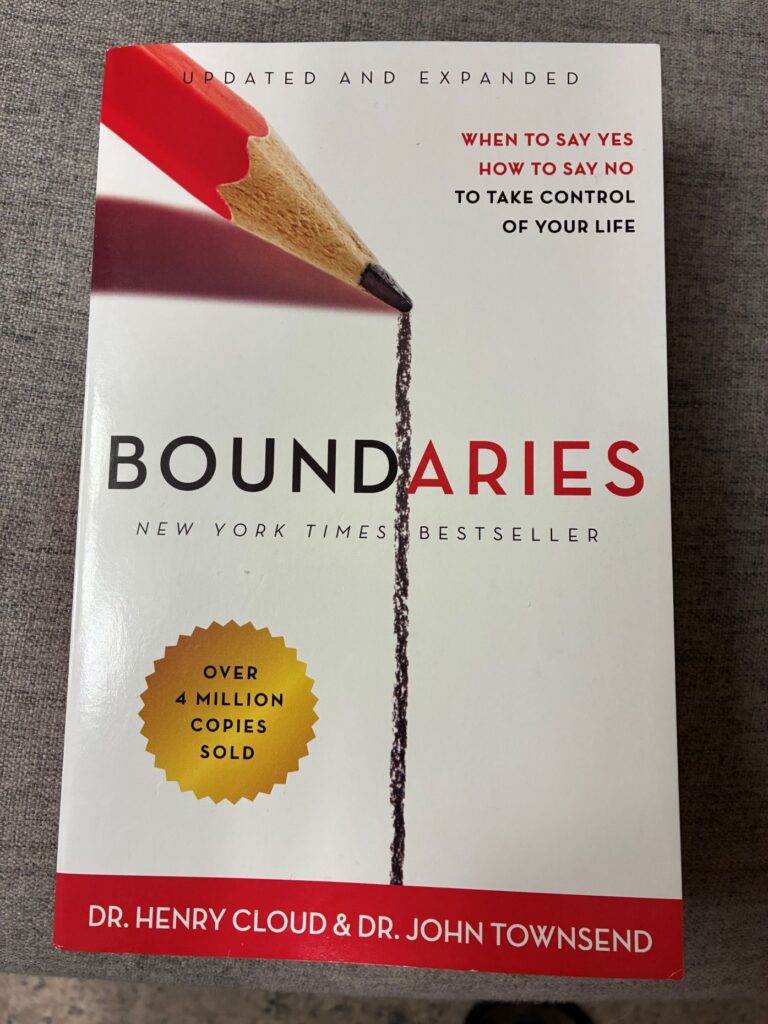
The concept of systems thinking comes to mind. By now, I hope that it is obvious that most problems have a systematic approach to resolution. I am not seeing much of a difference between a boundary issue with friend versus a spousal relationship. Sure, there is more intimacy between partners and hopefully more grace as well but the reality is that they have similar roots and resolutions.
In fact, this chapter reapplies several laws found in chapter five to use as examples. The book also adds a nine point list to help with resolution. I don’t see it specific to spousal boundaries but to all mature boundary problems.
- Inventory the symptoms
- Identify the specific boundary problems
- Find the origins of the problem
- Take in the good
- Practice
- Say no to the bad
- Forgive
- Become proactive
- Learn to love freedom and responsibility
Moving to chapter ten, let’s hope that you don’t have too many boundary problems with children. Otherwise we need to call the police and protective services. Rightly so, a large focus of this chapter is all about installing age appropriate boundaries as well as teaching them so children grow up as healthy, appropriate adults.
When I was a young child (pre school) I remember that my bedtime was seven o’clock. As I moved into grade school, my bedtime became 8PM until summertime and then it was nine. Throughout grade school it bounced back and forth in this manner, it seemed normal. So that by the time I was in middle school, this was routine and there were no questions asked.
We had a bit of a kerfuffle in middle school as my peers and friends found Saturday Night Live. My mom said that we were expected to be ready and attentive for church the next day. The pastor’s husband was also a fan of Saturday Night Live and he could not make it to church routinely and slept late on Sunday’s. After that point, I never questioned that my bedtime was nine o’clock no matter what season or day it was.
It was late May in my senior year and my parents were confronting me with something else. I was already 18, but what I said in the conversation is that I had no meaningful connection with my peers. They were exercising their adulthood and transitioning out of the house and yet I felt nothing relatable with them. My parents responded with ‘there was no reason why I couldn’t do the things that they were doing’.
Somewhere in the age of middle school to high school, I missed the boat of age appropriate freedom and boundaries. Ultimately, it was my fault for not trying to exert or push for expanded boundaries but I never realized it was something that I should be doing or that would have long term effects. To date, I have a hard time relating to pop culture trends and platonic relationships.
This is a polite way of saying that I have to own my own problems. I have the power to do anything that I want if I desire to change this. That being said, it is the parents responsibility to guard their children against retarded development. I think that my parents fell into the convenience trap of saying ‘well he is not asking for anything, so it should be fine’ rather than saying some of these choices are more age appropriate.
My wife and I are completely opposite. As much as I had severely restricted boundaries, she had almost no boundaries. Therefore, we have struggled over the years to set appropriate boundaries with our kids. It is almost the opposite where she would want more and I would want less for them. And then we went full circle to boundary problems within our relationship. It is always way more complicated than this but it is an example.
End Your Programming Routine: There is a lot of discussion in chapter nine about feelings. Not what you do causes this or that result but I feel scared, lonely, abandoned, whatever. I have never been much into feelings but I now understand that these are signals for boundary problems. Be warned that it is just as likely a boundary problem that other’s own to cause negative feelings. But, that is delicate and this is the place that you really need double down on collaborative resolution.
Recent Comments