When I was a kid, I loved Legos. Between my brother and I, we didn’t have a ton of them but certainly enough to be creative. There wasn’t the plethora of different lines that they have today but I was partial to the ‘Space’ series. A couple of those kinds of sets along with a good foundation of basic blocks gave us enough to build lots of things.
The pinnacle of what we built was a clipper, sailing ship complete with cloth sails and rigging. My only regret is that we didn’t have enough of the same colors to make the ship really look proper. I was pretty proud of that back then and if they had allowed Legos in the state fair then, I think we could have won. I have a picture of it somewhere, maybe I will try to find it some day.
The Legos of today seem to have tons of specialty parts. I feel like that takes some of the creativity out of the process. For one thing, after I built the model and threw away the instructions, that was the one and only time the actual structure was built as intended. Everything else was improvised.
I know that when I built my Ford GT500, all I did was follow the instructions. Everything was in unit bags and all you had to do was open the unit bag and follow the instructions sequentially. It certainly took several hours but honestly it was easy. I see no reason why the most advanced kits are labelled for ages 18+. Honestly, a determined 12 year old should be able to follow directions and complete the model without breaking a sweat.
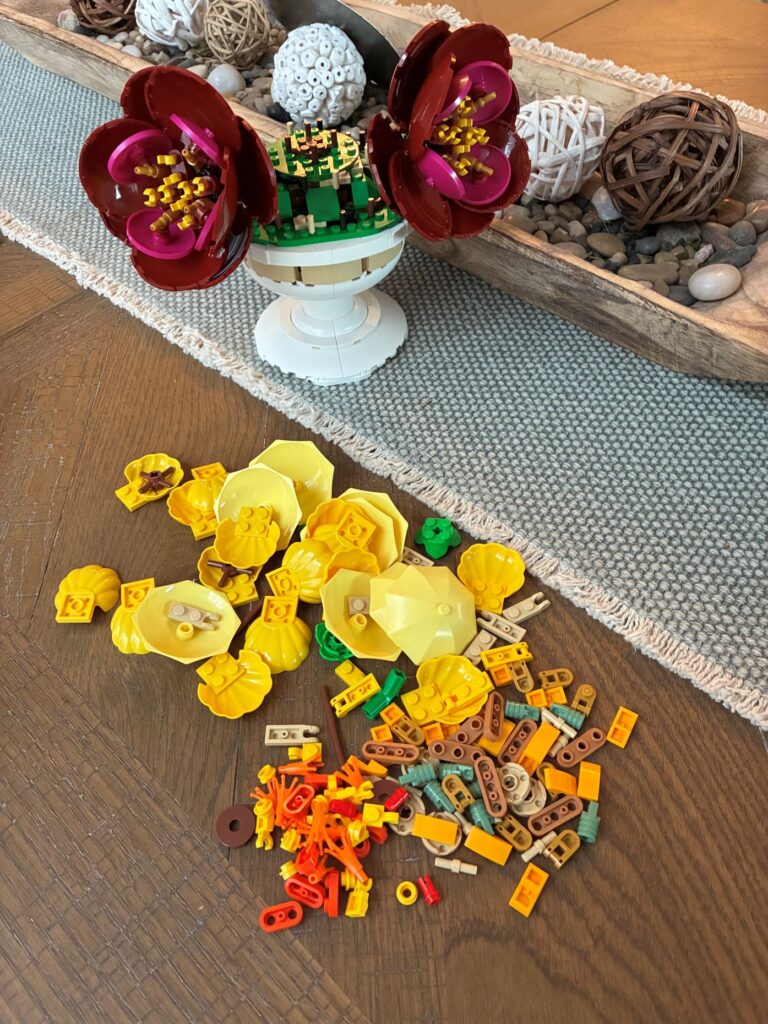
My wife bought me this set for Father’s Day. It is from the ‘Botanical’ line. I am taking my time building one type of flower a day. This is just to extend the enjoyment that I am getting from doing this. I don’t think it will ever get disassembled and my wife wants to display them where we currently have a Lego cityscape.
There are certain pastimes that I did as a youth that I honestly believe were highly influential as an adult. Those things would be reading, Legos, G.I. Joes, Dungeons and Dragons and drawing. Some of things I have written or spoken about before and some I have not. I am pretty sure this is the first time I have written about Legos at least.
We had this old, brown fleece covered bean bag. That thing became army base, moon scape, race track etc. I remember times when it would be all setup and then it was time to put stuff away for the night. I instructed everyone in the family not to touch the bean bag because it would then ruin the scenario that was setup for future play. You know what? It worked more often than it did not.
Not having a build plan, not having a bunch of specialty parts, not having access to mind numbing TV is what made this so beneficial. I had to look for pieces, I had to estimate scale from a picture, I had to figure out how a bunch of squared off blocks could make a curve of a hull. I think that another thing I learned was that if I didn’t have the exact part, it was going to be OK.
We like puzzles in this house. I think puzzles and Legos share some common elements. But more so than that, I believe that puzzles are good for the brain. This is especially true for analytical skills. There is pattern searching and recognition as well as visualization involved.
One other thing I notice with puzzles as well is that the efficacy diminishes over time. I attribute that to brain fatigue. I think that awareness with puzzles can help you become cognizant of when you are starting to see brain fatigue.
End Your Programming Routine: We often do a puzzle during a break time like Thanksgiving or Christmas. That has become a mixture of Legos or a puzzle over the last ten years. As I stated above, I think that they provide similar kinds of benefits albeit puzzles are significantly more difficult and cheaper. The next time you are wanting to go back in time a little bit, try building a Lego set.
Recent Comments