Category: Review

April 18, 2023 – Milk Street: The World In a Skillet

The World In a Skillet by Christopher Kimball is the April 2023 is the Left Coast Culinary Book Club selection for April. We find ourselves back from fiction last month to a cookbook. Not that there is anything wrong with that, I find a it difficult to evaluate a book without using it. That certainly is the case here. That being said, there are some unique elements to this particular cookbook.

You may be familiar with Christopher Kimball as he was a host of America’s Test Kitchen for many years. I did notice that he was gone from the show about eight years ago. In fact, his fixture was so long and his transition abrupt that I thought that maybe there was a health problem or something. This is actually the first time I had seen anything publicly and learning that he changed directions.

My supposition about his whereabouts were not without merit. I ran across some allegations and apparently there was a lawsuit between America’s Test Kitchen and Kimball accusing theft of intellectual property and damages in his new endeavor Milk Street. If you ever watched any of his previous work then you will know it was highly technical. Fortunately, it appears this new direction is simpler and more approachable.
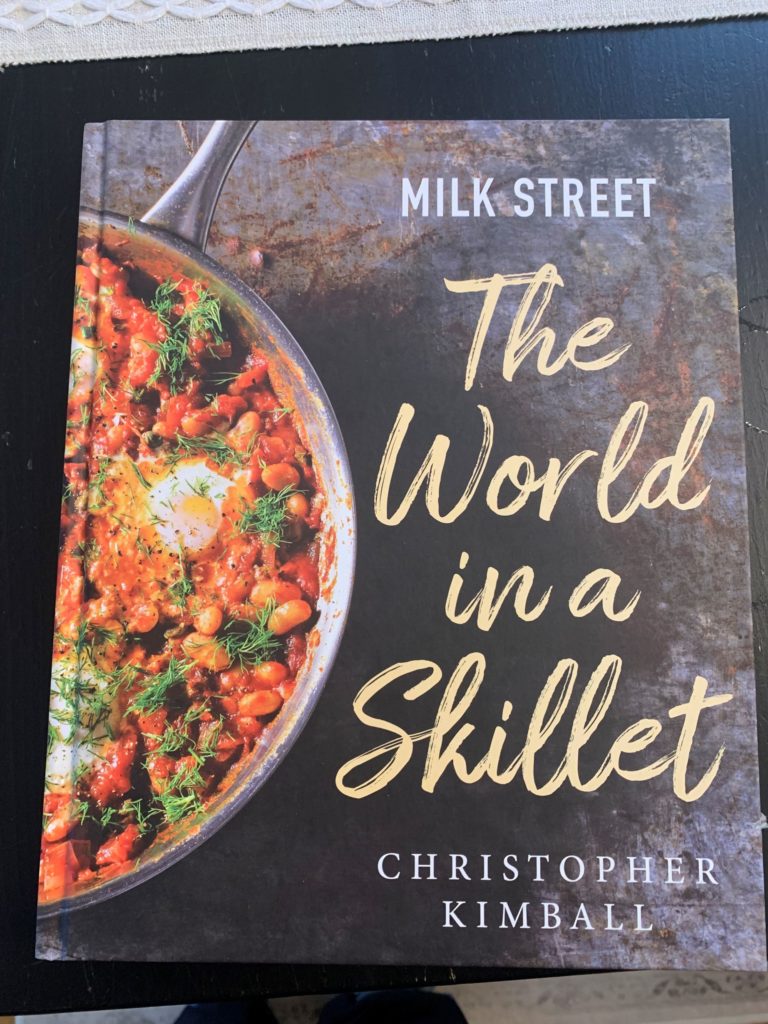
It is interesting to see different approaches, dare I say novel approaches to cookbook and I would say this is one of them. Let’s talk about the title first. Kimball’s premise is that there are a lot of specific apparatus involved in ethnic cooking. Or said another way, each culture uses a proprietary piece of cookware and he surmises that this could all be substituted with a skillet.

That was the approach, but it wasn’t the only innovation. The cookbook is organized by time to cook. So, the user can go to the section and look at the 20 recipes that require less than 45 minutes to make. I think that this is a brilliant because skillet meals are often one dish meals. One dish meals are often those made in time constrained periods (weeknights, after work).

I do have a varied palate and I like the idea of Asian one night, Mexican another, soul food on another and comfort food on Friday. I think that it is pretty interesting that the recipes go from Vietnamese, to Italian to African to Chinese on page by page basis. So, it does seem to me that this approach fits my cooking instincts and preferences.

But wait… there’s more. It is not just single dish recipes but also sides and deserts and all things skillet. Now, maybe that is a step too far from what we need in a cookbook. But, if it is anything it is all in on skillets. So, I will give props for wringing the most out of the one-trick pony.

Out of 300 or so pages, nearly half of them are pictures. It does make you stimulated to page through the book. So, barring the fact that I haven’t cooked anything yet, it is a beautiful book. However in my kitchen, books are starting to clog up spaces so I am moving to the point that they need to earn their place. I do plan on trying a few things in the next month to see if it is worthy.

End Your Programming Routine: The book club is emerging out of our Covid hangover. Starting in 2020, we cut our interactions from about 10 a year to 4 (including March that was already scheduled) with outside summer gatherings. We have more books and meetings in the pipeline again as the composition of the group has changed to the new reality. I love reading and cooking but I warm up to people over time. I also love that being part of this group is a leap of faith for the interests of others. More books to come.
April 14, 2023- Animal Farm, Chapter 6

Happy Friday. Maybe this is how parables are written or maybe it is just this one that is packed full of little things. This chapter is no exception. But, it could also be that it is just the way things go and not just a story. I don’t know, all I can say is that this story just seems to be giving truths.

I will keep it short because the chapter is only ten pages or so. It does seem to get a little old saying every other sentence is a validation of the world the way that it is too. I guess I would be remised if I didn’t acknowledge the significant number of truths and parallels that are in the chapter. So, let’s get into it.

Now that the animals have all been unified under Napoleon and the project focus is building the windmill, it seems like that takes all the focus at the expense of everything else in the world. We might not all remember or were around after 9/11 but I am pretty sure everyone reading this were around during Covid. So, let’s use that example even thought I want to eventually evolve away from that period.

We as a society did everything we could possibly do to focus on Covid. Never mind that people were still getting the flu let alone cancer or having their own personal disasters (and to be fair triumphs too) that happened in the midst of this. In our effort to combat the common cold, we destroyed our economy and nearly ourselves because we couldn’t see the forest from the trees. This is animal farm. Every bit of effort went to build the windmill and so the harvest suffered along with the people.

Spoiler alert: If you haven’t read this book a storm ruins the work. Wouldn’t you know it we have to find someone to blame. In the case of the book it was Snowball. But, we can find plenty of other patsies in our recent history. It was Osama bin Laden, well actually it was Saddam Hussein, no I think it was Muhammar Khadhafi. I don’t know, kill ’em all. Whatever we can do to transplant anger from our own administration and questionable decisions keeps the heat of our own problems.

Regardless of our problems with the boogie man, a modern society has a desire to trade outside of the internal economy. Even North Korean and Iran have limited trade partners. I think that it is arguable that an actual animal farm would need to go outside the farm, but when members want more than what is offered they need to look outside. Because animals are now building a windmill, they need supplies to finish the project and increase the overall comfort.

Finally, when the leaders find it advantageous, they are willing to change principal for their own gain. In this chapter, the pigs are living in the house and sleeping in the beds. If you remember, that violates the forth rule. Because the animals aren’t very literate they cant read the actual rule and can’t remember the actual rule. They are easily manipulated into what was wrong is now right.

This is the problem that we have today. We are actually moving the needle from what was wrong to now there is no longer a wrong and right. We are doing this by denying actual biology by men can be women and women can be men. It only matters if we feel like being called or acting however we feel. Don’t you dare question the should or shouldn’t of the situation.

Actually I misstated the above. What is actually wrong is not acknowledging that people can be whatever gender they want. We no longer read the rules (of morality) and we no longer remember the rules. The more absurd statements that are made, the more when you retract halfway between where we are and what was said becomes reasonable.

End Your Programming Routine: You know that I don’t really care if people feel strongly about becoming another gender. What I can’t really believe is all the mindless dolt’s who don’t see this happening. But then again, I suppose that these are the same people that thought that once we get Hussein or wear masks for the rest of our lives, things will be alright. I am not for condemnation, just stop getting hoodwinked.

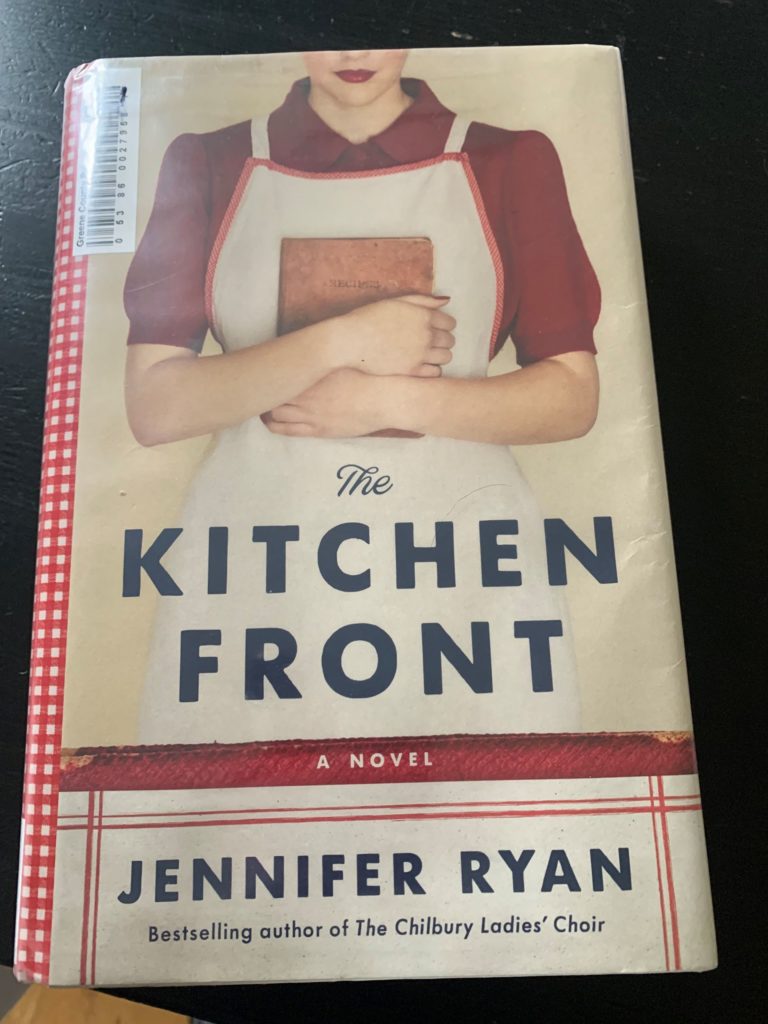
April 11, 2023 – The Kitchen Front

The Kitchen Front by Jennifer Ryan is the March selection of the Left Coast Culinary Book Club. This is a fictional book set in World War II Great Britain with a story about for women. The story is about a cooking contest and the women’s role in it where each person has their own reasons for entering and winning.

I think that this is the first work of fiction that we have actually read. It is definitely a genre and subject matter that I would have never considered if I would not have been part of the book club. Despite the format, it is not a long read at a little over 400 pages.

The contest that the book is about is a cooking contest that uses war rations effectively. As things go along, we also learn that it is not simply rationed items but also non-rationed items and wildcrafting is also permitted. So, said another way it is making recipes with what is available when certain items are strictly limited.

For context, the book starts out with what is included in rationing for one week for one person.

  • 4oz bacon or ham
  • meat to value of 1 schilling (2lbs mincemeat or 1 steak)
  • 2oz cheese
  • 8tbls butter
  • 3 pints milk
  • 1 cup sugar
  • 4tbls jam
  • 2oz tea (15-20 cups)
  • 1 egg (plus powdered eggs equal to 12 once a month)
  • 3oz sweets or candy

I think that you will agree with me that the above is not a lot of food. Notice too that it is largely meat, fats and sweets. Apparently things like fish or flour were not actually rationed. These would be items that could be obtained locally or not used in the war effort and not have to be imported due to the German blockade.

What is super cool about the book is that there is frequently a recipe at the end of the chapter. These would be the creations that were entered into competition or something based on the context of what was happening in the story. I didn’t do this but you could eat along with the story if you chose to do so.

I’m not going to give away the story but it ends like a Hallmark movie. Which by my book is better than a Lifetime movie. It’s ok to sometimes get lost in the feelgood story.

End Your Programming Routine: I think that you can tell that I liked the book by how I was writing. Honestly, I didn’t make any of the recipes. Not for any reason other than I mostly read a lot of on the plane or away from home. Of course the subject of thrift, survival and resourcefulness are the subjects that speak to me. Other than a bit of a campy ending, I enjoyed the journey.

April 7, 2023 – Animal Farm, Chapter 5

It has been a long time since I actually read this chapter. My plan was to stub out concepts weeks ago but as you know I have been a little busy. So, I skimmed through it a couple of days ago to refresh my memory on what happened. Doing so, my inference was confirmed that this is a powerful chapter.

When you read this chapter you get a lesson in how to manipulate a population. It makes me wonder how many people have read this book and yet either forgot or ignore what happened. One headline I read said 11 million copies sold. Surely a portion of those went to libraries or schools where they were read over and over again. The reality is that 11 million over 75 years is not really that many in a country that has 300 million people. Maybe people have just not read it?

Nuance is subtle. I was reading one opinion on Animal Farm and I came across this quote. “Every line of serious work I have written since 1936 has been, directly or indirectly, against totalitarianism and for democratic Socialism.” I suppose that democratic socialism works in Sweden where they never had the same expectations of freedom as the United States. Yet, I look at what we are doing as a country and I just cannot get clarity that we are not moving toward totalitarianism.

There are at least three main things that happen in this chapter. The first one happens when Napoleon sick’s the dogs on Snowball. This is the one that is the most covert and significant. It is mentioned earlier in the book that the puppies were removed from the rest of the animals and educated. It is this act that we need to learn our lesson. Isolation and indoctrination is the tactic.

Do you want to know what Drag Queen Story Hour and gender fluidity have to do with Animal Farm? That would be isolation and indoctrination. Create laws that ensure kids are in school, then start pushing doctrine to move the status quo. It won’t be long until the entire population is numb to insanity and we can no longer say A is A. My kids are within a presidential election of being full fledged adults. They are already a product of this environment because it has been normalized within their lifetime.

The second concept is repeat a lie long enough and it will become the truth. How many people believe that if you put a frog in boiling water and slowly turn up the heat that it will eventually boil to death? We have heard it our whole lives, but it simply is not true. That is a small and innocuous example but there are others.

This is a common tactic in politics today. For instance, elect Republicans and they will repeal the healthcare mandate or lower taxes. No they are not, no they are not, no they are not; repeat after me. My tax bill has gone up by tens of thousands of dollars a year since the Trump tax cuts. I have heard from others that theirs actually went down. But that is a segment of business owners and that is who got the benefit of the tax cuts. By twisting the facts, there were tax cuts implemented but it was for a certain segment of voters at the expense of the rest.

This plays out in the book by Napoleon campaigning against Snowball with plans to build the windmill. Napoleon was dead set against the project, even peeing on the plans. But as soon as Snowball was chased off the premises Napoleon immediately adopted the project. What is the truth here? What side can you really trust? I think this leads into the next concept.

There is something called The Iron Law of Bureaucracy. There are individuals committed to the mission (Snowball) and those that are committed to the institution (Napoleon). Eventually, those committed to the institution will take over running it, forever. This is the reason why I cannot get behind democratic socialism because it just keeps moving to totalitarianism. It is just a matter of the speed.

End Your Programming Routine: I suppose that this last concept is where I struggle the most. I am always a mission oriented guy and it seems like it frustrates me when I can’t change the organization. Intellectually I have been aware of the Iron Law of Bureaucracy but it is so difficult for me to internalize and accept. I feel like it is unjust and just grates me the wrong way. I suppose that just accentuates my need to work outside of systems.

March 31, 2023 – Animal Farm, Chapter 4

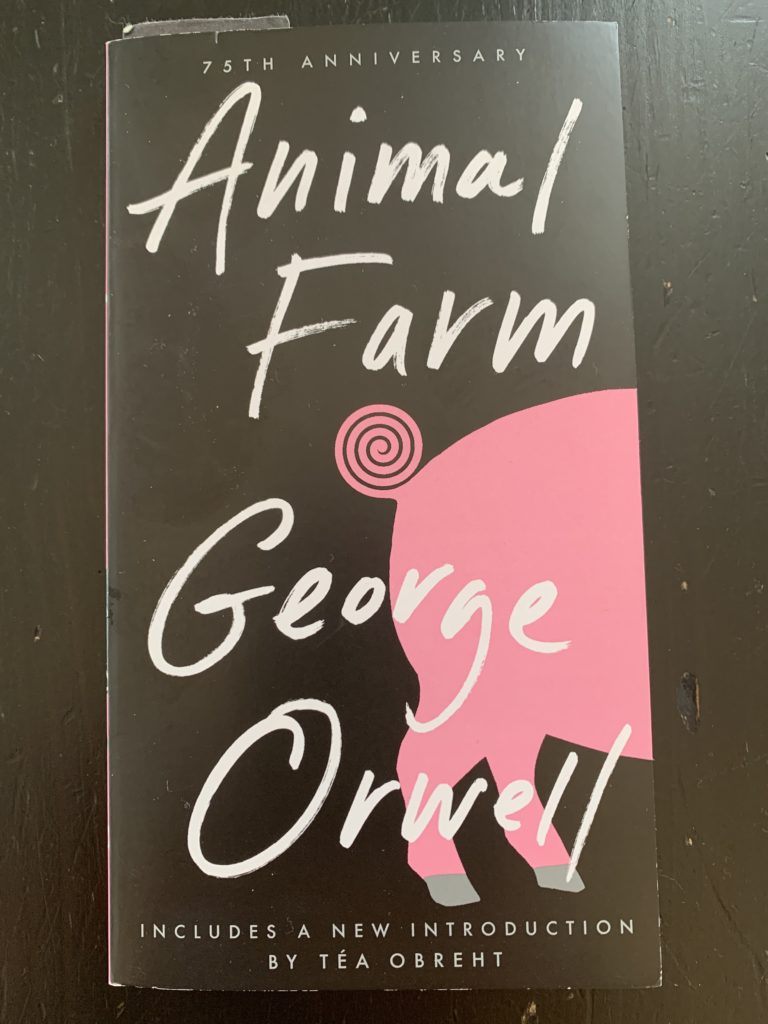
Weird, the very same image I used on the other posts ended up rotated 90 degrees in the Word Press library. I have no idea why or how because I didn’t even take the photo in that orientation nor did I edit it. I tried to rotate it in Word Press but it said that it couldn’t access the meta data and therefore edit. The only thing that I can see different is that the first three embeds were done at once and this one was two weeks later. Anyway, keep an eye out for technical gremlins.

This chapter has Farmer Jones and his buddies riling up each other to take back the farm. The humans march on the farm and “The Battle of Cowshed” ensues. Despite having weapons and gumption, the animals beat back the humans. There is one casualty, a sheep is shot and killed by Jones. This whole chain of events inspires and solidifies the animals to their cause and their dedication to it.

In this short chapter, what is being laid out is the celebration of war and the resulting ceremony. I think that these events are crafted into propaganda as unifiers toward the entity. Said another way “aren’t we so proud that we defeated our enemy”. To a small degree, the United States does this but then other countries like North Korea have built a calendar out of it.

Military celebration seems to be a central theme that autocratic regimes have adopted probably because they don’t have much else to celebrate. I think it is because they desperately try to shed other traditional trappings of culture and religion in efforts to solidify power absolutely.

The title “Animal Hero, First Class” is created and bestowed to the fallen sheep. Once again, eliminate old beliefs and build new ones. A hero that dies for the cause becomes a martyr in the situation. By awarding a title, this act helps legitimize the leaders of the movement.

Honestly, I can’t think of one actual US holiday that is based on a military victory. I am familiar with what is called VE day or Victory in Europe Day which is a named day on the calendar, but not a holiday. There may be celebrations or events in combination with the date, but it has limited recognition.

There are two actual holidays that have military origins. This would be Memorial day which was originally the ending date of Battle of Antietam in the Civil War and Veterans day which was originally Armistice Day or the ending of World War I. I would say in either case, they do not celebrate a victory.

This is not to say that we are better than Animal Farm, but it is a different kind of spirit. For those that actually participate in the American ceremonies, I would say that they lack the exuberance of celebration in favor of a somber remembrance. That being said, celebrating victory, service or sacrifice fills the same role, solidification of the might of the nation.

End Your Programming Routine: Orwell is a complicated guy. I thought that he had spent time in the USSR, but upon further research I was wrong. Apparently his politics were leftist however his anti-communist business associates were what inspired him to write Animal Farm. On one hand, I don’t see the two going together. But on the other, people involved in politics and business are all about getting theirs. Create laws that eliminate competition no matter what side of the dichotomy you are on.

March 24, 2023 – Animal Farm, Chapter 3

This is week three and things are progressing pretty much the way that history has taught us. More on that later but maybe this book isn’t as revolutionary as it was when it was written in 1945. Because I grew up in the 1980s, there was a lot of talk/movies/propaganda about how people thought the USSR was, maybe not how it actually was. I would say that it was pretty hard to imagine from the outside what life was actually like under the Soviets in 1982.

We all know the arc, trajectory and result of the hard, Marxist movements. Instead, I want to focus more on movements themselves rather than one specific one because I think that they share the same similarities as the conclusion of the USSR. Now to the the book.

The chapter starts out with the animal doing harvest. It was performed with exuberance and better than normal results. I think that this is a pretty normal situation. Participants are excited to be part of something. There are lots of hands for work. The momentum carries the animals not just on an emotional high of the task but a phyiscal high of the results, more hay put away.

For some, the exuberance dies rather quickly. I am speculating that for those individuals, they were not really committed to the cause in the first place. It was more likely that that they were ignorant of the goals and aims and the excitement of newness to everyone was the result of initial commitment. Some animals are starting to shirk their equal contribution i.e. the cat.

As the movement matures, changes in the fire and brimstone of the core values sometimes change. Sometimes they are refined but other times they are edited to retain adherence to the group. In this case, it was stated that not all the animals could read or understand the seven commandments. As a result they were simplified to to one “Two legs bad, four legs good”.

As the pigs start to take ownership of the leadership roles, some interesting things start happening. For instance, Snowball is sequestering all of the offspring for ‘education’. It is not just that, but the pigs are carving out special exemptions for themselves, because they can and no other animal realizes what is happening.

The United States has been full of movements. Religious utopias, racial and women’s rights, temperance, labor and political to name a few. In my opinion anyway, movements either have an endpoint or they are point in time. What I mean by that is that Movements that are results oriented, like temperance or women’s suffrage I would say were successful because the had specific, targeted outcomes. Things like the ‘Tea Party Movement’ of 2009-2012 failed because they had unrealistic, non-measurable outcomes.

There is one more concept to take in with this. That is The Iron Law of Bureaucracy. There are those within any organization (including movements) that committed to the cause and those that are committed to the organization. Tacitly, when an individual is committed to the organization, they start making decisions on what is best for the organization and not necessary accomplishing the mission. I think that the pigs belong to the second group.

End Your Programming Routine: I will let that sink in. What we have in US politics is people committed to the organization. To make it worse, most legislation or regulation is wrapped up in paper that tries to make it look like what is being proposed is for the mission. Why else would we have 80 year old senators? Is that what is best for representing the state or is that what is best senator? I really can’t imagine working sixteen hours a day six to seven days a week at that age when the average life span is less than that.

March 17, 2023 – Animal Farm, Chapter 2

And in this corner coming in at Week 2, we have the bantamweight champion of the dystopian fiction universe, Animal Farm. There is still a lot of fight left in it as we have only seen one chapter. Animal Farm came out swinging with the Animal’s grievances against the human population. They landed some solid hits with accusations of starvation and abuse. This chapter they are going to put their fight plan into action but I think the humans are going on the ropes before it is all over.

Kind of silly of me but, I heard it in my head when I sat down to write. I hope that I can always laugh at myself and take some chances. Life is too short to be stiff and serious all the time.

All chapters of this book are short, so I am not going to keep repeating that. But as a synopsis of the chapter we have the animals chase out the Jones. Manor Farm is renamed Animal farm. The new leaders of the movement are the pigs Snowball and Napoleon. They come up with seven rules to represent the new movement. They are as follows.

  1. Whatever goes on two legs is an enemy
  2. Whatever goes on four legs, or wings is a friend
  3. No animals will wear clothes
  4. No animal shall sleep in a bed
  5. No animal shall drink alcohol
  6. No animal shall kill another animal
  7. All animals are equal

While this is seven specific rules, another word for that is a core values. Each successful movement is guided by things such as core values. Values differ from beliefs as values drive internal behavior as well as being outwardly visible. They help devise a code of conduct for behavior as well as provide a framework for evaluation when specific rules do not exist.

While not surprising, you could probably describe these values as anti-human. This type of behavior is sometimes described by the boomerang effect. Briefly, that means that when people get tired of a long period of one set of ideas or operating parameters, they often double down on on going the opposite direction in policy and attitude. The periodic swings in the US House of Representatives is a good representation of this.

I thing that it also goes without saying that movements are judged by their core values or more specifically adherence to. I think most people consider the legitimacy or sincerity of all members particularly leaders when they meet and live their core values. How many times are Christians chastised for not living up to values? Ironically, most non-believers have no concept of sin and fallibility. Nevertheless, it is an example that most people can relate to.

It is a little early to say how this will go, the animals just got started running their own farm. Will they all get it? Will they all buy in? Will they truly be equal? I think that we have enough human data to answer the question, but will the animals be any different?

End Your Programing Routine: Buying into core values are the first step to programming. Once the premises have been accepted, many decisions are boiled down to litmus tests. “Is this situation good” is compare to established criteria within your values and there is really very little additional judgement is involved because the outcome has already be predetermined.

March 10, 2023 – Animal Farm, Chapter 1

We have a new book this week, George Orwell’s “Animal Farm”. I know that this is a short book and originally I was thinking that I was going to cover it in four sessions. Once I started reading, it became very apparent that each chapter is it’s own subject. Or said another way, I don’t think that chapter one has that much to do with chapter 3 in terms of concepts. They are interrelated but they are also very standalone.

Unlike 1984, we do know from Orwell (Blair) that this was deliberately written as a precautionary warning against Communism. It’s a cutesy little tale some might call a parable or a story with point. This isn’t my first time through the book, I read it in 2019. But, it definitely fits into my Friday genre.

It is no small consequence that Orwell picked the pig to be the instigator. They are among the smarter domesticated animals and they have a penchant for breaking the rules. In farm terms, that means destroy things, escape, etc. They can be brutal, killing other animals that they perceive to be weak. And finally, if they truly do escape they become feral within a generation.

Major, the pig had a dream. He dreamt that there was a place that the animals were in control of production and therefore their lives. The animals would band together and work in lock stock together to perform all the tasks that they have been forced to do throughout their lives.

Along with working toward the common goals, they would also reject all things that are seen as human. These would be things like wearing clothes, sleeping in beds living in houses, using money, drinking/smoking, use money or trade. Major died a few days after revealing his idea. I believe that Major was a caricature of Lenin.

It is perfectly natural for beings to want to own their own production. The opposite of that is actually defined as slavery. I think that is is also natural for an oppressed group to reject all trappings of their oppressors. It’s either that or the trappings become appropriated.

As with all ideas, they are just that. When attempted to be put into practice, it is often times more complicated that it would be seem. In addition to that, when things are large it can take more than a lifetime to come to fruition. When others assume the tasks, they may not take them in the same direction as the visionary intended.

I was reading about Lenin and while he was no Stalin, he certainly was not afraid to make some heads roll. It would seem like his galvanization into the ways of Marx was the execution of an older brother in 1887. But in reading about his first government apparently he was not the most radical. I had never realized that the Bolsheviks were not one and the same as Lenin. They wanted total conversion of all private assets to be redistributed while Lenin was a more reserved socialist.

My point with all of this is that a Visionary sets the path and the tone. But, no one lives forever and once that power has transitioned, the vision will be molded or adapted to the person succeeding. Therefore, the manifestation of the original vision may be far from what the founder intended.

End Your Programming Routine: I will take this week by week. As it stands, this will be a ten week series, one per chapter. But if it makes sense, I will combine chapters in the course of this study. This chapter was only an introduction. The lesson this week is a revolutionary has an idea of something different than what is. It’s not hard to persuade a population that understands and identifies with the benefits of the revolution.

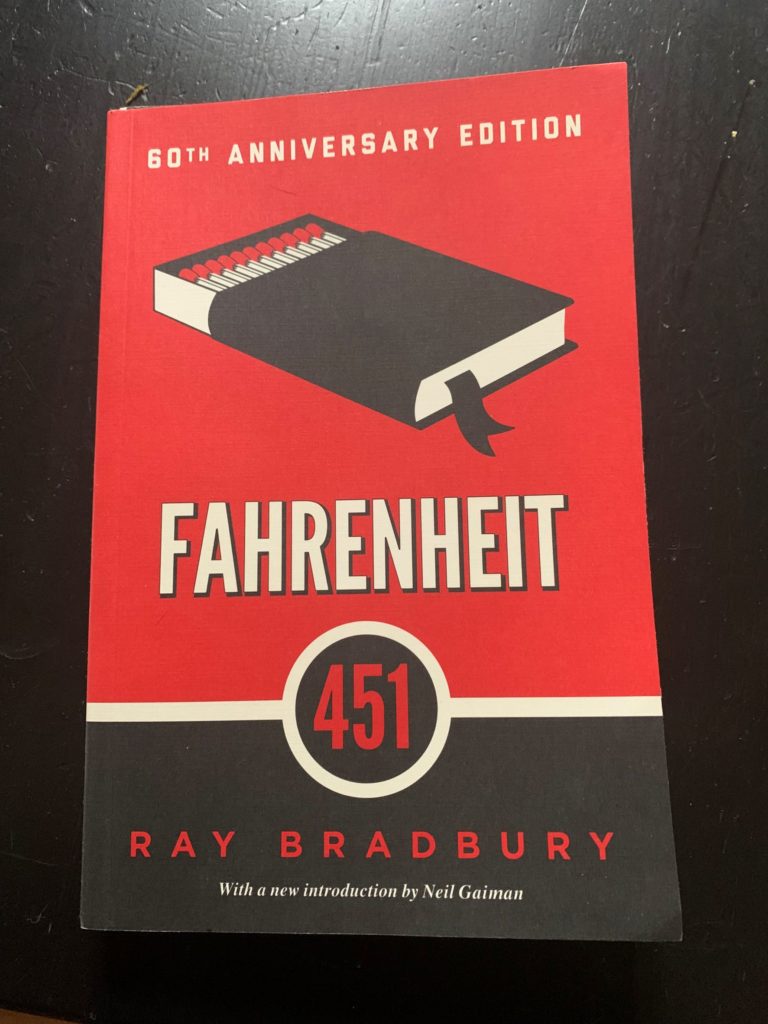
March 3, 2023 – Fahrenheit 451 Conclusions

To understand Fahrenheit 451 is to understand the backstory to how it was written. Of course, none of this is written in the book but it was part of mine as an appendix.  Fahrenheit 451 is an evolution and combination of several short stories and an ongoing effort to get published. Unlike Orwell, Bradbury was alive for many decades after it’s publishing and indeed had some words to say in confirmation of what I am about to write.

The inspiration for the story came from a book called “Darkness at Noon” by Arthur Koestler.  This is not a book that I have read or am familiar with, but the description seems worthy of going on the reading list especially if it inspired Bradbury. It is a story of persecution in a totalitarian regime.  It was at that time that Bradbury decided that science fiction was the genre of literature the permitted the most leeway for his beliefs and story. All that being said, I don’t think that this was a protest story as much as it was a warning.

Though not formally educated, you could probably say that Bradbury had a desire to write. One of the precursor stories to Fahrenheit 451 was a short story called “The Pedestrian”. Essentially, this was based on an encounter with police that Bradbury thought he was wrongfully accused. This interaction pissed him off enough to write a story about it.

Later, Bradbury developed another short story titled “The Fireman” as a science fiction magazine submission.  This was the true basis of Fahrenheit 451 with the portions of “The Pedestrian” weaved in.  That part of the story was Montag’s interaction with Clarisse whereas most of the rest of it was “The Fireman”.  This was all done in an attempt to make a book length story for publishing.

On an interesting note, as Bradbury’s work got critical acclaim it began to be read in schools in the 1960s. The publishers took it upon themselves to sanitize the book from the largest adult themes such as language unbeknownst to Bradbury.  It was some years before it was brought to his attention and Bradbury immediately demanded that be stopped, which they did.  I think that you can say that he walked the walk.

In the grand scheme of things, Bradbury was no slouch. He could read the tea leaves on the way things were going and the subject manner of banning books was no coincidence. With the age of new media coming, and I mean TV he could anticipate that books being passed over.  The reason the subject matter was banning books was because it was more palatable considering TV was quickly surpassing reading for entertainment.  It was also Bradbury’s belief (and mine) that there was more to lose banning them. You see, with books you have to think about what is being said and interpret what is happening.  Thinking is what makes them “dangerous”.

I realize that this has been a little different than some of my other wrap-ups because I have a lot of information on and from Bradbury himself. With that, I think I will leave the analysis there. This is a short book that can easily be read in a couple sessions. The story is easy to follow and I think that it is approachable science fiction. In today’s world, it doesn’t even seem too far out there. That was probably different when it was written in the 1950s.

You can probably tell from my complimentary tone that I hold a high opinion of the book. I think a lot of factors come together between the story, the length and the approachability to make that happen. If I had one criticism, I would say that the ending was a little unbelievable. I am not totally convinced that after multiple nuclear detonations that it would be possible to go back to the city. I imagine that the radiation and fallout would be off the charts.

But, in Bradbury’s defense the first nuclear bomb was tested in 1952 which was one year before the book was published. We know so much more about the effects of nuclear detonation now the at that time. Plus, we have the benefit of almost instantaneous and comprehensive information with the internet. I am sure his depiction of nuclear war was was colored by the perception what the public thought about war at the time with the information that was available.

End Your Programming Routine: The warning that I am referring to in the first paragraph is the warning about taking in your surroundings or some people use the phrase being in the moment, that is living.  With your earbuds in, driving around at 200mph to get home and watch TV people are losing touch with reality.  I feel like that is just as relevant today as it was in 1953. And maybe even a little more so as we approach that era of life in a four-screen environment.

February 28, 2023 – A History of the World in 6 Glasses

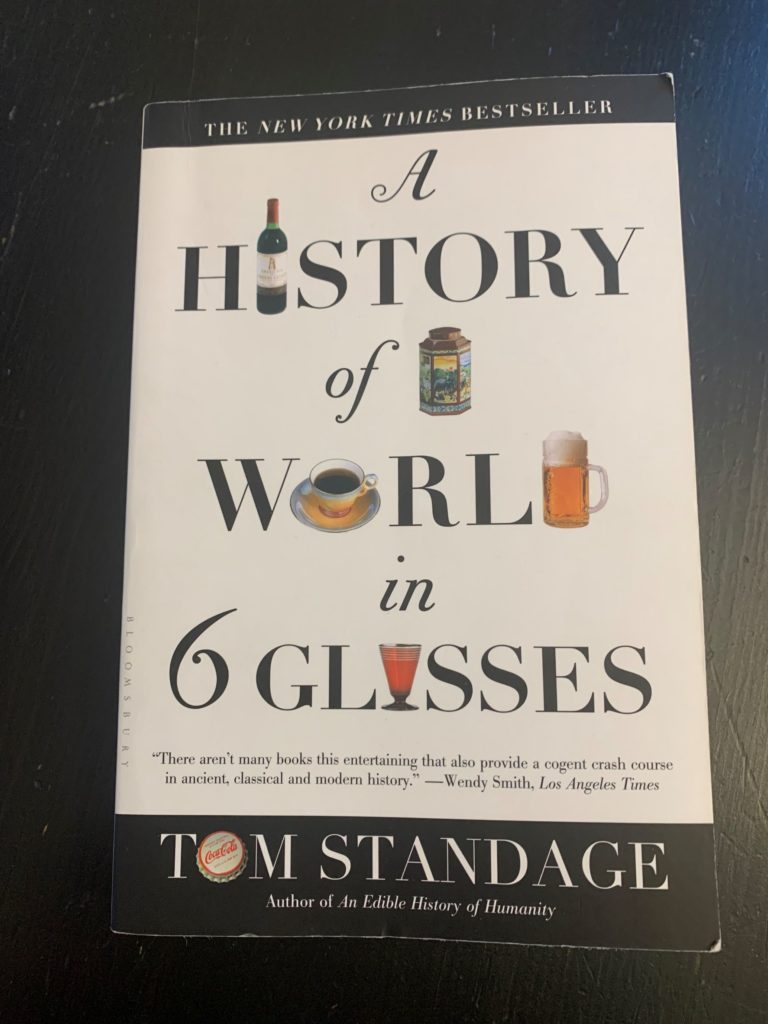
Sometimes I get lazy and put up books that I have read because it is convenient not necessarily because I thought that it was interesting. This is not one of those times, I was fascinated with the concept from the title through the end.

A History of the World in 6 Glasses by Tom Standage proposes a world view of history through six different drinks. I don’t think I am giving away too much by listing them as beer, wine, spirits, coffee, tea and Coca-Cola. It isn’t a long or difficult read by any means. The book is 250 pages and takes the position of reader as a novice.

If you were looking for an anti-racist approach, you will be sorely disappointed. This really takes the approach of history through the drink. For instance, I think that tea gets a little short shrift. The book is the western perspective about the tea trade and proliferation of tea through the British Empire with only a handful of pages before that. So, it is not totally ignored but what a fascinating perspective that the British Empire was fueled on tea.

I think part of the fascination of this book for me is the transition of one drink to another. This is the explanation of how one drink overtook the other. A lot of it had to do with rise and fall of empires but what a unique take to frame them through drink. I thought that it was particularly interesting about how the political decisions drove economic activity and made or broke empires.

Another wildcard for me was how a brand came to represent an empire. I don’t know if I totally buy the premise however I certainly understand how the brand represented a philosophy and the philosophy symbolized a way of thinking and a way of doing. It was that thinking and doing that was novel and therefore the empire grew as a result of a better idea.

Since the book is short and the it is all about history which of course is already known, I don’t want to spoil the remaining secrets that are within. I definitely had no problems keeping up and reading the book. I didn’t find it dry in the least. For that, I would say that if you run across a copy, it is definitely worth reading.

End Your Programming Routine: It isn’t that often that someone gives you a book that they haven’t read that actually turns out to be good. From that standpoint, I wouldn’t have taken it if I didn’t think that it looked interesting from reading the jacket. For me, the programming is looking at things the same way, over and over. This is not that. This is looking at history by aggregating events through the perspective of a drink. What a novel concept.