Author: bhayes952

December 10, 2021 – An Unappreciated Art Ruined by Fakes and Slander, Fruitcake

A couple of days ago a friend came by and delivered us a fruitcake.  We talked a little about the process  and she said this is something she said that she has been doing for nearly 60 years.  I think it was last year, I happened to catch a segment on TV on how to make a fruitcake and my opinion and appreciation changed immediately.

Adjectives that I think most people apply to fruitcake are cheap, tacky, passé or dare I say thoughtless.  I have to say that I held that opinion as well.  The reason being is that my impression of fruitcake was that someone bought a couple $5 processed fruitcake to reciprocate as hostess gifts or ‘whoops, I forgot about your family’ enjoy this crappy fruitcake.

With a real fruitcake, nothing could actually be farther from the truth.  This is an art that takes a lot of effort and planning.  I suppose that is where the breakdown starts.  I think about mole for instance.  Good mole is incredible, bad mole is almost inedible.  It all has to do with the process.

Today, most people and restaurants make mole from a base.  That starter includes poor ingredients and substitutes like hydrogenated oils replacing lard and thickened with chemical agents.  This leaves a semi-sweet, pasty and lifeless sauce that kind of makes me regret the upcoming meal when I smell it.

But, enough with mole lets get back to fruitcake.  How did we get here?  The planning, effort and cost is how.  A proper fruitcake would be soaked in Rum 30-60 days.  That means that it needs to being made around Halloween.  When you combine a corn syrup drizzled concoction of a ‘store-bought’ fruitcake with peoples lack of dedication to the finer points of cooking our only context is a sticky, bland uninspiring mass.

We have a society that doesn’t know fruitcake because of our lifestyle and it is easy to see why we can’t appreciate it.  My wife and I are old soles.  As we were talking to our friend yesterday, she offered to give me the recipe.  I immediately jumped at the chance.  Ultimately, I don’t care to change the world and if you aren’t willing to try then fine, more for me.  But, the tradition seems appealing to me so I think it is something I want to try next year.

End Your Programming Routine: This is the definition of ‘End Your Programming’.  Tradition, culture, effort and craft combine into something special, wonderful and counter to popular belief.  I think it is an honor to learn from someone that has persevered through the opinion of fruitcake to keep on doing what you believe.


December 9, 2021 – ‘Tacticool’ Thursday

Just because I don’t shoot as much as I would like, it doesn’t mean that there isn’t maintenance that needs to be done.  There is a saying in the used firearm world ‘Carried a lot, shot a little’.  This implies that there is what is called holster wear or places where the holster contacts the metal and rubs the finish but the bore is like new.

So, if you are in that carried a lot, shot a little camp like I am, then you should also take a look at things now and again.  The two primary things to watch out for are corrosion and lint build-up.  Both of those things are fortunately addressed by periodic cleaning.  This is a long way of saying, inspect and clean you firearms even if you don’t shoot them.

It is the similar justification I use for changing my own oil.  When I am in there, I plug in the scanner, look at the washer fluid levels, check the battery and the conditions of belts and hoses.  Most people argue that it is not worth their time to change your own oil, as you know from my previous post, I think it saves you time.  Plus, I am familiar with my vehicle and its’ condition.  You need to assess the condition of your tools.

I have heard advice from people that live in hot/humid climates to clean firearms once a week.  The premise being that you are constantly sweating and that doesn’t mix well with metal.  This of course has a lot to do with the construction of the item.  Polymer and stainless steel have much less issue with corrosion.  However the small screws and springs are rarely ever mad corrosion resistance.

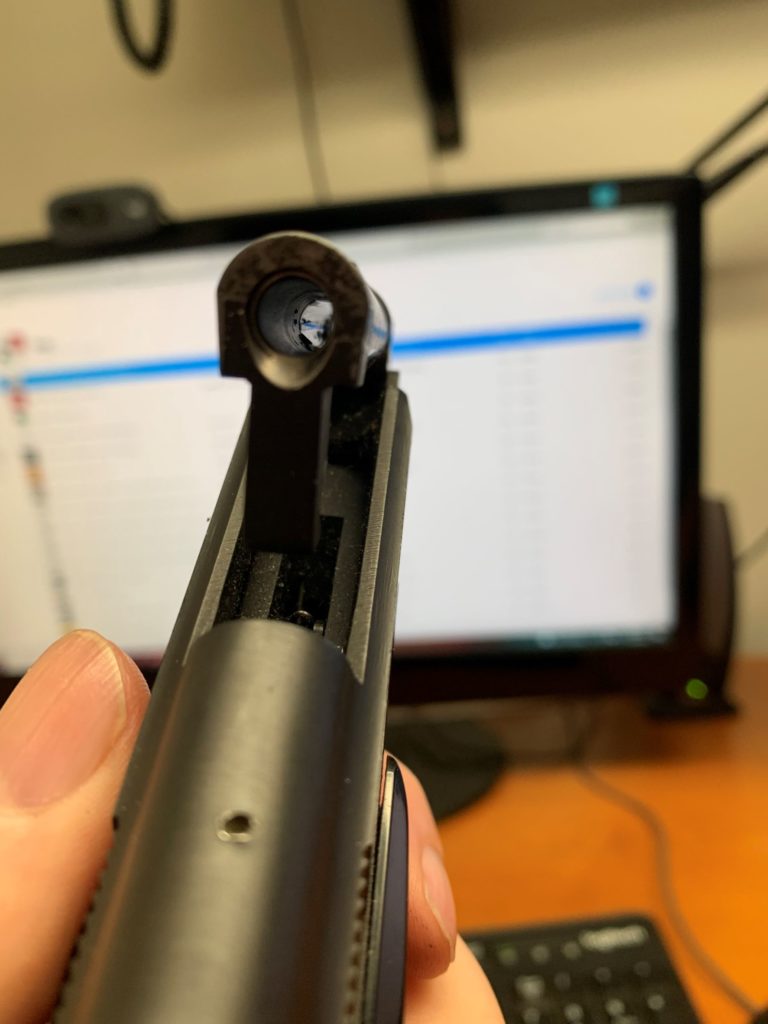
You can see all of the crud in the barrel from the picture above.  This was clean, post the last use.  I also disassembled everything (for the first time) so that all the interior lint and powder crud could be cleaned out.  It is also worth noting that magazines should be inspected and possible cleaned as well.  It goes without saying but the last thing you want in a carry piece is a failure because of neglect.

There are other considerations after cleaning.  Particularly carry pieces, you want them as dry as possible.  I am not saying no lubricant, but as little as possible.  That reduces the amount of stuff that ultimately adheres to an oily surface.  If your firearms are in a high humidity environment and just stored, I prefer a wipe down with a light silicone oil lie Birchwood Casey Barricade. 

End Your Programming Routine:  If you are serious about personal safety, then you realize that concealed carry is a lifestyle.  Your wardrobe, your tools, your choice of spare time activities and where you spend your money is part of the consideration.  I think it has been over a year since I last cleaned this firearm, and I feel OK.  It doesn’t mean that you have to be obsessive, just be aware of the risks and responsibilities.


December 8, 2021 – Review: Husky 36″, 11 Drawer Toolbox Combo

It’s been a long time since I did a review. This was supposed to be one of the cornerstones of my work so that at some point I could gain a business advantage buying, using and reviewing items. It’s not that I haven’t bought things since 2020, I suppose that it is I kind of forgot about reviews.

This is one of those items that I always wanted.  I imagined that I would have a bright red, Craftsman toolbox with everything organized and accessible.  It is not just that, but also I would have space to add more tools, if needed.  It sounds a little fruity, but another thing I could accessorize.  

When I moved to South Carolina, I built a bench in the garage that had custom slider drawers.  I could see all of my wrenches in order so I could easily find what I wanted.  When we moved here in 2005, the shop already had cabinets so I stashed stuff where it would fit.  It wasn’t my ideal, but it worked well enough that I couldn’t justify the cost.  

About a year ago, the plastic container that organized all of my sockets started to fail.  That meant that every time I was pulling out my sockets, I was having to reorganize them because they would fall all over the place.  To top it off, my son started ‘borrowing’ tools and leaving them in his car.  I repeatedly asked him to return them when done and because they weren’t too organized, I really couldn’t tell what was missing. Plus, with my sometime working on cars, I find that I was constantly going back and forth to the shop when I could have what I need right next to me.

I finally decided to make the plunge and buy a tool chest.   I had some experience with a Craftsman tool chest in the lab and I knew that weight can quickly add up and then things don’t work so well.  I suppose some of the difference between the consumer chests like Kobalt, Craftsman, Husky, etc. is the real amount of weight each drawer could hold.  I don’t know for sure, but I think the Snap-On ones can really handle the load which is why they are 10 times more expensive, even the used ones.

I knew that I wanted ball bearing drawers.  They just work better.  I also looked at the total weight capacity.  In this case, the 36″ chest  castors were rated for 1500 pounds.  The 40″ chest was rated for 1200 pounds.  Even though I wanted the larger size, overall weight capacity was more important to me.  I also liked the price better at $400 versus $600 and I got 10% coupon, I was sold on my choice.

I looked at the different brands.  I know that Stanley bought Craftsman so DeWalt and Craftsman in theory are the same.  The truth is, I couldn’t find much difference between any of the brands based on specs including US General at Harbor Freight or Stack-On at Napa.  Unless you are going to pony up for Snap-On, it boils down to color, drawer layout and price.  

I probably overanalyzed every detail because I couldn’t find exactly what I wanted, but I saw this blue color and I really liked it.  I knew that I really would have no practical opinion without actually putting tools in it and using it. The price was good, the need was there and it was a good project to work on while my wife was in Texas and I was spending all of my time organizing junk in the garage going through my in-laws estate.

Thin drawers are good because everything can be laid out in a way that each can be seen and extra stuff cant be put in the drawers.   When the drawers start getting deeper, then it feels like there is room to add an organizer.  What I have learned about those is that the cost starts to really add up and they add a lot of bulk to the overall use of the chest.  But again, one of the main goals was to organize tools.

With organizers in the drawer, they take up a lot of space.  That means that there is a lot less weight in each drawer (at least for now).  I found that Harbor Freight has a number of inexpensive options, in stock.  Of course online you can easily start having more cost in the organizers than in the actual chest.  

Here is my analysis.

  Score Advantages Disadvantages
Value 5/5 This was the most inexpensive choices I have seen with the features I wanted Still $400
Quality 3/5   The locks  and latch are really flimsy.  Top lid could easily be pried open to access the rest of the top
      I am not a fan of soft close drawer runners.  They offer artificial resistance and causes the drawer to operate stiffly when cold
Performance 4/5 I got all of my tools in the chest.  I have been able to roll it to the vehicle to work on things rather than running back and forth to the shop. I wish there were more thin drawers.  My optimum design would be 80%, 1 1/2 inch drawers with maybe two larger drawers.

End Your Programming Routine:  It is like most things for me.  I dreamed of one day having a nice chest with everything organized. Now that I have it, it is anti-climactic.  I will say rolling it next to my work has been nice and it is so much less frustrating to be able to easily find the tools without sorting through the pile of wrenches.  I have seen nothing that would make me say “buy that, not this”.  

December 7, 2021 – In Contrast to Yesterday…

I have an experiment going on. I got this bicycle light for Christmas in 1994. I got the batteries for this light at the same time. Guess what, they still work. That is 27 years later, functioning alkaline batteries.  I like to check the light every couple of years to see if it is still working.  

December 6, 2021 – What Is Wrong with Batteries?

It am starting out with anecdotal observation. It seems to me that say 20 years ago, batteries rarely failed. It also seems like today batteries nearly always fail. When I say fail, I mean that batteries leak and frequently ruin the device in which they are placed.

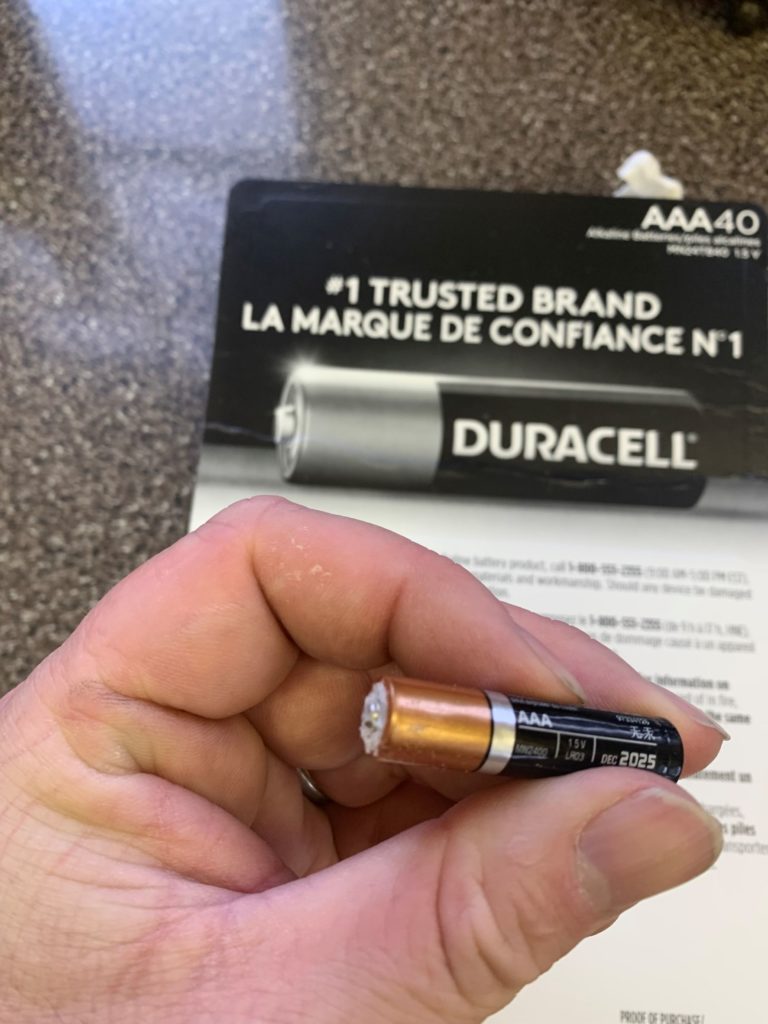
I use to believe when batteries were treated poorly for instance left in a hot vehicle for years, those were the cases where we would see a battery failure.  I can understand that.  I now deliberately keep batteries out of devices unless I am going to routinely use them.  You can see from the photo above that the battery in question was well within expiration date and kept at room temperature (below).

What you are seeing is my weather center display that is plugged in on the kitchen counter and has batteries for power back-up for things like the clock setup.  It is less than two years old.  That also means that the batteries have been in place less than two years.

Batteries that are labelled as ‘alkaline’ mean that the overall chemistry of the battery is basic or a pH higher than 7.  This is different than the chemistry of a car battery which uses sulfuric acid with a pH lower than 7.  Why does that matter?  If you are going to salvage the device, you need to neutralize the reaction in the right direction. 

Looking at the chemistry of the situation, the leaking battery forms potassium hydroxide which then reacts with carbon dioxide to form a crystal of potassium carbonate.  That then reacts with the plating on the terminals.  You must first stop the reaction.  Use an acid like vinegar to clean the corrosion of the terminal.  Then, neutralize acid with a base like baking soda.

Hopefully, the device is still salvageable at this point.  I have even gone to the point of filing terminals to try and get a new conductive surface with mixed results.  The only reason I even checked this was because my time was off and I unplugged the device to reset the time and date.  

There may be more to this story.  I am debating about calling the guarantee number because I am upset about so many battery failures.  I also have a remarkable situation as well that I might talk about this week.  Suffice to say, the weather center that this replaced was ruined by leaking batteries.  Remote controls, portable radios, LED lights and flashlights are all things I can think of off the top of my head that have been ruin in the last couple of years due to leaking batteries.

End Your Programming Routine: I also used to believe that brand and cost mattered.  It seemed like I had consistent failure with one brand over the other.  I also thought that paying more for batteries was less likely for failure.  I do not hold that belief anymore.  Like I said at the beginning, the only safe way to protect your devices is keep the batteries out of them unless you are using them.

December 3, 2021 – Turkey Soup for the Soul

Still have Thanksgiving leftovers? Believe it or not, we do still. A large part of it was that things were packed for days in the coolers while we travelled and the other was that we ate last Friday with other family members. Finally, we still have a travel hangover.

Today I am making turkey soup.  I have yet to figure out exactly what the end form will be noodle or rice, leaning toward rice.  If I was thinking better last week, I would have done something about leftovers last Friday but it really didn’t occur to me until yesterday as I was planning dinners and thinking about how to use leftovers.

Going even deeper with this… this isn’t simply about using leftovers to make soup.    Yesterday, my mother-in-law had her first chemo here in Oregon.  My wife was the designated caretaker for this round and I was thinking it would be helpful for me to make some dinner to share.  

After a five days on the road on the road last week, I had my fair share of ‘snacks’  and fast food as well as eating out.  My general feeling about all of that is that it is not satisfying and leaves you only temporarily satiated. When you are a caregiver, it can be very tempting to give up on cooking and settle for temporary relief. 

Only having the perspective as a a caregiver, I think that is a much more difficult job than being the patient.  Sometimes you are walking on eggshells and sometimes you are wondering if there is an end in sight.  We still have all of the other aspects of life to manage, particularly the future.  The patients only focus is the current, it is the caregiver that is managing the future for the patient.

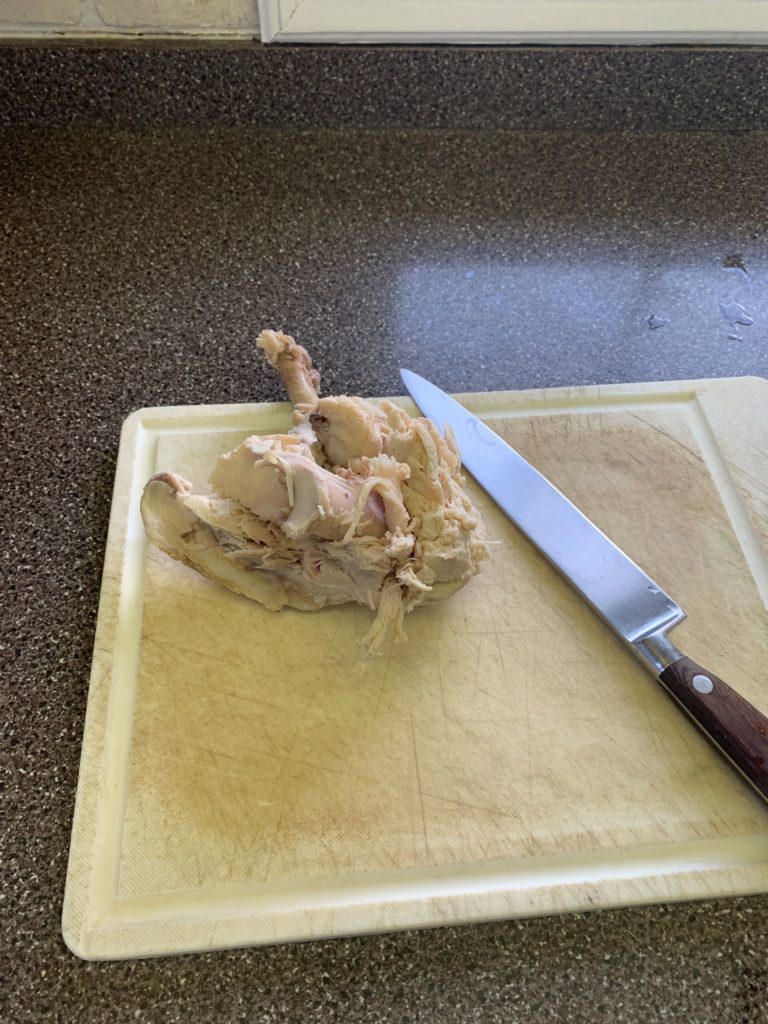
To get started, I am going to debone all of the turkey. It doesn’t have to be stripped but I want the bones to make the stock.  I also don’t want a lot of fat because that just sets on the top.  I have covered stock making before but as a refresher, I am going to add aromatics and set it on just under boiling if possible.  I want to try and convert all of the collagen and connective tissues from the bones into the broth. 

Ideally, that is when it is done but that also takes days of preparation before hand and if you don’t have days, it can be done the day of.   So, don’t let the planning stop you, remember Samin Nosrat said use water if you cant make your own stock, so this is the most important step for best results.

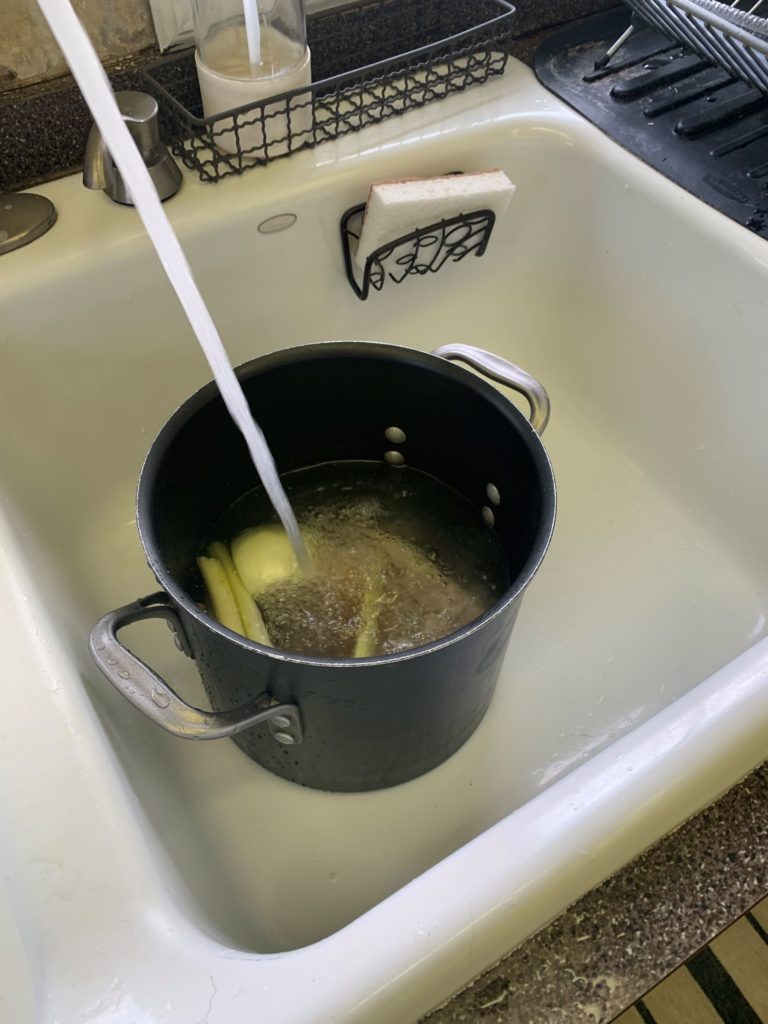
I used carrots, celery and onion along with salt and set it on the stove.  I gave it about six hours.  If I have the time, I am also going to cool and filter.  In this step, I can skim off hardened fat and remove all of the bones and vegetables.  It is not really a quality step but mostly for appearance.

I am going to dice turkey, and more carrots and celery.  I am going add rice and some parsley.  From there I will add salt and pepper to taste and that should be it.  I will probably serve with buttermilk biscuits and a side salad.  How does that sound compared to a Big Mac meal?

End Your Programming Routine:  I keep telling myself that I need to do more with food here.  Particularly the aspects that I like such as transforming leftovers.  We need to feed the souls of patients and the caregivers, as it is a difficult and many times thankless job. 

December 2, 2021 – ‘Tacticool’ Thursday

Today, I am going to try and talk about a technical topic in a simple way.  That topic is bore sighting an optic on a firearm.  In order to do that, you need to think about math.  And, I should add that there are different ways to do this.  I am showing my technique.

Before starting, I would also point out that this is a simplistic attempt.  In theory, the firearm should be levelled in two directions from bore to butt and left to right.  Then the optic should be levelled on top of the firearm.  That may require shims or modification any of the mounting components.  I plan on sighting this in at 50 yards so with that, slight inaccuracies are really negligible.  

The next step is to measure center of bore to center of optic.  This is to measure how much height difference there is between how the bullet will travel versus how you are seeing it through the sight.  If you imagine two lines, one will come from the bore and one will come from the sight.  At some point, those two lines will cross and that is ‘sighting in’.   You want the two lines to cross at the right point at the proper distance you expect to shoot.  The good news for me is that it takes a lot of adjustment at short yardage to make much change so slight inaccuracies are negligible.

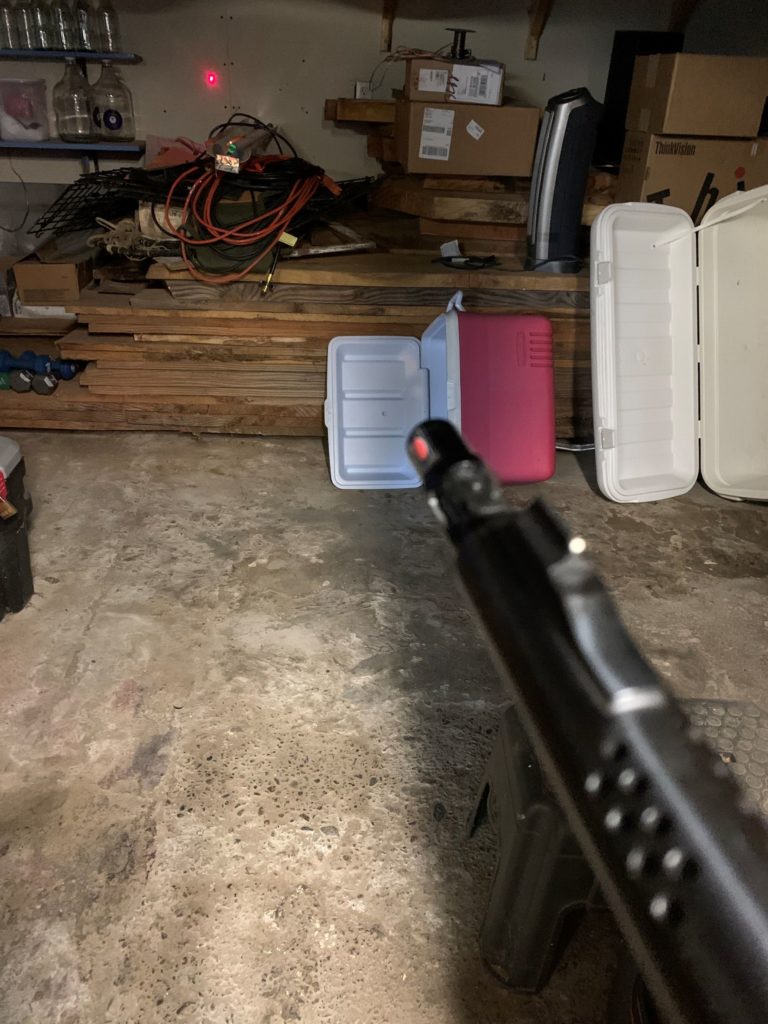
I have an inexpensive laser sight I put in bore.  That laser will put a spot at whatever distance you like.  Ideally, I would put it at fifty yards and then adjust my sight accordingly.  But, I don’t have that kind of space so I just point it at the wall.  A couple of other notes about the laser.  It works best at low light and the farther away it is, the more distortion the dot has.  I have done this at the range but it is far more difficult to see.

Once the firearm is stabilized and aimed, mark a point that represents the measurement of the bore to sight centerline above the laser dot.  Adjust the sight  to the mark. That is your target and in theory, at the muzzle and 2 1/2 inches high everything will be ready to shoot.

This is a down and dirty bore sight.  After this point, I go to the range and start working on actually sighting in at the range.  Start at the closest target and make sure that the bullet is hitting the target.  Adjust just enough that you can move on to the next distance if that is your goal.  Remember, changing loads can change results dramatically, so stay consistent when sighting in and always check for verification when changing.

End Your Programming Routine: Right now, I do not have confidence that this firearm will be accurate without taking to the range for verification.  This is why I have held onto this sight for over a year without mounting.  Life is super busy and this will likely have to wait until after the holidays at this point to get to the range.  But we will get there.

December 1, 2021 – A Tour of the Free States

The trip we took last week took us from Oregon to California, Arizona, New Mexico and then Texas. On our return trip it was everything in reverse.  I had an opinion on what I thought I would see and I will say it wasn’t quite what I expected.

First of all, it was standard fair for workers in all states to be masked. As we headed south, I expected California to be similar to Oregon in customers wearing one.  That was not always the case.  What I observed was in rural California people were not wearing masks and suburban California they were.  

As we moved into Arizona, I really didn’t see any mask wearing.  We only made one stop in New Mexico both ways and it seemed as though masks were an afterthought.  Finally, I would say ‘Dont Mess With Texas’.

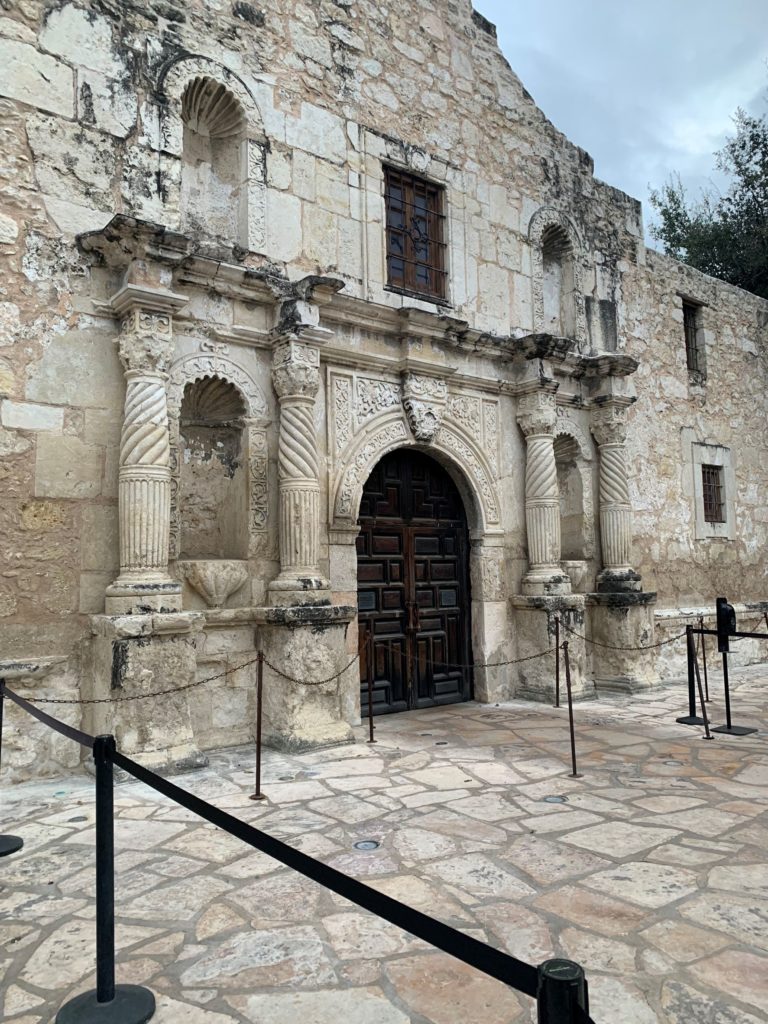
Prior to 1836, Mexico occupied the Alamo compound as a fort.  They abandoned it and some locals took it over, still technically Mexicans.  The winter of 1836 the Mexican Army came back to retrieve a couple cannons that were left at the site a battle ensued.  That was the spark of the Texas Revolution.  The idea that Texans would submit to policy if it suits them is derived all the way back to this time period.  Among the chief disputes that lead to the revolution were individual rights and taxes, sound familiar?

What I think I observed was a general consensus of will not comply rather than what I see here.  If I could try to describe it I would say here there are two distinct camps, hard left and hard right.  What I saw in Texas is an acceptance that we are just not going to comply.  For instance, in all of my travels I did not see a single pick-up flying a ‘Fuck Joe Biden’ or  ‘Trump 2024’ flag which I see on any given day here.  What I did see were signs that ‘such and such city government requires masks to be worn in this location’ and no one complying.

To me this means that in the hard left states like Oregon pushes the opposition into extreme positions.  It is like trying to block the daily tides, you might get lucky but that is really unlikely so all you can do is hope for a miracle.  In contrast, in Texas there is a general ease that this is the way things are and doesn’t require people to go to extremes to promote one side or the other.

My overall impression was pretty favorable with Texas.  I have lived in the south before and I would say that Texas attitude is more refined that of say South Carolina.  Of course not everything is roses, there is high heat and humidity.  Fire ants and cockroaches and other bugs and no real public land.  But, you cant have everything. 

End Your Programming Routine:  Where I will come down here is that the real difference is the urban-rural divide.  It is not necessarily state lines that define attitude and behavior but common values.  If you are ever driving on I5, there is a barn between Yreka, CA and the Oregon border that has a roof painted the statement ‘The State of Jefferson‘.  That has been there  before I was in college (mid-1990s).  Despite being in California that farmer shares more in values with Ozona, TX then the next closest neighbor in Ashland, OR twenty miles away.

November 30, 2021 – Lessons From the Road, Part 2

Let me just say that, I am bushed.  The drive home wasn’t as smooth as originally anticipated.  Day 1 we drove from Houston to Blythe, California, that is 1200 miles.  The plan was to drive from Blythe to home at a little under 1000 miles.  After Day 1, it should have been easier – nope.

Sunday, we were only able to get 200 miles in 10 hours.  I kept watching the arrival time get later and later.  We got to the point that our arrival time exceeded my start time for the work day.  The freeway traffic was showing red from LA all the way to Sacramento and we were running on 5 hours of sleep.  We decided to bag it for the night.

It still took us nearly 14 hours to get home yesterday.  By that, I will be getting to my finer analysis of the trip below.

  • I was worried about the weather, I never considered the traffic in the drive.  I5 was a parking lot all day Sunday and I never had any idea this would be the case.  I think about traffic during the weekdays but not weekends.
  • The original plan for the trip did not included driving my mother in law back (with all of her stuff).  We barely had room to move and when we stopped, we had to move stuff to move people to move stuff to get in and out.
  • Our overall planning for the time in Texas was weak.  I expected to work two days,  which I did.  That being said, the rest of the family did nothing on Monday.  We spent all day Wednesday driving to San Antonio (200mi one way) and back even though we past it both ways on I10.  I think that we could have done a better job of planning the trip so that we could have done more sightseeing while we were there.
  • It was extremely difficult to keep 11 people on track with only stopping for fuel and minimizing the down time.  I selfishly wanted to get home as early as possible because I wanted as much time as possible before work the next day.  No one else had the same urgency that I did.
  • I think a daily cap of twelve hours is probably a good limit.  That is still a long time in the car but it leaves a little more room for not keeping a blistering schedule.  There wasn’t a ton of sites that I would have liked to taken a little more time but having some proper rest in between days would have been beneficial.
  • Overall, the kids did a good job for the most part, the adults not so much.  There were several incidents of inappropriate behavior for no good reason.  For that reason, I will never do a multiple family unit in one vehicle again.  Between the difference in urgency and the plain ridiculousness, I will not do it.  It is not to say that I wont travel together, just not in the same vehicle.  That way, I have the freedom to go ahead if I want to.

I will probably post one more time about the trip and a different subject matter this week.  I plan to talk about my assessment of the states we crossed and how they compared with Oregon.  There are definitely some differences.

End Your Programming Routine:  I am not trying to be negative,  I am saying that I would do things differently if I could. Overall, this was definitely an experience for the memories.  And, I am not saying all memories are good.  The focus was on providing an experience for the kids and providing one more family get together as its current dynamic.  I think that was accomplished.  I am pretty sure the kids felt like this was an adventure despite what my opinion was exactly and that is the best I could hope for.

November 29, 2021 – Lessons From the Road, Part 1

Never having done anything quite like this before, some things sound like a better idea then before you try it.  This was a two pronged approach to getting from our place to Texas.  The first one was that it would save us some money ultimately.  The second one was that it would be a family adventure.

There is no doubt that we have accomplished both but I also think that there are some lessons learned this trip, this time and this approach.  The original plan was to drive 36 hours straight from our house to Texas, hot swapping drivers along the way.

  • We didn’t actually rotate amongst all the drivers.  Adding additional drivers raised the overall price of the rental significantly to where we were starting to lose some of the cost advantage of driving over flying.  All of the driving was done by my wife and I, with me doing most of it.
  • Starting our trip on Friday evening was a good way to getting started from a time perspective but we were already starting to feel the fatigue Saturday morning from being up all night.  We haven’t solidified our trip home plans yet but it might be better to not start through the night and make the first day longer.
  • We only made 21 hours on the first day.  We had planned to go to El Paso but we only made it to Tucson.  That is where we stopped for dinner.  The thought of four more hours and arriving at a hotel at one in the morning to leave by seven was too much at that point.  
  • Thirty-six hours in a van is a long time.  I would give it a slight edge over an airplane from a leg and elbow room standpoint.  Of course the ability to stop and stretch was an advantage, but it was also a disadvantage that I will talk about next.
  • To think that nine other people were going to have the same dedication to the schedule and forethought about when and where to stop was a mistake.  We rarely went more than 100 miles without stopping.  And when we did, it was an event to get everyone back in the van quickly.  Out of our 19 hours traveling yesterday, over three of it was out of the car.
  • I never realized that my wrists and hands would be sore from driving.  There were very strong winds most of the day which required tight control of the steering wheel for a high-standing van blowing all over the road at any moment.   By late last night, my wrists were aching.  
  • Cell phone service coverage made the drive largely peaceful.  I am generally not a fan of the kids incessant use of the phone, however there was almost no fighting or complaining for the duration of the trip.  Between fatigue and phones the kids did a great job getting along.
  • Starting the trip with two cases of water and a tote worth of snacks was a good idea.  I think that it helped stave off some of the complaining along the way as well.  It also may have contributed to extra stoppage however.  

Getting in at 1AM and starting work at 7AM is less than ideal after a twenty hour drive.  We did also lose two hours (time zone change) by heading east.  That time is important when schedule is driving behavior.  

End Your Programming Routine:  I will definitely have a final opinion and recommendations in part 2 tomorrow.  We are still on the road as I write this.  That will be part of the story.