When I got my keezer (kegerator), it had one tap and therefore one keg. There is probably room for four kegs of this type inside the refrigerated space. the vessel is called a Cornelius keg, often called a ‘Corny’ keg and used by Pepsi Co. That makes a lot of used ones available in the market for whatever reason.
My strategy if you will is to have one on tap, one in waiting and one used extensively for flushing the lines. I have considered adding more taps but realistically I should not make drinking beer easier. Plus, it is a lot a work to brew and flushing the lines is often not done after use so for now, one is plenty. The point is that I have added two more kegs to the system.
Both of the kegs I have purchased were used. In fact both were also dirty. One had Mountain Dew under pressure in it. I don’t recall the second one other than to say I know it was dirty. But, I imagine that these things are not taken out of service for no reason. As a result, I have taken to having to give them a once, twice and often three times over to figure out what is wrong.
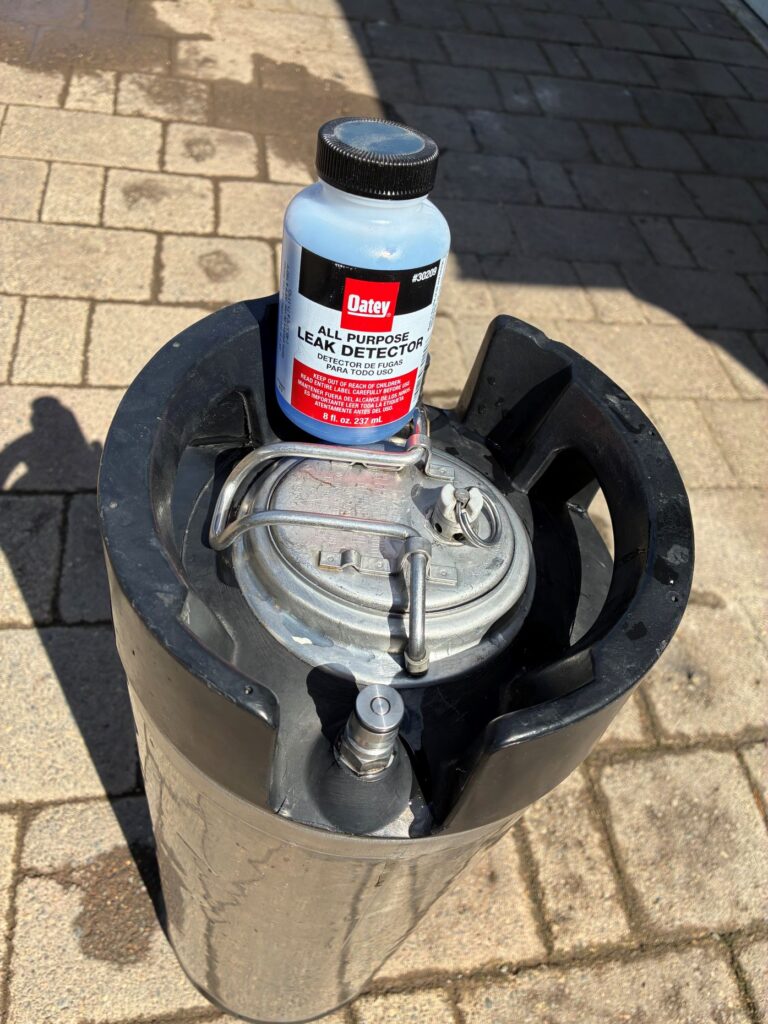
Aside from being dirty, the most common problem is leaking. Even though I have had extensive work in scientific air analysis, the tools I have at my disposal are pretty rudimentary. Most of it involves guessing and checking. The one thing that works pretty well is the soap solution looking for bubbles. The one I am showing in the picture comes from the plumbing section of a home improvement store.
You can make your own solution with dish soap and water. I don’t honestly know what the mixture is and I suppose it probably matters which detergent you use because of the factory concentration. The reason I chose to buy one is that the cap comes with a brush and so you can swab areas of interest. The one we used in the lab was a squeeze bottle with a tube at the nozzle so you could really target small areas but it is $25 a bottle.
I think it is pretty obvious how you know that there is a leak. That being said, how did I know? I opened the tap handle and nothing came out. Normal keg pressures should be around 15psi and there should be enough pressure in the vessel to fill a cup without the source pressure on (again laziness about the proper steps). But if I did things right, you should not hear gas going into the keg when you turn the cylinder valve because everything should be at equilibrium in this closed system.
When it comes to troubleshooting this system, the distribution line likely only needs to be checked once for leak Go to each break in the line and swab the joint under pressure. If it leaks, that joint will need to be tightened (only occasionally loosened depending on the connection type but beyond the scope of this article). Honestly, I only do this if during my initial test, I lose pressure. This is called ruling out the variables.
By far and away the most frequent failure parts are the action parts. These are things like valves and O-rings that seal connections. If no leaks are found around the valve, then try replacing O-rings. These are designed as replaceable parts anyway and it could have gotten damaged during transit or worn from heavy use. If your vessel leaks, then it is almost certainly junk unless you can weld on stainless steel.
I found that on my keg in the picture above was leaking around the main seal O-ring. Even my soap test did not reveal the leak and it would occur over the span of three days or so. I also knew that my O-rings on the valves were OK because the keg leaked whether it was connected to the distribution line or not. Other kegs I have did not leak and so it wasn’t the other end of the connection either.
Generally speaking, these tests should be done under system pressure. This should reduce the risk of contamination from the soap. Cranking up the pressure should make leaks more obvious but it is possible to cause new problems, so be careful. The one thing that I also wanted to add with soap is to make sure product surfaces are cleaned after testing unless you like soapy beer.
End Your Programming Routine: This troubleshooting technique works for beer kegs, water lines, air lines etc. In plumbing, lines are pressurized to prove that they are solidly connected (generally new construction). One final thing, the air molecules are generally smaller than liquid water, so a leak in an air line is much more likely than a water line. So-so connections can still hold water that don’t stand a chance containing gasses for long term.
Recent Comments