The Mushroom Hunters by Langdon Cook is the Left Coast Culinary Book Club selection for May 2025. I got a head start compared to my normal pace due to last month being a cookbook and setting our club schedule a little bit in advanced. I started reading this at the beginning of the month and got a good way through it on our back and forth to the east coast.
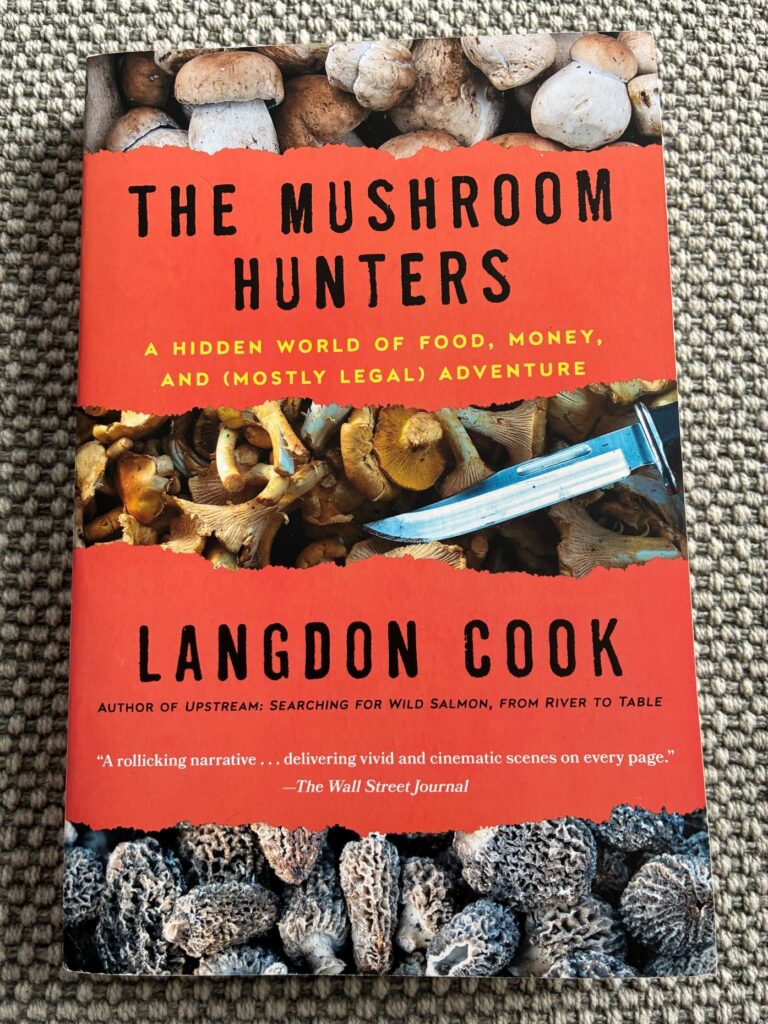
This is one of those rare books that our club reads that is not fiction, not a memoir and not a cookbook. It is culinary non-fiction. It reminds me a lot of the book Cork Dork by Bianca Bosker that we read in some of our earliest days of the club. It was so early that I didn’t have AltF4.co running yet and I never reviewed it here. But, essentially it is a story about Bianca’s quest to become a sommelier.
I cannot say what the exact motivation for writing this book was but it sure appears that the author Cook is very into mushrooms. The number of miles driven and time spent over the span of the story is significant. I suppose that is a mark of a good journalist to really get into the story, to get it right and not just phone it in.
Cook is from Seattle and most of the story takes place in the Pacific Northwest with a couple main characters. One is a mushroom picker and the other is a buyer/broker. They run up and down from Canada to California and from the ocean to Missoula as the parameters of their picking seemingly on an instant.
I would love to know more about personal mushroom picking. But, to tell you the truth I am scared to death of eating the wrong mushroom. I have have heard too many stories of mistaking the variety and either puking all night or even dying. I had no idea that there were so many varieties of edible mushrooms that grew wild here. According to the book, they happen most of the year.
The thing that I liked the most about the book is that the action was all around me. I kept reading and saying to myself ‘I know that place’ or ‘I had no idea this was going on around me’. In particular, there is a tiny town near the place that we have been deer hunting that turned into an Asian shanty town at the same time deer hunting was going on. The impromptu camp had a popup karaoke bar and pho restaurant. All this and I never even noticed.
Reading the book took me back to my youth. As the primary picker was a former logger, I got to thinking about the impact of the timber drought that began in the early 1990s. Once those mills stopped operating, loggers were out of work too. There was a whole genre of forest literate men but lacking transferable job skills. This in turn gave way to government assistance, poverty and drugs.
There is a 20 mile stretch between the town I grew up in and a reservoir that we water skied. There were at least four mills on that stretch. Now, there is one and it is a Weyerhaeuser mill. The biggest survived. It wasn’t totally an environmental situation as much as it was all the old growth was logged. Combine that with a US policy of conservation rather than production and only the companies that owned vast tracks of their own land survive. The good news for mushrooms is that second growth opened the door for a lot more production.
If you ask me, I would say a lot more of the mushroom harvest (written about) was more gray market. There was a lot of situational ethics in play such as ‘they don’t care about the mushrooms, only the timber’. Or, that No Trespassing sign is the result of equipment damage, sabotage and environmental damage. It doesn’t actually mean me who is not hurting anything. There is a lot of truth to that sentiment.
When timber comprised a significant portion of the economy, companies made a much greater effort to have a symbiotic relationship with the public. It seems like in today’s world that attitude has changed. I don’t remember a single locked gate growing up and now most private timber is access by recreational lease holder only. When you couple that with the vast amount of land owned and the semi-dubious methods by which it was acquired, it does seem like situational ethics are appropriate to a point.
I loved this book and thought it was fantastic. But the reason I did was because I could picture probably a quarter of the book. If you don’t live here, it may not hold some of the same romance. It doesn’t really tell you where to go specifically or how to identify mushrooms but that there is a whole cash based, gray market subculture feeding the finest and trendiest restaurants in New York as well as the Pacific Northwest.
End Your Programming Routine: Cookbooks are fine. The truth for me is that most of them I don’t get a lot out of. I am grateful that we step away and read something else, particularly something as fascinating as this. This late in the game, I won’t get into the storyline but the broker is still in business. I thought about e-mailing him and thanking him for participating even if it left his situation a little vulnerable. Part of me thinks that he won’t reciprocate or care. I don’t know but I sure admire his passion.
Recent Comments