I won’t assume that everyone reading this went to college. We hear the term 101 thrown around all the time, but what does that mean and what is the difference between 101 and 201? Well, 101 is a survey level course. In the case of Chemistry the year long sequence of 101, 102 and 103 attempts to cover three different disciplines of chemistry in a year long, high level series of courses. If you ask me, in many ways the 100 series is the hardest because the student is not given any basis for understanding the disciplines as they are intended for non and unrelated majors.
In contrast to the 100 series, the 200 level courses are intended for students that are going to go forward in the area of study. This means that the topics are harder and deeper with more emphasis on the why and not just the what. Today I am going to cover, why is the bathroom so cold?
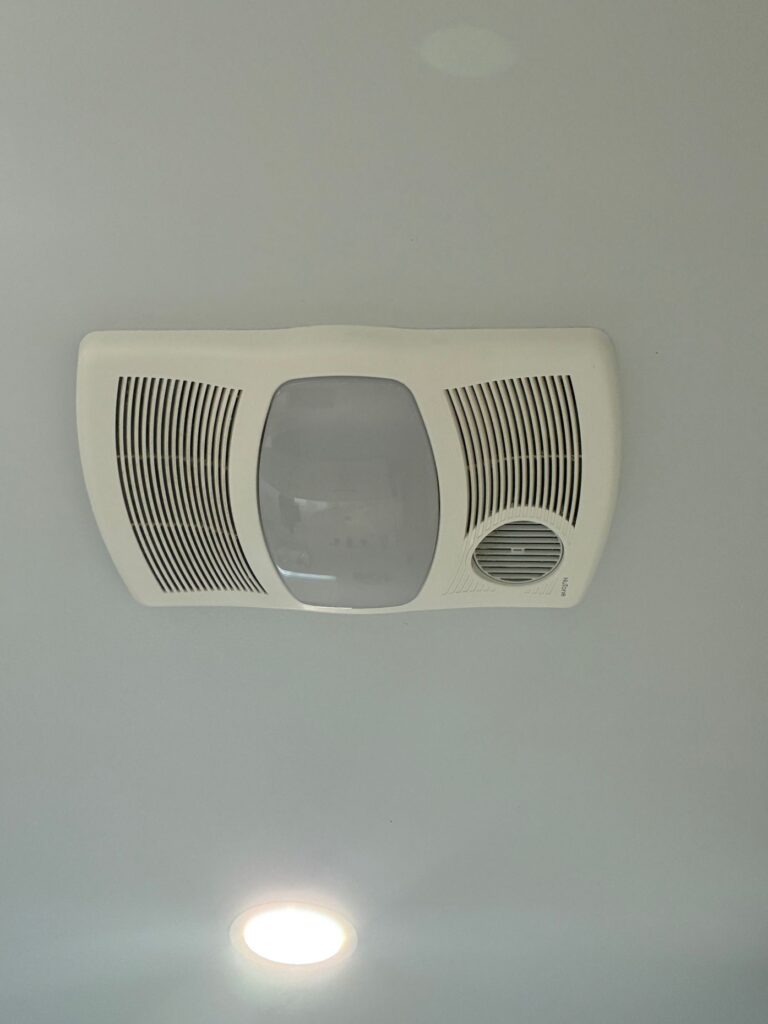
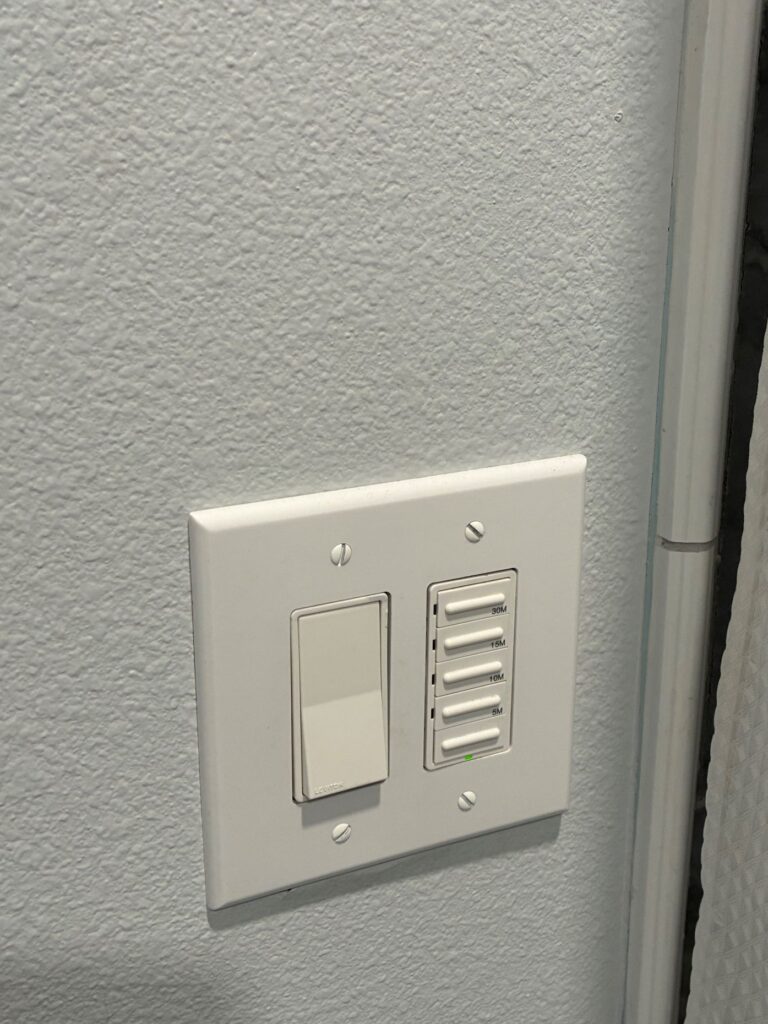
From the first picture on the left, I see a bathroom fan with an integrated heater. It is not heating. This means that it could be broken or it is not wired correctly. Those are really the only two options. When I look at the picture to the right, I see two switches. One controls the lights in the bathroom and the other controls the fan. Based on what fan switch does, it should turn on the fan, a heater and a light. Only the fan worked.
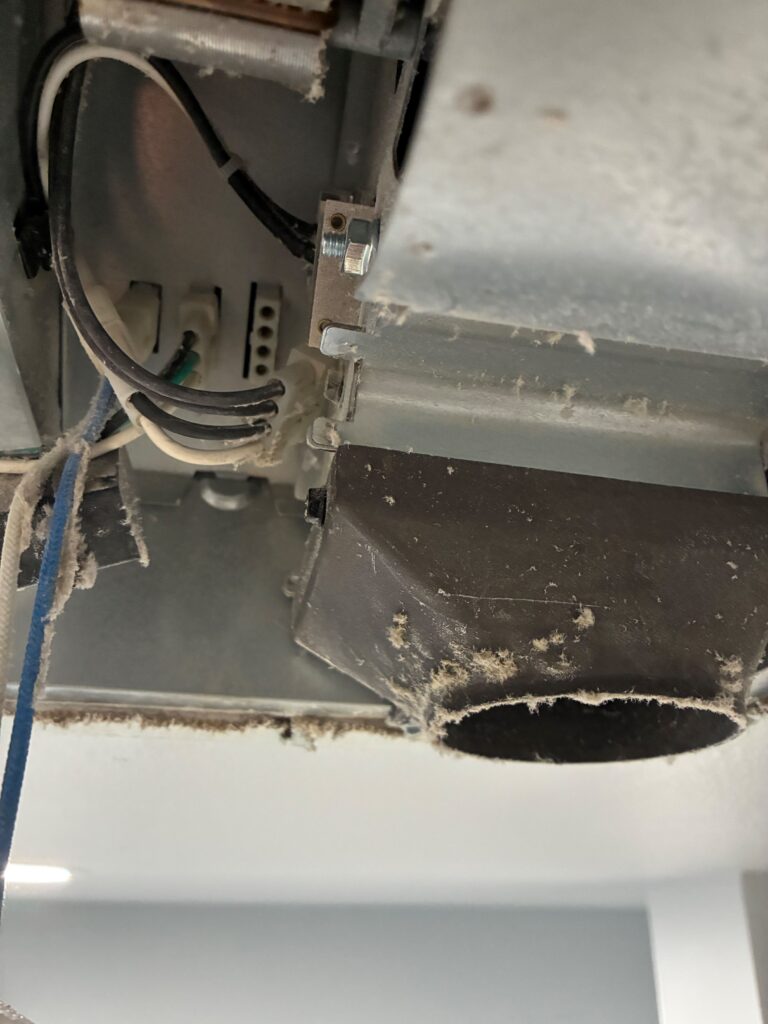
That cannot rule out either of my hypotheses yet. It is either miswired or broken. I took the cover off of the fan. Low and behold there was a connector that was not connected. This is missing heater connection. I plug the connector in and turn on the switch, the heater belches and smokes to life. The problem now is that there are three things and only one switch.
This is a permissible mode of operation. What I mean by that is that power to the unit turns on the light and the fan and the heater. But, does that make any sense? I say no. Imagine that this is summer and now the heater is on every time the fan is on. Further to that, you are now blowing heat into the room and then sucking it out with the fan. This seems wrong in my book.
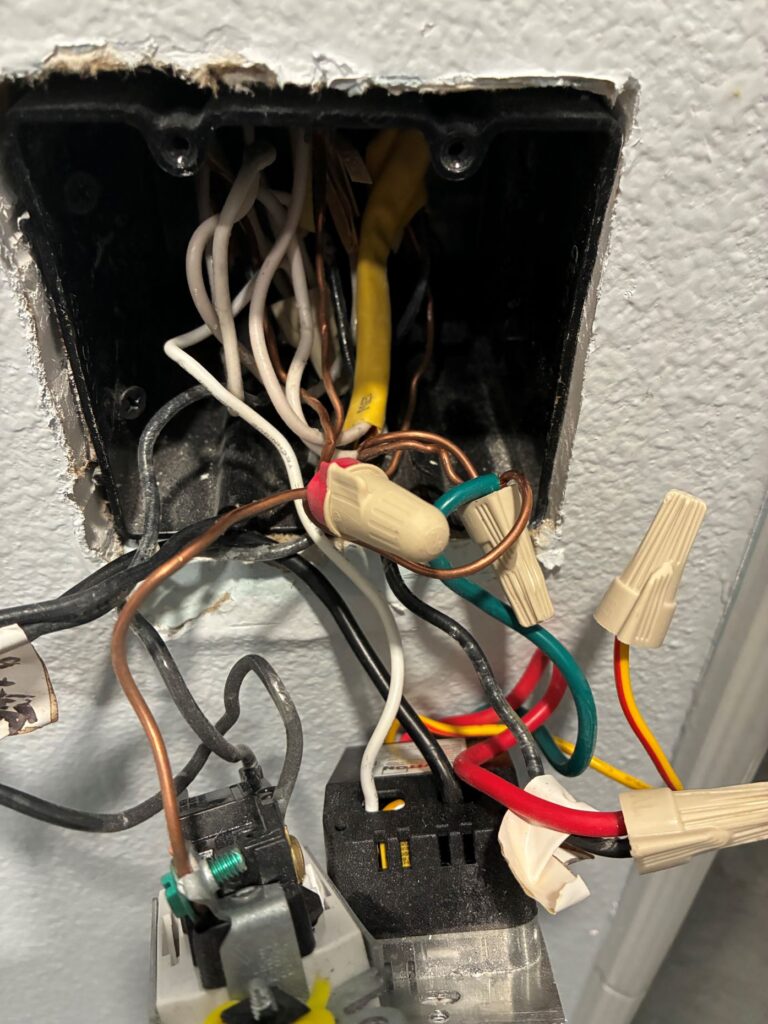
When we installed a similar unit in the ADU a few years ago, I separated the heater and the fan operation. That way you can have heat or the fan or both if it makes sense. In order to do that, you have to look at the wiring. I pulled the switches out to determine if it just wasn’t wired correctly. You probably can’t tell from the picture below but unfortunately it was not wired for separate operation.
Certain devices benefit from a more complicated wiring scheme. Take for example a ceiling fan. Before remote controls and external switches, it was very common to wire two hot wires to the fan. That way you could operate the fan and the light independently. Today you can control most ceiling fans at the device so that makes two hot wires irrelevant.
In electrical vernacular, the cable operating the device is labelled 12/2, 12/3 or 14/x. The first number is the wire diameter and the second number are the number of conductors in the cable. Without getting too deep into theory, 14 gauge wire is for 15A circuits and 12 gauge wire is for 20A circuits. This particular heater is a 1300W heater. If you do the circuit math, the total load is 15A * 120V = 1800W. The means that the heater could be on either a 15A or 20A circuit. I know it is 12 gauge wire because the cable insulation is yellow. But, what I do not see is 12/3 cable. Based on how the switch is wired, it is not possible for independent control.
To fix this situation, a cable would have to be pulled from the fan to the switch containing three conductors instead of the two conductor cable that is currently in use. OK, I don’t like that but it is doable. When I look at the other bathrooms, it gets more complicated. The pictures I am showing is the bathroom with a fan/heater combination already installed. To upgrade the other bathrooms, the overall circuit load has to be considered.
What has been standard was 15A circuits for lights and 20A circuits for outlets. Doing the math again, 1800W/ 60W = 30 permissible bulbs on one circuit. In old houses, you might even have all the lights on one circuit. In these days of LEDs, light bulbs are drawing 10-15W. That is now 120 or more permissible bulbs on one circuit. Not only is this power efficient, but it means that the lights can be on while you work on the outlets or other electrical concerns.
That is one way of wiring, the other is to have all terminations on one circuit. This means the lights and the outlets are all part of the same circuit. According to AI, a hairdryer uses about 2000W of electricity. That means one device is taking the entire circuit load on a 20A circuit. There is simply no way to add a 1300W heater and operate a hairdryer at the same time. This means running a new, dedicated circuit. Not only is the wiring from the fan to the the switch inadequate (but perfectly acceptable for just a fan only) but the power requirements are simply not there.
End Your Programming Routine: As I have stated previously, this new house is in a heating climate and the heat that is available is completely substandard. The good news is that one bathroom has the capacity to be fixed and operate properly, the other two are going to take more effort. It is my opinion that the house was miswired and even poorly designed. While not code to have heat in the bathroom, it is required in certain loans (not ours). More so than any of that, the house is simply uncomfortable. We aim to rectify that.
Recent Comments