Good Things by Samin Nosrat is the January selection of the Left Coast Culinary Book Club. I have to admit that I groaned slightly on the inside when it was decided that this was the book that we were going to pursue. I guess for me I much more enjoy culinary fiction more so than another cookbook. I also kind of get a little of worn out of celebrity cooking personalities that put out cookbooks frequently
Several years ago, we covered Salt, Fat, Acid, Heat. In fact, we did a month on each subject. I have to say that if there was one thing I took away from that was to salt beef early. But, I really did not put too much stock in the book. We also watched the Netflix series. But, after reading this book, I wonder if I got it all wrong.
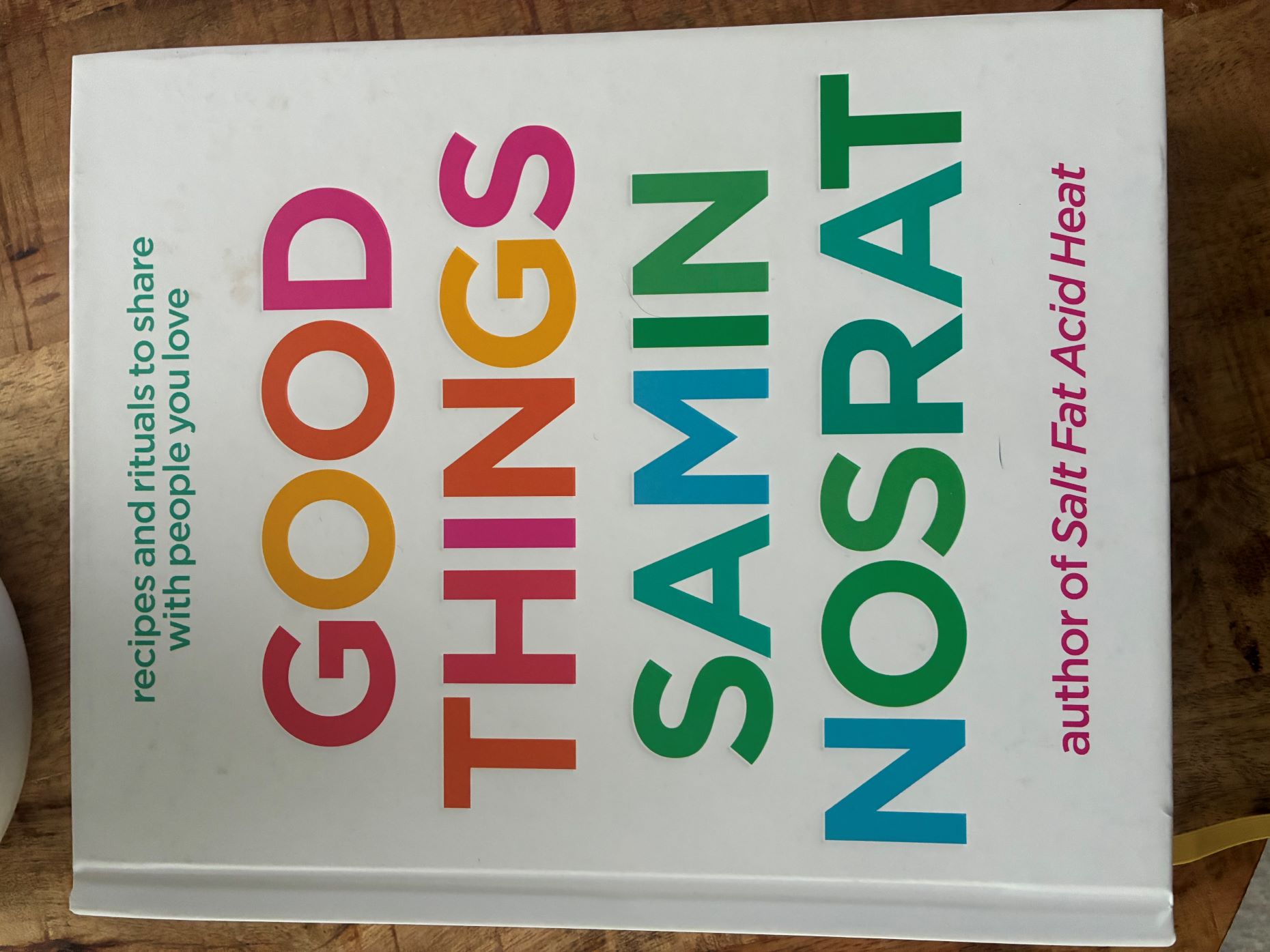
Yes, I would call Nosrat a celebrity chef. I have seen her on Anthony Bordain’s No Reservations as well as well as other places. That being said, I do not see her putting out content like The Pioneer Woman, Bobby Flay or Emeril. This is her first book that she has published since Salt, Fat, Acid, Heat. When starting this book, she admits that this is a very different book in that her first one was all about how to create something using what she calls the key elements with no recipes. Now that you have all of the tools you should need to be successful, this seems counterintuitive.
This one starts off with building some fundamental sauces or condiments or what have you. It then moves into techniques for cooking ingredients and then you would layer those sauces into the recipes. This book builds on dishes using a matrix. So, you can pick one or two or three vegetables that you have and then the sauce and a few sprinkles or spritzes and you have a finished product.
It is kind of a ground up approach or a reverse recipe. While most recipes show a picture and then a list of ingredients to make it, this book starts with an ingredient and then it provides three to ten recipes that can be made with that ingredient. Typically, you kind of look a category and then try to pick something that is appealing or read to see if you have everything. Whereas this book, you pick a vegetable and see what options you have to make something appealing.
This is the way that I cook and I suspect that this is the way many of us approach meals, especially for people with gardens or deep pantries. “I have a lot of such and such, what can I do with it”? It is so revolutionary, that it made me consider going back to Salt, Fat, Acid, Heat because I suspect that I missed the significance of it.
If there is one knock on the book to me, it is that I feel like the book uses a lot of semi-exotic ingredients. Nosrat is middle eastern born and it highly influenced her cooking. As an example I don’t know where I would find a Persian cucumber or labna. I would say that if you are going to use this book then it behooves you to do some research on sourcing middle eastern ingredients. The beauty of Salt, Fat, Acid, Heat would be using whatever cucumber you can find.
I will also admit that I haven’t done much cooking from the book either. Part of it is because I have not finished reading it as of the time of writing. I have gotten through 75% which I feel qualifies me to be able to comment at this point. I am also somewhat dubious of grocery store produce and so things like eggplant need to wait until a better time of the year. I did broil some cauliflower the other night because I was feeling the pull of Nosrat.
In my opinion, this isn’t the first cookbook you should buy. I feel like this cookbook is for someone that already has some skills and desires to learn more. From there, you can really elevate things with the knowledge that Nosrat can impart. But, it is not too bad either. I suspect that if you knew nothing, you might come away wondering why they all are not organized this way.
End Your Programming Routine: Before Christmas, my son sent me a picture from Barnes and Noble. Good Things was the 2025 gift book of the year. He knew that it was on my bookshelf to read. It very well could be, it is that good.
Recent Comments