Month: March 2026

March 6, 2026 – The Talent Code: Part 3

I am sorry about this one. I should have just bit the bullet and written Part Three in a timely manner. I finished this book in early February and it was just my life getting in the way. Now, I have to go back to the time machine and try to remember what was going on in the book because now it is packed up in a box somewhere. Fortunately I took some notes weeks ago to kind of jog my memory.

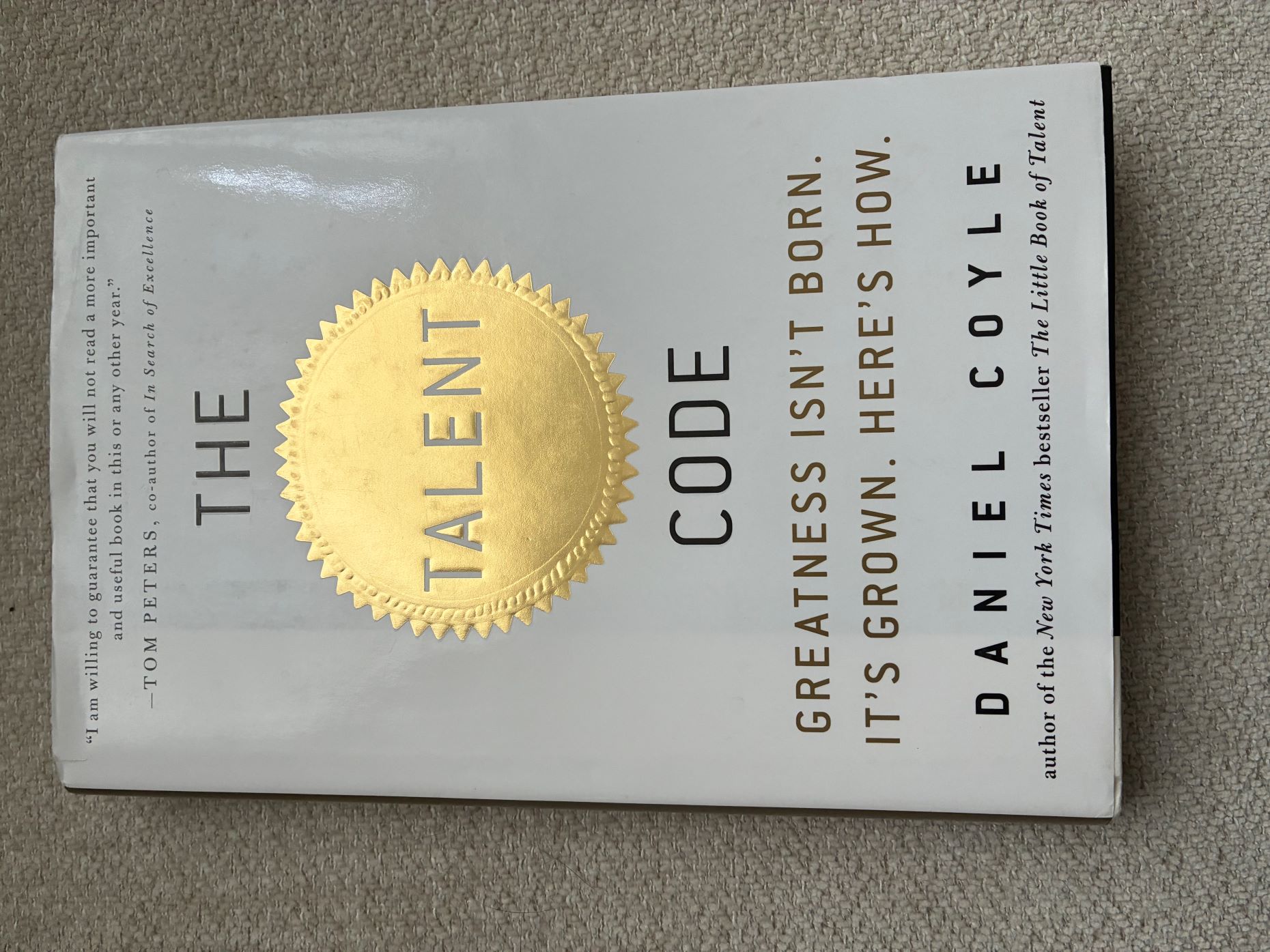
Since it has been so long, I could spend a few words trying to summarize where we have been. Part One was all about how greatness is built. Part Two is about where to find talent and now Part Three is about harnessing it. Or said another way, it is coaching greatness.
I think the timing on this is pretty good. It would have been even better if I was actually writing this to come out during the Olympics like I should have. Nevertheless, I was watching one of the twenty something, American, gold medal athletes talking about how it is a dream come true and that this is what they have been working their whole life for this when it hit me. This is where this Part of the book comes to life.

Actually, what really hit me is that these athletes were enabled by choice or by circumstance. Circumstance is what the book talks about but I have to think choice is just as helpful. What I mean by choice is that a gold medal may be an athlete’s dream but it started well before this moment. The winners didn’t just show up to the Olympics and win. There was years of practice going into this moment. And to be frank, an eight year old is not getting to the mountain alone. Somebody opened the door and kept it open at least until emancipation.

OK, I was talking about the parents and not exactly the theme of today. But, coaching is what Coyle asserts as the third component of greatness. Chapter nine deals with a study of John Wooden and his habits. For those of you that weren’t around in the 1960s and 70s you don’t know how UCLA won ten of twelve championships. That is dominance.

What did Wooden do? He had two traits that were effective. The first one was that he did not treat players equally. The ones that needed riding got that treatment and the others were left alone, even if it seemed crazy. The second trait was constant but short feedback. Those two things were his keys to success.

Chapter ten was different but the same man. A good coach is able to navigate the matrix of relationships and performance. They are some how able to figure out what is important in the big organic blob called a human being. They are able to get to the root of motivation and correction. And they do it with theatrical honesty meaning that it is load and very readable.

Chapter eleven is one of those that probably would be re-written today. It was all about the (Las Vegas) Raiders evaluation of Jamarcus Russell prior to drafting him as the number one pick in 2008. I hope that they are reading this book this year as well. Russell had tremendous physical ability, it was said that he could throw a seventy yard pass on his knees with precision.

I think today we would look back and say that while there was no doubt Russell’s athleticism was unparalleled, however he was a terrible quarterback only lasting two seasons. The second of which he was benched early in the season. He had no ability to lead the team resulting in poor performance. After being dropped by the Raiders, he never played professional football again.

This book was written as that was all unfolding and I suspect that Coyle (as we all did) thought that he was going to be one of the greats. However, something so poignant was said in the book by the pro scout. Even greats need coaching. And, this is why Russell failed, coaching with the Raiders has been abysmal (mostly).

You know, you don’t have to look very far to find coaches and success. Think about who is considered one of the greatest current quarterbacks, that would be Patrick Mahommes of the Kansas City Chiefs. And yet, who is the coach, Andy Reid someone that has been perennially successful wherever he has been employed. Coincidence? I don’t really think so.

End Your Programming Routine: So, this is the book. It makes a lot of sense to me. Next week I am going to wrap up “The Talent Code”. Looking forward to what is next I am planning “Surprised By Joy” by C.S. Lewis. It seems to be a memoir from what I can surmise. I will plan to cover three chapters per week. I am relatively certain that next week is going to happen but I wouldn’t be surprised if there is a gap after that.
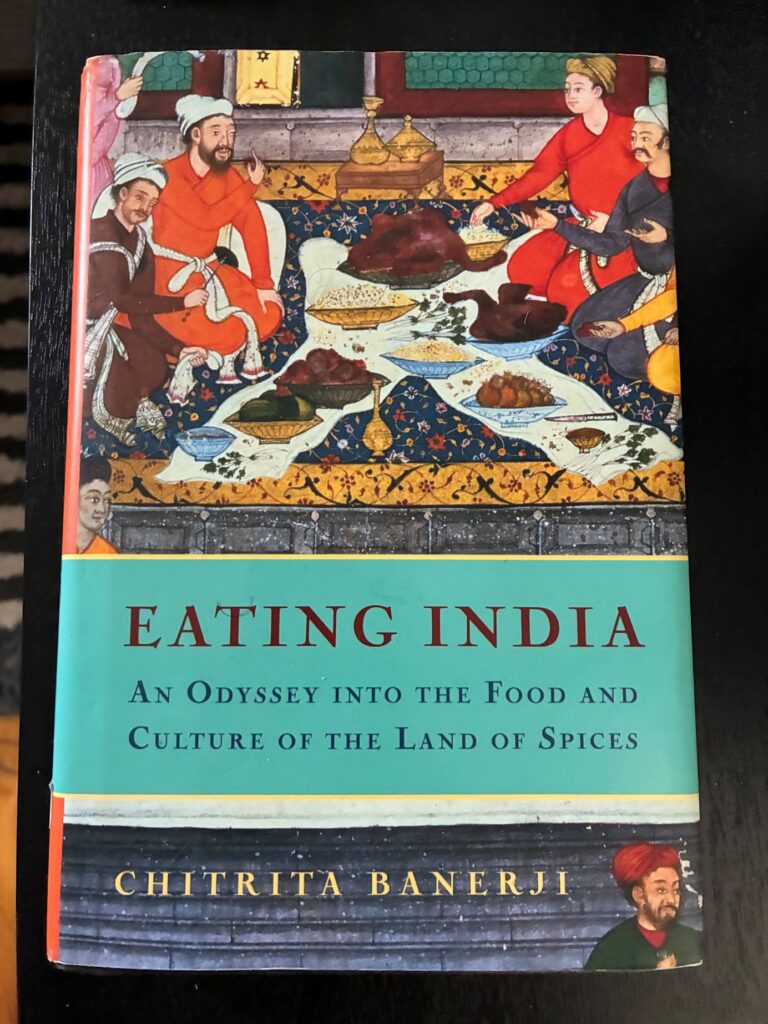
March 5, 2026 – Eating India: An Odyssey Into the Food and Culture of the Land of Spices

Five years ago, I worked for a North American company. We were a specialized outfit that did specific work with primarily North American clientele. That all changed when I signed on with a multinational, conglomerate service company. It seems like these days nearly all of my interactions are from people in India or from Indian descent.

Eating India was the February Left Coast Culinary Book Club selection. We chose it because in our eight years of existence we have never looked at Indian food. But secretly, I wanted to learn more about this culture that I interact with every day. This book is not a cookbook but a book about food (and culture). The author makes deliberate trips to different regions of India and then writes about it. It is kind of a targeted and less sensational Parts Unknown.

After reading about half of the book, I began to realize that India is way more diverse than I originally thought. When we go to a ‘Indian’ restaurant, we are getting an amalgamation and interpretation of the entire country. The largest factions of India are the Hindus and Muslims. I thought that the Muslims of historical India were in the north (and became Pakistan) and to the west which became Bengal leaving India largely Hindu which is not the case at all. India is very much still a mixture of the two.

Hindus are by default vegetarian. For that reason, much of Indian food is actually vegetarian. The Muslims are not, so any meat dish has at it’s roots in that side of the culture. While not prevented, generally Muslims in India do not eat beef as a cultural nod and why most meat dishes are seafood, goat, lamb or chicken.

The Portuguese colonized India in the 1600s. They brought with them new world foods such as potato and tomato. More so than that, they brought the mechanisms to transform sugar into desserts and confections. I never really realized it but I have noticed many a prolific, sweet tooth among them.

The latest colonizers, the British added very little to the cuisine. But, what they did do was take and promote Indian cuisine throughout the world. It was said that one queen had a propensity for tea. Because of that, it popularized tea in Briton and the western world. I would say Indian cuisine to a lesser point than tea. However, I was stricken by how popular Indian restaurants were in London. It kind of reminded me of how prolific Mexican food is in the southwest.

Those were the well known factions and influences. What about the Jains and the Sikhs? Or how about the Indian Jews? I suppose that in today’s world, anybody can be anywhere. I remember that when I was working in China one of my co-workers is Latter Day Saints and he found an active church. I found it interesting that the Indian Jews are amongst the most orthodox observers of religion. The Sabbath and Kosher are two examples. It actually struck me about how similar Jews and Muslims are when it comes to religious practice.

To me, the book was pretty interesting. I am not sure everyone would feel this way as it strays away from our traditional titles in the book club. It wasn’t a cookbook or even a fictional story with an plot. It was someone’s travel observations. I have one criticism and that is the author Banerji writes as if the layman knows all of the vocabulary. There were a lot of food names that quite honestly, I have no clue about.

I think that it would also be helpful to read this book with a map in hand. In terms of spatial relationship, I have no idea about the places that were mentioned. Yes, I have heard of Bombay and Calcutta but I couldn’t point to where they were in India. A book all about regional differences should have some context about where those regions are in proximity to each other.

This book is for people that want to know more about India, particularly the nuance of culturally influence food. It would be a good one to read the e-version so that you can constantly look up definitions of unfamiliar words. I was entertained and educated but I could really only read one chapter a night. There was a lot of information that I was digesting.

End Your Programming Routine: I heard while I was watching the Olympics a few weeks ago that India is now the most populous country in the world with 1.7 billion people. I had no clue that China had been overtaken. I think this makes it all that more important to start learning about the world’s largest country. That is not to say that Indian food is extremely delicious too.

March 4, 2026 – Troubleshooting 201

I won’t assume that everyone reading this went to college. We hear the term 101 thrown around all the time, but what does that mean and what is the difference between 101 and 201? Well, 101 is a survey level course. In the case of Chemistry the year long sequence of 101, 102 and 103 attempts to cover three different disciplines of chemistry in a year long, high level series of courses. If you ask me, in many ways the 100 series is the hardest because the student is not given any basis for understanding the disciplines as they are intended for non and unrelated majors.

In contrast to the 100 series, the 200 level courses are intended for students that are going to go forward in the area of study. This means that the topics are harder and deeper with more emphasis on the why and not just the what. Today I am going to cover, why is the bathroom so cold?

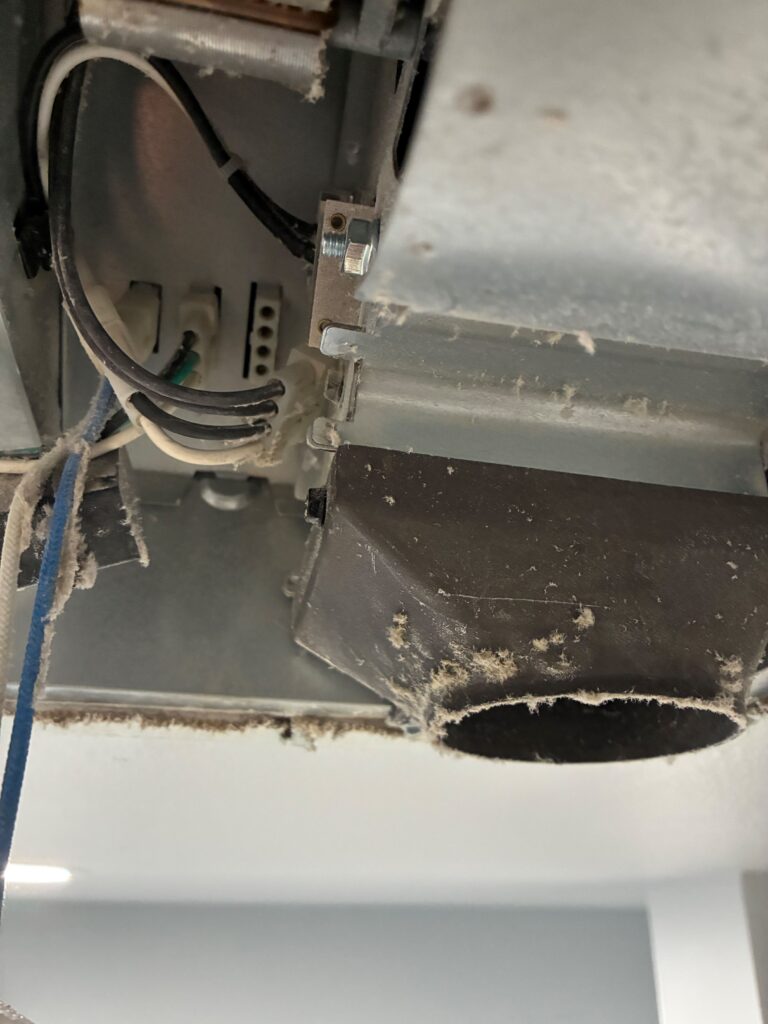
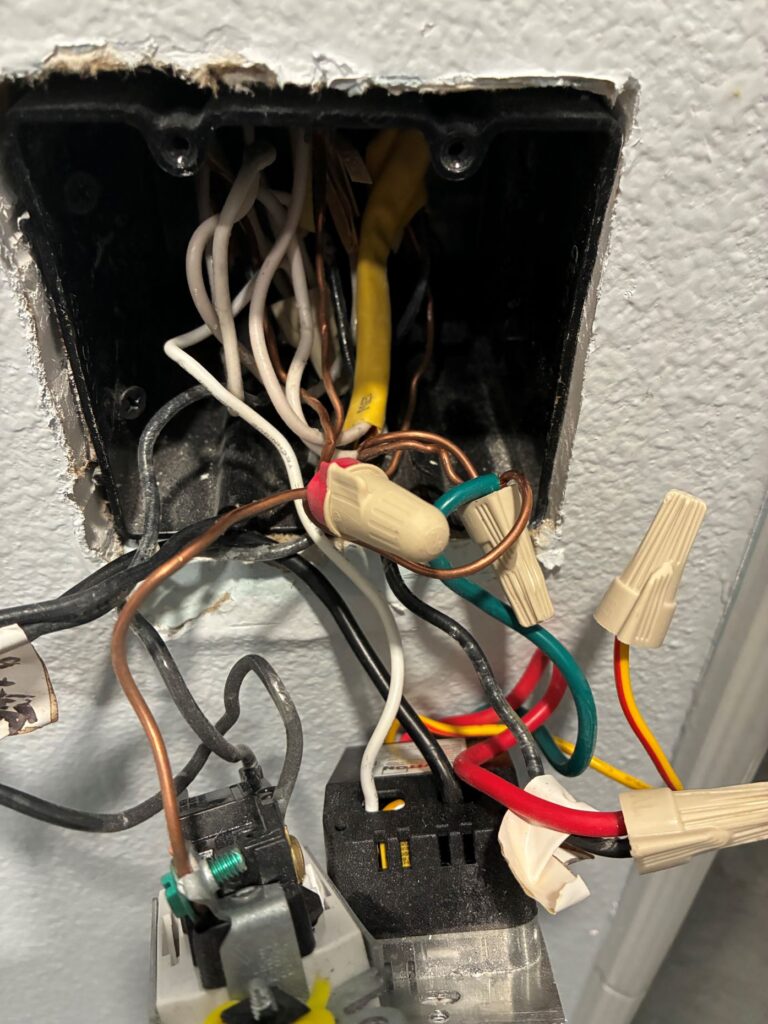
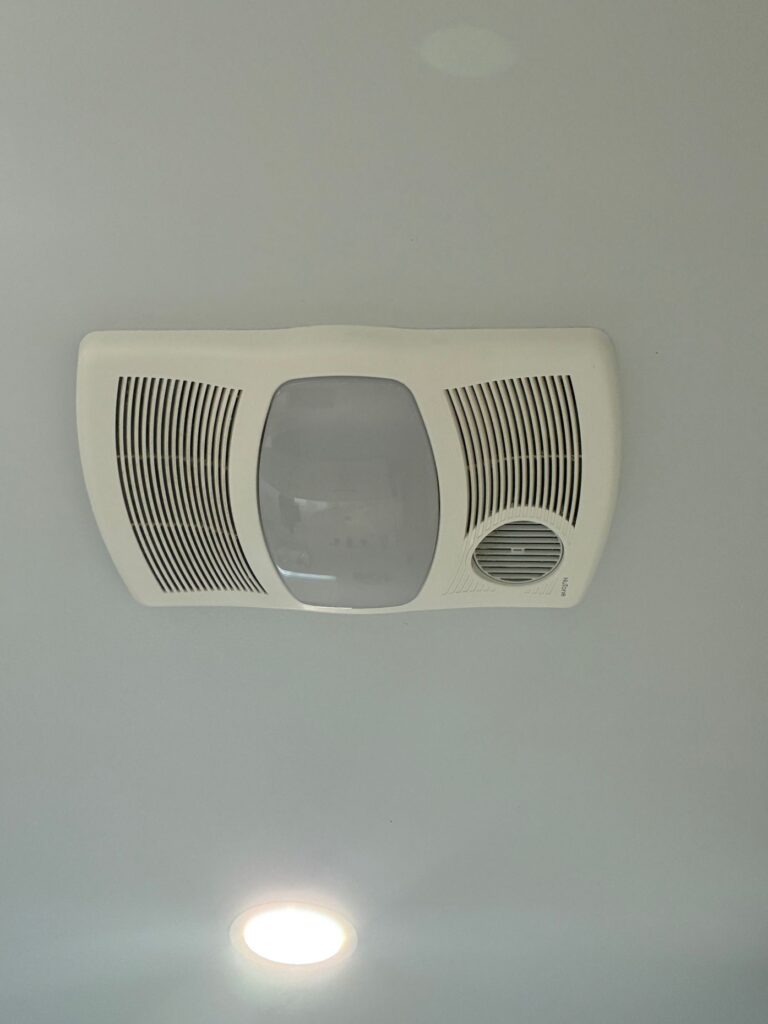
From the first picture on the left, I see a bathroom fan with an integrated heater. It is not heating. This means that it could be broken or it is not wired correctly. Those are really the only two options. When I look at the picture to the right, I see two switches. One controls the lights in the bathroom and the other controls the fan. Based on what fan switch does, it should turn on the fan, a heater and a light. Only the fan worked.

That cannot rule out either of my hypotheses yet. It is either miswired or broken. I took the cover off of the fan. Low and behold there was a connector that was not connected. This is missing heater connection. I plug the connector in and turn on the switch, the heater belches and smokes to life. The problem now is that there are three things and only one switch.

This is a permissible mode of operation. What I mean by that is that power to the unit turns on the light and the fan and the heater. But, does that make any sense? I say no. Imagine that this is summer and now the heater is on every time the fan is on. Further to that, you are now blowing heat into the room and then sucking it out with the fan. This seems wrong in my book.

When we installed a similar unit in the ADU a few years ago, I separated the heater and the fan operation. That way you can have heat or the fan or both if it makes sense. In order to do that, you have to look at the wiring. I pulled the switches out to determine if it just wasn’t wired correctly. You probably can’t tell from the picture below but unfortunately it was not wired for separate operation.

Certain devices benefit from a more complicated wiring scheme. Take for example a ceiling fan. Before remote controls and external switches, it was very common to wire two hot wires to the fan. That way you could operate the fan and the light independently. Today you can control most ceiling fans at the device so that makes two hot wires irrelevant.

In electrical vernacular, the cable operating the device is labelled 12/2, 12/3 or 14/x. The first number is the wire diameter and the second number are the number of conductors in the cable. Without getting too deep into theory, 14 gauge wire is for 15A circuits and 12 gauge wire is for 20A circuits. This particular heater is a 1300W heater. If you do the circuit math, the total load is 15A * 120V = 1800W. The means that the heater could be on either a 15A or 20A circuit. I know it is 12 gauge wire because the cable insulation is yellow. But, what I do not see is 12/3 cable. Based on how the switch is wired, it is not possible for independent control.

To fix this situation, a cable would have to be pulled from the fan to the switch containing three conductors instead of the two conductor cable that is currently in use. OK, I don’t like that but it is doable. When I look at the other bathrooms, it gets more complicated. The pictures I am showing is the bathroom with a fan/heater combination already installed. To upgrade the other bathrooms, the overall circuit load has to be considered.

What has been standard was 15A circuits for lights and 20A circuits for outlets. Doing the math again, 1800W/ 60W = 30 permissible bulbs on one circuit. In old houses, you might even have all the lights on one circuit. In these days of LEDs, light bulbs are drawing 10-15W. That is now 120 or more permissible bulbs on one circuit. Not only is this power efficient, but it means that the lights can be on while you work on the outlets or other electrical concerns.

That is one way of wiring, the other is to have all terminations on one circuit. This means the lights and the outlets are all part of the same circuit. According to AI, a hairdryer uses about 2000W of electricity. That means one device is taking the entire circuit load on a 20A circuit. There is simply no way to add a 1300W heater and operate a hairdryer at the same time. This means running a new, dedicated circuit. Not only is the wiring from the fan to the the switch inadequate (but perfectly acceptable for just a fan only) but the power requirements are simply not there.

End Your Programming Routine: As I have stated previously, this new house is in a heating climate and the heat that is available is completely substandard. The good news is that one bathroom has the capacity to be fixed and operate properly, the other two are going to take more effort. It is my opinion that the house was miswired and even poorly designed. While not code to have heat in the bathroom, it is required in certain loans (not ours). More so than any of that, the house is simply uncomfortable. We aim to rectify that.

March 3, 2026 – There Are No Serviceable Parts

While training for my half marathon ten years ago, my wife bought me this Garmin Forerunner 10 as a birthday present. As I have stated many times, it really wasn’t my goal to run a half marathon but I committed because it was something that she wanted to do. We could do it together. It couldn’t hurt my health any.

Garmin promised seven days of GPS on runtime and two or three weeks of regular operation. The way it worked is when you pushed the ‘go’ button, it would record a bunch of GPS coordinates as cookies. When you synced the watch, it would put those events into maps and then you would have your runs plotted. Those could be accessed when you log into the Garmin website.

I have to admit, I had no desire to be some sort of athlete. But, I did use the watch each time I ran. I would periodically check the maps to see if my pace was getting better. Honestly, the best part about the watch is that it would track your distance from the time the start button was pushed. That made training much easier because I could run halfway and then turn around to get my intended mileage.

The watch never lived up to it’s advertised runtime. When it was new, I could track one or two 5K length runs and it would be depleted after two days. It started getting to the point where it would die before the end of a half marathon with the GPS on and a full charge. By the time I did my actual race, the watch was unusable for tracking. I had to go back to the old fashioned way of timing my pace. It did work as a basic watch for about a week in between charges. So, that is how I used it.

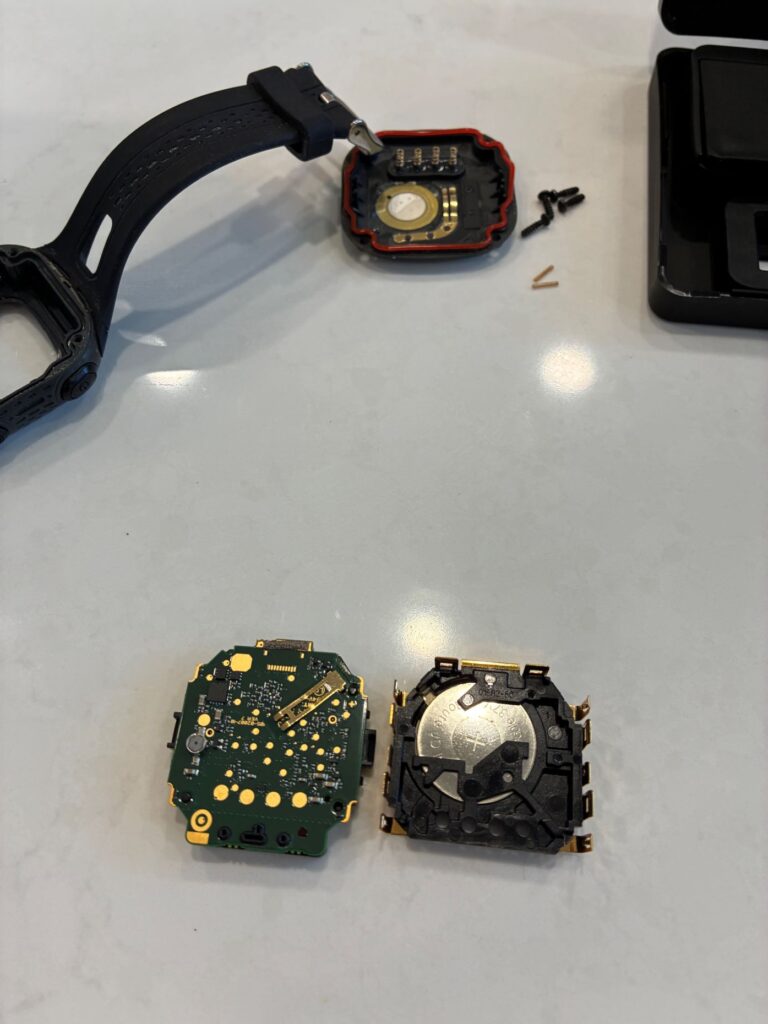
You know how I hate to throw things away. I inquired about the ability to repair the watch. There are no serviceable parts. Where have I heard that before? My son’s e-Bike. The watch gathered dust form quite a few years until I looked up online and there are plenty of how-tos on how to do this. I never realized that there were rechargeable and non-rechargeable CR2032 batteries. The trick was that I did not want to order 10 of them, just one good one. That is what I did, I ordered one battery.

Why Garmin would say that there are no serviceable parts is beyond me. It actually looks pretty straight forward. You open the case, carefully disassemble the electronics and then swap the battery. It is assembled in the reverse order. This was a lake house project that I did. I took all of the stuff with me and I did it in the afternoon.

I plugged the watch in and it appeared to be charging. That is where I left things until the next day. When I took it off of the charger, all I got was a triangle, the sign that it is off and charging. Pressing the power button yielded not change. I did further research to say that it needed to be synched but I didn’t have my computer with me to do that. I tried to sync it when I got home and the watch was dead.

The battery indicator shows that it has a full charge but the watch does not function. The whole point of this was to see if I could sell it for $10 to some aspiring runner. I have to say that is certainly not going to be the case. I should probably spend some more time troubleshooting this watch. Now that I am home, I could certainly try some multimeter tests and another attempt to disassemble and re-assemble. But is it really worth it?

I have already moved on to a new model watch. I have also invested $6 for a new battery and time to do this battery swap, not to mention a $10 watch band replacement all in the name of keeping this watch out of the landfill. I also hate to be defeated and I cant simply admit that something so seemingly simple does not work.

End Your Programming Routine: It could be that I did not put this together correctly. It could also be that this thing has ran it’s course. I don’t really know the reason. My problem is that I have bigger fish to fry now. The time to wheel and deal cheap electronics has past. I have to get onto the business of moving to the new house. I haven’t fully conceded yet but maybe sometimes no serviceable parts actually means what the phrase implies.

March 2, 2026 – It’s a First

Brace yourselves, this is my first podcast in my new office. Yes, the audio quality is not good at all. The room is super echo-y and I am on my Bluetooth headset for a microphone. That makes the resolution low to begin with, nevermind the acoustics. This is all about what I have been up to and I didn’t just seemingly disappear. That means that the podcast stays. I will work to make this better just not today.